
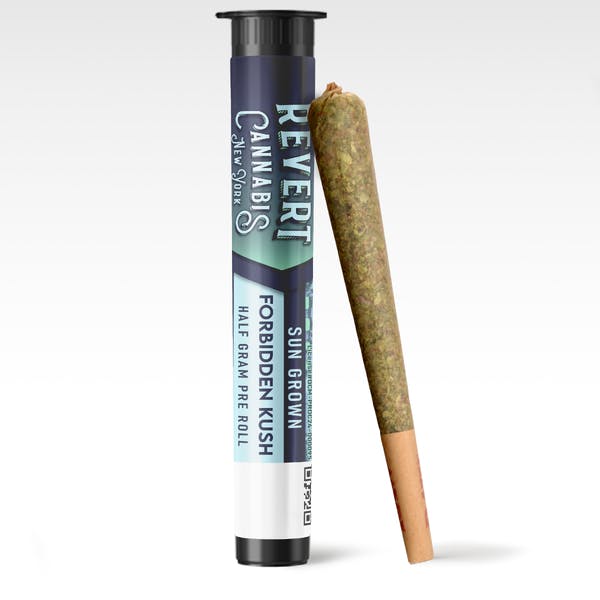
Indica
All strains Forbidden Kush
1 live products in stock
Quick answer · What is the Forbidden Kush cannabis strain?
Forbidden Kush arrives with the quiet authority of a strain that has earned its place in the indica canon. Dense, resinous, and anchored by an earthy sweetness edged with grape and spice, it offers a full-bodied descent into calm that rewards patience and intention. This is an evening companion — deliberate, unhurried, and distinctly New York in its refusal to be rushed.
Shop Forbidden Kush · 1 of 1 live products
About Forbidden Kush
Everything to know about Forbidden Kush.
Lineage & origin
Forbidden Kush is a cross of two well-documented indica heavyweights: Forbidden Fruit and OG Kush. Forbidden Fruit itself is a union of Cherry Pie and Tangie, lending Forbidden Kush its signature fruit-forward top notes and a measure of its visual brilliance. OG Kush, whose own lineage remains partially debated — likely descended from Chemdawg, Hindu Kush, and possibly Lemon Thai — contributes the resinous density, the deep earthiness, and the potent physical weight that defines the Kush family. The strain is associated with Elev8 Seeds, which brought it to wider market attention in the mid-2010s, a period when breeders were actively mining Forbidden Fruit's aesthetic and aromatic qualities as a crossing partner. The combination produced a plant that inherited OG Kush's structural sturdiness and terpene richness while softening the profile with Forbidden Fruit's tropical, grape-tinged sweetness. Within the broader Kush lineage, Forbidden Kush sits alongside strains such as Bubba Kush and Purple Kush as expressions of the indica archetype: compact, trichome-heavy, and built for depth rather than breadth. It has not produced widely documented phenotypic offshoots of its own, though individual cultivators have selected for both the more fruit-forward and more fuel-leaning phenotypes, each emphasizing different aspects of its dual parentage.
Effects
The onset of Forbidden Kush is characteristically measured — most experienced consumers report a 5-to-15-minute window before the first wave registers, which tends to arrive as a gentle pressure behind the eyes and a loosening of the shoulders. This initial phase carries a mild cerebral warmth, not the sharp clarity of a sativa, but a pleasant softening of mental chatter that creates space without demanding productivity. As the experience deepens into its peak — typically between 30 and 60 minutes in — the indica character asserts itself more fully. A notable body component settles across the limbs, often described as weighted ease rather than paralysis, and the mental register shifts from warmly relaxed to quietly contemplative. Myrcene, the dominant terpene in most Forbidden Kush expressions, is associated in cannabis literature with sedative and muscle-relaxing qualities, and its influence feels evident in this phase. Caryophyllene's presence likely contributes a mild analgesic warmth to the body experience. Duration typically spans two to three hours before a gentle tapering toward drowsiness. The comedown is gradual and rarely disruptive — most consumers find it dissolves naturally into rest. Given its indica weight, those newer to cannabis or those sensitive to THC-forward cultivars are well served by the time-honored guidance: start with a small amount, allow a full thirty minutes before reassessing.
Aroma, flavor & terpenes
The aromatic profile of Forbidden Kush is one of its most compelling features, layered in a way that rewards a slow, attentive approach. On the initial open, the nose meets a ripe, grape-adjacent sweetness — the clear inheritance of Forbidden Fruit — underlined immediately by the damp, forest-floor earthiness that is the hallmark signature of OG Kush. Myrcene leads this presentation, bringing its characteristic musky, herbal depth that anchors the sweeter top notes and keeps the overall impression grounded rather than floral. Secondary terpenes add meaningful complexity. Caryophyllene introduces a faint black-pepper spice that sharpens the mid-palate and provides a subtle dryness on the exhale. Limonene, present in moderate concentrations in many phenotypes, lifts the profile with a whisper of citrus — less a bright lemon than a candied orange peel — ensuring the sweetness reads as fruit rather than sugar. Pinene, where present, adds a faint resinous evergreen note that deepens the earthiness and bridges the fruit and kush elements cohesively. On the palate, whether consumed via flower or vapor, Forbidden Kush delivers a smooth, full smoke with a notably sweet entry that transitions through earthy and slightly spiced mid-notes before finishing with a clean, lingering grape-and-hash exhale. The vapor character is particularly expressive, allowing the individual terpene layers to present themselves with greater fidelity and less combustion interference.
Appearance
Forbidden Kush produces compact, densely packed buds that reflect its OG Kush lineage in structure — tight calyxes, minimal spacing between nodes, and a heft that communicates quality before any other quality is assessed. The trichome coverage is substantial, giving well-cured specimens a frosted, almost silver-white sheen that catches light distinctly and signals the resin production that defines this family. The colour palette leans into the influence of Forbidden Fruit's Purple Kush ancestry. Under cooler finishing temperatures, Forbidden Kush can express deep violet and indigo tones within the leaves and along the calyx edges, contrasting against the bright amber and rust-coloured pistils that curl generously through the bud. The base colour of the flower itself is a rich, mid-tone olive green, and the combination of purple, amber, and silver gives a finished specimen a visual character that is genuinely distinctive on a display shelf.
Growing notes
Forbidden Kush is considered a moderately approachable cultivar for experienced home growers, though its indica structure makes it more forgiving than many sativa-dominant hybrids. It performs well in both indoor and outdoor environments, though indoor cultivation — particularly in a controlled climate with moderate humidity — tends to coax out the purple pigmentation that makes this strain visually distinctive. A deliberate temperature drop during the final weeks of flowering is the most reliable method for encouraging those characteristic violet tones. Flowering time runs approximately 8 to 9 weeks indoors, which is typical for its Kush lineage. Indoor yields are generally moderate to generous, rewarding growers who apply techniques such as low-stress training or a light scrog to manage its naturally compact canopy. Outdoors, it performs well in Mediterranean-adjacent climates and typically reaches harvest in early to mid-October in the Northern Hemisphere. Its density, while visually rewarding, does require attentive airflow management to guard against moisture-related issues in humid growing environments.
When it's best enjoyed
Forbidden Kush is firmly an evening strain — its pace, its weight, and its trajectory toward calm and eventual rest make it poorly suited to daytime demands but deeply well-suited to the deliberate wind-down. It is an excellent companion for the solo ritual of an unhurried night in: a long bath, the slow reading of something with depth, or the kind of introspective listening session a complex record deserves. The grape and earth terpene profile pairs naturally with music that shares those qualities — something low and resonant, whether classic soul, late-night jazz, or ambient electronic. At the table, Forbidden Kush's sweetness and spice make it an interesting companion to foods that reflect similar contrasts. A charcuterie selection with aged cheese and dark fruit preserves mirrors the strain's own aromatic interplay between richness and brightness. For those who appreciate the strain's social dimension, it works quietly well in small, trusted company — an intimate setting rather than a gathering, where conversation can deepen without the pressure of performance. In every context, the best approach is the unhurried one: allow the experience to arrive on its own schedule.
If you like Forbidden Kush, also explore
Forbidden Fruit
As one of Forbidden Kush's parent strains, Forbidden Fruit shares the grape-and-tropical aromatic character and indica body effect, making it a natural next exploration for anyone drawn to Forbidden Kush's sweeter, fruit-forward dimension.
OG Kush
Forbidden Kush's other parent, OG Kush offers the same earthy, fuel-edged Kush foundation and heavy body presence for consumers who want to understand the structural backbone beneath Forbidden Kush's sweeter profile.
Bubba Kush
Sharing the dense bud structure, deep earthiness, and full-body sedative arc of the Kush family, Bubba Kush appeals to the same evening-ritual consumer who prizes physical ease and a gradual, reliable descent into calm.
Purple Kush
For those drawn to Forbidden Kush's violet colouration and grape-inflected sweetness, Purple Kush offers a comparably rich indica expression with similarly striking visual character and a long, unwinding body effect.
Cherry Pie
A grandparent strain via Forbidden Fruit, Cherry Pie shares the sweet-and-earthy terpene balance and the measured, relaxing effect arc that defines Forbidden Kush's most approachable qualities.
Common questions
Is Forbidden Kush indica or sativa?+
Forbidden Kush is an indica-dominant strain, the product of crossing Forbidden Fruit and OG Kush — both of which carry significant indica genetics. Its effects reflect that lineage clearly: a body-weighted, calming experience with a gradual onset that deepens over time rather than arriving with sativa-style immediacy. It is best approached as an evening or late-night option rather than a daytime companion.
What does Forbidden Kush taste like?+
Forbidden Kush offers a layered palate of ripe grape and tropical fruit sweetness on the entry, drawn from its Forbidden Fruit parentage, followed by a grounding earthiness and a subtle black-pepper spice from caryophyllene on the mid-palate. The exhale is smooth, finishing with a lingering grape-and-hash character that is both distinctive and satisfying. Vapor tends to express these layers with greater clarity than combustion.
What are the typical effects of Forbidden Kush?+
The experience typically opens with a mild cerebral warmth and a releasing of physical tension in the shoulders and jaw. As it deepens, a full-body ease settles across the limbs — weighted but not immobilising — and the mental state shifts toward quiet, contemplative calm. Most consumers report a duration of two to three hours, with a gradual tapering toward drowsiness. It is a strain that rewards patience and a slow start.
What are the dominant terpenes in Forbidden Kush?+
Myrcene is the dominant terpene in most Forbidden Kush expressions, responsible for its characteristic earthy musk and its association with physical relaxation. Caryophyllene follows, contributing spice and warmth. Limonene adds a restrained citrus brightness that lifts the overall aroma profile, while pinene is present in some phenotypes, adding a faint resinous evergreen quality that ties the fruit and kush elements together.
What strains are similar to Forbidden Kush?+
Consumers who enjoy Forbidden Kush often find common ground with its parent strains, Forbidden Fruit and OG Kush, as well as fellow indica expressions such as Bubba Kush and Purple Kush. Cherry Pie, a grandparent strain via Forbidden Fruit, also shares the sweet-and-earthy terpene balance that characterises Forbidden Kush. Each offers a slightly different emphasis on the same underlying spectrum of qualities.
Is Forbidden Kush good for beginners?+
Forbidden Kush can be appropriate for beginners who are drawn to indica-dominant experiences, provided they approach it with care. Its THC-forward profile and notable body effect mean that overconsumption can feel overwhelming for those with low tolerance. The standard guidance applies clearly here: start with a very small amount, allow at least thirty minutes to assess the experience, and resist the temptation to re-dose before the initial effects have fully expressed themselves.
When is the best time to consume Forbidden Kush?+
Forbidden Kush is best suited to evening or nighttime use. Its indica weight, sedative myrcene profile, and gradual arc toward drowsiness make it a poor companion for daytime responsibilities or situations that require sustained focus. It thrives in unhurried, intentional settings — a quiet night in, a contemplative solo session, or a small, relaxed gathering where the pace of the evening is already winding toward rest.
What does Forbidden Kush look like?+
Well-cultivated Forbidden Kush is visually striking. Buds are compact and densely structured in the OG Kush tradition, with heavy trichome coverage that gives them a frosted, resinous sheen. When grown under cooler finishing temperatures, deep violet and indigo tones emerge within the leaves and calyx edges, contrasting against rust-coloured pistils and an olive-green base. It is among the more visually distinguished expressions of the indica form.
Related strains