
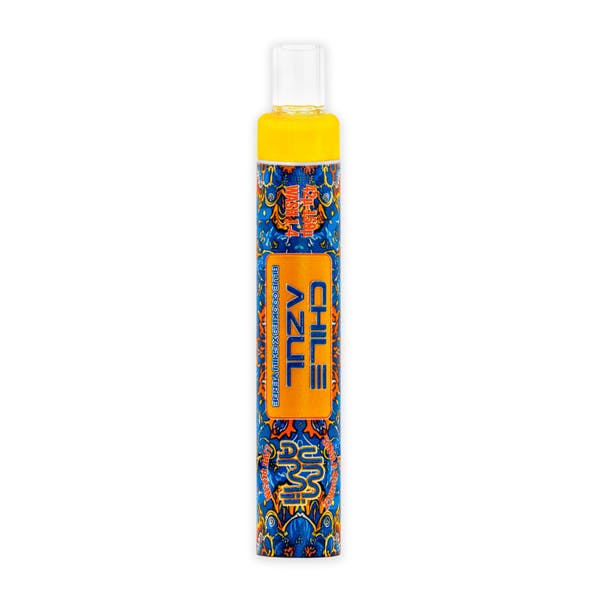
Hybrid
All strains Chile Azul
1 live products in stock
Quick answer · What is the Chile Azul cannabis strain?
Chile Azul is a measured, well-composed hybrid whose name evokes the cool depths of a blue-tinged pepper and the quiet heat that follows. Earthy and subtly spiced on the nose, it settles into the session with a layered calm that neither overwhelms nor disappears too quickly. For those who appreciate nuance over spectacle, this strain offers a grounded, contemplative experience that rewards patience and attentiveness.
Shop Chile Azul · 1 of 1 live products
About Chile Azul
Everything to know about Chile Azul.
Lineage & origin
Chile Azul's precise lineage is not widely documented in major public cannabis databases such as Leafly or Wikileaf, and the breeder has not made a definitive public statement naming its parent strains. What circulates in cultivator communities suggests a cross rooted in Blueberry genetics — the celebrated indica-leaning strain originally developed by DJ Short in the 1970s and formally recognized during the 1990s High Times Cannabis Cup era — combined with a pepper-forward, landrace-adjacent or OG-influenced line that contributes the strain's distinctive spiced earthiness. The "Chile" designation in the name is widely interpreted as a nod to that peppery, caryophyllene-rich aromatic character rather than a geographic origin. Blueberry itself descends from Thai and Afghani landraces, lending Chile Azul a genealogical thread that stretches back to some of the most historically significant cannabis cultivars on record. If the OG or Kush influence in the second parent holds, that would place additional Hindu Kush landrace genetics in the background. A small number of phenotypes have been noted by growers who describe variation in trichome density and color expression, suggesting the strain may not have been fully stabilized at the time of its wider release. Shoppers seeking absolute genetic certainty should ask their budtender for the most current breeder documentation available.
Effects
The onset of Chile Azul tends to arrive gradually, with most consumers reporting that the first perceptible shift comes within ten to fifteen minutes of inhalation. That initial movement is characteristically cerebral — a gentle lift in mood and a mild brightening of sensory focus that does not tip into anxiety or restlessness. The myrcene and caryophyllene profile works in parallel to temper any edge, keeping the early cerebral quality soft and approachable rather than stimulating. As the session deepens into its peak, typically between twenty and forty-five minutes in, a body-oriented warmth begins to distribute itself broadly. This is where Chile Azul's hybrid character becomes most evident: the mind remains engaged and present while the body settles into a state of ease. Conversations flow without effort; creative tasks feel accessible rather than demanding. The caryophyllene content is thought to interact with CB2 receptors, contributing to that physical softness without inducing sedation in moderate consumption. The comedown is gentle and unhurried, gradually returning the consumer to baseline over the course of one to two hours. There is little abruptness to the transition, which makes this strain particularly well-suited to those who prefer a predictable, measured arc. As always, individual experience varies, and those new to cannabis are encouraged to start low and go slow.
Aroma, flavor & terpenes
Chile Azul's aromatic profile opens with a grounding earthiness that calls to mind dark soil after rain, underscored immediately by a thread of black pepper and dried spice. This character is largely attributed to beta-caryophyllene, a sesquiterpene found in black pepper and clove that is among the most commonly cited terpenes in spice-forward cannabis cultivars. Caryophyllene is notable for being the only terpene known to interact directly with the endocannabinoid system's CB2 receptors, adding functional relevance to its aromatic presence. Myrcene, the most prevalent terpene across much of the cannabis spectrum, is believed to anchor the earthy, slightly musky base note, contributing a ripe stone-fruit quality that aligns with the Blueberry genetic heritage. This lends a faint sweetness beneath the pepper — not sugary, but reminiscent of a plum left to deepen at room temperature. Secondary contributions from pinene introduce a crisp, resinous brightness that keeps the overall nose from feeling heavy or flat. On the palate, the smoke or vapor is smooth and moderately dense, carrying the spiced earth forward through the mid-palate with a berry-adjacent sweetness on the exhale. The finish is clean, leaving a faint peppery warmth that lingers briefly without harshness. Those consuming via vaporizer at lower temperatures will find the fruit notes more pronounced, while combustion tends to foreground the earthier, spice-driven character.
Appearance
Chile Azul typically presents compact, moderately dense buds with a structure that reflects its indica-influenced heritage — broad calyxes that stack tightly without becoming brick-like. The color palette leans toward a deep, forest green with occasional blue-violet undertones in the leaves when the plant is exposed to cooler temperatures during its final weeks of flowering, a phenotypic expression consistent with anthocyanin pigmentation activated by cold. These cooler hues give the strain its "Azul" identity and distinguish it visually on a well-curated shelf. Trichome coverage is generous and even, giving the surface a frosted, almost dusty quality that speaks to the resin production associated with its Afghani lineage. Pistils run from a warm amber to a deeper burnt orange at full maturity, providing a striking contrast against the darker canopy. Well-cured examples will hold their structure without crumbling excessively, and the trim should be clean enough to allow the trichome layer to remain visible and intact.
Growing notes
Chile Azul is considered a moderate-difficulty cultivar, accessible to intermediate home growers but demanding enough to reward careful environmental management. It performs well both indoors under controlled conditions and outdoors in temperate climates where late-season temperatures can drop sufficiently to coax the anthocyanin expression responsible for its characteristic blue-violet coloring. Indoor cultivators working with this strain typically report a flowering window in the range of eight to nine weeks. Indoor yields are described as moderate, reflecting the compact bud structure rather than any deficiency in resin quality. Outdoor plants, given adequate space and nutrition, can develop more expansively, with harvest typically falling in the early-to-mid October window in northeastern North America — relevant context for New York-area outdoor cultivators. The strain appears to appreciate consistent humidity management during late flowering to protect its dense bud structure from moisture-related issues. Training techniques such as low-stress training or a light topping during vegetative growth are reported to improve canopy evenness and light penetration, contributing to more uniform development across the plant.
When it's best enjoyed
Chile Azul occupies the productive middle of the day-to-evening spectrum — settled enough for a late afternoon transition out of work mode, yet mentally present enough to carry a thoughtful conversation or a focused creative project. It is a particularly fitting companion for solitary work that benefits from gentle concentration: writing, sketching, or moving slowly through a long-form piece of music with full attention. The spiced, earthy terpene profile pairs naturally with food experiences that lean savory and roasted — a bowl of mole, a slow-cooked lamb dish, or a dark rye bread with aged cheese all echo the caryophyllene and myrcene notes in the strain itself. Musically, Chile Azul's unhurried, layered character aligns well with artists who prize texture over tempo: recordings in the vein of Nils Frahm's quieter piano compositions, or early Talk Talk, where the space between notes carries as much weight as the notes themselves. For social settings, it suits small gatherings where conversation is the primary activity — dinners of four to six, or an evening on a rooftop with a considered view.
If you like Chile Azul, also explore
Blueberry
As a likely parent or close genetic relative, Blueberry shares the fruit-forward sweetness and body-oriented ease that define Chile Azul's quieter moments.
Blue Dream
Fans of Chile Azul's balanced cerebral lift paired with physical relaxation will find a familiar arc in Blue Dream's well-documented hybrid character, though Blue Dream skews brighter and more sativa-expressive.
Granddaddy Purple
The violet hues, earthy depth, and body-forward warmth of Granddaddy Purple will resonate with Chile Azul consumers who favor its more grounding, indica-leaning qualities.
OG Kush
If the OG lineage speculation holds, consumers drawn to OG Kush's spiced, fuel-and-earth nose and measured body effect will find thematic overlap with Chile Azul's caryophyllene-driven profile.
Black Cherry Punch
The dark fruit notes, dense bud structure, and blue-violet aesthetic that Chile Azul shares with Black Cherry Punch make either strain a natural recommendation for admirers of the other.
Common questions
Is Chile Azul indica or sativa?+
Chile Azul is classified as a hybrid, drawing on both indica and sativa genetic heritage. In practice, the experience leans toward a balanced expression: an initial cerebral softness that gives way to a body-oriented ease as the session progresses. It does not strongly favor either end of the spectrum, making it a versatile choice for consumers who want presence of mind alongside physical comfort.
What does Chile Azul taste like?+
Chile Azul delivers a palate that opens with spiced earth and black pepper, consistent with its caryophyllene content, then softens toward a faint berry sweetness on the exhale that reflects its Blueberry lineage. The finish is clean and mildly warm, with a lingering peppery note. Consumers who favor savory, resinous profiles over overtly sweet or citrus-forward strains tend to find this one particularly satisfying.
What are the typical effects of Chile Azul?+
Consumers generally describe a gradual onset that begins with a mild mood lift and heightened sensory focus, transitioning over thirty to forty-five minutes into a broader physical ease. The experience is calm and composed rather than stimulating, maintaining mental engagement while allowing the body to settle. The comedown is measured and unhurried. Individual responses vary, and those new to cannabis are encouraged to start with a modest amount.
What strains are similar to Chile Azul?+
Consumers who enjoy Chile Azul often respond well to Blueberry for its shared fruit and body-ease qualities, Blue Dream for a comparable hybrid balance with a brighter tilt, Granddaddy Purple for deeper body relaxation and similar purple aesthetics, OG Kush for the spiced-earth terpene overlap, and Black Cherry Punch for its dark fruit character and visually striking appearance.
Is Chile Azul good for beginners?+
Chile Azul's gradual onset and measured intensity make it relatively approachable compared to more potent or fast-acting cultivars. That said, it is an adult-use product available to those 21 and older in New York, and no cannabis strain is without the potential for an overwhelming experience if consumed in excess. The standard guidance applies: begin with a small amount, allow sufficient time to assess the effect, and adjust from there.
What are the dominant terpenes in Chile Azul?+
Beta-caryophyllene is considered the defining terpene in Chile Azul, contributing the characteristic black pepper and spice notes as well as its known interaction with CB2 receptors. Myrcene provides the earthy, musky base and the faint stone-fruit sweetness associated with the Blueberry heritage. Alpha-pinene appears as a secondary contributor, adding a crisp resinous brightness that keeps the overall profile from feeling too heavy or one-dimensional.
When is the best time of day to consume Chile Azul?+
Chile Azul is most naturally suited to the late afternoon or early evening — a transitional window when the day's obligations are winding down but the evening is still open. Its balanced hybrid character sustains enough mental clarity for conversation or creative engagement while offering the physical ease associated with an unhurried close to the day. It is less suited to first-thing-in-the-morning use or situations requiring sharp analytical focus.
What is the lineage of Chile Azul?+
Chile Azul's lineage is not fully documented in major public cannabis databases, and the breeder has not made a definitive public disclosure of its parent strains. Community consensus suggests Blueberry genetics on one side — DJ Short's celebrated indica-leaning cultivar — combined with a peppery, possibly OG-influenced second parent. The "Chile" in the name is generally understood as a reference to its caryophyllene-driven spice character rather than a geographic designation.
Related strains