
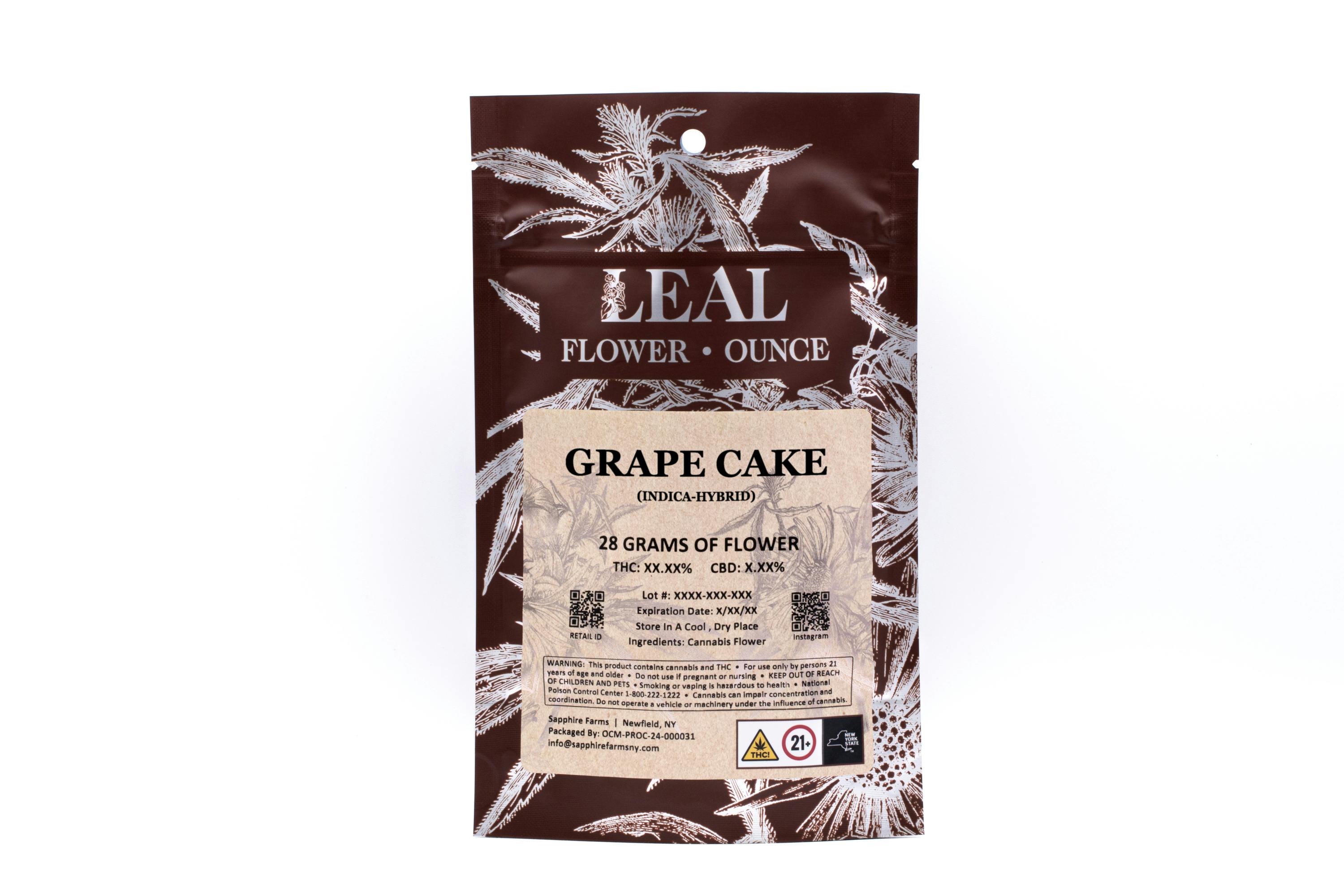
Indica-Hybrid
All strains Grape Cake
2 live products in stock
Quick answer · What is the Grape Cake cannabis strain?
Grape Cake arrives with the quiet confidence of a well-cellared dessert wine — its dense, resinous buds carry a layered perfume of dark fruit, vanilla, and earth that lingers well before the first draw. An indica-leaning hybrid built for the evening hours, it delivers a measured, full-bodied experience that settles gradually across both mind and body, making it a thoughtful choice for those who appreciate depth over immediacy.
Shop Grape Cake · 2 of 2 live products
About Grape Cake
Everything to know about Grape Cake.
Lineage & origin
Grape Cake is generally attributed to the cross of three well-regarded cultivars: Grape Stomper, Wedding Cake, and Cherry Pie. Grape Stomper — itself a Sour Diesel phenotype crossed with Purple Elephant, bred by Gage Green Genetics — contributes the strain's most distinctive viticultural character, lending notes of concord grape and subtle fuel. Wedding Cake (also known as Pink Cookies), a cross of Triangle Kush and Animal Mints developed in the California market around 2016 and popularized through Seed Junky Genetics, brings a rich, doughy sweetness and the resinous, high-trichome structure the strain is known for. Cherry Pie, thought to be a cross of Granddaddy Purple and Durban Poison, introduces a bright, jammy top note and a slightly more balanced cannabinoid and terpene expression. The precise breeder of Grape Cake as a named cultivar has not been consistently or publicly credited by a single originating seed company, and some sources attribute early cuts to California's underground market circa 2018 to 2019. Multiple phenotypes circulate under the name, which accounts for some variation in reported aroma and effect profiles across different dispensaries and regions. The strain's lineage places it firmly within the broader "dessert strain" movement that defined West Coast cannabis culture in the late 2010s, a period characterized by Wedding Cake offshoots and fruit-forward Kush hybrids dominating premium shelves.
Effects
The onset of Grape Cake tends to be measured rather than abrupt — most experienced consumers report the first perceptible effects within five to fifteen minutes of inhalation, beginning as a gentle pressure behind the eyes and a softening of ambient mental noise. The cerebral opening phase is calm and clarifying rather than stimulating; thoughts may become quieter and more present-focused without the anxious edge that some high-potency sativas can introduce. This initial lucidity is one of Grape Cake's more appealing qualities for those who prefer indica-leaning effects that do not immediately cloud cognition. As the experience deepens over the following thirty to forty-five minutes, the body component becomes increasingly prominent. A progressive physical ease moves from the shoulders downward, characteristic of the indica inheritance from its Kush-adjacent grandparent lines. The peak is warm, enveloping, and conducive to stillness — not sedating in the early stages for most tolerant consumers, but clearly oriented toward rest and sensory ease rather than productivity. Duration typically runs two to three hours depending on individual metabolism and method of consumption. The terpene profile plays a meaningful role in shaping this arc. Myrcene, the dominant terpene across most reported tests, is associated in the literature with sedating, muscle-relaxing qualities and is thought to facilitate cannabinoid uptake across the blood-brain barrier. Caryophyllene adds a layer of tension relief, while linalool contributes to the strain's reputation for a gentle, unhurried comedown.
Aroma, flavor & terpenes
The aromatic profile of Grape Cake is among its most immediately compelling attributes. Myrcene anchors the nose with a deep, musky earthiness that reads almost humid — like dark soil after rain — beneath which a distinct concord grape sweetness emerges, a contribution primarily inherited from the Grape Stomper lineage. This fruit character is ripe and jammy rather than sharp or citrus-adjacent, leaning toward the fermented side of the fruit spectrum. Caryophyllene, the second dominant terpene in most phenotypes, introduces a dry, peppery spice that prevents the sweetness from becoming cloying and adds structural complexity to the nose. Linalool, present in the Wedding Cake heritage, contributes a soft floral note — not perfumed or overpowering, but detectable as a background lavender-like warmth that bridges the fruit and spice elements. Limonene, when present, lifts the profile with a faint citrus brightness in the upper register. On the palate, Grape Cake tends to be creamy and full-bodied, particularly when consumed through a clean vaporizer at lower temperatures. The inhale delivers the grape and berry sweetness most prominently, while the exhale transitions into a vanilla-dough character — a direct inheritance from Wedding Cake — with a faint, lingering pepper finish. In combustion, a smooth, thick smoke carries all of these elements in a somewhat compressed form, with the earthier myrcene notes becoming more pronounced on the finish.
Appearance
Grape Cake produces buds that are compact and densely packed, consistent with its Kush-heavy lineage. The calyx structure is tight and rounded, building into chunky, somewhat elongated nuggets that hold their shape well through handling. The color palette leans into deep greens with frequent purple and violet hues throughout the interior of the bud — an expression of anthocyanin pigmentation inherited from Grape Stomper and Granddaddy Purple ancestry, most vivid when the plant has been exposed to cooler temperatures during the late flowering phase. Pistils range from rust-orange to deep amber and weave densely across the surface, adding warmth to the cooler tones of the foliage. Trichome coverage is exceptional — a dense, frost-like layer of milky to amber-tipped capitate-stalked trichomes coats both the flowers and the surrounding sugar leaves, lending the dried bud a near-luminous quality under direct light. Well-cured examples are notably sticky to the touch, a testament to the resin production carried forward from the Wedding Cake parent.
Growing notes
Grape Cake is considered an intermediate-level cultivar, accessible to home growers with some prior experience but likely to reward more seasoned hands who can manage its specific needs. It performs well both indoors and outdoors, though indoor cultivation with controlled humidity is generally preferred given the strain's dense bud structure, which can make it susceptible to mold and botrytis in humid or poorly ventilated environments. Indoors, Grape Cake typically finishes flowering in approximately eight to nine weeks. Yields are moderate to generous under optimized conditions, with indoor grows reported to produce in the range of 400 to 500 grams per square meter under adequate lighting. Outdoor plants thrive in warm, dry climates similar to those of Southern California and Mediterranean regions, with harvest typically falling in mid-October in the Northern Hemisphere. The plant responds well to low-stress training and defoliation techniques to improve canopy airflow and light penetration given its propensity for dense foliage. For the cultivator-curious shopper, it is worth noting that the quality of terpene expression — particularly the grape and vanilla notes — is meaningfully influenced by the curing process, with longer, slower cures often yielding a more pronounced aromatic complexity.
When it's best enjoyed
Grape Cake is, at its core, an evening strain — one that rewards patience and a deliberate absence of agenda. It suits the ritual end of a considered day: the hour after dinner when the pace of the evening slows and conversation becomes more reflective than purposeful. Its physical warmth and unhurried onset make it particularly well-suited to solo unwinding — reading something absorbing, listening to music with full attention, or simply allowing stillness to settle in without agenda. For food pairing, Grape Cake's terpene profile aligns naturally with richly flavored, fat-forward preparations. A dark chocolate tasting, a cheese course anchored by aged cheddar or a creamy brie, or a small pour of a late-harvest Zinfandel would each complement and echo the strain's vanilla, earth, and dark fruit character without competing with it. Musically, the experience pairs well with something that rewards close listening — a Bill Evans record, a low-tempo soul album, or a well-produced ambient set. For those who prefer more active settings, a post-yoga or post-hike wind-down ritual is a natural fit, where the body-forward character of the strain meets physical ease already in progress.
If you like Grape Cake, also explore
Wedding Cake
As a direct parent of Grape Cake, Wedding Cake shares the same doughy-sweet terpene base, dense trichome structure, and indica-leaning full-body effect arc, making it an obvious companion for those drawn to the dessert strain character.
Grape Stomper
The other key parent in Grape Cake's lineage, Grape Stomper delivers the same distinctive concord grape aroma and a slightly more balanced cerebral quality for those who prefer a touch more lift in the experience.
Gelato 41
Sharing a heritage that overlaps with the Cookie family and a similarly creamy, dessert-forward terpene profile, Gelato 41 offers a comparable luxury-feel experience with a slightly more energetic onset.
Granddaddy Purple
Fans of Grape Cake's purple aesthetics, grape-dominant aroma, and deeply relaxing body effect will find familiar territory in Granddaddy Purple, one of the foundational cultivars of the fruit-forward indica tradition.
Cherry Pie
As the third parent strain in Grape Cake's lineage, Cherry Pie shares the jammy, berry-forward nose and a similarly balanced, gently sedating effect profile that makes it a natural bridge for Grape Cake enthusiasts.
Common questions
Is Grape Cake indica or sativa?+
Grape Cake is an indica-leaning hybrid. Its lineage — drawing from Wedding Cake, Grape Stomper, and Cherry Pie — skews toward the indica end of the spectrum, particularly in its physical effect character and dense bud structure. While the early onset carries a mild cerebral quality, the experience is predominantly body-forward and oriented toward rest and relaxation rather than stimulation or activity.
What does Grape Cake taste like?+
Grape Cake offers a layered, dessert-oriented flavor profile. The primary taste is a rich concord grape sweetness on the inhale, inherited from Grape Stomper, which transitions on the exhale to a creamy, vanilla-dough character drawn from the Wedding Cake lineage. A faint peppery finish — contributed by caryophyllene — adds structure and prevents the sweetness from reading as one-dimensional. Clean vapor or well-cured flower expresses these notes most clearly.
What are the typical effects of Grape Cake?+
Grape Cake typically delivers a gradual, measured onset beginning with a gentle cerebral quieting before progressing into a warm, full-body physical ease. The peak experience is deeply relaxing, favoring stillness and sensory comfort. Most consumers find it well-suited to evening use. The experience generally lasts two to three hours, with a smooth, unhurried comedown. Individual response varies based on tolerance, consumption method, and the specific phenotype encountered.
What strains are similar to Grape Cake?+
Consumers who enjoy Grape Cake often appreciate its parent strains — Wedding Cake and Grape Stomper — for their overlapping terpene profiles and effect characters. Gelato 41 offers a similarly creamy, dessert-forward experience with broader availability. Granddaddy Purple shares the grape-dominant aroma and deeply relaxing body effect, while Cherry Pie, the third parent in Grape Cake's lineage, bridges the jammy fruit and balanced hybrid qualities that define the strain.
Is Grape Cake good for beginners?+
Grape Cake can be approachable for newcomers, though its indica-leaning potency warrants a cautious, start-low-go-slow approach. The gradual onset can sometimes lead inexperienced consumers to over-consume before effects are fully felt, which may result in an uncomfortably sedating experience. For those new to cannabis, beginning with a single, measured inhalation and allowing fifteen to twenty minutes before reassessing is a reasonable approach to exploring this cultivar respectfully.
What are the dominant terpenes in Grape Cake?+
Myrcene is generally the most prominent terpene in Grape Cake, contributing its signature earthy musk and the deeply relaxing physical character associated with many indica-leaning cultivars. Caryophyllene follows, adding a dry peppery spice and structural complexity to both the aroma and effect profile. Linalool, inherited from the Wedding Cake lineage, offers a subtle floral warmth. Limonene appears in some phenotypes, contributing a faint citrus brightness to the upper register.
Why does Grape Cake vary so much between dispensaries?+
Because no single breeder has been publicly and consistently credited with originating the Grape Cake cultivar, multiple phenotypes and seed-line interpretations circulate under the same name. This means the specific expression of aroma, effect, and appearance can differ meaningfully depending on the grower's genetic source, cultivation practices, and curing methods. Asking dispensary staff about the specific genetic provenance or the growing source for their current Grape Cake offering can provide useful clarity.
When is the best time of day to consume Grape Cake?+
Grape Cake is most naturally suited to the evening or late afternoon — after responsibilities have concluded and the pace of the day has slowed. Its body-forward, progressively relaxing effect arc is poorly matched to productive morning or midday contexts. The strain rewards an unhurried environment: a quiet evening at home, a contemplative wind-down after physical activity, or a deliberate moment of sensory rest. It is not generally considered a functional daytime cultivar.
Related strains