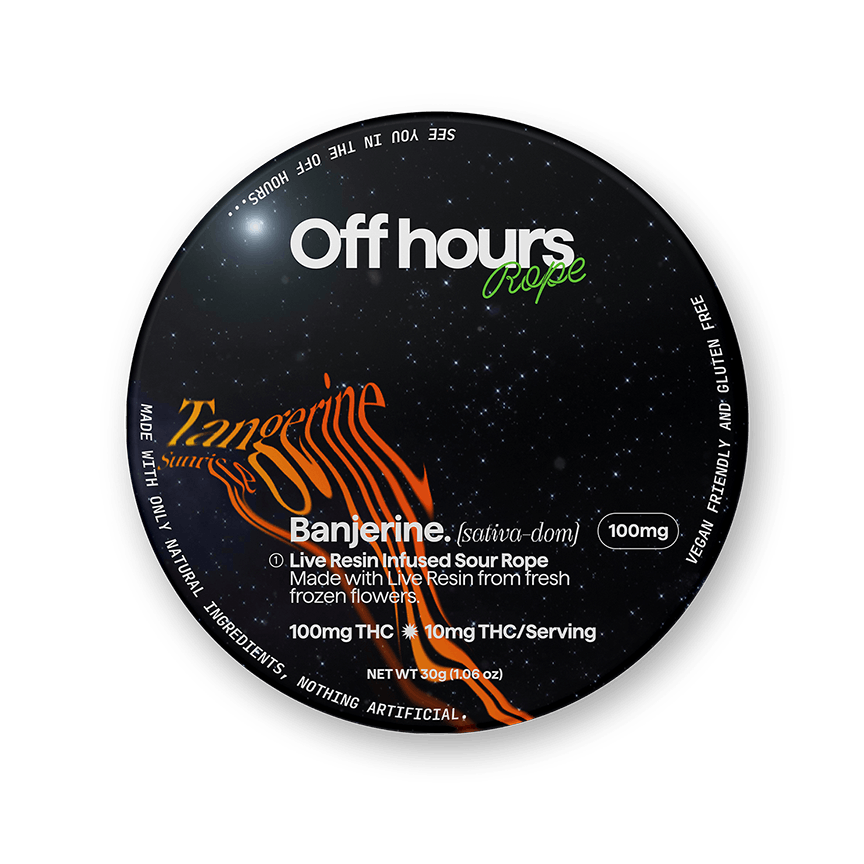
THC 100mgSativa
Off HoursOff hours - Live Resin Rope (Banjerine - Sour Tangerine Sunrise) · 0.01g
$22.12
$25after tax

weeddispensarynearme.com
You must be 21 years or older to enter. By entering, you confirm you’re of legal age in your state to purchase cannabis.
For use only by adults 21+ • Keep out of reach of children
1 live products in stock
Quick answer · What is the Banjerine cannabis strain?
Banjerine arrives as a citrus-forward hybrid with a profile that rewards patience and attentiveness. Its tangerine-laced aroma and rounded, even-keeled effects have earned it a dedicated following among those who prize clarity alongside warmth. Neither aggressively cerebral nor deeply sedating, Banjerine occupies a considered middle ground — a strain suited to the connoisseur who prefers nuance over blunt force.
$25after tax
About Banjerine
Banjerine is a hybrid cultivar bred by Archive Seed Bank, the Portland-based operation known for its meticulous selection work with Tangie-influenced genetics. The strain is understood to be a cross of Tangie and an undisclosed OG or Kush-adjacent male, though Archive has not publicly documented the full paternal lineage in detail, making the precise second parent a subject of community speculation on forums such as Grasscity and ICMag. What is well-established is the Tangie influence: Tangie itself is a modern rendition of the classic Tangerine Dream lineage, developed by DNA Genetics and Crockett Family Farms and celebrated since roughly 2013 for its explosive citrus terpene profile. Archive Seed Bank built upon this foundation with Banjerine, seeking to temper Tangie's sometimes racy, sativa-leaning energy with a grounding body component contributed by the Kush-side genetics. The result is a strain that sits comfortably in the hybrid category, carrying forward the signature orange-peel aromatics of its Tangie parent while exhibiting a more balanced cannabinoid and terpene expression. Banjerine has not spawned the same volume of documented phenotypes as some Archive flagship releases, but it remains a respected offering within the Oregon and broader West Coast craft-cannabis scene, appreciated by breeders who use it as a Tangie-adjacent building block for new citrus-dominant hybrids.
Banjerine tends to announce itself within five to fifteen minutes of consumption, consistent with the relatively swift onset characteristic of Tangie-lineage cultivars. The initial wave is predominantly cerebral — a gentle brightening of mood and a loosening of mental rigidity that does not tip into anxious overstimulation for most moderate consumers. Thoughts flow with a certain unhurried ease, and sensory details — music, texture, light — register with heightened but not overwhelming acuity. This opening phase reflects the influence of limonene and terpinolene, terpenes associated in preliminary research with uplifting and mildly euphoric qualities. As the experience matures into its middle phase, typically between thirty and ninety minutes in, the Kush-adjacent genetics introduce a softer body presence: a gentle warmth across the shoulders and a mild settling of physical tension that keeps the session from feeling purely heady. This duality is what distinguishes Banjerine from a straightforward sativa — the mind remains engaged while the body is comfortably at ease. The comedown is gradual and relatively clean, rarely accompanied by the sharp drop in energy associated with more heavily indica-dominant cultivars. Duration for most consumers falls in the two-to-three-hour range. Given the balanced THC delivery, those newer to cannabis are encouraged to start with a modest amount and allow sufficient time before reassessing.
The aromatic character of Banjerine is dominated by terpinolene and limonene, the same pairing responsible for Tangie's celebrated citrus signature. Terpinolene delivers the higher, more volatile top notes — fresh tangerine rind, a faint floral lift, and a slightly herbal undertone reminiscent of fresh hops — while limonene anchors the profile with a rounder, sweeter orange-citrus body that lingers after the initial burst. Together they create an olfactory impression that is bright without being sharp, recalling a hand-zested citrus peel rather than a commercial fragrance. Secondary terpene contributions add welcome complexity. Myrcene appears in moderate amounts, softening the citrus brightness with an earthier, almost tropical undercurrent — think ripe mango skin beneath the orange. Caryophyllene introduces a faint spiced warmth, a whisper of black pepper at the back of the nose that keeps the profile from reading as purely fruity. On the palate, Banjerine delivers admirably in both combustion and vapor forms, though vapor at moderate temperatures (roughly 170–185°C for those using dry-herb devices) best preserves the terpinolene volatility. The smoke carries a smooth tangerine sweetness on the inhale, transitioning to a mild, slightly doughy exhale with a citrus-herb finish. The aftertaste is clean and not resinous, making Banjerine a strain that many consumers find approachable across multiple sessions without palate fatigue.
Banjerine's buds reflect its hybrid constitution: they are medium-dense, neither the tightly packed, almost spherical calyxes of a pure OG expression nor the elongated, airy structures of a classic sativa. The flowers tend to be small-to-medium in size with a slightly tapered, popcorn-adjacent shape. Coloration skews toward a rich, saturated green — often a deep forest green on the interior leaves — with occasional whispers of pale gold or faint amber on the broader fan-adjacent sugar leaves when the plant has experienced a cooler late-flower period. Pistils are a warm burnt-orange, true to the Tangie lineage's characteristic colour cues, and they are present in moderate density, weaving between the calyxes without obscuring the underlying structure. Trichome coverage is generous and even, giving cured Banjerine a frosted, slightly luminous quality under direct light. The resin glands themselves are predominantly capitate-stalked, contributing a tacky hand-feel when buds are handled and signaling a respectable terpene-and-cannabinoid load preserved within the cured flower.
Banjerine is classified as a moderately demanding cultivar, appropriate for growers with at least one or two prior grows under their belt. Its Tangie heritage means it tends toward vertical stretch during the first two to three weeks of the flowering phase, so cultivators working with limited canopy height are advised to train aggressively during the vegetative stage — topping and low-stress training both respond well. Flowering time indoors falls in the nine-to-ten-week range, slightly longer than many comparable hybrids, a reflection of its Tangie genetics which require that additional time to fully develop terpene complexity. Indoor yields are reported as moderate, broadly consistent with Archive's other boutique hybrid offerings. Outdoors, Banjerine performs well in dry, Mediterranean-style climates where humidity can be managed during the critical late-flower window; the dense citrus-resin profile makes it somewhat susceptible to botrytis in humid environments. Harvest timing, as with most Tangie-derivative cultivars, benefits from close trichome monitoring — allowing the glands to reach a balanced clear-to-milky ratio preserves the terpinolene-forward brightness that defines the strain's identity.
Banjerine occupies a distinct and valuable niche in the experiential calendar: it is most at home in the hours that fall between obligation and rest — a late Sunday afternoon, a slow weekday evening before dinner, or the early portion of a social gathering where conversation and ease are the agenda. Its balanced hybrid arc means it neither demands solitude nor overwhelms a group setting; it pairs equally well with focused solo creative work (writing, sketching, playing an instrument) and with the relaxed company of a small, trusted group. The citrus-dominant terpene profile has a natural affinity with food and drink that share that aromatic register. A tasting flight of natural-process Ethiopian or Colombian coffee, with its inherent berry-citrus brightness, makes a considered pairing, as does a simple spread of aged Manchego, honey, and fresh citrus segments. Musically, Banjerine's profile aligns well with recordings that balance structural clarity with warmth — classic soul, West Coast jazz from the 1960s, or contemporary R&B produced with a light touch. For the physically active, a post-hike wind-down on a warm evening is a natural context, where the body warmth of the session dovetails with residual muscle ease.
Tangie
As Banjerine's most direct genetic ancestor, Tangie shares the tangerine-forward terpene profile and uplifting cerebral onset, though it leans slightly more sativa-dominant and less grounded in the body.
Clementine
Bred by Crockett Family Farms from Tangie and Lemon Skunk, Clementine offers a similarly bright citrus aroma and clear-headed, energizing effect arc that appeals to the same terpinolene-and-limonene enthusiast.
Agent Orange
A classic citrus hybrid from TGA Subcool Seeds, Agent Orange shares the warm orange-peel aromatics and balanced, sociable hybrid effects that characterize the Banjerine experience.
Mimosa
Mimosa's Clementine-and-Purple-Punch lineage delivers a comparable fruity-citrus brightness layered over a gentle body presence, making it a natural recommendation for consumers who enjoy Banjerine's tonal balance.
Sunshine #4
Another Archive Seed Bank creation built on Tangie genetics, Sunshine #4 shares the citrus-resin character and craft-cultivar quality that defines Banjerine's appeal within the connoisseur market.
Banjerine is classified as a hybrid. It draws its uplifting, citrus-forward cerebral character from its Tangie sativa heritage, while a Kush-adjacent parent — not fully disclosed by breeder Archive Seed Bank — contributes a grounding body component. The overall experience sits closer to a balanced hybrid than to either pure expression, offering mental engagement alongside physical ease.
Banjerine leads with a fresh tangerine-rind sweetness shaped by its dominant terpinolene and limonene content. On the palate, the inhale is smooth and citrus-forward, transitioning to a mild, slightly earthy exhale with a faint herbal and spiced note from secondary caryophyllene. The finish is clean and relatively brief, without the heavy resinous coating associated with more OG-dominant cultivars.
Most consumers describe an initial brightening of mood and a loosening of mental tension, arriving within five to fifteen minutes. This gives way to a comfortable dual-state: an engaged, sociable mind paired with a gentle warmth in the body. The experience typically runs two to three hours before a gradual, relatively clean comedown. Those new to cannabis should begin with a modest amount and allow adequate time before consuming more.
Consumers who enjoy Banjerine frequently also gravitate toward Tangie, Clementine, and Agent Orange for their shared citrus-dominant terpene profiles and uplifting hybrid effects. Mimosa offers a comparable fruity brightness with a slightly more relaxed body tone, while Sunshine #4 — another Archive Seed Bank release — shares Banjerine's craft-cultivar DNA and Tangie-influenced character.
Banjerine's balanced hybrid profile makes it more approachable than many high-potency sativa-dominant cultivars, but its Tangie lineage means it can still deliver noticeable cerebral intensity. Beginners are encouraged to follow a start-low, go-slow approach — taking a small amount and waiting a full session duration before reassessing. The relatively clean comedown is a point in its favor for newer consumers.
Terpinolene and limonene are the defining terpenes, jointly responsible for the strain's signature fresh-citrus and tangerine-rind aroma. Myrcene appears as a secondary contributor, adding an earthy, mildly tropical depth, while caryophyllene provides a faint spiced warmth. This terpene quartet also informs the effect character: the brightness and uplift associated with terpinolene and limonene, and the mild grounding quality associated with myrcene.
Banjerine was developed by Archive Seed Bank, a well-regarded boutique breeder based in Portland, Oregon, known for its careful work with Tangie and OG-influenced genetics. Archive has confirmed the Tangie parentage but has not publicly detailed the full paternal lineage. The strain emerged within the Oregon craft-cannabis scene and has been available through select seed and dispensary channels on the West Coast and beyond.
To preserve Banjerine's terpinolene-forward citrus character, lower-temperature consumption methods tend to be most revealing. A dry-herb vaporizer set in the moderate temperature range allows the more volatile terpenes to express fully before combustion can degrade them. Slow, deliberate inhalation — whether through a quality glass piece or a vaporizer — allows the tangerine and herbal top notes to register clearly before the earthier base notes follow.
Related strains
Pick your store
We'll show pricing, deals, and delivery zones for the store you pick. You can switch any time from the header.