THC 90.16%·CBD 0.19%Indica
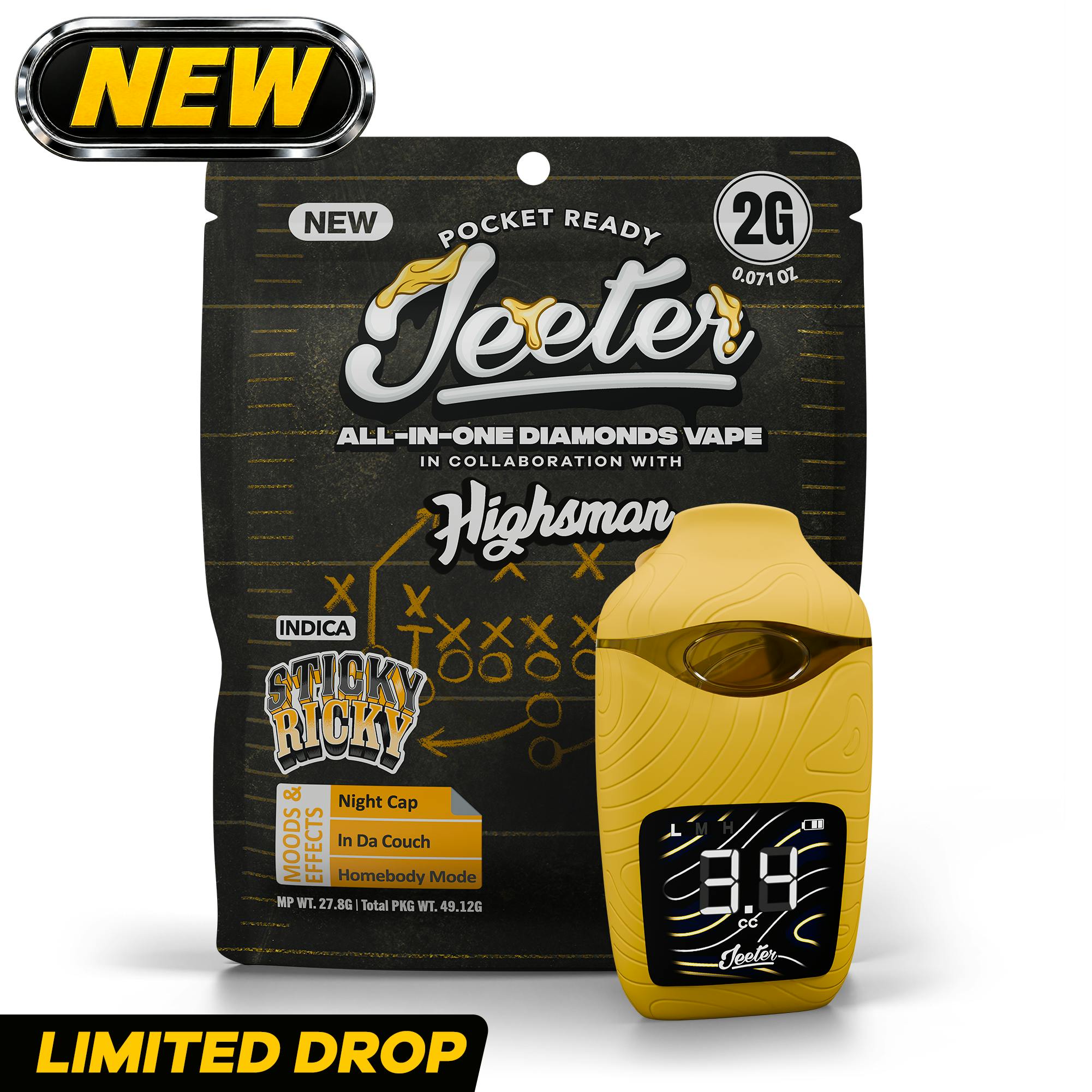
JeeterJeeter Highsman | Sticky Ricky | All In One Liquid Diamonds Vape · 2g
$84.96
$96after tax

weeddispensarynearme.com
You must be 21 years or older to enter. By entering, you confirm you’re of legal age in your state to purchase cannabis.
For use only by adults 21+ • Keep out of reach of children
1 live products in stock
Quick answer · What is the Sticky Ricky cannabis strain?
Sticky Ricky arrives with the quiet confidence of a strain that needs no introduction — dense, resinous buds that announce themselves the moment the jar is opened. An indica-leaning cultivar celebrated for its pronounced body character and earthy, fuel-tinged aromatics, it suits the end of a long day in New York as naturally as a well-poured glass of something aged and considered. For the seasoned consumer who values depth over flash, Sticky Ricky delivers.
$96after tax
About Sticky Ricky
Sticky Ricky's precise lineage is not consistently documented across major public cannabis registries, and the breeder has not made a definitive public statement naming its parent strains. What is broadly reported in cultivator communities points toward a heavy indica genetic foundation, with phenotypic characteristics — pronounced resin production, compact bud structure, and an earthy-fuel terpene signature — consistent with OG Kush or Afghani heritage somewhere in the background. The name itself has appeared across multiple regional markets, which further complicates any single-source attribution, as regional growers have applied it to phenotypes with slightly varying profiles. What remains consistent across the strain's documented appearances is its classification as a true indica-dominant expression, likely carrying genetics common to the Hindu Kush corridor — a gene pool responsible for the thick trichome coats and sedative body effects that define this cultivar's reputation. In the absence of certified breeder documentation, consumers should understand that the Sticky Ricky name may represent a cut or phenotype selected by regional cultivators rather than a formally bred and stabilized F1 or F2 line. As with several craft-tier cultivars that have migrated from underground markets into the licensed adult-use space, Sticky Ricky's influence is less about a traceable genealogy and more about its consistent on-shelf performance — the kind of cultivar that earns loyalty through repeatable experience rather than prestige branding.
The onset of Sticky Ricky typically arrives within five to fifteen minutes of inhalation, beginning as a gentle pressure behind the eyes and a soft loosening of tension through the shoulders and upper back. This early phase is unhurried — there is little of the sharp cerebral lift associated with sativa-forward varieties. Instead, the experience settles in gradually, which is a hallmark of indica-dominant cultivars whose cannabinoid and terpene profiles favor a fuller body response over immediate mental stimulation. At its peak, the effect is predominantly physical: a weighted, enveloping sensation that encourages stillness rather than activity. Myrcene — commonly identified as a dominant terpene in this profile — is associated in the broader terpene literature with sedative and muscle-relaxing qualities, and its presence here is palpable. Caryophyllene may add a layer of ease that tempers any residual mental chatter, while the overall experience skews toward deep relaxation rather than introspective depth. Duration for most consumers tends to run between two and three hours, with a gradual comedown that lacks abruptness. The descent is smooth, often transitioning naturally into drowsiness or a comfortable stillness. Because of this pronounced body character and the potential for sedation, new consumers and those sensitive to high-potency indicas are well advised to begin with a modest amount and allow adequate time before reassessing.
The aromatic profile of Sticky Ricky leans unmistakably toward the earthy and fuel-forward end of the cannabis spectrum. On first opening, there is a dense, damp-earth note — the kind associated with myrcene's characteristic musk — layered beneath a sharp diesel or rubber undertone that suggests the presence of caryophyllene and possibly trace amounts of ocimene contributing to a slightly herbal brightness at the edges. The combination is rich and unapologetically pungent, appealing to consumers who favor cultivars with assertive, old-school aromatic character. On the palate, the smoke or vapor carries the earthiness forward with fidelity. The initial draw is smooth, with a rounded, almost hashish-like body that coats the mouth and throat without harshness. Secondary notes — a faint pine quality attributable to pinene, and a subtle spice from caryophyllene's pepper-adjacent character — emerge on the exhale, adding complexity to what might otherwise read as a one-dimensional earthy profile. The finish is long and resinous, with the fuel and musk notes lingering pleasantly. For consumers who enjoy the classic Afghani or OG-adjacent aromatic lineage, Sticky Ricky sits comfortably within that tradition. It does not chase bright citrus or floral modernity; it is a grounded, richly aromatic cultivar whose terpene expression rewards those who take a moment to appreciate the slower, deeper register of its character.
Sticky Ricky lives up to its name visually. The buds are compact and densely packed — a hallmark of indica-dominant structure — with a tight calyx formation that gives each nugget a sturdy, almost sculptural quality when trimmed well. Trichome coverage is notably heavy, lending the surface a silver-white frosting that explains the cultivar's reputation for resin production. Under adequate light, the glandular heads catch and scatter light in a way that signals potency before any jar is even opened. The colour palette runs from a deep forest green at the core to muted olive tones at the surface, where the trichome layer softens the visual contrast. Pistils tend toward a warm amber or burnt orange, weaving through the bud in dense clusters that add visual warmth to an otherwise cool-toned structure. Overall bag appeal is substantial — this is a cultivar whose appearance rewards the attention of a consumer who knows what to look for in a well-grown indica.
Sticky Ricky's indica-dominant structure makes it a natural candidate for indoor cultivation, where its compact plant height and lateral branching can be managed efficiently within standard tent or room setups. Flowering time is typically reported in the range of eight to nine weeks, consistent with indica-leaning genetics of probable Afghani or OG descent. Yields are considered moderate to generous indoors when canopy techniques such as low-stress training are applied to maximize light penetration. The cultivar's pronounced resin production, while a selling point for consumers, also demands attention to humidity management during the late flowering phase, as dense bud structure can create conditions favorable to mold in poorly ventilated environments. Outdoor cultivation is viable in temperate climates with warm, dry late summers — the plant prefers to finish before the first frost and benefits from consistent airflow. For the cultivator-curious shopper, Sticky Ricky represents a moderately approachable grow with high-reward visual and aromatic results, though the humidity sensitivity means it is better suited to growers with some environmental control experience rather than absolute beginners.
Sticky Ricky is, at its core, an evening cultivar — one that earns its place in the latter hours of the day when the agenda has been satisfied and the only remaining obligation is to rest well. It suits the solitary wind-down: a quiet apartment, low light, and the kind of music that rewards unhurried listening. Its terpene profile — earthy, weighted, faintly spiced — pairs naturally with the slow end of a day rather than its active middle. For food pairings, the earthy musk of myrcene and the subtle pepper of caryophyllene align comfortably with robust, savory flavors: aged hard cheeses, slow-cooked braises, or a well-seasoned grain bowl. In terms of music, the cultivar's heavy, grounded character finds a natural counterpart in low-tempo hip-hop, dub, or acoustic delta blues — anything with space and weight to it. Those who enjoy unwinding with a long-form documentary or an absorbing novel will find that Sticky Ricky's body-forward experience supports that kind of passive, receptive attention without pushing toward sleep too aggressively — at least for the first hour.
OG Kush
Fans of Sticky Ricky's fuel-and-earth aromatic signature and weighted body effect will find familiar comfort in OG Kush's well-documented earthy, diesel-forward profile and indica-leaning relaxation.
Afghani
As a landrace cultivar likely in Sticky Ricky's genetic background, Afghani offers the same dense resin production, compact bud structure, and deeply sedative body character for consumers who want to explore the roots of the profile.
Bubba Kush
Bubba Kush shares the heavy, hashish-adjacent earthiness and pronounced physical relaxation of Sticky Ricky, making it a natural recommendation for consumers who favor that grounded, couch-compatible indica experience.
Northern Lights
Another resinous, indica-dominant classic with a similarly smooth, earthy palate and reliable full-body effect arc, Northern Lights appeals to the same consumer drawn to Sticky Ricky's unpretentious, deeply relaxing character.
Granddaddy Purple
For consumers who appreciate Sticky Ricky's sedative body quality but want a slightly sweeter aromatic dimension, Granddaddy Purple offers a complementary experience with its grape-and-earth profile and equally pronounced indica weight.
Sticky Ricky is classified as an indica-dominant cultivar. Its physical characteristics — compact, dense bud structure, heavy resin production, and a body-forward effect profile — are consistent with indica genetics, most likely rooted in Afghani or OG Kush lineage. The experience it delivers aligns with what most consumers associate with indica: physical relaxation, a weighted sensation, and a natural inclination toward rest rather than activity.
Sticky Ricky presents an earthy, fuel-tinged palate with a rounded, hashish-like body on the inhale and subtle notes of pine and pepper on the exhale. The finish is long and resinous. Consumers who appreciate the classic OG or Afghani flavor tradition — dense, musky, and unapologetically pungent — will find its aromatic and flavor profile familiar and satisfying. It does not chase bright or sweet modern terpene profiles.
Sticky Ricky delivers a gradual, body-forward experience. Onset typically arrives within five to fifteen minutes, beginning with a release of physical tension and a softening of mental noise. At its peak, the effect is predominantly physical — weighted and enveloping. The experience generally runs two to three hours, with a smooth comedown that often transitions naturally into drowsiness. It is best suited to the evening or any period when rest is the intended outcome.
Consumers drawn to Sticky Ricky's earthy, resinous character and sedative body profile typically also enjoy OG Kush, Bubba Kush, Northern Lights, Afghani, and Granddaddy Purple. Each of these cultivars shares at least one defining quality with Sticky Ricky — whether that is the fuel-and-earth aromatic signature, the dense trichome coverage, or the deeply relaxing indica effect arc that defines this cultivar's appeal.
Sticky Ricky is a potent, indica-dominant cultivar with a pronounced body effect that may be intense for those new to cannabis. Beginners are encouraged to start with a very modest amount and allow sufficient time — at least thirty to forty-five minutes — before considering more. The sedative quality can come on gradually and accumulate. For those newer to cannabis, starting low and going slow is not simply conventional advice here; it is genuinely prudent given the cultivar's character.
Based on its documented aromatic and effect profile, Sticky Ricky is consistent with myrcene as a dominant terpene — responsible for the earthy musk and the sedative, body-relaxing qualities — supported by caryophyllene, which contributes pepper and spice notes alongside a potential complementary ease to the overall experience. Pinene appears to play a secondary role, adding a faint brightness to the otherwise grounded aromatic character. Ocimene may also be present in trace amounts.
Sticky Ricky is best positioned as an evening or late-night cultivar. Its weighted, sedative body effect and grounded aromatic profile make it poorly suited to daytime obligations or situations requiring sustained focus and energy. It excels in moments of intentional rest — a quiet evening at home, a slow dinner, or the transition into sleep. Consumers who have tried it report that it supports stillness and comfort rather than motivation or creative output.
Sticky Ricky's precise origin and breeder are not definitively documented in major public cannabis registries. The name has appeared across multiple regional markets, and the cultivar appears to have been developed or selected at the craft tier rather than through a formally documented breeding program. Its phenotypic characteristics — dense resin, compact structure, earthy-fuel terpenes — suggest indica genetics consistent with Afghani or OG Kush ancestry, though this lineage has not been publicly confirmed by a named breeder.
Related strains
Pick your store
We'll show pricing, deals, and delivery zones for the store you pick. You can switch any time from the header.