
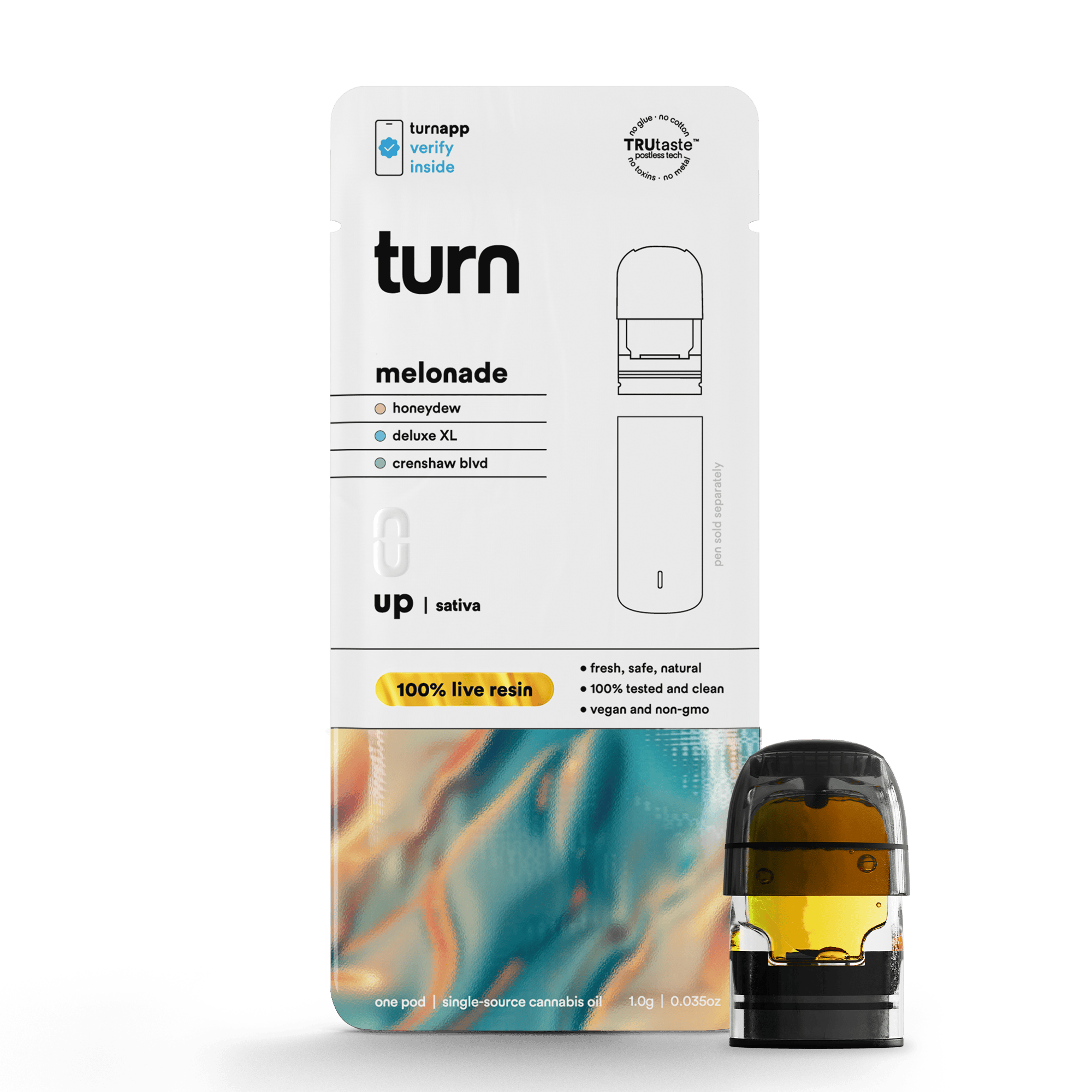
Sativa
All strains Melonade
1 live products in stock
Quick answer · What is the Melonade cannabis strain?
Melonade arrives like the first afternoon of summer — bright, clean, and quietly electric. A sativa-leaning cultivar built on the celebrated Watermelon Zkittlez and Lemon Tree parentage, it delivers a citrus-forward aroma that reads almost edible, paired with a cerebral lift that feels measured rather than overwhelming. For those who approach cannabis the way a sommelier approaches a crisp Provence rosé, Melonade rewards attention.
Shop Melonade · 1 of 1 live products
About Melonade
Everything to know about Melonade.
Lineage & origin
Melonade is the work of Alien Labs, the Northern California collective known for a meticulous, small-batch approach to genetics. The strain crosses Watermelon Zkittlez — itself a phenotype selection from the Zkittlez family that leans into ripe, candy-like melon notes — with Lemon Tree, a widely respected hybrid whose own lineage traces to Lemon Skunk and Sour Diesel. That pairing places Melonade squarely within the modern California sativa tradition: fruit-forward, terpene-rich, and grown with an eye toward expression over sheer output. Alien Labs introduced Melonade as part of their collaborative and in-house catalogue in the mid-to-late 2010s, a period when the California market was beginning to reward complexity and provenance. The strain gained rapid traction among connoisseurs, appearing frequently on dispensary menus in Los Angeles and the Bay Area before spreading nationally as recreational markets opened. Its closest genetic relatives on the Alien Labs menu include Kryptochronic and Area 41, though Melonade is distinct for the way Lemon Tree's sharp citrus expression tempers the sweeter Watermelon Zkittlez base. No widely documented phenotype splits have been formally named by the breeder, though cultivators and consumers note variation between cuts — some leaning more toward the melon-candy register of Watermelon Zkittlez, others sharpening toward Lemon Tree's astringent citrus. The lineage is well-documented and not contested.
Effects
Melonade's onset is characteristically sativa in its pacing — a gentle cerebral brightening that typically becomes noticeable within five to ten minutes when smoked or vaped, settling into clarity and gentle focus rather than an abrupt rush. The initial phase carries a mood-lifting quality that feels social and open, without the anxious edge that can accompany more diesel-forward sativas. This is in part attributable to the terpene profile: limonene, the dominant terpene, is associated in current research with uplifted mood states, while the secondary presence of caryophyllene may add a subtle grounding character that softens the leading edge. At peak, the experience occupies a productive middle ground — alert enough to support conversation, creative work, or light physical activity, but not so stimulating as to feel restless. Many consumers describe a mild sense of physical ease accompanying the cerebral lift, which likely reflects the myrcene component carried over from the Watermelon Zkittlez side of the lineage. Duration for most is in the range of two to three hours, with a gentle, gradual comedown rather than an abrupt drop. As with any sativa-leaning cultivar, those with sensitivity to THC-driven stimulation should approach Melonade with the standard 'start low, go slow' discipline. The profile is generally considered approachable, but set and setting remain relevant variables for any consumer.
Aroma, flavor & terpenes
The aromatic profile of Melonade is one of its most immediately distinctive qualities. Limonene dominates the nose — bright, clean lemon zest with a hint of the sweeter citrus register you find in Meyer lemon rather than commercial lemon cleaner. Beneath that, terpinolene contributes a fresh, almost floral-herbal lift that keeps the aroma from reading as one-dimensional, while myrcene adds a soft, ripe-fruit roundness that calls back to the Watermelon Zkittlez parentage without veering into candy-sweet territory. Caryophyllene makes its presence known on closer inspection — a faint peppery undercurrent that adds structural complexity and prevents the profile from becoming too purely sweet. Some batches show a whisper of ocimene, which in high-terpene expressions can lend a light tropical or anise-adjacent note. Together, the terpene matrix reads as a composed, layered fragrance rather than a single loud headline note. On the palate, Melonade translates cleanly from nose to taste. Smoked in a clean pipe or glass piece, the inhale is smooth and citrus-forward, with the melon sweetness arriving mid-palate before the exhale finishes on a mild, herbal brightness. Vaped at moderate temperatures — roughly in the 170–185°C range — the profile becomes more nuanced, with the terpinolene's floral character more legible and the limonene sharpening pleasantly. The finish is clean and does not linger with harshness, a quality that distinguishes well-grown Melonade from lesser executions.
Appearance
Well-cultivated Melonade presents buds that are medium to medium-large in size, with a structure that leans toward dense without becoming rock-hard — the kind of formation that speaks to thorough canopy management and an unhurried cure. The colour palette is a study in contrasts: a bright, almost lime-tinged green on the outer leaves, deepening toward a slightly more saturated jade at the calyxes, occasionally accented by narrow veins of pale lavender in cooler-grown phenotypes. Pistils run in a warm amber-to-rust spectrum, winding visibly through the bud structure and contributing to the visual warmth of the finished flower. Trichome coverage is generous and even, giving cured Melonade a frosted, almost matte finish under ambient light that catches and scatters cleanly under direct illumination. The overall impression is of a flower that has been grown with care — resinous without being sticky to the point of structural collapse, and trimmed closely enough to let the bud architecture speak for itself.
Growing notes
Melonade is considered an intermediate-level cultivar — not prohibitively demanding, but rewarding to growers who invest attention in environmental consistency. As an Alien Labs genetics release, it has historically been available primarily through licensed channels and select clone distribution, meaning home cultivators may encounter limited access to verified cuts. That said, the strain's characteristics in cultivation are reasonably well-documented among enthusiasts. Indoors, Melonade performs well in controlled environments with stable humidity and good airflow, as the dense bud structure creates some susceptibility to moisture-related issues if conditions are not managed. Flowering time is typically in the range of eight to nine weeks. Indoor yields are moderate to good, commensurate with the genetic emphasis on quality over sheer volume. Outdoors, the strain suits a warm, dry climate analogous to the Northern California Mediterranean conditions in which it was developed; harvest in the Northern Hemisphere typically falls in late September to mid-October. The plant exhibits moderate stretch during early flowering, making height management a relevant consideration for indoor operators working with limited vertical space.
When it's best enjoyed
Melonade is a strain calibrated for the daylight hours — specifically, the unhurried stretch of a late morning or early afternoon when the agenda is open-ended rather than fixed. It sits naturally beside creative work: writing, sketching, the kind of focused-but-wandering thinking that benefits from a gentle lift without cognitive noise. Solo sessions with a well-curated playlist reward the strain's capacity for sensory heightening; the citrus-bright terpene profile pairs particularly well with music that shares its register — something clean and rhythmically alive, whether that's a Nils Frahm record or a well-mastered jazz piano set. On the table, Melonade finds its complement in food that echoes its terpene palette: a board of sliced stone fruit and aged chèvre, a glass of sparkling water with yuzu, or a lightly dressed ceviche where lime and fresh herb are the primary notes. It functions equally well as a social cultivar for a small gathering of people who appreciate the strain and want to stay present in conversation rather than retreating inward. It is less well-suited to late evening use for those who find limonene-forward sativas interfere with the quieting of the mind that sleep requires.
If you like Melonade, also explore
Lemon Tree
As a direct parent of Melonade, Lemon Tree shares the sharp citrus terpene backbone and sativa-leaning cerebral clarity, making it the most logical next exploration for anyone drawn to Melonade's limonene-forward character.
Watermelon Zkittlez
The other parent of Melonade, Watermelon Zkittlez delivers the ripe, candy-melon sweetness that rounds out Melonade's profile — ideal for those who want to isolate and explore that fruity, rounded register further.
Zkittlez
Sharing deep genetic roots with the Watermelon Zkittlez side of Melonade's lineage, Zkittlez offers a comparable fruit-candy aromatic experience in a slightly more indica-leaning, relaxed package.
Lemon Skunk
A foundational ancestor of the Lemon Tree lineage, Lemon Skunk provides a comparable citrus-dominant, mood-brightening experience with a classic structure that Melonade fans tend to appreciate for its directness.
Mimosa
Sharing a bright, citrus-and-fruit terpene orientation and a similarly social, daytime sativa character, Mimosa appeals to the same palate as Melonade while offering a slightly different genetic angle via its Clementine and Purple Punch heritage.
Common questions
Is Melonade indica or sativa?+
Melonade is classified as a sativa-leaning hybrid by its breeder, Alien Labs. Its parentage — Watermelon Zkittlez crossed with Lemon Tree — skews toward uplifting, cerebral effects rather than heavy physical sedation. While all modern cannabis exists on a spectrum and individual experience varies, Melonade is broadly consistent with what consumers associate with sativa character: alertness, mood lift, and a relatively clear-headed quality.
What does Melonade taste like?+
Melonade tastes primarily of bright citrus — specifically lemon zest with a Meyer-lemon sweetness — layered over a ripe melon-fruit mid-palate that arrives from the Watermelon Zkittlez side of its lineage. A mild herbal, slightly peppery finish from caryophyllene rounds the experience. Vaped at moderate temperatures, the profile becomes more nuanced, with floral and faintly tropical notes from terpinolene becoming more perceptible.
What are the typical effects of Melonade?+
Melonade typically produces a bright, mood-lifting cerebral onset that becomes noticeable within five to ten minutes when smoked or vaped. The peak is characterized by focus and social openness, accompanied by mild physical ease. The experience is generally considered stimulating but not anxious, and the comedown is gradual. Duration for most consumers falls in the two-to-three-hour range. As always, starting with a modest amount is advisable.
What strains are similar to Melonade?+
Consumers who enjoy Melonade most often find common ground with its parent strains, Lemon Tree and Watermelon Zkittlez, as well as with Zkittlez, Lemon Skunk, and Mimosa. Each shares some portion of Melonade's fruit-forward terpene character or its sativa-leaning, daytime-appropriate effect profile, though all carry their own distinct nuances worth exploring independently.
Is Melonade good for beginners?+
Melonade is generally considered one of the more approachable sativa-leaning cultivars, owing to a terpene profile that is bright rather than aggressive and an effect character that tends toward clarity rather than intensity. That said, beginners to cannabis or those with sensitivity to THC-driven stimulation should follow standard 'start low, go slow' practice — beginning with a small amount, waiting to assess the full onset, and adjusting from there.
What are the dominant terpenes in Melonade?+
Melonade's terpene profile is led by limonene, which accounts for its signature citrus-zest aroma and is associated with mood uplift. Terpinolene contributes a fresh, floral-herbal dimension, while myrcene adds a soft, ripe-fruit roundness inherited from the Watermelon Zkittlez lineage. Caryophyllene is present as a secondary terpene, lending a subtle peppery structure and, according to current research, possible mild grounding qualities.
Who bred Melonade and where does it come from?+
Melonade was bred by Alien Labs, a respected Northern California cannabis collective known for small-batch, quality-focused cultivation and genetics. The strain emerged in the mid-to-late 2010s as part of their growing catalogue of fruit-forward, terpene-expressive cultivars. Alien Labs has been influential in shaping the modern California connoisseur market, and Melonade is among their more widely recognized releases outside the state.
When is the best time of day to enjoy Melonade?+
Given its sativa-leaning, limonene-forward character, Melonade is best suited to daytime or early-evening use — late morning through mid-afternoon being a particularly natural fit. Its cerebral brightness and capacity for focus make it well-suited to creative work, social interaction, or outdoor activity. Those with sensitivity to stimulating cultivars may find it counterproductive in the hours before sleep and should plan accordingly.
Related strains