On sale· 20% OFF
THC 29.8%Indica-Hybrid
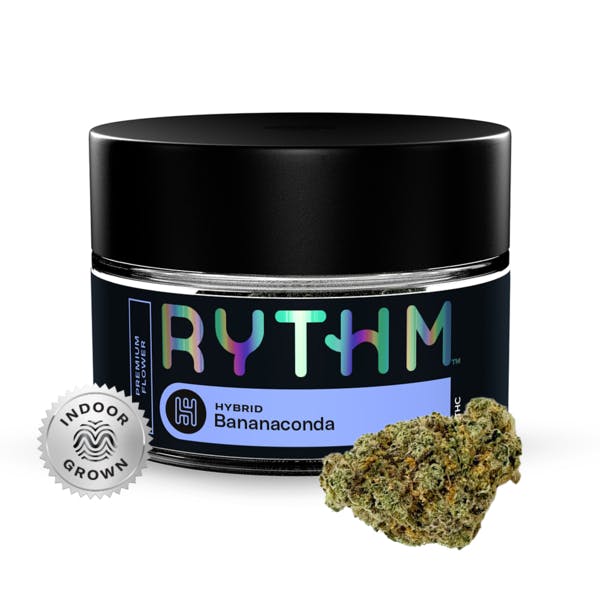
RYTHMBananaconda | Premium Flower | Hybrid | 3.5g · 3.5g
$40.35$50.44
$47after tax
weeddispensarynearme.com
You must be 21 years or older to enter. By entering, you confirm you’re of legal age in your state to purchase cannabis.
For use only by adults 21+ • Keep out of reach of children
4 live products in stock
Quick answer · What is the Bananaconda cannabis strain?
Bananaconda arrives with the quiet confidence of a strain that needs no introduction — rich, tropical aromatics layered over an earthy, creamy foundation, and an indica-leaning character that eases the body into repose without fully dimming the mind. A relative newcomer to the premium shelf, it rewards the unhurried consumer who appreciates nuance in both nose and effect, making it a compelling choice when the evening calls for something genuinely different.
$47after tax
$40after tax
$180after tax
$115after tax
About Bananaconda
Bananaconda is a cross of Banana OG and Anaconda, two strains with distinct but complementary identities. Banana OG itself descends from OG Kush and Banana, the latter sometimes listed as a Banana Kush phenotype, lending the lineage its signature fruit-forward aromatics alongside the structural potency that OG genetics reliably deliver. Anaconda, the lesser-publicized half of the pairing, is a heavy indica-dominant variety; its full parentage has not been formally disclosed by its breeder in widely available public records, and some sources treat it as a proprietary line developed within the Pacific Northwest breeding community. The cross is most commonly attributed to small-batch cultivators working in Washington and Oregon in the early-to-mid 2010s, a period that saw significant experimentation with OG-adjacent genetics carrying exotic terpene profiles. Bananaconda emerged from that wave as one of the more cohesive expressions — the Banana OG influence anchors the fruit character while Anaconda contributes density, resin production, and a grounding body quality that prevents the profile from becoming overly light or one-dimensional. No widely recognized named phenotypes have been formally catalogued in public databases as of this writing, though individual cultivators have reported variation in fruit intensity across different grows. The strain has maintained a loyal following on the West Coast and has gradually found its way onto curated menus on the East Coast as appreciation for terpene-forward, indica-leaning hybrids has grown among discerning consumers.
The onset of Bananaconda tends to arrive within five to fifteen minutes of inhalation — measured and deliberate rather than sudden. The initial wave is primarily cerebral: a gentle lift in mood, a quiet softening of mental noise, and a mild sharpening of sensory awareness that makes the first few minutes feel unhurried and pleasant. This early phase is notably sociable without being energizing, making conversation feel easy and unpressured. As the session progresses into its peak — typically settling between twenty and fifty minutes after first consumption — the indica foundation becomes more pronounced. The body takes on a familiar warmth, tension releasing gradually from the shoulders and through the limbs. This is not the kind of sedation that demands a horizontal surface immediately; rather, it is a comfortable, weighted ease that encourages stillness without entirely foreclosing on light activity. The cannabinoid profile, which skews toward higher total THC in most cultivated expressions, is complemented by the myrcene-heavy terpene character, which is well-documented in cannabis literature as a contributor to the physical, relaxing dimension of the experience. The comedown is characteristically soft. The cerebral clarity recedes first, leaving a pleasant, uncomplicated sense of calm. Duration for most consumers falls in the two-to-three-hour range, though individual response varies considerably. Those newer to cannabis or to potent indica-leaning hybrids are well advised to begin with a conservative amount and allow ample time before reassessing.
The aromatic profile of Bananaconda is one of its most immediately compelling qualities. Myrcene leads — as is common among OG-descended genetics — delivering a ripe, almost overripe tropical fruit quality reminiscent of banana at peak ripeness, with a subtle earthiness underneath that keeps the nose from reading as purely confectionery. This earthiness is the myrcene's secondary face, a musky, herbal depth that gives the aroma genuine complexity. Caryophyllene registers in the mid-register, adding a faint spiced warmth — think white pepper or clove — that prevents the fruit notes from becoming cloying. On the palate, this spice element becomes more distinct on the exhale, giving the vapor or smoke a mild bite that balances the sweetness. Limonene appears in a supporting role, brightening the overall profile with a citrus uplift that is perceptible more as a sharpening of the fruit notes than as a standalone lemon or orange character. Pinene, though typically present in smaller quantities in OG-lineage strains, may contribute a fleeting herbal freshness to the opening of the nose. On the palate, Bananaconda is notably smooth. The smoke is creamy and full-bodied, the banana-and-earth combination translating with reasonable fidelity from nose to taste. Vaporization at moderate temperatures tends to preserve the fruit character most faithfully, allowing the sweeter terpene fractions to express before the spicier, heavier compounds dominate. The finish lingers gently, leaving a warm, slightly sweet aftertaste.
Bananaconda produces buds that reflect its indica-heavy heritage in structure — compact, densely packed calyxes that hold their shape well and feel substantial in the hand without being brick-hard. The overall form tends toward short, chunky clusters rather than elongated sativa-style spires. The colour palette is a deep, saturated forest green with pronounced olive undertones, occasionally punctuated by hints of purple — particularly in phenotypes grown in cooler finishing temperatures. Pistils are a warm amber-orange, distributed generously across the surface and adding visual contrast to the darker foliage. Trichome coverage is notably generous, a fine, even frost of milky-white glandular heads that gives properly cured flower a near-luminous quality under direct light. The visual density of resin production speaks to the OG Kush ancestry on the Banana OG side and signals the aromatic richness before the jar is even opened.
Bananaconda is generally considered a moderately challenging cultivar — accessible enough for experienced home growers but not ideally suited to true beginners who are still developing foundational skills. Its indica-dominant structure means it stays relatively compact, which can be an advantage in limited indoor spaces, though canopy management and airflow remain important given the density of the buds and the associated risk of moisture retention. Indoors, flowering typically completes in approximately eight to nine weeks, with yields that growers report as moderate to above-average when the plant is given adequate nutrition and light intensity. Outdoor cultivation is viable in temperate climates with warm, dry finishing conditions — the Pacific Northwest origin of the genetics suggests a preference for mild summers and low humidity in the final weeks before harvest. Colder nighttime temperatures during the final stretch of flowering can encourage the purpling that some phenotypes are capable of expressing. Resin production is generous throughout the flowering period, and growers with an interest in solventless extraction often regard this variety favorably for that reason.
Bananaconda occupies a comfortable position in the evening-to-night spectrum — it is well-suited to the hours after the day's obligations have concluded but before sleep becomes the primary objective. Solo consumption pairs naturally with activities that benefit from a quieted mind and a relaxed body: reading something unhurried, working through a long-form documentary, or simply sitting with music at a volume that rewards genuine attention. On the food pairing front, the strain's tropical, creamy terpene profile finds an easy accord with flavors that share its register — a ripe mango sorbet, a plate of sliced stone fruit, or a warm, spiced dessert such as banana foster or a cardamom-laced custard. For music, the combination of mood lift and physical ease suggests something melodic and textured: late-period jazz, warm electronic ambient, or the slower end of soul and R&B. In a social setting, Bananaconda works well for small gatherings where the energy is relaxed and the conversation is unhurried — an after-dinner circle rather than a pre-party warm-up.
Banana OG
As a direct parent of Bananaconda, Banana OG shares the ripe tropical fruit profile and OG-rooted body effect, making it the most natural adjacent choice for fans of Bananaconda's aromatic identity.
Banana Kush
Banana Kush delivers a comparable sweet, fruit-forward nose and indica-dominant body effect, offering familiar terpene territory for consumers drawn to Bananaconda's tropical character.
Granddaddy Purple
Those who appreciate Bananaconda's physical ease and evening-appropriate sedation will find Granddaddy Purple's deep body relaxation and similarly sweet aromatic profile an appealing alternative.
OG Kush
Sharing ancestral genetics with Bananaconda through the Banana OG lineage, OG Kush offers the same earthy, complex foundation with a slightly more pronounced piney and fuel-adjacent character for those who prefer less fruit emphasis.
Tropicana Cookies
Consumers who enjoy the bright, fruit-forward lift of Bananaconda's opening phase but want a slightly more cerebral, less sedating experience may find Tropicana Cookies a well-matched complement.
Bananaconda is an indica-leaning hybrid. Its parentage — Banana OG crossed with Anaconda — pulls heavily toward the indica end of the spectrum, expressing the compact bud structure, physical ease, and warm body effect characteristic of indica-dominant genetics, while retaining enough hybrid balance to offer a notable mood lift in the early stages of the experience.
Bananaconda tastes primarily of ripe tropical fruit — specifically banana — layered over a creamy, earthy base. On the exhale, a mild spiced warmth from caryophyllene becomes noticeable, adding depth and preventing the profile from reading as purely sweet. The smoke is smooth and full-bodied, and the banana-forward character translates from aroma to palate with notable consistency, especially when vaporized at moderate temperatures.
The experience typically opens with a gentle mood lift and a quiet softening of mental tension before the indica body effect gradually takes hold. Peak effects include a warm physical ease and a comfortable sense of calm that encourages stillness without full sedation. The overall arc is measured and relatively long-lasting, generally running two to three hours. Consumers new to indica-leaning hybrids should approach with care and begin conservatively.
Consumers who enjoy Bananaconda often find common ground with Banana OG, its direct parent, as well as Banana Kush and Granddaddy Purple for comparable body effect and sweet aromatics. OG Kush satisfies those drawn to the earthier, structural side of the profile, while Tropicana Cookies offers a fruitier but more cerebrally oriented alternative for moments when lighter effects are preferred.
Bananaconda is a potent indica-leaning hybrid and warrants some caution for those new to cannabis or to high-THC varieties. The effects build gradually, which can lead less experienced consumers to underestimate the eventual intensity. A start-low, go-slow approach is strongly advisable — beginning with a small amount and waiting a full thirty minutes before considering more is a sensible and widely recommended practice.
Myrcene is the dominant terpene, responsible for the ripe, earthy tropical fruit quality that defines the strain's nose and contributes to its physical, relaxing character. Caryophyllene follows, adding a spiced warmth on the exhale. Limonene appears in a supporting role, brightening the fruit profile with a citrus lift. Pinene may be present in smaller amounts, offering a faint herbal freshness to the opening aroma.
Given its indica-leaning character and the gradual body relaxation it delivers, Bananaconda is best suited to late afternoon or evening consumption — after the day's responsibilities have concluded. It occupies the space between alert functionality and full sedation, making it well-suited to quiet, unhurried evenings, whether solo or in a small, relaxed social setting, rather than as a daytime or productivity-oriented choice.
Bananaconda is most commonly attributed to cultivators working in the Pacific Northwest — Washington and Oregon — where experimentation with OG-adjacent, terpene-forward genetics was particularly active in the early-to-mid 2010s. The strain crosses Banana OG with Anaconda. While the Banana OG parentage is well-documented, the full breeder origin of the Anaconda parent has not been formally disclosed in widely available public sources.
Related strains
Pick your store
We'll show pricing, deals, and delivery zones for the store you pick. You can switch any time from the header.