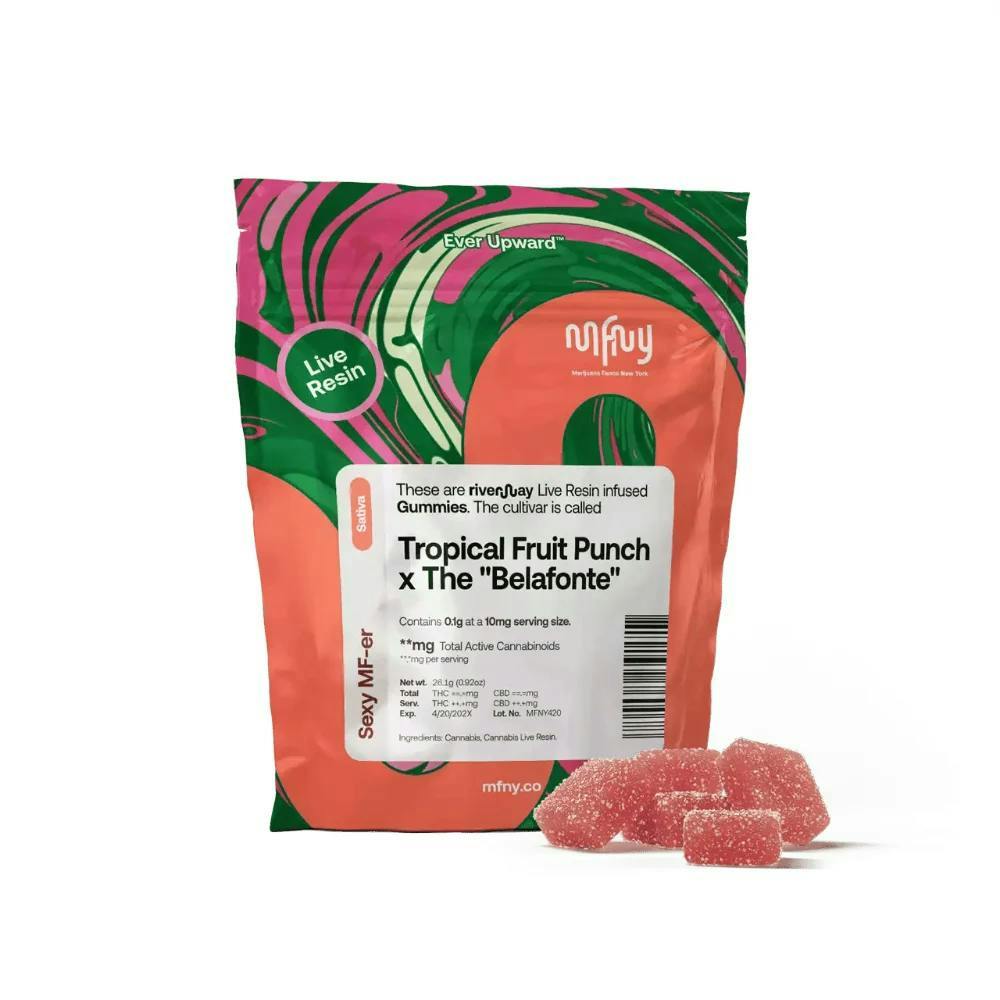
On sale· 15% OFF
THC 100mgSativa
MFNYMFNY | Tropical Fruit Punch x The Belafonte | Live Resin Gummies | 10pk · .1g
$18.80$22.12
$22after tax

weeddispensarynearme.com
You must be 21 years or older to enter. By entering, you confirm you’re of legal age in your state to purchase cannabis.
For use only by adults 21+ • Keep out of reach of children
2 live products in stock
Quick answer · What is the Tropical Fruit cannabis strain?
Tropical Fruit arrives like a warm coastal breeze carried inland — bright, sun-ripened, and quietly enlivening. This sativa-leaning cultivar earns its name through an aromatic profile that layers ripe mango and guava over a citrus-forward backbone, while its effects tend toward mental clarity and a gentle lift in mood. For the discerning New York shopper seeking a daytime companion that feels as refined as it is approachable, Tropical Fruit offers a well-rounded introduction to the more luminous end of the cannabis spectrum.
$22after tax
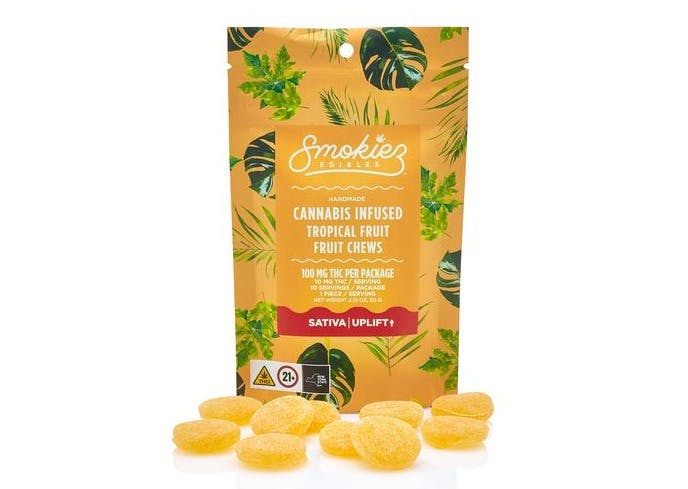
About Tropical Fruit
Tropical Fruit is a sativa-dominant cultivar whose precise lineage remains partially contested across public cannabis databases, a situation not uncommon among strains popularized through regional seed markets before rigorous documentation became standard. The strain is most frequently associated with crosses involving landrace or near-landrace genetics from equatorial growing regions — genetics historically linked to the fruit-forward terpene profiles that define the 'tropical' category of sativa cultivars. Some pheno hunters and seed bank listings point to parentage involving Skunk-derivative genetics crossed with Southeast Asian or Caribbean landrace material, a pairing that would account for its characteristic sweetness alongside a more grounded, resinous base note. The breeder of origin has not been publicly named in widely cited sources, placing Tropical Fruit in a category of strains whose popularity preceded the current era of transparent breeding records. What is well-documented is that the strain gained traction within cultivation communities on both coasts of the United States during the mid-2010s, prized primarily for its terpene expression rather than any singular cannabinoid profile. Phenotypic variation is reported by cultivators, with some expressions leaning more toward citrus and others emphasizing ripe stone-fruit notes. This variability suggests the strain may exist as a loosely defined cultivar family rather than a single stabilized line, a detail worth noting for consumers who encounter it across different producers.
Tropical Fruit tends to announce itself with a relatively prompt onset — often within five to ten minutes when smoked or vaped — beginning as a gentle clarifying sensation behind the eyes and across the forehead. This initial cerebral quality is characteristic of sativa-dominant cultivars with significant limonene and terpinolene content, terpenes associated in the literature with uplifting, alerting effects. The experience rarely feels jarring; instead, the transition from baseline is smooth, almost conversational in its arrival. At its peak, the experience is predominantly cerebral: thoughts move with a quality of easy association, sensory details — light, sound, texture — register with slightly heightened acuity, and social inhibition tends to soften without disappearing entirely. There is typically a mild physical warmth present as a background note, likely attributable to myrcene, which grounds the experience and prevents the edge of restlessness that some purely cerebral sativas can produce. This balance is one of Tropical Fruit's more appreciated characteristics among experienced consumers. Duration runs moderate for a sativa — roughly ninety minutes to two and a half hours at typical consumption levels, with a comedown that is generally described as a gradual, unhurried return to baseline rather than an abrupt drop. Novice consumers are encouraged to follow a start-low, go-slow approach, as the initial clarity can escalate with higher doses toward a more pronounced mental intensity that some may find overstimulating.
The aromatic signature of Tropical Fruit is led by terpinolene, a monoterpene that contributes the fresh, almost floral-citrus top note most consumers encounter first when the flower is broken apart. Terpinolene is the defining terpene in many fruit-forward sativas and is responsible for the strain's distinctly bright, candy-like opening — reminiscent of fresh guava skin and underripe papaya rather than the heavier sweetness of dried fruit. Beneath that primary note, limonene contributes a clean citrus layer — closer to lime zest or yuzu than to conventional orange — that adds lift and brightness to the overall bouquet. Myrcene, present at moderate levels, introduces an earthier, slightly herbal undertone that prevents the profile from reading as one-dimensional. Ocimene, another terpene frequently found in tropical-category cultivars, adds a subtle sweet-herbaceous quality that some tasters describe as reminiscent of fresh basil or tarragon alongside ripe fruit. Trace amounts of caryophyllene may contribute a faint spice on the back end, particularly noticeable on the exhale. On the palate, Tropical Fruit smokes with a notable smoothness when properly cured, the fruit-forward notes translating faithfully from nose to taste. The inhale carries the citrus-guava character cleanly, while the exhale reveals the earthier myrcene and light spice of caryophyllene. Vapor production tends to accentuate the floral and citrus elements, making vaporization a preferred method for consumers who wish to explore the more nuanced dimensions of the terpene profile.
Tropical Fruit typically presents in moderately dense, elongated buds consistent with its sativa-dominant structure — less compact than an indica-leaning cultivar, with a slightly airy internal architecture that allows for good airflow during cultivation. The calyxes tend to be pointed and loosely stacked, giving well-grown specimens an almost architectural quality when viewed up close. The color palette skews toward medium to bright green, often with yellow-green undertones that reinforce the 'tropical' visual impression. Pistils are characteristically vivid — burnt orange to amber in hue — and present in good density across the surface of mature buds. Trichome coverage is moderate to generous depending on the phenotype and cultivation conditions, with the resin glands appearing milky to lightly amber at peak maturity. Under direct light, a well-cured batch carries a subtle luminosity, the trichomes catching and diffusing light in a way that signals attentive post-harvest handling.
Tropical Fruit performs well in both indoor and outdoor settings, though its sativa lineage — likely including equatorial landrace genetics — means it favors warmth and benefits from a longer vegetative period than many hybrid cultivars. Outdoor grows in climates that approximate Mediterranean or subtropical conditions tend to yield the most expressive terpene profiles, allowing the plant adequate sun exposure to fully develop its characteristic aromatic compounds. Indoors, flowering typically runs between nine and eleven weeks, reflecting the strain's sativa heritage. Yields are reported as moderate to above average under optimized conditions, with indoor harvests responding well to training techniques such as low-stress training or screen of green methods that help manage the plant's natural inclination toward vertical stretch. The strain is considered intermediate in difficulty — manageable for a cultivator with a season or two of experience, but perhaps less forgiving of environmental inconsistencies than many stabilized hybrid lines. Humidity control during the late flowering period is particularly relevant given the slightly open bud structure, which can create vulnerability to moisture-related issues if airflow is insufficient.
Tropical Fruit is, at its core, a daytime cultivar — its clarity and sociability make it a natural fit for morning or early afternoon consumption, particularly on days when creative engagement or social interaction is on the agenda. A solo writing session, a walk through a neighborhood market with its layering of sensory detail, or a leisurely brunch conversation all align well with the strain's characteristic lift and gentle perceptual brightening. The terpene profile suggests natural pairings with food and beverage that complement rather than compete with its fruit-forward character. A plate of fresh tropical fruit — sliced mango, pineapple, or papaya — echoes the strain's terpinolene-driven sweetness in a satisfying way. On the music side, something rhythmically buoyant but not frenetic fits the experience well: Brazilian jazz, early-period Vampire Weekend, or a carefully curated Afrobeats playlist each provides an appropriate backdrop. Afternoon gallery visits, outdoor farmers markets, or casual creative collaboration with a friend or colleague round out the range of contexts where Tropical Fruit tends to show its best character. It is not, generally speaking, a late-evening cultivar — the cerebral quality that makes it appealing by day can occasionally interfere with the mental quietude that precedes restful sleep.
Pineapple Express
Fans of Tropical Fruit's bright citrus-tropical aromatic profile and mood-lifting sativa effects will find Pineapple Express covers similar terpene territory with a comparably smooth, approachable onset.
Maui Wowie
As a classic Hawaiian landrace-descended sativa with a fruit-forward sweetness and clean cerebral uplift, Maui Wowie shares both the aromatic family and the daylight-clarity character that defines Tropical Fruit.
Mimosa
Mimosa's citrus-heavy terpene profile and energizing, socially oriented effects make it a natural next step for consumers who appreciate the limonene-bright, uplifting dimension of Tropical Fruit.
Strawberry Cough
Strawberry Cough's terpinolene-forward sweetness and gentle cerebral clarity sit in the same sativa register as Tropical Fruit, appealing to consumers who value fruit-driven aroma alongside mental lift.
Tangie
Tangie's pronounced citrus-terpinolene profile and sativa-dominant character share significant common ground with Tropical Fruit, particularly for consumers drawn to the brighter, more aromatic end of the sativa spectrum.
Tropical Fruit is classified as a sativa-dominant cultivar. Its effects lean toward mental clarity, mood lift, and social ease rather than the body-heavy relaxation associated with indica-dominant strains. The growth structure — longer internodal spacing, elongated buds — also reflects its sativa heritage. Some phenotypes may carry a mild indica-influenced body warmth as a secondary characteristic, but the overall experience is predominantly cerebral and uplifting in nature.
Tropical Fruit tastes broadly as its name suggests: the inhale delivers a fresh citrus-guava sweetness with a floral edge, driven largely by terpinolene and limonene. The exhale introduces a softer, earthier undercurrent — myrcene and trace caryophyllene — that balances the sweetness without overwhelming it. Properly cured flower has a notably smooth palate character. Vaporization tends to accentuate the lighter citrus and floral notes, while combustion brings the earthier base tones into slightly greater relief.
Consumers most commonly describe a prompt onset of mental clarity and gentle mood elevation, followed by a peak that is social, creatively curious, and lightly energizing. A background body warmth keeps the experience grounded. Duration is moderate — typically ninety minutes to two and a half hours. The comedown is generally gradual and unhurried. Those new to sativa-dominant cultivars should begin conservatively, as higher doses can amplify the cerebral quality toward an intensity some may find overstimulating.
Consumers who appreciate Tropical Fruit's fruit-forward aroma and daylight clarity tend to also enjoy Pineapple Express, Maui Wowie, Mimosa, Strawberry Cough, and Tangie. Each shares elements of the terpinolene-limonene aromatic family and the sativa-dominant effect profile that defines Tropical Fruit, though each carries its own distinct character — from Tangie's more pronounced citrus to Maui Wowie's cleaner, more minimalist landrace expression.
Tropical Fruit is reasonably approachable for adults new to cannabis, provided a start-low, go-slow approach is observed. Its onset is relatively smooth and its fruit-forward flavor profile is easy to appreciate without prior experience. However, as a sativa-dominant cultivar, it can produce a pronounced cerebral intensity at higher doses that some beginners find unexpected. Starting with a single, modest inhalation and allowing adequate time to assess the effect before consuming more is always advisable.
Tropical Fruit is typically led by terpinolene, which provides the bright, floral-citrus top note most consumers recognize immediately. Limonene contributes a clean citrus layer — lime or yuzu-adjacent — beneath that primary impression. Myrcene is present at moderate levels, adding an earthy, herbal grounding note. Ocimene contributes subtle sweet-herbaceous complexity, and trace caryophyllene may account for a light spice character on the exhale. Together these terpenes define the strain's characteristic tropical-fruit aromatic identity.
Tropical Fruit is best suited to morning or early-to-mid afternoon consumption. Its sativa-dominant effects — mental clarity, mood lift, gentle perceptual brightening — align naturally with daytime activities: creative work, social outings, or sensory-forward experiences like gallery visits or farmers markets. Evening or nighttime use is generally less recommended, as the cerebral lift that makes the strain appealing by day can occasionally work against the mental quietude that supports restful sleep.
Terpinolene and limonene, the two dominant terpenes, are both associated in the cannabis literature with uplifting, alerting qualities — a correlation supported by studies on their interaction with serotonergic and dopaminergic pathways, though research is ongoing. Myrcene tempers this with a mild sedative-adjacent body effect that prevents overstimulation. Ocimene and trace caryophyllene contribute mood and anti-inflammatory nuance respectively. The overall terpene ensemble helps explain Tropical Fruit's reputation as an energizing yet manageable daytime cultivar.
Related strains
Pick your store
We'll show pricing, deals, and delivery zones for the store you pick. You can switch any time from the header.