THC 28.77%Sativa
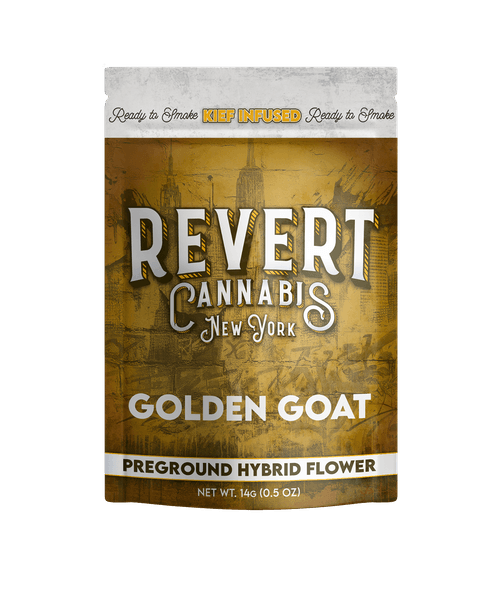
Revert CannabisRevert Kief Infused Pre-Ground Flower Golden Goat - Hybrid · 14g
$70.00
$79after tax

weeddispensarynearme.com
You must be 21 years or older to enter. By entering, you confirm you’re of legal age in your state to purchase cannabis.
For use only by adults 21+ • Keep out of reach of children
1 live products in stock
Quick answer · What is the Golden Goat cannabis strain?
Golden Goat arrived from the American heartland with a complexity that belies its accidental origins — a vivid, citrus-forward sativa that has earned a devoted following across the country. Bright in aroma, energizing in character, and dressed in a striking palette of gold and green, it occupies a rare space: approachable enough for an afternoon in the city, yet layered enough to reward the seasoned connoisseur who slows down to pay attention.
$79after tax
About Golden Goat
Golden Goat is the product of a happy accident in Topeka, Kansas, where a male Hawaiian-Romulan plant accidentally pollinated a female Island Sweet Skunk. The cross is credited to a cultivator known by the handle Mr. Spaceman, and while the exact year of the original pollination is not formally documented, the strain gained regional traction in Colorado dispensaries sometime around 2008 to 2010, coinciding with that state's early medical cannabis expansion. The three-way genetic foundation — Hawaiian, Romulan, and Island Sweet Skunk — is what gives Golden Goat its breadth. Hawaiian genetics contribute the lifted, cerebral brightness and tropical aromatic notes; Romulan, a potent indica-leaning strain whose own lineage is debated but generally traced to North American indica stock, grounds the experience with a subtle physical undertone; Island Sweet Skunk layers in the sharp, sour citrus and grapefruit facets that define the strain's nose. No large commercial breeder has officially stabilized Golden Goat into feminized seed stock under its original name, so plants on the market often vary in expression, with some phenotypes leaning more tropical and others pushing toward a sharper, skunkier profile. Despite its informal origins, Golden Goat became one of the defining sativas of the Colorado market's early era and influenced a generation of dispensary shelves across the country.
Golden Goat typically announces itself within five to ten minutes of inhalation, an onset window consistent with its sativa-dominant character. The initial wave is cerebral and uplifting — a sharpening of focus accompanied by a gentle elevation in mood that feels social and curious rather than racey or anxious. This is largely attributed to the strain's terpene-cannabinoid interaction, where limonene and terpinolene work alongside a moderately high THC expression to produce that characteristic bright-headedness without the edge that some pure sativas can carry. The peak phase, which tends to settle in around twenty to thirty minutes in, is where the Romulan lineage becomes perceptible: a mild warmth that spreads through the shoulders and upper body, softening the intensity of the head effect without sedating it. The experience reads as a well-balanced sativa — energizing but not jittery, physical but not couch-bound. Duration is typically two to three hours for experienced consumers, with a gradual, relaxed comedown that rarely feels abrupt. Newer consumers should approach Golden Goat with the standard start-low, go-slow principle, as the cerebral onset can feel pronounced. The overall arc suits activity and engagement rather than passivity — this is a strain that tends to move with you rather than settle you in place.
The aromatic profile of Golden Goat is one of its most celebrated qualities, and it draws directly from the convergence of its three parent lines. The dominant terpenes most consistently identified in well-grown Golden Goat are terpinolene, myrcene, and caryophyllene, with limonene and ocimene appearing as significant secondary contributors depending on phenotype and cultivation conditions. Terpinolene, the standout, delivers the strain's signature sweet, slightly floral, and faintly piney character — an aroma that reads as tropical fruit with a herbaceous edge, often described as guava, mango, or a ripe yellow citrus. Myrcene adds depth and a subtle earthiness beneath the fruit, grounding the bouquet without dulling its brightness. Limonene reinforces the citrus dimension with a sharper, more distinctly grapefruit-forward quality that becomes especially apparent when the bud is broken. Caryophyllene introduces a mild spice note on the back end, giving the exhale a faint warmth. Ocimene, when present, contributes an almost sweet, slightly herbal top note that rounds the overall impression. On the palate, Golden Goat smokes with considerable smoothness for a sativa, delivering a tropical and slightly sweet inhale that gives way to a subtle, skunky exhale. In vapor, the terpene clarity is heightened — the grapefruit and guava notes become more distinct, and the spiced finish lingers pleasantly.
Golden Goat is visually distinctive in a way that makes it recognizable on a well-stocked shelf. The buds are typically medium to large in size, with a structure that sits between dense and moderately airy — a hallmark of its sativa-leaning heritage that allows light to pass through the calyxes while still forming cohesive, well-developed nuggets. The color palette is one of the strain's most talked-about qualities: a warm interplay of pale green, soft gold, and occasionally pink-tinged hues that emerge during the final weeks of flowering, particularly when plants experience cooler night temperatures. Pistils tend toward a vivid amber or burnt orange, contributing to the golden visual impression that gave the strain its name. Trichome coverage is generous and appears as a frost of fine, milky-to-amber glands that coat both the calyxes and the surrounding sugar leaves, lending the surface a luminous, slightly resinous sheen under direct light.
Golden Goat presents moderate difficulty for home cultivators, primarily because consistent seed stock is not widely available from a formal breeder, meaning most plants are grown from clones sourced within established cannabis communities. When grown from a reliable clone, the plant expresses a tall, sativa-typical structure with significant vertical stretch during the flowering transition — a consideration for growers working in confined indoor spaces. Indoor flowering time is generally estimated at nine to eleven weeks, on the longer end for a sativa-dominant strain, and yields are regarded as moderate when training techniques such as topping or low-stress training are applied to manage height and canopy spread. Outdoors, Golden Goat performs well in warm, Mediterranean-style climates and can produce notably larger harvests when given ample vertical space and a long, warm autumn. Humidity control during the final weeks of flowering is worth attention given the relatively dense floral clusters that can develop on productive phenotypes. For the cultivator-curious shopper, Golden Goat is a rewarding strain to understand — its longer flowering time and variable phenotype expression reflect the kind of craft attention that translates into the aromatic complexity found in the finished flower.
Golden Goat occupies an ideal space in the early-to-mid afternoon — that window between the productive push of the morning and the ease of the evening when a lift in perspective feels both earned and purposeful. It suits solo creative work particularly well: the cerebral brightness it delivers can sharpen engagement with a canvas, a manuscript, or an extended listening session without the distraction of a heavily sedating body effect. For the socially inclined, it also translates gracefully into an outdoor gathering or a walk through a neighborhood market, where its mood-elevating and conversational qualities can enhance the texture of ordinary experience. On the pairing front, Golden Goat's terpinolene and limonene profile aligns naturally with tropical or citrus-forward foods — think a ceviche with fresh grapefruit, or a simple plate of mango and chili. Musically, the strain's energetic but grounded character suits something with momentum and warmth: a well-produced soul record, a Brazilian jazz set, or the measured propulsion of a thoughtfully sequenced electronic album. In all contexts, the key is engagement — Golden Goat rewards the consumer who brings curiosity to the session.
Island Sweet Skunk
As a direct parent of Golden Goat, Island Sweet Skunk shares the sharp citrus and skunky-tropical aroma profile and similarly uplifting, sativa-dominant effects that Golden Goat fans have come to expect.
Tangie
Tangie's terpinolene-forward, citrus-saturated character and energizing cerebral onset closely mirror the aromatic brightness and elevated mood that define Golden Goat's peak experience.
Durban Poison
Durban Poison shares the terpinolene dominance and clean, focused mental clarity that Golden Goat delivers, making it a natural next step for fans who enjoy the productive, daytime quality of the strain.
Strawberry Cough
Strawberry Cough's sweet, fruit-forward aroma and gentle, mood-lifting sativa effect profile offer a slightly softer parallel to the tropical brightness and sociable character of Golden Goat.
Lemon Haze
Lemon Haze mirrors Golden Goat's limonene-driven citrus nose and uplifting, energizing arc, and would appeal to any consumer drawn to the grapefruit and tropical-fruit facets of Golden Goat's terpene profile.
Golden Goat is a sativa-dominant hybrid. It emerged from a cross involving Hawaiian, Romulan, and Island Sweet Skunk genetics, with the sativa influence from Hawaiian and Island Sweet Skunk driving the majority of its uplifting, cerebral character. The Romulan lineage contributes a subtle physical warmth that keeps it from feeling purely heady, but the overall experience is firmly in sativa territory — energizing, mood-brightening, and suited to active, engaged consumption.
Golden Goat carries a distinctly tropical and citrus-forward flavor, with notes of grapefruit, guava, and ripe mango on the inhale — a profile driven largely by terpinolene and limonene. A subtle skunkiness inherited from its Island Sweet Skunk parent adds depth, while caryophyllene contributes a faint spiced warmth on the exhale. In vapor, the fruit notes become more pronounced and clean; in smoke, a mild herbal sweetness rounds the overall palate impression.
Golden Goat typically delivers a bright, uplifting cerebral onset within five to ten minutes, characterized by elevated mood, sharpened curiosity, and a sense of social ease. As the experience deepens, a mild body warmth from its Romulan lineage tempers the head effect without inducing sedation. The overall arc is energizing and engaged, lasting roughly two to three hours for most consumers before tapering into a relaxed, clear-headed comedown. It is generally regarded as a daytime or early-afternoon strain.
Consumers who enjoy Golden Goat's tropical citrus aroma and uplifting sativa character often appreciate Island Sweet Skunk, which shares its direct parentage and skunky-fruit profile; Tangie, which mirrors the terpinolene-forward brightness; and Durban Poison, which delivers comparable focused mental clarity. Strawberry Cough and Lemon Haze also overlap meaningfully with Golden Goat's mood-elevating, citrus-accented character and are worth exploring for fans of the strain's daytime functionality.
Golden Goat can be approachable for newer consumers when used thoughtfully, but its sativa-dominant, cerebral onset means it is worth treating with the standard start-low, go-slow approach. The uplifting head effect, while pleasant for many, can feel pronounced for those unaccustomed to high-terpinolene strains. Beginning with a modest amount and allowing ample time before reassessing is the advisable path. In a comfortable, familiar setting, many newer consumers find its warm, sociable character accessible and enjoyable.
The terpenes most consistently found in well-cultivated Golden Goat are terpinolene, myrcene, and caryophyllene, with limonene and ocimene appearing as notable secondary contributors. Terpinolene is the defining terpene, responsible for the tropical, floral, and faintly piney aromatic quality that distinguishes the strain. Myrcene adds an earthy depth, limonene sharpens the citrus edge, caryophyllene delivers mild spice on the finish, and ocimene contributes a subtle sweet-herbal top note when present.
Golden Goat originated in Topeka, Kansas, where a cultivator known as Mr. Spaceman produced it through an unplanned pollination: a male Hawaiian-Romulan plant fertilized a female Island Sweet Skunk. The resulting seeds gave rise to Golden Goat, which gained its first significant commercial profile in Colorado dispensaries during the late 2000s and early 2010s. It has never been formally stabilized into seed stock by a named breeder, so most Golden Goat in circulation is grown from clone.
Golden Goat is best suited to daytime or early-afternoon use. Its sativa-dominant, energizing character and mood-brightening terpene profile make it a natural fit for hours when engagement, creativity, or social activity is on the agenda. Most consumers find that using it in the late afternoon or evening can extend wakefulness beyond what is comfortable for a restful night, making morning through mid-afternoon the practical window that best aligns with the strain's natural temperament.
Related strains
Pick your store
We'll show pricing, deals, and delivery zones for the store you pick. You can switch any time from the header.