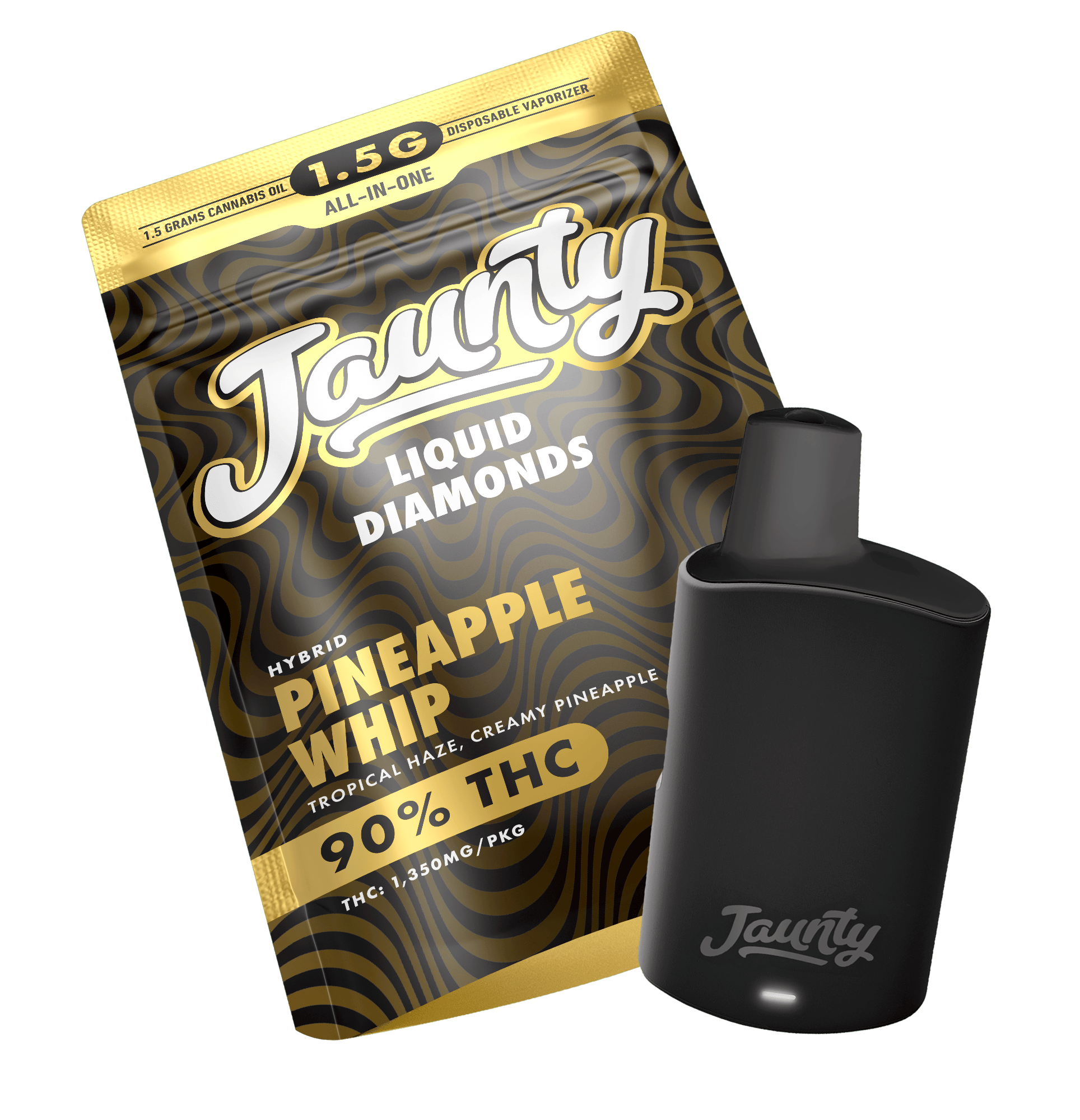
THC 92.96%Hybrid
JauntyPineapple Whip | Liquid Diamonds | Hybrid | AIO | 1.5g · 1.5g
$70.00
$79after tax

weeddispensarynearme.com
You must be 21 years or older to enter. By entering, you confirm you’re of legal age in your state to purchase cannabis.
For use only by adults 21+ • Keep out of reach of children
1 live products in stock
Quick answer · What is the Pineapple Whip cannabis strain?
Pineapple Whip is a sun-drenched hybrid whose name captures its character with quiet precision. Tropical fruit notes spiral through a creamy, almost dessert-like exhale, while the effect settles into a balanced elevation that neither races nor sedates. For the discerning New York consumer seeking a daytime companion with genuine depth and warmth, Pineapple Whip occupies a considered, unhurried space between stimulation and ease.
$79after tax
About Pineapple Whip
Pineapple Whip's exact lineage is not uniformly documented across public cannabis databases, and the breeder of record has not been universally confirmed — a situation common to many boutique hybrid cultivars that circulated through the West Coast craft market before formal documentation became standard practice. The consensus among Leafly and Wikileaf community data points toward a cross involving Pineapple, itself a descendant of Ed Rosenthal Super Bud and possibly Skunk phenotypes, and a secondary parent that introduces the creamy, vanilla-adjacent sweetness implied by the 'Whip' designation — potentially a Cookies-adjacent or OG-influenced line, though this remains unverified. What is well-documented is the influence of Pineapple as a foundational tropical hybrid: it carries Haze genetics that deliver cerebral lift, grounded by Indica-leaning structure from its Skunk heritage. Pineapple Whip appears to have entered wider circulation through California's licensed market in the mid-to-late 2010s and gained regional momentum as tropical-forward hybrids became a defining aesthetic of that era's premium flower segment. Genetic siblings in spirit, if not always in verified lineage, include Pineapple Express, Pineapple Kush, and Tropicana Cookies — strains that share the tropical-terpene priority that defines this broader family of cultivars.
Pineapple Whip typically announces itself within five to fifteen minutes of inhalation, beginning with a gentle brightening of mood and a light clarity behind the eyes that many consumers describe as a quiet lifting of mental static. This initial cerebral warmth is characteristic of strains with notable limonene and terpinolene content, both of which are associated in the literature with uplifted, sociable states. The onset is rarely jarring — it tends to arrive as a gradual shift in perspective rather than an abrupt rush, which makes the experience accessible across a range of tolerance levels. As the session progresses toward its peak, a mild body softness settles beneath the mental clarity, lending the overall character a hybrid balance that leans sativa-dominant without abandoning physical comfort. This duality — present and engaged upstairs, relaxed and unhurried in the body — tends to sustain for one to two hours under typical conditions, tapering into a gentle, contented ease rather than fatigue or heaviness. The comedown is generally smooth, reflecting the balanced cannabinoid and terpene profile. Myrcene, present as a secondary terpene in most Pineapple-family cultivars, likely contributes to the soft landing. As with any cannabis experience, individual response varies, and a measured, low-and-slow approach to consumption is always the considered starting point.
The aromatic profile of Pineapple Whip is one of its most immediately distinguishing qualities. On the nose, the dominant impression is bright tropical fruit — specifically the acidic-sweet register of fresh pineapple — underpinned by a softer, almost vanilla-cream note that justifies the 'Whip' in its name. Terpinolene, a terpene associated with floral, herbaceous, and lightly piney top notes, appears to drive the more volatile citrus-tropical facets of the aroma and is well-documented in Pineapple-lineage cultivars. Limonene reinforces the citrus brightness and contributes to the strain's clean, uplifting olfactory character. Secondary to these is myrcene, which adds a faint earthiness and tropical musk that keeps the aroma grounded and prevents it from reading as artificial or one-dimensional. Caryophyllene, if present as a minor terpene — which is plausible given any OG or Cookies influence in the parentage — would contribute a subtle spice that rounds the back end of the profile. On the palate, Pineapple Whip delivers its name faithfully. The inhale carries the fruit-forward brightness established by the nose, while the exhale softens into that creamy, smooth finish that distinguishes it from more astringent tropical cultivars. The smoke or vapor is generally regarded as gentle on the throat, making it an approachable choice for those who value both flavor and comfort in their sessions.
Pineapple Whip's flower typically presents with a structure that reflects its hybrid balance — buds are moderately dense without the tight compression of a heavily Indica-dominant cultivar, and possess a visual lightness that aligns with its sativa-leaning character. The color palette runs from medium sage green to brighter, almost lime-toned patches on well-cured specimens, occasionally punctuated by subtle gold or amber undertones. Pistils — the hair-like structures threading through the calyx — tend toward a warm burnt-orange or russet hue, providing a pleasing chromatic contrast against the green canvas. Trichome coverage is typically generous, lending a frosted, slightly luminous quality to the surface of the bud that signals a reasonably potent resin profile. When broken apart, the interior of the bud reveals a slightly paler green and releases the tropical aroma in full, confirming the integrity of the cure and the density of the terpene expression beneath the outer layer.
Pineapple Whip is generally considered a moderately challenging cultivar — approachable for intermediate home growers but perhaps best appreciated by those with some prior experience managing hybrid phenos. Its Haze-influenced genetics suggest a preference for warm, Mediterranean-style climates when grown outdoors, where it can express the full range of its terpene profile under natural light cycles. Indoors, it responds well to Screen of Green (SCROG) techniques given its tendency toward lateral branching and moderate vertical stretch. Flowering time is typically estimated in the range of eight to ten weeks under standard indoor lighting protocols. Indoor yields are moderate to above-average when plants are well-supported and fed appropriately through the mid-flowering stretch. Outdoor cultivation in the Northern Hemisphere tends toward a late-September to mid-October harvest window. Humidity management during the final weeks of flower is worth attention, as dense trichome coverage can create microenvironments hospitable to moisture-related issues. For the cultivator-curious consumer, Pineapple Whip represents the kind of craft challenge that rewards patience and environmental attentiveness with an expressive, aromatic final product.
Pineapple Whip occupies a compelling position in the daytime and early-evening register. Its balanced, clarity-forward effect makes it a natural companion for creative work that benefits from loosened perspective without the restlessness that some more aggressively sativa-leaning strains can introduce — writing, visual art, or the early planning stages of a project all feel well-suited. Socially, it translates with equal grace to a relaxed gathering: the mood lift is warm and communicative without tipping into anxiety or overstimulation, making it a considered choice for a rooftop evening or a casual dinner gathering with close company. On the flavor and terpene side, Pineapple Whip pairs naturally with foods that echo its tropical-citrus profile — a ceviche with fresh mango, a yuzu-dressed salad, or a light coconut-forward dessert would all complement rather than compete with the strain's character. Musically, the combination of cerebral brightness and physical ease aligns well with something melodic and unhurried — Khruangbin, Sylvan Esso, or a well-curated bossa nova playlist would each honor the strain's particular register. It is, in short, a strain for savoring.
Pineapple Express
Fans of Pineapple Express will recognize the same tropical-fruit brightness and uplifting hybrid energy in Pineapple Whip, with the latter offering a creamier, smoother finish on the palate.
Tropicana Cookies
Tropicana Cookies shares the citrus-forward terpene architecture and mood-lifting sativa lean that defines Pineapple Whip, while adding a deeper GSC-derived earthiness for those who want added complexity.
Pineapple Kush
Those drawn to Pineapple Whip's tropical aroma who also appreciate a more physically relaxed, Indica-tinged experience will find Pineapple Kush a natural companion in the same flavor family.
Mimosa
Mimosa's bright citrus-and-cream terpene profile and balanced, socially oriented hybrid effect make it an intuitive next step for consumers who enjoy Pineapple Whip's mood and flavor register.
Tangie
Tangie's terpinolene-rich citrus dominance and cerebral, creative-leaning lift share significant common ground with Pineapple Whip, appealing to the same daytime, flavor-first consumer.
Pineapple Whip is classified as a hybrid, and its overall character leans toward the sativa side of the spectrum. The onset and peak tend to be cerebral and uplifting, consistent with its Haze-influenced lineage, while a softer body component prevents it from feeling purely stimulating. It is well-suited to daytime and early-evening use for consumers who prefer a mentally engaged, mood-forward experience with physical ease in the background.
Pineapple Whip tastes much as its name suggests — bright tropical fruit on the inhale, led by fresh pineapple and citrus notes, followed by a smooth, creamy sweetness on the exhale that recalls a dessert-like finish. The vapor or smoke is generally gentle on the throat. Terpinolene and limonene drive the fruit-forward brightness, while myrcene contributes a subtle earthiness that keeps the profile from feeling one-dimensional.
The typical experience begins with a gradual mood lift and a brightening of mental clarity, arriving within ten to fifteen minutes of inhalation. At peak, most consumers report a balanced state of cerebral engagement and mild physical relaxation — present and social upstairs, easy and unhurried in the body. The duration tends to run one to two hours, with a smooth, contented comedown. Individual responses vary; a measured approach to dosing is always advisable.
Consumers who enjoy Pineapple Whip tend to respond well to other tropical and citrus-forward hybrids. Pineapple Express offers a closely related flavor and effect profile. Tropicana Cookies and Mimosa both share the citrus-cream terpene architecture and uplifting hybrid character. Tangie is a strong parallel for those drawn specifically to the terpinolene-led brightness. Pineapple Kush suits those who want the same tropical aroma with a more Indica-leaning physical effect.
Pineapple Whip's balanced, sativa-leaning hybrid profile makes it relatively approachable, but as with any cannabis product, new consumers should start with a small amount and allow sufficient time to assess their individual response before consuming more. The onset is generally gradual rather than abrupt, which tends to make the experience more manageable. Adult-use cannabis in New York is for consumers 21 and older, and a low-and-slow approach is always the considered starting point.
The dominant terpenes in Pineapple Whip are generally understood to be terpinolene, limonene, and myrcene, consistent with its Pineapple-family lineage. Terpinolene contributes the floral, tropical top notes; limonene adds citrus brightness and is associated with uplifted mood; and myrcene provides a grounding earthiness and contributes to the smooth, relaxed body component. Caryophyllene may also be present as a minor terpene depending on the specific phenotype and cultivator.
Pineapple Whip is most naturally suited to daytime and early-evening consumption. Its cerebral clarity and mood-forward character make it a thoughtful companion for creative work, social situations, or leisurely outdoor activity during daylight hours. As the day winds down, its mild body ease supports a relaxed transition into the evening without the heavier sedation associated with more Indica-dominant cultivars. Consumers who are sensitive to sativa-leaning effects may prefer to enjoy it earlier in the day.
Pineapple Whip's lineage is not fully confirmed across public cannabis sources. The most commonly cited parentage involves Pineapple — a Haze and Skunk-descended tropical hybrid — crossed with a secondary parent that introduces the creamy, dessert-like sweetness the strain is known for, potentially from a Cookies or OG-adjacent line, though this is unverified. The breeder of record has not been universally documented, which is consistent with many craft cultivars that emerged from the California market in the mid-to-late 2010s.
Related strains
Pick your store
We'll show pricing, deals, and delivery zones for the store you pick. You can switch any time from the header.