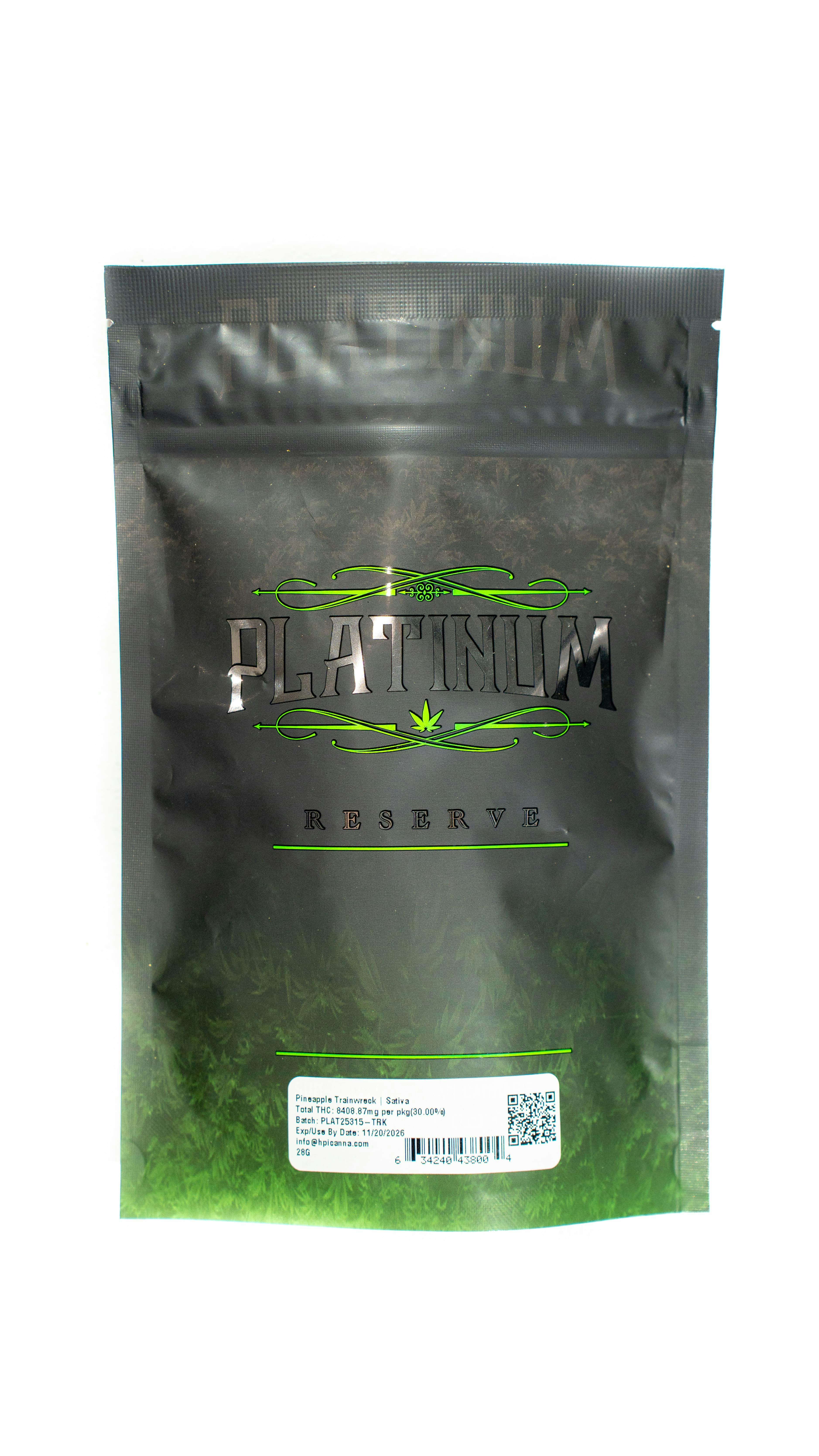
THC 30%Sativa
Platinum ReservePlatinum Reserve | Flower | Pineapple Trainwreck · 28g
$226.00
$255after tax

weeddispensarynearme.com
You must be 21 years or older to enter. By entering, you confirm you’re of legal age in your state to purchase cannabis.
For use only by adults 21+ • Keep out of reach of children
1 live products in stock
Quick answer · What is the Pineapple Trainwreck cannabis strain?
Pineapple Trainwreck arrives like a coastal breeze carrying the scent of ripe tropics — bright, citrus-laced, and unmistakably energetic. A sativa-forward cross that marries the legendary cerebral momentum of Trainwreck with the sun-drenched sweetness of Pineapple, this strain rewards the curious and the creative in equal measure. Its golden-hued buds and layered terpene profile make it a considered choice for those seeking clarity and uplift without sacrificing depth of experience.
$255after tax
About Pineapple Trainwreck
Pineapple Trainwreck is a sativa-dominant hybrid produced by crossing two storied cultivars: Trainwreck and Pineapple. Trainwreck itself is a foundational West Coast strain with roots tracing back to Humboldt County, California, reportedly developed in the late 1970s or early 1980s by two brothers whose crop was interrupted by a train derailment — lending the strain its distinctive name. Trainwreck's own lineage draws from Mexican and Thai sativas crossed with an Afghani indica, producing a balanced but cerebral character that proved enormously influential on the California cannabis scene and the broader American craft genetics movement. The Pineapple parent adds a tropical dimension that softens Trainwreck's sharp, electric edge. Pineapple strain lineage is itself somewhat debated across public sources; it is most commonly listed as a Skunk phenotype or a cross involving Ed Rosenthal Super Bud, though the exact derivation has not been uniformly confirmed by a single named breeder. What is consistent across references is Pineapple's warm, sweet terpene character and its ability to impart an uplifted, sociable quality to its offspring. Pineapple Trainwreck as a named cross has been offered by several boutique cultivators over the years, with Humboldt Seed Organization among the more recognized breeders to have worked with a version of this pairing. Genetic siblings or phenotype variations exist in the broader market, and expressions can vary considerably depending on the specific Pineapple phenotype selected as a parent.
The onset of Pineapple Trainwreck tends to arrive with notable swiftness — a quality inherited from the Trainwreck lineage, which is consistently reported across public sources as fast-acting and cerebral in its initial character. Within the first ten to fifteen minutes, most consumers describe a brightening of mood and an increase in mental clarity, accompanied by a gentle but discernible elevation in sensory awareness. Thoughts quicken without becoming scattered, and there is often a sense of focused energy that makes conversation and creative tasks feel more fluid. At its peak, the experience leans decidedly cerebral: the dominant impression is one of lightness, optimism, and a kind of purposeful wakefulness rather than sedation. The body registers the effect as ease rather than heaviness, with muscular tension dissolving without the sinking quality associated with indica-dominant cultivars. This is largely consistent with the strain's terpene composition, in which limonene and terpinolene are understood to contribute to its mood-elevating, alert character. Duration typically runs in the range of two to three hours for most consumers, with the peak gradually softening into a calm, grounded finish rather than an abrupt comedown. New consumers and those with lower tolerance should approach with measured intention — the Trainwreck influence means potency can register quickly, and a considered, start-low-go-slow approach is always advisable.
The aromatic profile of Pineapple Trainwreck is among its most immediately compelling qualities. On first encounter, the nose receives a wave of bright tropical sweetness underscored by citrus — ripe pineapple and mango notes dominate, softened by a faintly earthy green base that keeps the overall impression from reading as candied or artificial. This opening character is attributed largely to terpinolene and limonene, two terpenes consistently associated with tropical, citrus-forward cannabis cultivars. Terpinolene in particular is known to contribute floral and slightly piney nuances that lend the aroma dimension and lift. Secondary aromatic notes reveal themselves on closer inspection: a whisper of fresh pine from pinene, a subtle spice warmth from beta-caryophyllene, and the faint herbal musk of myrcene rounding the base. Myrcene, present in moderate quantities in most Trainwreck-derived cultivars, contributes the earthy body that keeps the profile grounded rather than purely effervescent. Ocimene may also be present in some phenotypes, adding an additional sweet, herbaceous dimension. On the palate, whether smoked or vaporized, Pineapple Trainwreck delivers a smooth initial draw with pronounced sweetness at the front of the tongue, transitioning to a cleaner, slightly piney mid-palate. The exhale carries a light, pleasant warmth — spiced faintly by caryophyllene — and leaves a lingering tropical sweetness that invites a second consideration of the flavor before dissipating cleanly.
Pineapple Trainwreck presents buds that are moderately dense and well-structured, reflecting its sativa heritage in a slightly elongated, tapered calyx formation while retaining enough compactness to signal careful cultivation. The color palette leans toward vivid mid-greens, often accented by chartreuse and occasional pale yellow tones — the latter particularly evident when the plant is finished under cooler temperatures. Rust-orange to amber pistils wind generously through the bud structure, contributing a warm visual contrast against the green backdrop. Trichome coverage is generous, giving well-cured specimens a frosted, almost luminous quality when examined closely under light. The resin glands sit prominently on both the calyxes and the sugar leaves, indicating a reasonably robust cannabinoid and terpene density. Overall, the visual impression is of a strain that carries its tropical character through even to its presentation — bright, warm, and carefully finished.
Pineapple Trainwreck is typically characterized by cultivators as an intermediate-to-experienced grow, owing in part to the vigor and stretch it inherits from its sativa-dominant lineage. Indoors, it flourishes under controlled environments with ample vertical space allowed for during the flowering stretch — training techniques such as topping or low-stress training are commonly recommended to manage canopy height and encourage lateral branching. Flowering time indoors generally falls in the range of nine to ten weeks, which is on the longer side of the spectrum and consistent with sativa-leaning cultivars. Indoor yields are reported as moderate to generous when plants are given sufficient light intensity and nutrient support. Outdoors, Pineapple Trainwreck prefers a warm, Mediterranean-style climate with consistent sun exposure and low humidity during the late flowering period, which helps protect the dense canopy from moisture-related issues. Harvest outdoors typically falls in late October in Northern Hemisphere climates. The strain is considered rewarding for cultivators willing to invest in proper environmental management, though it is not generally recommended as a first grow for the novice home gardener.
Pineapple Trainwreck is a strain that earns its place in the earlier hours of the day or the golden, unhurried hours of a weekend afternoon. Its cerebral clarity and mood-elevating character make it a natural companion for creative work — writing, visual art, or any pursuit that benefits from an open, associative quality of thought. The lack of sedative weight means it does not foreclose on productivity or conversation, and it integrates well into social settings where engagement and ease are the desired register. For a considered food pairing, the strain's tropical terpene profile finds a complementary echo in dishes with bright acidity and natural sweetness — a well-composed ceviche, a citrus-dressed grain bowl, or a plate of fresh tropical fruit prepared simply. Musically, the experience aligns with recordings that carry similar qualities: warm but clear, rhythmically alive without being overwhelming. Albums from artists working in Afrobeat, bossa nova, or contemporary jazz tend to resonate naturally with the strain's character. It is, in sum, a cultivar for those who wish to remain present and engaged with the world around them while softening its harder edges.
Trainwreck
As Pineapple Trainwreck's direct parent, Trainwreck shares the cerebral onset and electric clarity, making it the natural reference point for consumers who enjoy the mental energy of this cross without the tropical sweetness.
Pineapple Express
Pineapple Express shares the tropical citrus terpene character and sativa-leaning uplift, offering a similarly bright and sociable experience that will resonate with fans of Pineapple Trainwreck's flavor profile.
Tangie
Tangie's limonene-dominant, citrus-forward aroma and mood-elevating sativa effects mirror many of the qualities that define Pineapple Trainwreck, particularly for consumers drawn to the strain's bright, fruit-forward nose.
Maui Wowie
Maui Wowie's classic tropical sweetness, Hawaiian lineage, and clean sativa energy make it a fitting companion for those who appreciate Pineapple Trainwreck's sun-drenched character and light-bodied euphoria.
Jack Herer
Jack Herer's blended sativa legacy — piney, slightly spiced, and mentally clarifying — appeals to the same consumer looking for purposeful cerebral uplift and an aromatic profile with depth beyond simple sweetness.
Pineapple Trainwreck is a sativa-dominant hybrid. Its parentage — the sativa-leaning Trainwreck and the uplifting Pineapple cultivar — produces a cultivar that leans decisively toward the cerebral, energetic end of the cannabis spectrum. While some indica genetics are present in the background of the Trainwreck lineage, the overall experience is characterized by uplift, mental clarity, and lightness rather than sedation or body heaviness.
Pineapple Trainwreck delivers a bright, tropical sweetness on the palate — ripe pineapple and citrus notes dominate the initial draw, transitioning to a slightly piney, spiced mid-palate. The exhale is smooth and warm, with a lingering tropical finish. Terpenes including terpinolene, limonene, and beta-caryophyllene are responsible for this layered flavor profile, which reads as sweet and fruit-forward without becoming cloying or artificial.
Consumers most commonly report a swift-onset cerebral uplift — heightened mood, increased mental clarity, and a sense of focused, purposeful energy. The physical experience is one of ease and lightness rather than sedation. The experience typically peaks with a sociable, creative quality before gradually softening into a calm, grounded finish over two to three hours. As with any potent sativa-dominant cultivar, a measured approach to consumption is advisable.
Consumers who enjoy Pineapple Trainwreck often find similar satisfaction in Trainwreck, Pineapple Express, Tangie, Maui Wowie, and Jack Herer. Each of these cultivars shares one or more of Pineapple Trainwreck's defining qualities — whether that is the tropical terpene profile, the cerebral sativa onset, or the uplifted, sociable character that runs throughout the experience.
Pineapple Trainwreck can be accessible to newer consumers who approach it with intention, but its sativa potency and the notably swift onset inherited from the Trainwreck lineage mean that caution is warranted. A start-low, go-slow approach is always advisable for those newer to cannabis. The energetic, cerebral nature of the effects can feel intense for consumers unaccustomed to sativa-dominant cultivars, so a measured first experience is the sensible path.
Pineapple Trainwreck's aroma and effect profile is shaped primarily by terpinolene, limonene, and myrcene, with secondary contributions from beta-caryophyllene and pinene. Terpinolene imparts the floral, tropical character; limonene contributes citrus brightness and mood elevation; myrcene grounds the profile with a subtle earthiness; caryophyllene adds a faint spice warmth; and pinene brings a clean, slightly resinous note to the overall composition.
Given its sativa-dominant character and energizing effects, Pineapple Trainwreck is well-suited to morning or early afternoon consumption. Its clarity-promoting, mood-elevating qualities align naturally with creative pursuits, social activity, or any engagement that benefits from an alert, open state of mind. Most consumers find it less suited to evening or pre-sleep contexts, where a more relaxing, indica-leaning cultivar would typically be a better fit.
Pineapple Trainwreck has been produced by multiple boutique cultivators over the years, with Humboldt Seed Organization among the more publicly recognized breeders to have worked with a version of this pairing. The cross draws on Trainwreck, a foundational Humboldt County, California cultivar with documented roots in the late 1970s and early 1980s, and the Pineapple parent, whose lineage is debated across public sources but is most commonly associated with Skunk-derived genetics.
Related strains
Pick your store
We'll show pricing, deals, and delivery zones for the store you pick. You can switch any time from the header.