
Sativa
All strains Lucid Blue
2 live products in stock
Quick answer · What is the Lucid Blue cannabis strain?
Lucid Blue arrives with the quiet confidence of a clear morning sky — bright, focused, and surprisingly expansive. A sativa-dominant cultivar prized for its cerebral lift and piney, citrus-laced aromatics, it has earned a devoted following among those who seek clarity over sedation. Whether encountered in a sunlit studio or an unhurried afternoon walk, Lucid Blue has a way of making the ordinary feel distinctly worth noticing.
Shop Lucid Blue · 2 of 2 live products
THC 38.52%Sativa
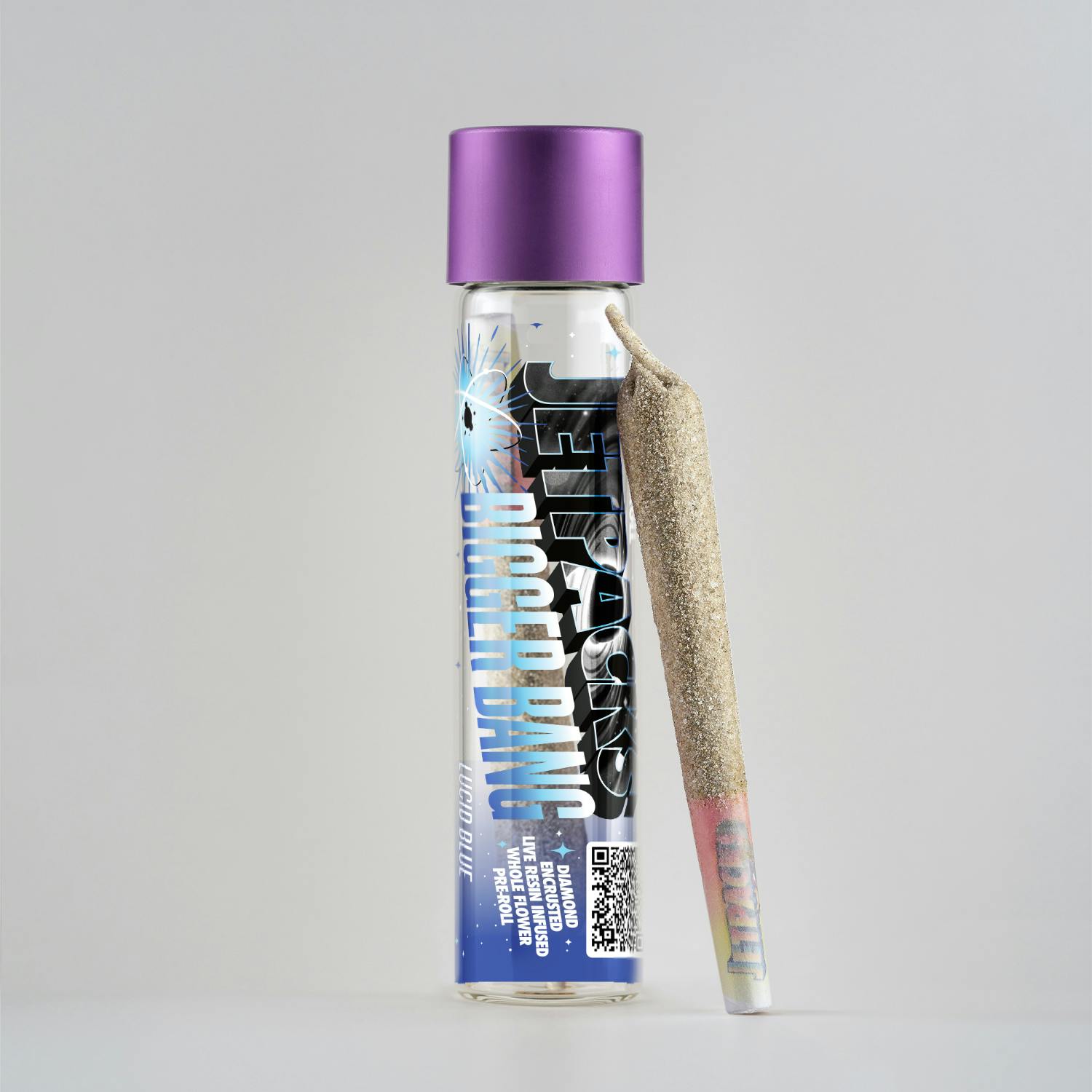
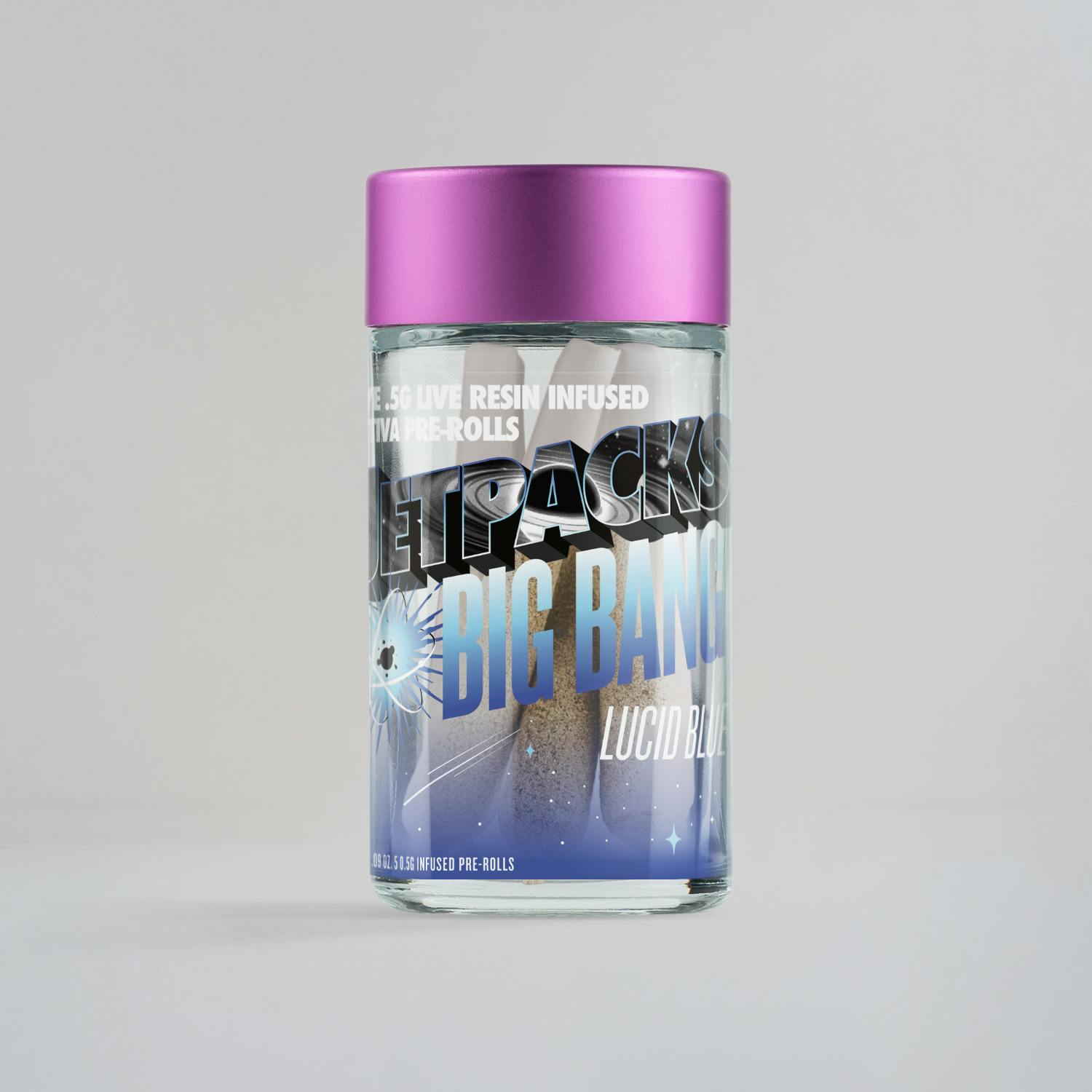
JetpacksJetpack | Lucid Blue | Big Bang Infused Preroll | 5PK · 0.5g/5pk
$52.21
$59after tax
About Lucid Blue
Everything to know about Lucid Blue.
Lineage & origin
Lucid Blue is generally documented as a cross of Grateful Breath and Blue Dream, though some sources cite slight variations in the exact parentage, and the original breeder has not been uniformly credited across major cannabis databases. The strain appears to have gained traction in the Pacific Northwest craft market during the mid-2010s, aligning with a broader consumer shift toward sativa-leaning cultivars that offered mental engagement without overwhelming sedation. Blue Dream itself is one of the most well-traveled genetics in North American cannabis history — a hybrid of Blueberry and Haze that became a coastal phenomenon, praised for its balanced yet uplifting character. Grateful Breath, typically understood as a cross of Grateful Dawg and Sherblato or similar OG-adjacent lineages depending on the phenotype, contributes a deeper, more grounded terpene complexity. The marriage of these two parents gives Lucid Blue a genetic profile that bridges the euphoric, haze-forward energy of Blue Dream with a subtle earthiness from the Grateful Breath side. The result is a cultivar with a distinctive terpene signature and a sativa character that feels considered rather than frantic. Phenotypic variation is documented in the community, so individual expressions may lean slightly more floral or piney depending on the specific cut.
Effects
Lucid Blue tends to announce itself gently. Most consumers report that onset arrives within five to fifteen minutes of inhalation — a gradual brightening behind the eyes that quickly evolves into a clean, focused cerebral lift. Unlike some high-velocity sativas that can tip into anxious territory, Lucid Blue's experience is widely described as organized and purposeful, with thoughts arriving with unusual clarity rather than in an undirected rush. The peak experience is largely cerebral in character, with attention sharpened and a mild but persistent sense of optimism coloring the session. This quality is plausibly linked to the strain's terpinolene content — a terpene associated in preliminary research with uplifting, somewhat energetic effects — alongside the limonene that Blue Dream genetics often contribute. Body sensation is present but understated: a soft peripheral ease that does not anchor the consumer to the couch. Duration for most users falls in the two-to-three hour range, with the sharpest clarity concentrated in the first hour and a graceful, unhurried descent thereafter. The comedown is notably smooth — rarely abrupt, more akin to a gradual return to baseline than a hard stop. Those new to sativa-dominant cultivars are well advised to start low and go slow, as the cerebral intensity, though measured, is genuine and dose-dependent.
Aroma, flavor & terpenes
The first encounter with Lucid Blue's aroma is defined by a bright, resinous pine note — a hallmark of its pinene content — layered over a subtler citrus brightness that most observers associate with the limonene its Blue Dream heritage reliably contributes. Together, these top-of-nose notes give the cultivar a clean, almost alpine quality: fresh, green, and quietly invigorating. Beneath that initial impression, terpinolene adds a floral, slightly herbal nuance that prevents the aroma from reading as purely sharp or resinous. Myrcene — present in modest amounts relative to the more forward terpenes — introduces a faint earthiness in the background, grounding the profile and keeping it from feeling one-dimensional. Some cuts also exhibit a whisper of ocimene, contributing a sweet, faintly tropical brightness that lifts the mid-register of the nose. On the palate, whether consumed via flower or vapor, Lucid Blue is consistent with its aromatic promise. The inhale carries that clean pine and citrus forward, while the exhale introduces a mild herbal sweetness. Vapor tends to preserve the more delicate floral notes that can be subdued at higher combustion temperatures. The finish is generally clean and brief, without the heavy, lingering resin some find in more OG-adjacent cultivars — an attribute that makes it a particularly approachable daytime smoke for those who value both flavor and function.
Appearance
Lucid Blue typically presents as a moderately dense, medium-to-large bud with a silhouette that leans toward the classic sativa structure — slightly elongated calyxes and a somewhat airy internal architecture relative to indica-dominant cultivars, though well-grown examples retain a satisfying heft. The color palette skews toward a medium-to-deep green, with some phenotypes expressing subtle sage or blue-green undertones that likely inspired the cultivar's name. Trichome coverage is generous, lending a silvery, frost-kissed surface that speaks to the strain's potency potential. Pistils tend toward amber and russet tones, creating a warm contrast against the cooler green of the leaves. The overall visual impression is one of quality without ostentation — a cultivar that rewards close inspection but does not announce itself through theatrical coloration alone. Well-cured examples hold their structure firmly and break apart with a slightly sticky resistance, a reliable indicator of adequate resin development.
Growing notes
Lucid Blue is considered a moderately challenging cultivar for home growers, and its cultivation data is less comprehensively documented than more commercially widespread strains. What the community has established suggests it performs well in both indoor and outdoor environments, with a preference for moderate, Mediterranean-adjacent climates outdoors — warm days, cool nights, and low humidity during the flowering window. Indoor flowering time is generally reported in the range of nine to ten weeks, consistent with many sativa-dominant hybrids. Yields are described as moderate to above-average when the plant's vertical growth tendency — again, typical for sativa-leaning genetics — is managed through low-stress training or strategic topping. Outdoor cultivators in appropriate climates may expect harvest in the early-to-mid October window. The plant's height can be a logistical consideration in confined indoor spaces. Those approaching the cultivation of Lucid Blue should budget for adequate vertical clearance and anticipate a stretch during early flowering. Experienced cultivators working with similar sativa-leaning phenotypes will find the plant's behavior familiar; newer growers may benefit from reviewing training techniques before committing to a full run.
When it's best enjoyed
Lucid Blue is calibrated, almost by design, for the hours between obligation and leisure — that particular window on a weekend morning or a free afternoon when attention is available but not yet directed. It pairs naturally with solo creative work: writing, sketching, music composition, or any discipline where focused attention and a degree of lateral thinking serve the task. The clarity-forward effect profile makes distraction less appealing and engagement more instinctive. For a food pairing that complements the strain's bright, piney terpene profile, consider something with clean acidity and herbaceous notes — a well-made citrus salad with fresh herbs, or a lightly dressed arugula and fennel dish. The limonene and pinene in the cultivar tend to harmonize with flavors in the same register rather than compete with them. Musically, Lucid Blue lends itself to recordings with space and texture — ambient electronic works, lightly produced jazz, or acoustic recordings where the room sound is audible. The strain's ability to enhance attentiveness without narrowing focus makes it well-suited to music that rewards close listening. It is equally at home accompanying an unhurried walk through a city neighborhood or a quieter stretch of urban park.
If you like Lucid Blue, also explore
Blue Dream
As a direct parent of Lucid Blue, Blue Dream shares the same citrus-and-pine aromatic register and sativa-leaning cerebral lift, making it the most natural point of comparison for anyone drawn to Lucid Blue's balanced energy.
Jack Herer
Jack Herer's resinous pine-and-spice terpene profile and its reputation for focused, clear-headed sativa effects occupy a very similar experiential space to Lucid Blue's organized cerebral character.
Green Crack
Consumers who appreciate Lucid Blue's daytime utility and sharpened attention will find Green Crack's energetic, mango-and-citrus-forward sativa profile a logical next exploration, though Green Crack tends to run somewhat more assertive in its stimulation.
Durban Poison
For those drawn to Lucid Blue's terpinolene-driven floral and herbal brightness, Durban Poison — another terpinolene-forward landrace sativa — offers a comparably uplifting and clear-eyed experience with a distinctly anise-and-pine aromatic signature.
Maui Wowie
Maui Wowie's tropical-citrus aromatics and its gentle, euphoric sativa lift share Lucid Blue's quality of expansive mental clarity without heaviness, appealing to the same consumer who values daytime function alongside sensory pleasure.
Common questions
Is Lucid Blue indica or sativa?+
Lucid Blue is classified as a sativa-dominant hybrid. Its lineage — generally traced to Blue Dream and Grateful Breath — leans strongly toward the sativa side in terms of both effect character and plant structure. Consumers typically report a cerebral, uplifting experience rather than the body-centered relaxation associated with indica-dominant cultivars. Individual phenotypes may vary slightly, but the sativa influence is consistent across most documented reports.
What does Lucid Blue taste like?+
Lucid Blue delivers a clean, resinous pine flavor on the inhale, underscored by a bright citrus note that reflects its Blue Dream heritage. The exhale introduces a mild herbal sweetness, with some phenotypes showing a faint floral character attributable to terpinolene. The overall palate impression is fresh and green rather than heavy or resinous, making it a particularly pleasant choice for daytime consumption when clarity of flavor matters as much as effect.
What are the typical effects of Lucid Blue?+
Lucid Blue is most commonly associated with a focused, clear-headed cerebral lift that arrives gradually and sustains itself over a two-to-three hour window. Consumers frequently describe enhanced attentiveness, a mild sense of optimism, and a peripheral body ease that does not tip into sedation. The experience is generally considered organized and purposeful rather than racy or disorienting. As with all cannabis, starting with a modest amount and building slowly is the most reliable approach for a comfortable session.
What strains are similar to Lucid Blue?+
Consumers who enjoy Lucid Blue often find common ground with Blue Dream, Jack Herer, Durban Poison, Green Crack, and Maui Wowie. Each of these shares at least one defining characteristic with Lucid Blue — whether a pine-and-citrus terpene profile, a terpinolene-forward floral quality, or a sativa-dominant effect arc centered on clarity and daytime utility. Blue Dream, as Lucid Blue's parent, is the most direct comparison.
Is Lucid Blue good for beginners?+
Lucid Blue can be approachable for newer consumers, but its sativa potency warrants some care. The cerebral lift, while generally described as organized rather than overwhelming, is genuine and dose-dependent. Beginners are encouraged to start with a small amount, allow sufficient time to gauge the onset — typically five to fifteen minutes when inhaled — and resist the temptation to re-dose prematurely. In measured quantities, many find the experience pleasant and well-suited to social or creative settings.
What are the dominant terpenes in Lucid Blue?+
Lucid Blue's terpene profile is typically anchored by terpinolene, which contributes floral and herbal brightness, alongside pinene, responsible for the cultivar's characteristic clean pine aroma. Limonene — inherited in part from its Blue Dream parentage — adds a citrus layer, while myrcene appears in a supporting role, introducing a mild earthiness that keeps the profile grounded. Some expressions also show ocimene, lending a faint tropical sweetness. Together these terpenes create a fresh, layered aromatic signature.
What is the best time of day to consume Lucid Blue?+
Lucid Blue is broadly regarded as a daytime cultivar. Its sativa-dominant, focus-enhancing character makes it best suited to morning or early afternoon consumption, when its cerebral clarity can be productively channeled. Most consumers would find its effect profile less compatible with evening wind-down routines, where indica or balanced hybrids typically serve better. The strain's aromatic and experiential profile aligns well with creative sessions, outdoor activities, or any engagement that benefits from attentive, unhurried presence.
What is Lucid Blue's lineage?+
Lucid Blue is most commonly documented as a cross of Blue Dream and Grateful Breath, though the specific breeder of record has not been uniformly identified across major cannabis reference sources, and some variation in the reported parentage exists in the community. Blue Dream — a Blueberry and Haze cross — is the more thoroughly documented parent. Grateful Breath is generally understood to carry OG-adjacent genetics. Those seeking absolute certainty on lineage may find the available record somewhat incomplete.
Related strains