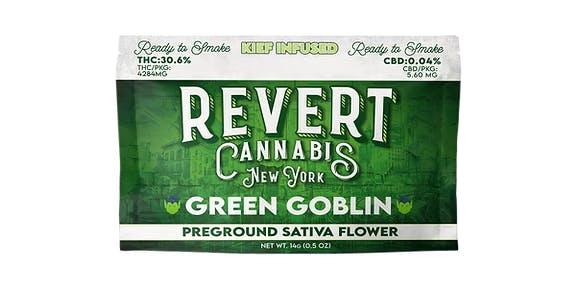
THC 29.55%Sativa
Revert CannabisRevert | Green Goblin | Infused Pre Ground Flower · 14g
$60.00
$68after tax

weeddispensarynearme.com
You must be 21 years or older to enter. By entering, you confirm you’re of legal age in your state to purchase cannabis.
For use only by adults 21+ • Keep out of reach of children
1 live products in stock
Quick answer · What is the Green Goblin cannabis strain?
Green Goblin arrives with a bright, herbal immediacy that is unmistakably sativa in character — a strain built for clear-headed momentum rather than sedation. Its citrus-forward aroma, energizing onset, and moderately dense bud structure have made it a reliable choice for those who prefer daytime cannabis with genuine lift. Rooted in classic Green Crack genetics, it carries the legacy of one of the genre's most focused lineages while carving out its own distinct personality.
$68after tax
About Green Goblin
Green Goblin is widely understood to be a phenotype or close genetic relative of Green Crack, the famously energizing sativa that itself traces its lineage to Skunk No. 1. Green Crack was popularized — and reportedly named — by Snoop Dogg after encountering it in the early 2000s, though its origins are generally credited to Cecil C., a breeder operating out of Athens, Georgia, in the 1970s and 1980s. The strain gained widespread distribution through the West Coast dispensary market in the mid-2000s, becoming a benchmark for daytime sativa performance. Green Goblin, as a named variety, has been distributed by several seed banks and cultivators, though the breeder of record has not been universally agreed upon in public-facing sources. Some catalogues list it simply as a Green Crack phenotype selected for particular terpene expression and vigor; others suggest possible crosses with additional sativa lines, though those claims remain unverified. Its naming likely draws on the vivid green coloration of its buds and the playful cultural imagery of the Marvel character, a common branding convention in the craft cannabis world. Genetic siblings and comparable expressions include the original Green Crack (also sold as Green Cush in some markets to avoid the loaded terminology), as well as Candyland and Super Silver Haze — strains that share the clean, cerebral sativa arc that defines this lineage's appeal.
The onset of Green Goblin is characteristically swift for a sativa-leaning variety, with most consumers reporting perceptible effects within five to ten minutes of inhalation. The initial impression is one of mental brightening — a gentle but unmistakable clearing of cognitive fog accompanied by a mild quickening of thought. This cerebral uplift sits at the core of the experience and tends to dominate the first hour of the arc. As the session progresses into its peak phase, the effects deepen into focused, engaged energy without the anxious edge that some high-powered sativas can produce. The body remains relatively unencumbered — there is warmth and a light physical ease, but no heaviness or sedation to interrupt the mental clarity. This balance is likely attributable to the interplay between its terpene profile, particularly the presence of limonene and terpinolene, which are associated with mood elevation and alertness, and myrcene, which tempers the experience with a mild relaxing undertone. Duration for most consumers falls in the two-to-three-hour range, with a gradual, even comedown that does not typically produce abrupt drops in energy. As the session closes, a quiet, contented calm tends to settle in. Those new to sativa-dominant varieties are encouraged to start with a conservative amount and allow adequate time before re-dosing.
The aromatic profile of Green Goblin opens with a bright citrus note — lemon and orange peel are the most commonly cited descriptors — underscored by a clean, herbal grassiness that reads almost like fresh-cut herbs or green tea. This initial impression is largely driven by terpinolene, a terpene associated with floral, piney, and citrus-adjacent aromas, and limonene, which contributes the more distinctly lemon-forward brightness. Together, they create an opening that is immediately invigorating without being sharp or abrasive. Myrcene, typically present as a secondary terpene, adds a subtle earthiness beneath the citrus brightness — a hint of damp soil or light musk that grounds the more volatile top notes and gives the overall aroma a pleasing complexity. Some phenotypes also express a faint pinene character, lending a whisper of forest pine that reinforces the green, botanical quality of the strain's identity. On the palate, the smoke or vapor is generally smooth and relatively light-bodied. The citrus and herb notes carry through from aroma to flavor with reasonable fidelity, though the exhale introduces a mild sweetness that rounds out the experience. There is little harshness at moderate temperatures, making it a comfortable choice for extended sessions. Vapor production tends to be clean and aromatic rather than heavy, which aligns with the strain's overall character of brightness and ease.
Green Goblin's buds are typically medium to moderately dense in structure — not the tightly packed, almost architectural forms associated with some OG-descended indicas, but cohesive and well-formed with a satisfying weight in hand. The calyxes are plump and clearly defined, contributing to the somewhat chunky silhouette of each flower. The color palette lives up to the strain's name. Vibrant, saturated greens dominate — ranging from a bright lime at the outermost leaves to deeper jade tones deeper in the bud structure. Pistils tend toward a warm orange or amber, providing an appealing visual contrast against the green canvas. Trichome coverage is generous across the surface and into the inner calyxes, giving cured buds a frosted, resinous appearance under direct light. When properly cultivated and cured, the surface shimmers with a density of capitate-stalked trichomes that speaks to reasonable resin production, consistent with its Green Crack heritage.
Green Goblin performs well in both indoor and outdoor cultivation environments, though it tends to express its best terpene complexity and trichome density under controlled indoor conditions where temperature and humidity can be managed precisely. Its sativa-leaning genetics mean it tends toward taller, more open branching structures, and growers typically employ low-stress or high-stress training techniques to manage canopy height and improve light penetration. Flowering time indoors is generally reported in the range of eight to nine weeks, which is relatively accessible for a sativa-dominant variety. Outdoor cultivation is best suited to warm, Mediterranean-style climates with long, dry late summers, with harvest typically falling in early to mid-October in the Northern Hemisphere. Yield potential is considered moderate to generous, rewarding attentive cultivators with well-developed, resin-rich flowers. The plant's vigor and relatively forgiving growth habit place it in an intermediate difficulty range — approachable for cultivators with some experience, though perhaps not the most beginner-friendly option for those encountering their first sativa-dominant grow.
Green Goblin is a strain that earns its place in the daylight hours. Its clear, engaged energy makes it particularly well-suited to creative work that benefits from sustained focus — writing, visual art, or any project that requires the mind to remain active and exploratory without drifting into distraction. Solo sessions in the late morning or early afternoon, before the day's demands have fully accumulated, tend to draw out its most articulate qualities. For social settings, it pairs naturally with informal gatherings centered on conversation and shared curiosity — a weekend brunch, a gallery visit, or a walk through a neighborhood market. The absence of heavy sedation keeps participants present and engaged. In terms of complementary food pairings, the strain's citrus and herbal terpene character finds an elegant partner in dishes that echo those notes: a simply dressed green salad with lemon vinaigrette, or a chamomile and citrus peel tea. Musically, it aligns with anything that rewards attentive listening — jazz with intricate arrangements, or the cleaner end of electronic composition. It is, in essence, a morning strain with a long, unhurried afternoon in mind.
Green Crack
As Green Goblin's most direct genetic ancestor, Green Crack delivers the same citrus-bright, focused sativa energy that defines the Goblin's core character — the natural first comparison for any fan of the latter.
Super Silver Haze
Sharing a comparable cerebral uplift and herb-forward aromatic profile, Super Silver Haze offers fans of Green Goblin a slightly more complex, resin-heavy expression of the daytime sativa experience.
Durban Poison
Those drawn to Green Goblin's clean, energizing onset and lack of sedation will find a kindred spirit in Durban Poison, a pure sativa landrace known for its anise-tinged brightness and mental clarity.
Candyland
Candyland's uplifting, socially engaging effects and sweet-herbal terpene character appeal to the same palate that gravitates toward Green Goblin's citrus-forward, clear-headed arc.
Jack Herer
Jack Herer's pine-and-spice aromatic complexity and reliably focused sativa effect profile make it a natural recommendation for those who appreciate Green Goblin's botanical brightness and energized clarity.
Green Goblin is classified as a sativa-dominant strain, generally understood to derive from Green Crack genetics, which itself traces back primarily to Skunk No. 1. Its effects profile — characterized by mental clarity, energized focus, and relatively light body sensation — is consistent with sativa-leaning varieties. It is not typically associated with the sedation or deep physical relaxation more common in indica-dominant strains.
Green Goblin delivers a citrus-forward flavor profile with clear notes of lemon and orange peel, supported by a clean herbal grassiness reminiscent of fresh botanical greens or light tea. The exhale introduces a mild sweetness that softens the citrus edge. Smoke and vapor tend to be smooth and light-bodied, with terpinolene and limonene driving the most immediately recognizable flavor notes.
The effects of Green Goblin are primarily cerebral — a clear, brightening mental lift that encourages focus and engaged curiosity. Onset is relatively swift, typically within five to ten minutes of inhalation. The body remains light and unrestricted throughout the experience. Duration is generally two to three hours, with a gradual, even comedown. It is not a strain commonly associated with sedation or couch-lock.
Consumers who enjoy Green Goblin tend to appreciate other citrus-forward, sativa-dominant varieties. Green Crack is the closest genetic parallel. Super Silver Haze, Jack Herer, and Durban Poison share the clear-headed, energizing effect arc. Candyland offers a comparable social, uplifting experience with a somewhat sweeter terpene profile. All five make strong alternatives or complements for those building a daytime cannabis rotation.
Green Goblin can be approachable for beginners who are specifically interested in sativa-dominant effects, though its energizing character means that those sensitive to cerebral stimulation should exercise some caution. Starting with a conservative amount and waiting to assess the full onset before re-dosing is always advisable — particularly with sativa-leaning varieties, which can occasionally amplify feelings of mental activation in those unaccustomed to them.
Green Goblin's terpene profile is typically led by terpinolene, which contributes its characteristic floral and citrus-adjacent brightness, and limonene, responsible for the more distinct lemon-forward aromatic note. Myrcene is generally present as a secondary terpene, adding a grounding earthiness beneath the brighter top notes. Some phenotypes also express detectable pinene, reinforcing the strain's clean, botanical character.
Given its clear-headed, energizing effect profile, Green Goblin is best suited to morning and daytime use. Its sativa-dominant character makes it a natural fit for creative work, social engagement, or active pursuits where sustained mental presence is valued. It is generally not recommended as an evening or wind-down strain, as its stimulating qualities are more likely to delay rest than encourage it.
Green Goblin is most commonly attributed to Green Crack genetics, a celebrated sativa line that traces its origins to Skunk No. 1 and was popularized in the early 2000s. The precise breeder of Green Goblin as a distinct named variety has not been uniformly established in public sources. Some catalogues list it as a selected phenotype; others suggest additional sativa crosses, though these claims have not been widely verified.
Related strains
Pick your store
We'll show pricing, deals, and delivery zones for the store you pick. You can switch any time from the header.