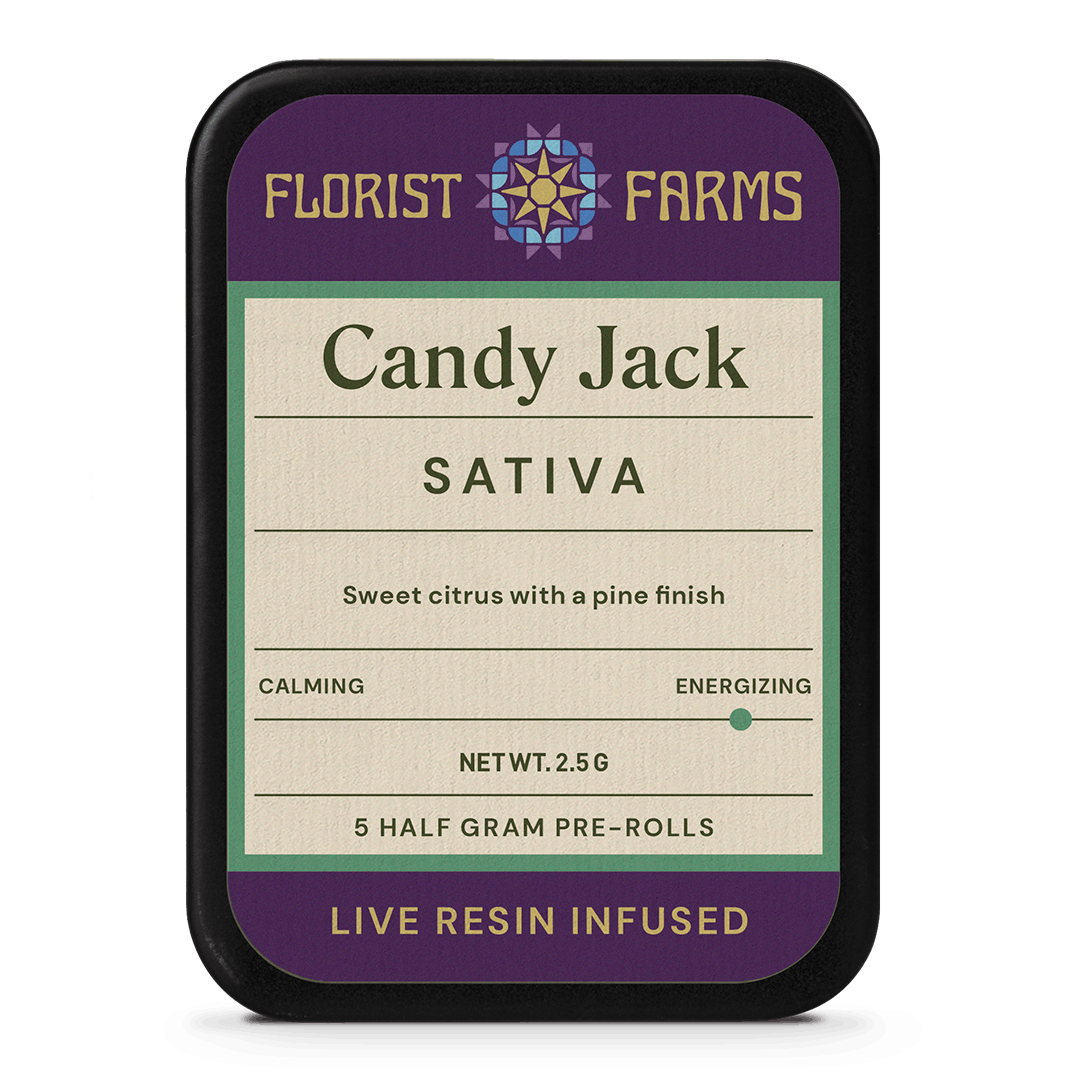
THC 38%Sativa
Florist FarmsInfused Live Resin Candy Jack | 1/2 Gram Joints | 5pk · 0.5g/5pk
$39.82
$45after tax

weeddispensarynearme.com
You must be 21 years or older to enter. By entering, you confirm you’re of legal age in your state to purchase cannabis.
For use only by adults 21+ • Keep out of reach of children
1 live products in stock
Quick answer · What is the Candy Jack cannabis strain?
Candy Jack arrives as a bright, sociable sativa that marries the electric clarity of Jack Herer with the sugary sweetness of Cotton Candy. The result is a strain defined by citrus-laced uplift and a candied, almost tropical aroma that lingers on the palate long after the first exhale. Thoughtful in its construction and lively in its expression, Candy Jack suits the daytime consumer who values mental engagement without sacrificing sensory pleasure.
$45after tax
About Candy Jack
Candy Jack is the product of crossing Jack Herer, one of the most celebrated sativas in modern cannabis history, with Cotton Candy, a sweet indica-leaning hybrid often attributed to Dutch breeding circles. Jack Herer itself was developed in the Netherlands during the mid-1990s by Sensi Seeds, blending Haze, Northern Lights, and Shiva Skunk genetics to produce a strain that became a benchmark for cerebral sativa performance. Cotton Candy, sometimes called Cotton Candy Kush depending on the phenotype in question, contributes a distinctly sweet, confectionary terpene profile and a softening body quality that rounds out Jack Herer's sharper edges. The specific origination of Candy Jack as a named variety is most frequently credited to Sin City Seeds, a Las Vegas-based breeder that released the cross and brought it to wider market attention in the early-to-mid 2010s. The pairing was deliberate: Sin City sought to preserve Jack Herer's legendary cerebral drive while layering in the approachable sweetness and mild physical ease that Cotton Candy provides. The result gained traction quickly in competitive cannabis circles, earning recognition at several regional events. Genetic siblings and close relatives include other Jack Herer crosses such as J1 (Jack Herer crossed with Skunk No. 1) and Super Jack, though Candy Jack occupies its own niche owing to its notably candy-forward terpene expression. Phenotypic variation exists within the line, with some cuts leaning more toward the hazy, spiced character of its Jack Herer parentage and others emphasizing the cotton-sweet notes from the Cotton Candy side.
The onset of Candy Jack tends to arrive within minutes of consumption, presenting first as a gentle pressure behind the eyes that quickly expands into a broad, luminous mental clarity. This initial wave is characteristically sativa in nature: thoughts accelerate, conversation flows more freely, and a gentle optimism settles across the mood without tipping into restlessness or anxiety in moderate amounts. The cerebral quality here owes much to the terpinolene and limonene content inherited from the Jack Herer lineage, both of which are associated in the literature with uplifted, alert mental states. At peak, Candy Jack sustains a focused, social energy that distinguishes it from heavier daytime options. There is meaningful physical ease present — a lightness in the limbs and a softening of tension in the shoulders — but the body component remains subordinate to the head effect, keeping the experience functional and outward-facing. This balance reflects the Cotton Candy contribution moderating what might otherwise be a purely cerebral ride. Duration for most consumers runs between one and a half to two and a half hours at moderate intake, with the comedown gradual and soft rather than abrupt. As the peak subsides, a mild warmth and quiet satisfaction settle in, making the transition back to ordinary activity seamless. As with any sativa-dominant strain, new consumers or those sensitive to THC are well advised to start low and go slow, as the energizing quality can intensify with higher intake.
The aromatic profile of Candy Jack is one of its most immediately distinctive qualities. On the nose, the dominant impression is of sweet citrus — think tangerine rind and Meyer lemon zest — layered over a confectionary base that evokes spun sugar or hard candy. This character is driven primarily by terpinolene, which contributes the fresh, slightly floral-fruity top note that defines the strain's opening impression, and limonene, which grounds the citrus quality and adds a clean, uplifting brightness. Secondary aromatic layers reveal themselves as the flower is broken apart or ground. A mild earthiness reminiscent of pine needles and damp wood emerges — the contribution of myrcene and pinene — lending the profile a natural complexity that prevents the sweetness from becoming cloying. Trace amounts of caryophyllene introduce a very subtle spice on the back end, a warm pepper note that surfaces more clearly in the exhale. On the palate, Candy Jack tends to smoke with a smooth, light character, particularly when consumed at lower temperatures through a vaporizer. The inhale delivers the candy-citrus front clearly, while the exhale brings out the warmer, earthier undertones and a faint herbal sweetness. The finish is clean and relatively short-lived, without the resinous coating associated with heavier indica varieties. Vapor at lower temperatures tends to preserve the terpinolene and limonene more faithfully, making controlled-temperature consumption the preferred approach for those who wish to experience the full aromatic range.
Candy Jack buds present with the structural hallmarks of its sativa-dominant heritage: elongated, somewhat airy calyxes arranged in loosely dense formations that allow light to pass through the canopy of the flower. The bud structure is neither as compact as a classic indica nor as wispy as a pure Haze descendant, occupying a pleasant middle ground that speaks to the Cotton Candy influence tempering the open, columnar growth of the Jack Herer side. Coloration runs predominantly through bright, medium greens with occasional yellow-green undertones that deepen slightly toward the interior of well-cured specimens. Pistils are vivid orange to amber, curling generously across the surface and providing warm visual contrast against the green backdrop. Trichome coverage is notably generous for a sativa-leaning variety: a frost of small, milky-white to slightly amber glandular trichomes coats both the calyxes and the sugar leaves, giving harvested flowers a luminous, resinous sheen that hints at the aromatic richness within.
Candy Jack is considered a moderately challenging cultivar, suited to growers with some prior experience managing sativa-dominant genetics. Indoors, it responds well to low-stress training techniques such as screen of green (SCROG) setups, which help manage its tendency toward vertical stretching and encourage lateral canopy development. Flowering time runs approximately nine to ten weeks indoors, which is consistent with Jack Herer-derived varieties. Indoor yields are moderate, rewarding attentive cultivation with well-developed, trichome-rich flowers. Outdoors, Candy Jack thrives in warm, Mediterranean-style climates with long, sunny growing seasons and low humidity in the final weeks of flower. It is sensitive to excess moisture, and growers in more temperate regions may need to account for mold pressure given the looser bud structure. Harvest outdoors typically falls in mid-to-late October in Northern Hemisphere climates. For the cultivator-curious shopper, Candy Jack represents the kind of project strain that rewards patience and attentiveness — its aromatic and visual qualities at harvest are a direct reflection of the care invested throughout the growing cycle.
Candy Jack is, above all, a daytime companion. Its combination of mental clarity and easy social energy makes it well-suited to morning or early afternoon sessions when the agenda calls for creative engagement, open conversation, or unhurried exploration. A solo writing session, a gallery visit, or a long walk through a neighborhood market each align naturally with the kind of alert, observant mindset this strain tends to cultivate. For food pairings, the citrus-forward terpene profile finds natural resonance with light, acidic dishes: think a ceviche with yuzu, a citrus-dressed arugula salad, or a well-made gin and tonic alongside a bowl of mixed citrus if the occasion calls for a non-cannabis pairing before or after. Musically, Candy Jack suits bright, rhythmically engaging listening — jazz with a quick tempo, Afrobeat, or early funk records reward the heightened attentiveness the strain tends to produce. It is, at its best, a strain for engagement and presence — a prompt to lean forward into whatever the afternoon holds rather than to recede from it.
Jack Herer
As Candy Jack's direct parent, Jack Herer offers the same cerebral, pine-laced sativa clarity, making it the natural reference point for consumers who enjoy Candy Jack but want a slightly earthier, spicier expression.
Super Lemon Haze
Super Lemon Haze shares the bright limonene-driven citrus character and uplifting sativa arc, making it an ideal recommendation for consumers drawn to Candy Jack's lemon-candy aroma and energetic onset.
Tangie
Tangie's dominant terpinolene and sweet citrus profile closely mirrors the confectionary, tangerine-laced character that defines Candy Jack, appealing to the same palate-forward, daytime-oriented consumer.
J1
A fellow Jack Herer cross bred with Skunk No. 1, J1 delivers a comparably focused cerebral effect with a slightly more savory terpene note, suiting consumers who appreciate Candy Jack's mental clarity but prefer less sweetness.
Green Crack
Green Crack's sharp mental focus and mango-citrus terpene notes occupy similar daytime territory to Candy Jack, making it a compelling alternative for consumers seeking sustained, alert energy without significant body sedation.
Candy Jack is a sativa-dominant hybrid, the product of crossing Jack Herer — one of the most recognized sativa cultivars in cannabis history — with the sweeter, slightly indica-leaning Cotton Candy. The result leans clearly toward the sativa end of the spectrum in both effect character and plant structure, though the Cotton Candy parentage introduces a mild body ease that prevents it from feeling purely one-dimensional.
Candy Jack tastes primarily of sweet citrus — tangerine, lemon zest, and a confectionary note reminiscent of hard candy or spun sugar. Secondary flavors include a mild earthiness and a light pine quality that surfaces on the exhale, along with a faint warmth attributed to trace caryophyllene. Consumed through a vaporizer at controlled temperatures, the citrus and candy notes are particularly well-preserved and clean on the palate.
The typical Candy Jack experience is characterized by a rapid, uplifting onset that produces mental clarity, elevated mood, and an easy social energy. The peak sustains a focused, cerebral quality with mild physical ease in the body — light and functional rather than sedating. Duration runs roughly one and a half to two and a half hours at moderate intake, with a gradual, soft comedown. It is broadly considered a daytime-appropriate strain suited to creative or social activity.
Consumers who enjoy Candy Jack frequently appreciate Jack Herer for its shared lineage and cerebral clarity, Super Lemon Haze for its citrus-forward terpene profile and uplifting arc, and Tangie for its comparably sweet, terpinolene-driven aroma. J1 and Green Crack also occupy similar daytime sativa territory, offering focused mental energy without significant sedation, though each brings a slightly different terpene character to the experience.
Candy Jack can be approachable for beginners who are comfortable with sativa-dominant experiences, but new consumers should proceed with care. Its energizing, mentally activating quality can intensify with higher intake, potentially producing heightened heart rate or anxious thoughts in sensitive individuals. As with any cannabis product available through New York's adult-use market, a start-low, go-slow approach is always advisable, particularly for those new to sativa-leaning varieties.
The dominant terpenes in Candy Jack are terpinolene, limonene, and myrcene, with secondary contributions from pinene and caryophyllene. Terpinolene is responsible for the fresh, floral-fruity top note; limonene provides bright citrus uplift; and myrcene introduces a grounding earthy base. Pinene adds a light herbal and pine quality, while caryophyllene contributes a subtle spice on the exhale. Together these terpenes define the strain's candy-citrus signature.
Candy Jack is most widely attributed to Sin City Seeds, a breeder based in Las Vegas that developed the cross between Jack Herer and Cotton Candy and brought it to broader market attention in the early-to-mid 2010s. Sin City Seeds is known for crafting flavour-forward crosses, and Candy Jack is among their more recognized releases. The strain gained particular traction in competitive cannabis events during that period, helping establish its reputation in the sativa-leaning category.
Candy Jack is well-suited to morning or daytime consumption, given its energizing, mentally clarifying character. Its combination of cerebral uplift and mild physical ease aligns with activities that benefit from heightened focus and open social energy — creative work, outdoor exploration, or unhurried afternoon gatherings. Evening use is less typical, as the activating sativa quality may interfere with the wind-down process for consumers sensitive to stimulating cannabis experiences.
Related strains
Pick your store
We'll show pricing, deals, and delivery zones for the store you pick. You can switch any time from the header.