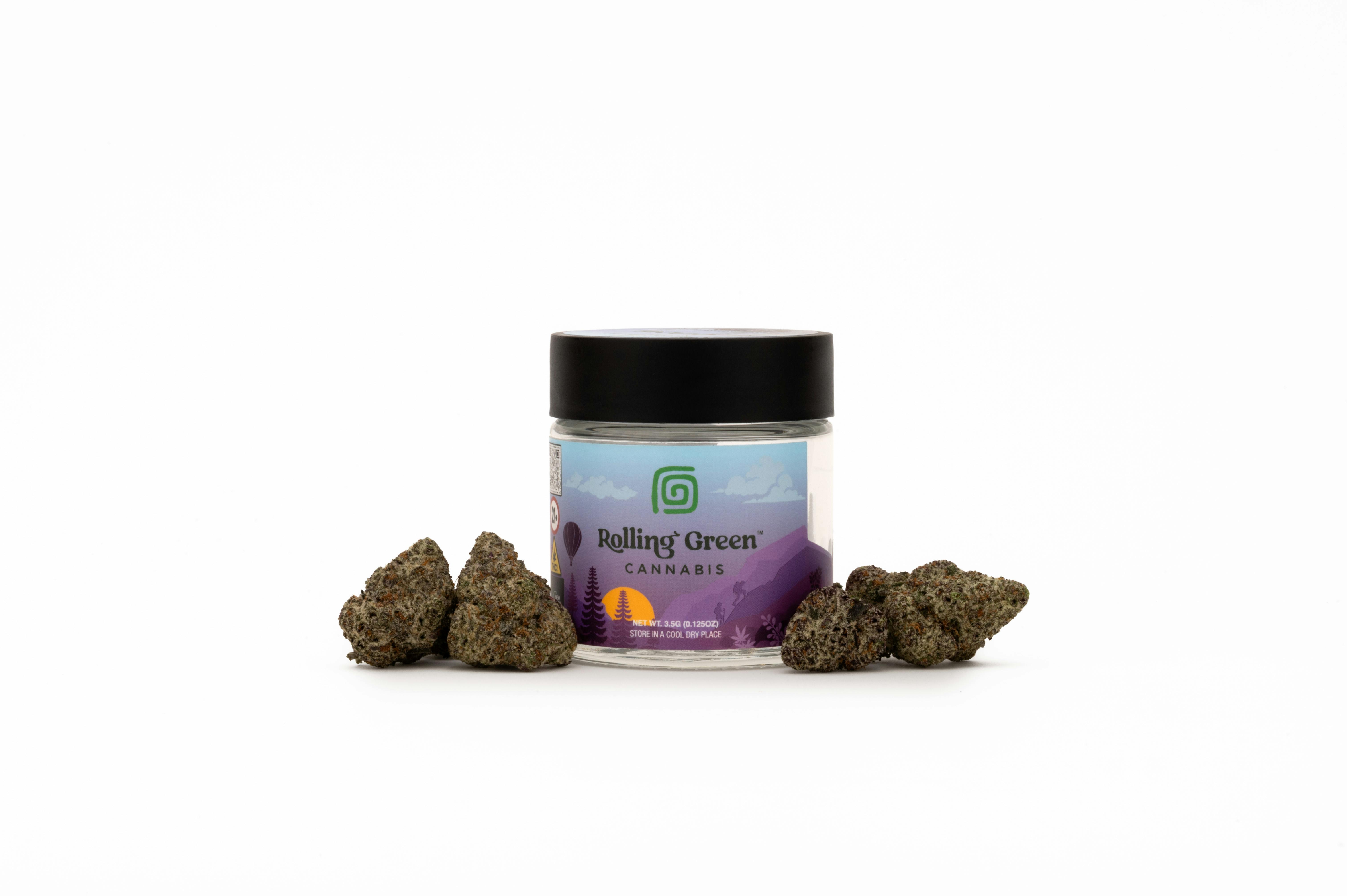
THC 31.93%Indica-Hybrid
Rolling Green CannabisRolling Green | Boss OG | Flower Jar · 3.5g
$53.10
$60after tax

weeddispensarynearme.com
You must be 21 years or older to enter. By entering, you confirm you’re of legal age in your state to purchase cannabis.
For use only by adults 21+ • Keep out of reach of children
1 live products in stock
Quick answer · What is the Boss OG cannabis strain?
Boss OG carries itself with the quiet authority its name implies — a dense, resinous indica-leaning hybrid that draws from some of California's most storied OG Kush genetics. Earthy pine and subtle citrus open the nose, while the effects settle into a grounded, contemplative calm that neither overwhelms nor disappears too quickly. For those who appreciate craft cannabis with genuine depth of character, Boss OG is a measured, deliberate choice.
$60after tax
About Boss OG
Boss OG is generally understood to be a phenotype or close derivative of OG Kush, the foundational West Coast hybrid whose own lineage remains one of cannabis culture's most debated subjects. The prevailing account traces OG Kush to a cross of Chemdawg and a Hindu Kush or Pakistani landrace strain, with some accounts crediting an additional crossing with Lemon Thai. The 'OG' designation — most credibly interpreted as 'Original Gangster' within the Southern California cultivation community of the early 1990s — signals a direct line to that founding material. Boss OG's specific breeder has not been definitively identified in major public cannabis databases, and the precise release year remains undocumented. The strain appears most frequently associated with the broader Los Angeles and San Fernando Valley OG scene that flourished through the 2000s and into the 2010s, when cultivators raced to select and name distinct OG phenotypes with particular vigor, authority, or bag appeal. Genetic siblings from that same OG Kush family tree include SFV OG, Fire OG, Tahoe OG, and Ghost OG — each sharing recognizable terpene architecture while expressing meaningfully different growth habits and effect profiles. Boss OG is distinguished within this family by its notably heavy resin production and a slightly more body-forward effect character than some of its cerebral cousins.
Boss OG tends to arrive with a measured onset — typically within five to ten minutes when inhaled — beginning as a subtle pressure behind the eyes and a gentle loosening of the shoulders that signals the indica influence taking hold. The initial wave carries a mild cerebral quality: thoughts slow to a more deliberate pace, ambient noise softens, and there is a quiet clarity that settles in before the body effects deepen. At its peak, Boss OG expresses itself primarily through physical relaxation. Muscle tension releases with some consistency, and many users describe a heaviness in the limbs that encourages stillness rather than activity. Myrcene, the most abundant terpene in most OG-family cultivars, is widely understood to contribute to this sedative, couch-adjacent quality, while caryophyllene may add a subtle grounding warmth. The experience is not typically disorienting at moderate consumption, though newcomers to high-potency OG genetics should approach with appropriate patience. Duration tends to run two to three hours for most users, with a gradual, unhurried comedown that rarely feels abrupt. The tail end of the experience is often characterized by a pleasant drowsiness and an appetite that arrives quietly but persistently — another hallmark of myrcene-dominant, OG-lineage varieties. As with all cannabis, individual response varies considerably.
The aromatic profile of Boss OG is rooted in the classic OG Kush terpene signature, led by myrcene, which contributes the strain's characteristic damp earth and overripe stone-fruit quality — think the forest floor after rain, with a faint musk underneath. Caryophyllene adds a spiced, slightly woody undercurrent that gives the nose some structural complexity and keeps the aroma from reading as purely sweet. Limonene, present as a secondary terpene in many OG phenotypes, contributes a lifted citrus note — closer to lemon rind than fresh juice — that brightens the top of the nose and prevents the earthiness from becoming heavy. Some phenotypes of Boss OG also carry a quiet pine character attributable to alpha-pinene, which threads through the background and recalls mountain air more than cleaning products. On the palate, the smoke is typically smooth and full-bodied, with the earthy and fuel-adjacent qualities of OG Kush lineage present but not aggressive. Vapor consumption through a quality device tends to open up the citrus and pine notes more distinctly, while the spiced caryophyllene finish lingers on the exhale. The flavor remains coherent from first pull to last, without sharp changes in character — a consistency that experienced OG enthusiasts often cite as a mark of well-grown material.
Boss OG produces buds that are compact and densely packed, reflecting the broad OG Kush structure — small to medium calyxes stacked tightly against one another in a formation that feels almost architectural. The surface is blanketed in trichomes, which under proper lighting give the flower a silver-white frost that signals the resin load characteristic of this lineage. The color palette sits in the mid to deep green range, occasionally punctuated by sage or olive undertones depending on curing conditions and harvest timing. Pistils are typically a warm amber-orange, which stands out vividly against the pale trichome coat. Well-cultivated examples have a slightly sticky, yielding quality when handled — a tactile confirmation of resin density. Trim is usually clean and tight on quality specimens, allowing the true structure of the calyx clusters to read clearly.
Boss OG, in keeping with its OG Kush heritage, presents a moderate-to-challenging cultivation profile that rewards experienced hands. The strain performs well in controlled indoor environments where humidity — particularly during the late flowering stage — can be kept in check. OG-family plants are notoriously susceptible to powdery mildew, and Boss OG is unlikely to be an exception, making airflow and low humidity management essential considerations. Flowering typically runs eight to nine weeks indoors, consistent with most OG Kush phenotypes. Indoor yields are moderate — generally characterful rather than voluminous — and the resin quality tends to justify the attentive care required. Outdoor cultivation is viable in warm, Mediterranean-style climates with low late-season humidity, and harvest typically falls in mid-October in the Northern Hemisphere. The plants stay relatively compact in stature, making them manageable in limited spaces, though they benefit from low-stress training techniques to improve canopy light penetration and overall yield uniformity.
Boss OG is best understood as an evening companion — one suited to the hours after the day's obligations have concluded but before sleep becomes the primary objective. The strain's body-forward relaxation makes it a natural fit for solo unwinding: a long soak, an unhurried film, or an evening of reading in which the mind's usual restlessness is gently quieted. The mild cerebral opening makes it more engaging than a purely sedative indica, lending just enough cognitive warmth to keep the experience contemplative rather than blank. For food pairing, the earthy, spiced terpene profile finds a natural counterpart in umami-rich dishes — aged cheeses, roasted mushrooms, or a well-seasoned braise. On the music side, the measured tempo of late-period jazz or ambient electronic — something in the lineage of Brian Eno's quieter records or the more spacious work of Nils Frahm — maps well to the strain's effect arc. This is not a strain built for high-energy social occasions; it is built for quality time with a trusted few, or for generous solitude.
SFV OG
As a fellow OG Kush phenotype from the San Fernando Valley scene, SFV OG shares the same earthy-pine terpene foundation and body-focused relaxation arc, making it a natural neighbor on the shelf.
Tahoe OG
Tahoe OG amplifies the sedative, heavy-limbed qualities that Boss OG expresses, appealing to those who want to follow the indica thread of the OG family further into evening-to-night territory.
Ghost OG
Ghost OG delivers the citrus brightness and fuel character of the OG lineage with a slightly cleaner, more refined finish — a compelling alternative for those drawn to Boss OG's aromatic profile.
Fire OG
Fire OG shares the resin density and earthy spice of Boss OG while adding a more pronounced fiery, fuel-forward nose that appeals to collectors who appreciate intensity within the OG family.
Skywalker OG
Skywalker OG crosses OG Kush with Skywalker to deliver a comparably body-heavy, relaxing experience with a slightly sweeter, more floral dimension alongside the familiar earthy OG backbone.
Boss OG is an indica-leaning hybrid. Its OG Kush lineage anchors it firmly in indica-dominant territory in terms of physical effect — relaxing, grounding, and body-forward — though it retains a subtle cerebral quality at onset that keeps the experience from being purely sedative. For most users, the indica character predominates as the effects develop and deepen through the session.
Boss OG tastes predominantly of damp earth and pine, with a secondary citrus note — closer to lemon zest than fresh fruit — that appears on the inhale. A spiced, slightly woody finish from caryophyllene lingers on the exhale. The flavor profile is classic OG Kush territory: grounded, resinous, and quietly complex rather than overtly sweet or fruity.
The typical experience begins with a gentle cerebral softening — a slowing of thought and easing of mental tension — before the body effects take over. Physical relaxation is the defining quality, often described as a heavy warmth through the limbs and a release of accumulated muscle tension. The experience is best suited to low-activity evening use. Duration generally runs two to three hours, with a gradual, drowsy comedown.
Strains within the broader OG Kush family offer the closest comparison: SFV OG, Tahoe OG, Ghost OG, and Fire OG all share recognizable terpene architecture and effect character. Skywalker OG is another reasonable parallel, adding a slightly sweeter dimension to the familiar OG foundation. Any shopper drawn to earthy, pine-forward indica-leaning hybrids with genuine resin depth will find familiar footing in this group.
Boss OG can be approachable for beginners, but its OG Kush heritage means it carries meaningful potency that warrants respect. A 'start low, go slow' approach is advisable — particularly for those unaccustomed to indica-dominant effects, which can intensify quickly if consumption is rushed. The effects are not typically disorienting, but the body heaviness can feel pronounced for those new to high-resin OG-family cultivars.
Boss OG's dominant terpene is myrcene, which drives the earthy, musk-adjacent aroma and contributes to the strain's characteristic body-relaxing quality. Caryophyllene follows as a secondary terpene, lending spice and warmth to both the nose and palate. Limonene adds a citrus brightness, and alpha-pinene contributes a quiet pine quality. This terpene combination is the defining signature of the OG Kush lineage to which Boss OG belongs.
Boss OG is best reserved for evening or late-afternoon use, when physical and mental obligations have wound down. Its body-forward relaxation profile and tendency to encourage stillness make it a poor fit for mornings or active, task-oriented periods of the day. The strain performs well as a transition between the active and restorative parts of the day — particularly paired with a quiet meal, ambient music, or an unhurried film.
Boss OG is generally understood to be a distinct phenotype or close derivative within the OG Kush family rather than a separate hybrid cross, which means the two share substantial character. Boss OG tends to express a slightly more pronounced body effect and heavier resin production than baseline OG Kush phenotypes, while the classic earthy-pine-citrus terpene profile remains consistent across both. The differences are ones of degree and refinement rather than fundamental divergence.
Related strains
Pick your store
We'll show pricing, deals, and delivery zones for the store you pick. You can switch any time from the header.