
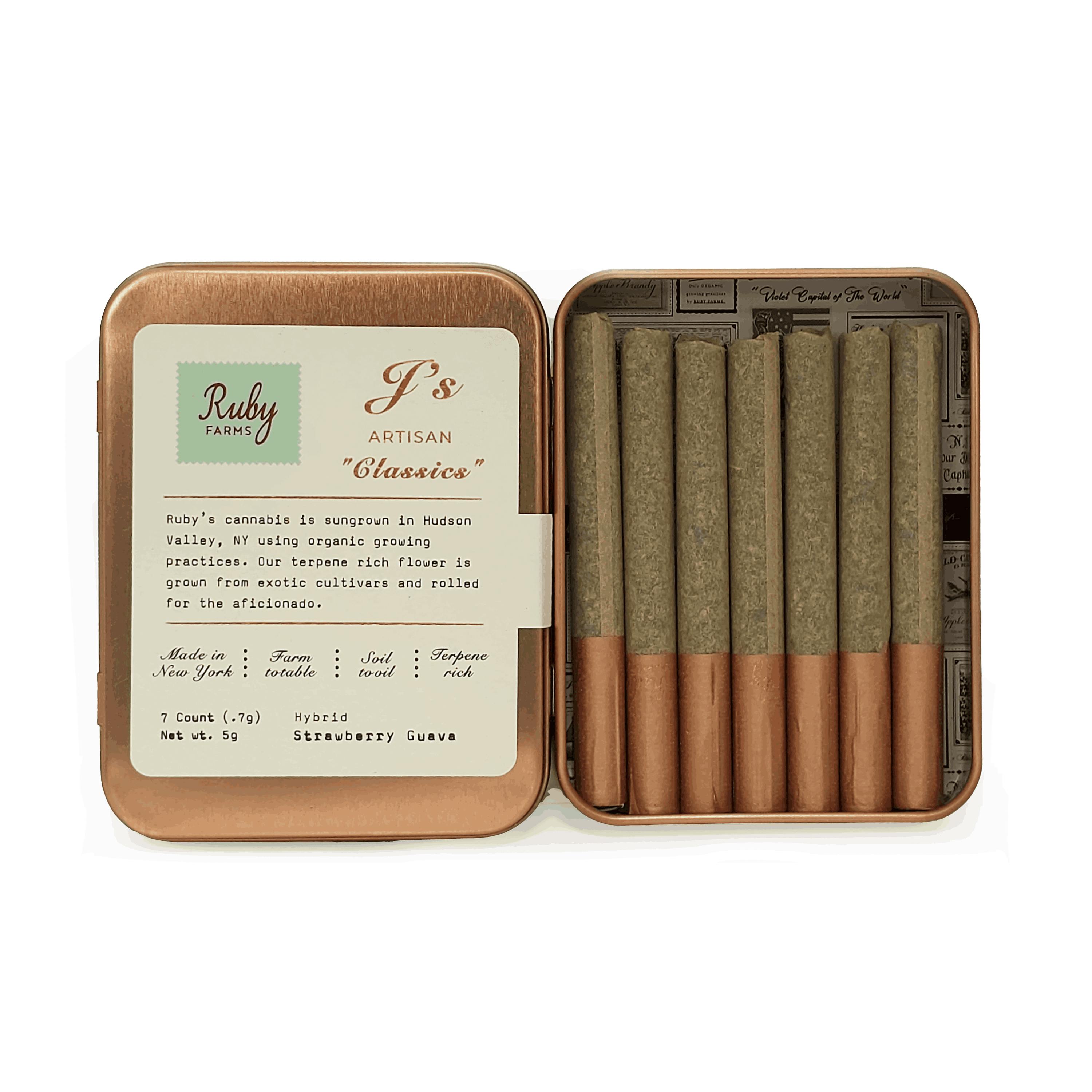
Hybrid
All strains Strawberry Guava
1 live products in stock
Quick answer · What is the Strawberry Guava cannabis strain?
Strawberry Guava arrives with the quiet confidence of a well-ripened tropical fruit — unhurried, fragrant, and layered in ways that reward attention. A balanced hybrid with a lineage rooted in celebrated West Coast genetics, it offers a clean cerebral lift that softens into a composed, body-easing finish. For those who favor a strain that reads as much on the palate as it does in the experience, Strawberry Guava occupies a distinctive and considered place in any curated selection.
Shop Strawberry Guava · 1 of 1 live products
About Strawberry Guava
Everything to know about Strawberry Guava.
Lineage & origin
Strawberry Guava is generally attributed to Dying Breed Seeds, a California-based breeding house that built a reputation for meticulous phenotype hunting and preserving heritage genetics under modern cultivation standards. The strain is understood to be a cross of Strawberry Banana and Papaya — two well-documented hybrids that each carry rich tropical aromatic profiles and strong resin production. Strawberry Banana, itself a cross of Crockett's Banana Kush and Bubblegum from DNA Genetics and Crockett Family Farms, contributes the cream, candy, and overripe-fruit qualities that define much of Strawberry Guava's lower register. Papaya, bred by Nirvana Seeds in the late 1990s and believed to incorporate Mango and Ice genetics, adds a denser body structure and the signature warm, musky-tropical aroma that balances Strawberry Banana's sweeter inclinations. Dying Breed Seeds released Strawberry Guava to wider recognition in the late 2010s, during a period when the California craft market was increasingly rewarding breeders who prioritized terpene expression and nose-forward appeal over raw potency figures. The strain quickly developed a following among connoisseurs drawn to its layered aromatic complexity and its well-tempered balance of effect. Documented phenotypes vary — some lean toward the strawberry-candy end of the spectrum while others express a deeper, earthier guava note — but the core character of the cross remains consistent across reputable cuts. The strain does not have widely documented genetic siblings released under the Dying Breed banner, though its parent Strawberry Banana has spawned numerous crosses across the industry.
Effects
The onset of Strawberry Guava tends to arrive within minutes, presenting first as a gentle clarifying pressure behind the eyes and across the temples — the early signature of a sativa-leaning hybrid that has not abandoned its body altogether. This initial cerebral phase carries a light, focused quality: thoughts organize themselves without urgency, and sensory input, particularly sound and visual detail, takes on a slightly heightened texture. The mood elevates steadily rather than abruptly, which tends to make the transition feel natural rather than jarring. As the experience deepens into its peak, the balance between the mental and physical components becomes more apparent. The body relaxes in a measured way — a loosening of held tension across the shoulders and jaw — without the sedative pull that a more indica-dominant strain might produce. This duality is likely shaped by the combined influence of myrcene, which contributes to muscle ease, and limonene, which supports the uplifted, mood-brightening character. The strain sits comfortably in the middle range of intensity, making it reasonably approachable for those with moderate experience while still offering enough complexity for seasoned consumers. The comedown is gradual and unremarkable in the best sense — there is no pronounced crash or sudden heaviness, but rather a slow unwinding back toward baseline that many find conducive to rest or quiet activity. Overall duration for most consumers falls within the two-to-three-hour window, with the cleaner cerebral effects dominating the first half and a softer, more bodily warmth characterizing the latter portion.
Aroma, flavor & terpenes
Strawberry Guava's aromatic profile is one of its most defining attributes, and it rewards a slow, deliberate approach. The dominant terpenes, typically myrcene, limonene, and caryophyllene, work in concert to produce a layered bouquet that opens with bright, sweet fruit — fresh strawberry on warm days, ripe guava with a faintly musky undertone — before settling into something earthier and more resinous as the bud is broken apart. Myrcene, the most abundant terpene in many cannabis varieties, provides the soft, ripe-fruit and herbal base that gives this strain its grounded warmth. Limonene lifts the top note with a citrus brightness that keeps the overall impression from reading as cloying or heavy. Caryophyllene enters more prominently on the exhale — a subtle, dry spice that cuts through the sweetness and adds structural complexity, the way black pepper functions in a well-composed dish. Secondary terpenes, which may include ocimene and terpinolene depending on the specific phenotype and cultivation conditions, can contribute a wispy, almost floral volatility to the fresh flower's nose that dissipates quickly upon breaking the bud. On the palate, Strawberry Guava is notably smooth in vapor form, delivering the tropical-fruit sweetness on the inhale with a clean, slightly creamy body. The finish lingers with a mild earthiness and a faint spice — that caryophyllene signature again — that keeps the experience from tipping too far into candy territory. The smoke character is similarly approachable, though the flavor resolution is generally cleaner and more precise at lower temperatures, making a convection vaporizer a thoughtful choice for those who wish to parse the profile fully.
Appearance
Well-cultivated examples of Strawberry Guava tend toward compact, moderately dense bud structure — a nod to its indica-inflected Papaya parentage — with calyxes that stack closely and hold their shape under handling. The color palette leans toward medium to deep green, often punctuated by warm amber and occasionally rusty-orange pistils that curl outward against the surface in the manner typical of well-finished hybrids. Lighter phenotypes may show pale sage or yellow-green hues in the leaves closest to the bud interior. Trichome coverage is consistently generous across quality cuts, giving the surface a silvery, almost frosted quality that catches light with a resinous luminosity. Under magnification, the trichome heads are typically full and globular — a visual marker of the aromatic density that follows in the jar. Overall, the flower presents as well-composed and considered, neither the dramatically colored showpiece of a purple-dominant strain nor the rough, airy structure of a loosely cultivated sativa. It is a strain that rewards closer inspection: the more attention paid, the more detail reveals itself.
Growing notes
Strawberry Guava is generally considered a moderately challenging cultivar, suited more comfortably to growers with at least one or two previous cycles of experience. It performs well in both indoor and outdoor settings, though controlled indoor environments tend to produce the most expressive terpene profiles, particularly when cultivators can manage temperature differentials in the final weeks of flower to encourage resin production and color development. Flowering time is typically estimated in the range of eight to nine weeks under standard light cycles. Indoor yields are moderate rather than prolific — this is a strain that rewards attention to canopy management and environmental precision more than heavy feeding regimens. Outdoor cultivation in warm, Mediterranean-type climates can yield generously, with harvest windows generally falling in early to mid-October in the Northern Hemisphere. The plants tend toward medium height with a branchy structure that benefits from low-stress training early in the vegetative phase. Humidity management during the late flowering window is worth prioritizing, as the dense bud structure can be susceptible to moisture retention if air circulation is inadequate.
When it's best enjoyed
Strawberry Guava occupies a temporal sweet spot that makes it a compelling choice for the transition hours of the day — the late afternoon into early evening, when the demands of structured work have eased but the desire for engaged, unhurried experience remains. Its balanced arc of effect, lifting without overstimulating and relaxing without sedating, makes it a natural companion for activities that benefit from a quiet sharpening of sensory attention: a slow dinner prepared at home, an hour with a novel or a record that merits full listening. For food pairing, the strain's tropical-fruit and spice terpene profile aligns naturally with dishes that carry similar flavor architecture — a ceviche with citrus and a clean heat, or a charcuterie arrangement anchored by aged cheeses and dried fruit. In terms of music, the warm, midrange-rich character of the experience tends to suit recordings with layered acoustic texture: jazz of the modal variety, or well-produced soul and R&B where the interplay between instruments rewards sustained attention. It is equally at ease in solo contemplation as it is in the company of two or three people sharing a quiet, unhurried evening — a strain that neither demands the room nor disappears into the background.
If you like Strawberry Guava, also explore
Strawberry Banana
As a direct parent of Strawberry Guava, Strawberry Banana shares much of the same tropical-fruit sweetness and creamy aromatic depth, making it the most logical next exploration for anyone drawn to Strawberry Guava's flavor profile.
Papaya
The other parent in the cross, Papaya offers the same musky-tropical warmth and dense resin structure, with a slightly more indica-leaning effect arc that appeals to Strawberry Guava fans seeking a longer, more body-centered experience.
Tropicana Cookies
Sharing a bright citrus-and-fruit terpene signature driven by limonene, Tropicana Cookies offers a similarly clean cerebral lift with a comparable tropical-candy nose that rewards connoisseurs who favor aromatic precision.
Mimosa
Mimosa's citrus-forward, uplifting hybrid character and smooth palate make it a natural companion recommendation for Strawberry Guava enthusiasts who enjoy daytime-friendly, mood-elevating experiences with refined aromatic profiles.
Zkittlez
For those who prize the ripe, multi-layered fruit expression in Strawberry Guava, Zkittlez offers a comparable spectrum of tropical and berry notes alongside a gentle, balanced body effect that does not overwhelm.
Common questions
Is Strawberry Guava indica or sativa?+
Strawberry Guava is a hybrid, generally understood to lean slightly toward the balanced center of the spectrum. Its Strawberry Banana parentage contributes a measure of sativa-leaning cerebral clarity, while its Papaya lineage grounds the experience with a modest indica warmth in the body. Most consumers describe it as a well-integrated hybrid rather than one that tips markedly in either direction, making it a versatile choice across a range of occasions.
What does Strawberry Guava taste like?+
Strawberry Guava tastes much as it smells: ripe tropical fruit — fresh strawberry and warm guava — with a creamy, slightly candy-like body on the inhale. The exhale introduces a subtle earthiness and a faint dry spice, courtesy of caryophyllene, that keeps the overall profile from reading as purely sweet. At lower temperatures, the vapor resolves with particular clarity, allowing the layered fruit notes to come forward without interference.
What are the typical effects of Strawberry Guava?+
Consumers typically describe Strawberry Guava as producing a clean, focused cerebral lift in the early phase, followed by a gradual softening into physical ease as the experience matures. The overall character is uplifting without being anxious, and relaxing without being sedating. The experience tends to be well-balanced across mental and physical dimensions, with a gentle, unhurried comedown. As with any cannabis product, individual experience varies — starting with a modest amount is always advisable.
What strains are similar to Strawberry Guava?+
Consumers who enjoy Strawberry Guava often gravitate toward Strawberry Banana and Papaya — its direct parent strains — as well as other terpene-forward tropical hybrids such as Tropicana Cookies, Mimosa, and Zkittlez. Each of these shares some portion of the aromatic warmth, fruit-forward palate, or balanced hybrid effect that defines the Strawberry Guava experience, though each carries its own distinct character worth exploring on its own terms.
Is Strawberry Guava good for beginners?+
Strawberry Guava sits in a moderate range of intensity that makes it more approachable than many high-potency cultivars, but it is not without character. Consumers new to cannabis or returning after a long pause are encouraged to follow the standard guidance of starting with a small amount and allowing adequate time to assess the experience before consuming more. The strain's balanced profile means there is less risk of an abrupt or disorienting onset, but individual sensitivity always warrants a measured approach.
What are the dominant terpenes in Strawberry Guava?+
The dominant terpenes in Strawberry Guava are generally identified as myrcene, limonene, and caryophyllene. Myrcene provides the ripe-fruit and herbal base note and contributes to the strain's physical ease. Limonene lifts the aromatic profile with bright citrus and supports the uplifted mood character. Caryophyllene adds a dry, peppery complexity on the finish. Secondary terpenes, which may include ocimene or terpinolene, can vary by phenotype and growing conditions.
Who bred Strawberry Guava and where does it come from?+
Strawberry Guava is generally attributed to Dying Breed Seeds, a California-based breeding operation known for its focus on aromatic expression and phenotype curation. The strain came to prominence in the late 2010s alongside a broader movement in the California craft cannabis market that prioritized terpene complexity and nose-forward cultivar selection. Its parents — Strawberry Banana and Papaya — are both well-documented strains with their own established lineages and reputations.
When is the best time of day to enjoy Strawberry Guava?+
Strawberry Guava's balanced effect arc makes it well-suited to the transitional hours of the day — late afternoon or early evening — when the structure of the workday has lifted but full sedation is not the goal. Its cerebral clarity in the early phase suits engaged, unhurried activity, while its gradual physical ease in the latter portion makes it a natural companion to a relaxed dinner or quiet social setting. It is less ideally suited to the early morning or to situations requiring sharp analytical focus.
Related strains