
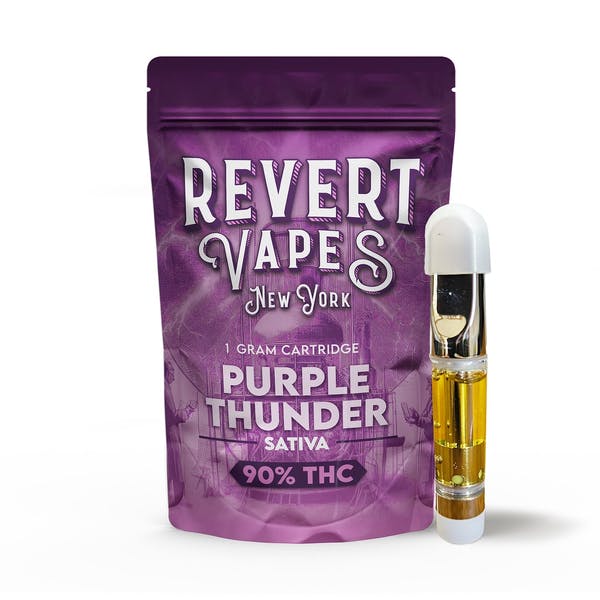
Sativa
All strains Purple Thunder
1 live products in stock
Quick answer · What is the Purple Thunder cannabis strain?
Purple Thunder arrives with a quiet confidence — a sativa-leaning cultivar whose deep violet canopy belies the bright, clarifying lift it delivers. Born from a lineage steeped in West Coast breeding tradition, it carries an aromatic complexity that moves from ripe berry on the inhale to a crisp, almost piney exhale. For those who seek an engaged, energized state of mind without sacrificing sensory pleasure, Purple Thunder occupies a distinctive place on the dispensary shelf.
Shop Purple Thunder · 1 of 1 live products
About Purple Thunder
Everything to know about Purple Thunder.
Lineage & origin
Purple Thunder's precise genetic record is not uniformly documented across public databases, and the breeder has not issued a single authoritative account of its parentage. The most widely cited account places it as a cross between a purple-expressing phenotype — likely drawing from the broader Purple family that includes Purple Urkle and Mendocino Purps — and a sativa-dominant partner, often suggested to be a Trainwreck-adjacent cultivar. That Trainwreck influence, itself a Northern California landrace hybrid of Mexican, Thai, and Afghani genetics documented by Leafly and corroborated across multiple breeder histories, would account for the strain's upward-driving cerebral character despite its visually indica-coded appearance. The purple coloration that defines the strain's aesthetic is attributable to anthocyanins — pigments activated by cooler temperatures during the late flowering phase, a well-understood botanical process rather than a marker of any particular genetic family. Strains expressing similar anthocyanin-driven coloration have appeared across decades of West Coast cultivation, from Granddaddy Purple popularized by Ken Estes in the early 2000s to the older Mendocino Purps phenotypes. Purple Thunder does not belong to a formally catalogued seed bank release with a fixed date, which is common among regionally circulated phenotypes that spread through clone networks before commercial documentation caught up. Its sativa character, however, has been consistently reported by cultivators and consumers alike, distinguishing it from the heavy-bodied purples that dominate the indica end of the spectrum.
Effects
The onset of Purple Thunder tends to arrive within five to fifteen minutes of inhalation, beginning as a gentle pressure behind the eyes and a brightening of ambient awareness — the kind of shift that makes a familiar room feel newly considered. This early phase is cerebral and social in character, with reported effects leaning toward elevated mood, focused curiosity, and a loosening of conversational inhibition. The sativa influence is apparent here: thoughts tend to move quickly and associatively rather than settling into the heavier, inward drift associated with indica-dominant cultivars. At peak, which typically spans thirty to sixty minutes depending on individual tolerance and consumption volume, the experience broadens into a mild body warmth that supports rather than sedates. Terpenes such as terpinolene and limonene, which are frequently identified in sativa-leaning profiles of this character, are associated in preliminary research with uplifting and anxiolytic properties, contributing to the strain's reputation for a clear-headed, optimistic quality. The comedown is generally described as gradual and soft — energy eases rather than drops, and the experience tends to resolve into a relaxed but functional baseline rather than fatigue or fog. As with any potent cultivar, those new to cannabis or returning after a break would benefit from the universal principle of starting low and going slow, allowing adequate time between sessions to gauge their individual response before proceeding.
Aroma, flavor & terpenes
Purple Thunder's aromatic profile opens on a foundation of ripe, dark berry — think blackcurrant and concord grape — that is both immediate and persistent on the nose. This quality is characteristic of myrcene, the most commonly occurring terpene in cannabis, known for its earthy, musky-sweet quality that underpins the berry impression without tipping into artificial sweetness. Myrcene's presence also contributes a subtle herbal density to the background, preventing the fruit notes from becoming one-dimensional. Moving deeper into the profile, terpinolene introduces a lifted, floral-piney brightness that cuts through the fruit and gives the strain its more distinctive sativa-coded character. Terpinolene, documented across multiple allbud and Leafly profiles for strains in this genetic vicinity, carries associations with citrus rind, fresh wood, and even a faint hint of anise — complex modifiers that reward a slower, more attentive inhale. Limonene adds a clean citrus sharpness, most apparent on the exhale, while trace caryophyllene — a spicy, peppery sesquiterpene — provides the dry finish that anchors the flavor and prevents it from becoming cloying. On vapor, the palate experience is particularly nuanced: the initial draw delivers that berry-forward sweetness, the mid-draw opens into a herbal pine register, and the finish resolves into a faintly spiced, dry citrus note. In combustion, the smoke is medium-bodied with a clean burn when properly cured, leaving a pleasantly sweet residue on the lips.
Appearance
Purple Thunder is, visually, one of the more arresting cultivars on a well-curated dispensary shelf. The buds are medium-to-dense in structure — not the tightly packed, round formations of a classic indica, but a more elongated, slightly tapered calyx architecture consistent with sativa heritage. Individual flowers hold their shape well and have a satisfying firmness when gently compressed, a reliable indicator of proper cure and adequate trichome development. The color palette is the strain's defining visual characteristic: deep violet and muted indigo tones spread across the outer leaves and calyxes, set against a foundation of forest green. Rust-orange pistils weave through the bud in generous density, providing a warm contrast to the cool purple tones. The trichome coverage is substantial, giving the surface a frosted, almost luminous quality under direct light — fine, crystalline glandular heads that reflect the considerable terpene and cannabinoid investment of a well-grown lot. Under close inspection, the resin glands appear predominantly milky with amber highlights in properly timed harvests.
Growing notes
Purple Thunder is reported to perform well in both indoor and outdoor settings, though indoor cultivation under controlled conditions allows growers to deliberately trigger and intensify the anthocyanin expression — the deep purpling — by introducing a modest temperature drop in the final two weeks of flowering. Outdoor cultivation in climates with cool autumn nights achieves a similar effect naturally, making the Pacific Northwest and higher-elevation California locales particularly well-suited terroirs. Flowering time is documented in the range of eight to ten weeks under a standard twelve-twelve photoperiod indoors, placing it in a mid-range window that is neither unusually demanding nor unusually fast. Yield reports are moderate to above-average for a sativa-leaning cultivar, which can trend toward lower output compared to heavier indica structures. The plant's growth habit tends toward vertical stretch during the early flowering transition — a characteristic of its sativa lineage — making low-stress training or topping beneficial for indoor environments with height constraints. Difficulty is considered intermediate: the strain is not forgiving of significant nutrient imbalances, and humidity management during the dense flowering period warrants attention. For the cultivator-curious shopper, it represents an engaging, visually rewarding project rather than a straightforward beginner grow.
When it's best enjoyed
Purple Thunder finds its most natural expression in the late morning or early afternoon — that window after the day has gathered its shape but before the obligations of evening have arrived. It suits solo creative work particularly well: the clarifying, association-rich headspace reported at peak can make writing, illustration, or musical composition feel more fluid and less self-critical. The mild body warmth that follows the initial cerebral onset is sufficiently grounding to prevent the restless edge that some pure sativas can carry, making sustained focus more attainable. Socially, it translates equally well to an intimate gathering — a Sunday market visit, a gallery walk, or a low-key gathering of friends where conversation is the evening's primary architecture. The strain's aromatic profile suggests natural pairings with food and drink that complement its berry-and-pine character: aged soft cheeses with dark fruit accompaniments, or a cold-brew coffee with citrus notes that echo the limonene finish. For a musical pairing, mid-tempo jazz or ambient electronic — something with structural complexity but unhurried momentum — mirrors the strain's own balance of stimulation and ease. Those sensitive to sativa-driven elevation should, as always, approach their first session conservatively.
If you like Purple Thunder, also explore
Trainwreck
Fans drawn to Purple Thunder's bright cerebral onset and piney-citrus terpene register will recognize the same energizing, mentally expansive arc in Trainwreck, one of Purple Thunder's likely genetic contributors.
Granddaddy Purple
Those who appreciate the deep violet aesthetics and dark berry aroma of Purple Thunder will find Granddaddy Purple's grape-and-berry profile familiar, though with a heavier, more indica-dominant body effect.
Purple Haze
A classic sativa with purple-coded heritage, Purple Haze shares Purple Thunder's elevated, creative headspace and berry-forward aroma, making it a natural recommendation for fans of either cultivar.
Mendocino Purps
As a likely ancestral branch of the purple-expressing genetics in Purple Thunder, Mendocino Purps offers a comparable aromatic sweetness and a similarly balanced euphoric character with strong West Coast terroir roots.
Jack Herer
Shoppers who value the focused, clear-headed sativa effects and complex terpene layering of Purple Thunder will find Jack Herer's piney, terpinolene-rich profile occupies a similar experiential register.
Common questions
Is Purple Thunder indica or sativa?+
Purple Thunder is classified as a sativa-dominant cultivar. Despite its visually striking purple coloration — which often signals indica genetics in popular convention — its reported effects lean cerebral and energizing rather than sedating. The color is the result of anthocyanin pigment expression, which is a temperature-driven botanical response rather than a reliable indicator of effect profile or genetic dominance.
What does Purple Thunder taste like?+
Purple Thunder delivers a layered flavor experience that opens with ripe dark berry — blackcurrant and concord grape are the most commonly cited references — and transitions through a herbal, piney mid-note before finishing with a dry, faintly spiced citrus exhale. The terpene combination of myrcene, terpinolene, limonene, and caryophyllene accounts for this arc from sweet to bright to subtly peppery.
What are the typical effects of Purple Thunder?+
Consumers most frequently describe an initial cerebral lift characterized by elevated mood, sharpened focus, and increased sociability, followed by a broadening body warmth that supports activity without inducing sedation. The experience tends to resolve gradually into a relaxed but functional baseline. The overall arc is consistent with sativa-dominant profiles: engaged and outwardly oriented rather than inward or heavy.
What strains are similar to Purple Thunder?+
Shoppers who enjoy Purple Thunder often find comparable experiences in Trainwreck for its energizing cerebral character, Purple Haze for its sativa-dominant berry profile, and Jack Herer for its terpinolene-forward clarity. Those drawn specifically to the visual and aromatic purple expression may also appreciate Granddaddy Purple and Mendocino Purps, though both lean more indica in their effect profiles.
Is Purple Thunder good for beginners?+
Purple Thunder is a potent sativa-dominant cultivar that may be overstimulating for those with low tolerance or limited cannabis experience. The energizing, thought-accelerating nature of sativa-leaning strains can occasionally heighten anxiety in sensitive individuals. Newcomers or those returning after a long break are encouraged to start with a single, conservative inhalation, wait a full fifteen minutes before reassessing, and avoid combining with other substances.
What are the dominant terpenes in Purple Thunder?+
The most prominently reported terpenes in Purple Thunder are myrcene, responsible for the earthy, dark-berry sweetness; terpinolene, which contributes floral, piney, and faintly citrus complexity; and limonene, which provides the clean citrus brightness most apparent on the exhale. Caryophyllene appears as a secondary terpene, adding a dry, peppery finish that grounds the otherwise fruit-forward aromatic profile.
When is the best time of day to enjoy Purple Thunder?+
Given its sativa-dominant, energizing character, Purple Thunder is generally better suited to daytime or early-evening use rather than the hours immediately before sleep. Late-morning and afternoon sessions are frequently cited as the most complementary window — a time when its capacity for focused, elevated engagement can be directed toward creative work, social activity, or an active outdoor outing rather than competing with the body's natural wind-down process.
Why is Purple Thunder purple?+
The violet and indigo coloration in Purple Thunder's buds is caused by anthocyanins — water-soluble pigments present in many plants, from blueberries to red cabbage. In cannabis, these pigments become visible when cooler temperatures during the late flowering phase reduce chlorophyll production, allowing the underlying anthocyanin hues to emerge. The coloration is a temperature-responsive botanical trait and does not in itself indicate a specific effect profile or potency level.
Related strains