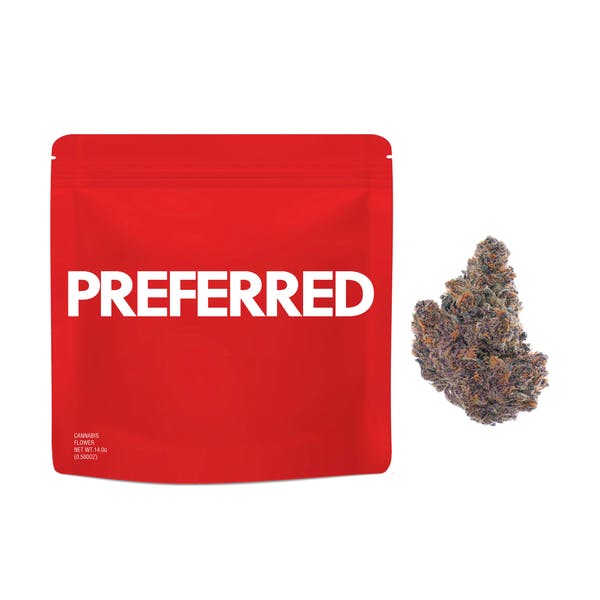
THC 28.52%Hybrid
Preferred GardensPreferred Gardens | Purple Medusa | Flower · 14g
$150.44
$170after tax

weeddispensarynearme.com
You must be 21 years or older to enter. By entering, you confirm you’re of legal age in your state to purchase cannabis.
For use only by adults 21+ • Keep out of reach of children
1 live products in stock
Quick answer · What is the Purple Medusa cannabis strain?
Purple Medusa arrives with the quiet authority of a strain that knows exactly what it is — a densely structured hybrid draped in violet and frost, carrying an aroma that moves from sweet grape through cool earth before settling into something warmer and more resinous. Unhurried in its onset and generous in its plateau, it is the kind of cultivar that rewards those who approach cannabis as a sensory ritual rather than a transaction.
$170after tax
About Purple Medusa
Purple Medusa is a hybrid whose precise parentage has not been uniformly documented across major public databases, and the breeder of record varies depending on the source consulted. Several cultivators and seed banks have released genetics under this name, which has contributed to some lineage ambiguity in the wider cannabis community. The most commonly cited genetic foundation points to a cross involving Medusa — itself a sativa-leaning strain with roots in early Dutch breeding programs — and a purple-expressing indica phenotype, likely drawn from the broader Purple family that includes Purple Kush, Granddaddy Purple, or related Oregon- and California-origin cultivars. The purple coloration that defines the strain is the result of elevated anthocyanin expression triggered by cooler overnight temperatures during the late flowering window, a trait inherited from its indica side. The Medusa lineage contributes a characteristic cerebral lift and a terpene profile that leans toward the floral and green-citrus end of the spectrum, while the purple parent brings the heavy resin production, the characteristic berry-grape nose, and the body-settling qualities that balance the experience. As with many named hybrids that circulate through both North American and European markets, phenotypic variation between batches and breeders is real, and shoppers may encounter slight differences in effect character or aroma emphasis from one source to another. The strain has gained a loyal following among those who value both aesthetic presentation and a well-rounded hybrid arc.
The onset of Purple Medusa is measured rather than immediate, typically arriving within five to ten minutes of inhalation as a gentle pressure behind the eyes and a subtle brightening of sensory attention. This initial phase is cerebral without being anxious — thoughts gain a certain ease and flow, and the immediate environment tends to feel more textured and present. The experience at this stage is social enough to support conversation while remaining introspective enough for solitary engagement. As the session moves into its peak, roughly twenty to forty minutes in depending on individual sensitivity and consumption volume, a warm physical quality begins to layer beneath the mental character. Muscle groups that carry habitual tension — shoulders, jaw, lower back — tend to soften, and the body settles without the heaviness that a more indica-dominant cultivar might impose. This balance is the strain's defining quality, and it reflects the interplay between its terpene profile and its hybrid cannabinoid expression. Myrcene contributes to the body ease; limonene sustains the mood elevation. The comedown from Purple Medusa is gentle and gradual, easing rather than dropping. Total duration typically falls in the two-to-three-hour range for most consumers, though those with lower tolerance may experience a longer arc. An unhurried, restful quality tends to characterize the final phase — not sedation, but a natural unwinding that makes the evening feel appropriately concluded. As always, starting with a conservative amount and observing the body's response before continuing is sound practice.
The aromatic character of Purple Medusa opens with what most people immediately read as grape — a sweet, slightly jammy quality that is the signature of myrcene operating in concert with the anthocyanin-rich genetics of its purple parent. Myrcene, one of the most prevalent terpenes in cannabis, delivers that recognizable musky-fruity warmth and is well-documented for its role in smoothing the overall sensory profile. Beneath the grape note, a layer of cool earthiness emerges — damp soil and dried herb — which grounds the sweetness and prevents it from reading as cloying. Secondary terpenes introduce complexity as the flower opens fully. Caryophyllene, a spicy sesquiterpene also found in black pepper and clove, adds a subtle edge that becomes more apparent mid-exhale. Linalool, best known from lavender, contributes a delicate floral softness that bridges the grape and the earth, lending the overall aroma a refined, almost perfumed quality that distinguishes Purple Medusa from blunter berry-forward strains. Pinene may also be present in smaller concentrations, adding a clean, resinous brightness that sharpens the finish. On the palate, the smoke or vapor is smooth and full-bodied rather than sharp. The inhale carries the sweet grape and floral notes established in the aroma, while the exhale reveals the spice of caryophyllene and a lingering herbal quality. The finish is clean and resinous, and the flavor holds reasonably well across multiple draws — a sign of careful cultivation and proper cure.
Purple Medusa is a visually striking cultivar, and its presentation is one of the primary reasons it has cultivated a devoted aesthetic following. The buds are dense and tightly formed, reflecting the indica influence in their compact calyx structure. Coloration is the dominant first impression: deep violet and plum tones saturate the leaves and calyxes, set against a backdrop of forest green that becomes visible primarily at the bud's core. This purple expression is genuine rather than superficial, running through the flower rather than residing only at the leaf tips. Trichome coverage is generous and uniform, laying a silver-white frost across the surface that catches light and lends the bud an almost iridescent quality at close range. Pistils — the hair-like structures that develop during flowering — appear in warm amber and rust tones, creating a color contrast against the violet and white that makes the flower particularly photogenic. The overall structure is well-resolved and cohesive, suggesting genetics that express consistently under skilled cultivation conditions.
Purple Medusa is considered a moderately challenging cultivar, better suited to growers with at least one or two prior grows under their belts rather than absolute beginners. Its flowering window typically falls in the eight-to-nine-week range indoors, making it a mid-length project. Indoor cultivation allows for the temperature manipulation — specifically, cooler nighttime temperatures in the final two to three weeks — that maximizes the violet coloration that defines the strain's identity and market appeal. Without that temperature drop, the purple expression may be muted. Yield indoors is moderate to above average when grown with adequate lighting and a well-maintained canopy; the dense bud structure rewards growers who manage airflow carefully, as the compact form can be susceptible to moisture-related issues if humidity is not controlled in the late flowering window. Outdoors, Purple Medusa performs well in temperate climates with reliably dry autumns, where natural evening temperature drops can encourage the same anthocyanin expression achieved deliberately indoors. Harvest typically falls in early to mid-October in the Northern Hemisphere. The strain's resin production makes it of particular interest to those curious about concentrate applications alongside traditional flower consumption.
Purple Medusa occupies the space between stimulation and ease that makes it particularly well-suited to the early evening — that transitional hour when the day's obligations have released their grip but the night has not yet fully settled in. It is a strain that rewards slow, deliberate engagement rather than hurried consumption, and it pairs naturally with activities that benefit from both physical comfort and a gently elevated attention. For the solitary consumer, it accompanies creative work that does not demand precision — freeform writing, sketching, or moving through a new record with full attention. The linalool and myrcene combination makes it a natural companion to ambient or atmospheric music, where the softened physical state and the enhanced sensory presence allow texture and space within the sound to come forward in a way that feels genuinely pleasurable rather than forced. For a shared occasion, it works well over a meal that leans into similar aromatic registers — dishes with berry reductions, earthy mushroom preparations, or anything with a spiced, warm finish that echoes the caryophyllene in the terpene profile. It is convivial without being overstimulating, and unhurried without encouraging early withdrawal from the evening.
Granddaddy Purple
Fans of Purple Medusa's grape-forward aroma and violet aesthetic will find a direct lineage echo in Granddaddy Purple, which shares the berry-myrcene profile and the visually saturated coloration that defines both cultivars.
Purple Punch
Purple Punch offers a similarly sweet, fruit-forward nose and a body-settling hybrid arc that will feel familiar to Purple Medusa consumers who value smooth, approachable transitions between cerebral onset and physical ease.
Zkittlez
For those drawn to Purple Medusa's layered fruit sweetness and refined terpene complexity, Zkittlez delivers a comparably polished aromatic experience with a calm, balanced effect profile.
Gelato
Gelato shares the dense trichome coverage, the dessert-adjacent flavor profile, and the measured hybrid balance that Purple Medusa consumers tend to find satisfying across multiple session types.
Do-Si-Dos
Do-Si-Dos offers a similar interplay of floral and earthy qualities alongside strong indica-leaning physical ease, making it a natural recommendation for those who appreciate Purple Medusa's linalool-caryophyllene character.
Purple Medusa is classified as a hybrid, drawing from both indica and sativa lineage. Its effect profile reflects that balance: the onset carries a cerebral, mood-elevating quality associated with sativa influence, while the mid-to-late session introduces a physical ease and warmth that traces to its indica heritage. Neither character overwhelms the other, which is precisely what makes it a versatile cultivar across different occasions and consumer preferences.
The flavor profile of Purple Medusa centers on sweet grape and berry on the inhale, underscored by a cool earthiness that adds depth without bitterness. The exhale brings forward a subtle spice — attributable to caryophyllene — and a lingering floral note from linalool. The overall palate impression is smooth, full-bodied, and well-resolved, with a clean resinous finish that holds across multiple draws when the flower has been properly cured.
Purple Medusa typically begins with a gentle cerebral lift — a brightening of mood and attention that arrives without urgency or anxiety. Within twenty to forty minutes, a warm physical ease layers in beneath the mental quality, relaxing tension without producing heavy sedation. The overall experience is balanced and unhurried, making it suitable for both social and solitary contexts. Duration generally falls in the two-to-three-hour range, with a gradual, restful comedown.
Consumers who enjoy Purple Medusa tend to gravitate toward other cultivars with berry-forward terpene profiles and balanced hybrid effects. Granddaddy Purple and Purple Punch share the grape-myrcene aromatic lineage, while Zkittlez offers comparable fruit complexity. Gelato provides a similarly refined trichome-rich presentation, and Do-Si-Dos echoes the floral-earthy terpene character. Any of these would be a reasonable next exploration for someone building on their experience with Purple Medusa.
Purple Medusa's balanced hybrid character makes it more approachable than highly potent single-note indica or sativa cultivars, but it is not without intensity for those new to cannabis. The layered terpene profile and the effect arc — which moves through cerebral and physical phases — can feel significant for consumers without an established tolerance. The standard guidance applies: start with a conservative amount, allow adequate time for the onset to fully develop, and observe your response before continuing.
Myrcene is the primary terpene in Purple Medusa, contributing the musky, berry-fruit warmth that anchors the aroma. Caryophyllene follows as a notable secondary terpene, adding spice and depth on the exhale. Linalool brings a soft floral quality that elevates the profile beyond simple fruit sweetness. Pinene may also be present in smaller amounts, providing a clean resinous brightness. This terpene combination is largely responsible for both the aromatic complexity and the balanced effect arc the strain is known for.
The violet and plum tones in Purple Medusa result from the expression of anthocyanins — water-soluble pigments that become visible when chlorophyll production slows late in the flowering cycle. In this strain, cooler nighttime temperatures during the final weeks of flowering trigger that shift most dramatically. The trait is inherited from its indica-side genetics, which carry the genetic predisposition for anthocyanin expression. The purple coloration is entirely natural and has no direct bearing on potency or flavor.
Purple Medusa is most at home in the early evening — after the day's demands have passed but before the intention to sleep has fully arrived. Its balanced effect arc, which moves from mild cerebral elevation into physical ease, suits that transitional window particularly well. It can accompany a shared meal, a creative session, or simply an unhurried hour of music or reading. Those sensitive to its effects may find it best reserved for moments when no further obligations remain for the evening.
Related strains
Pick your store
We'll show pricing, deals, and delivery zones for the store you pick. You can switch any time from the header.