
THC 34.73%Hybrid
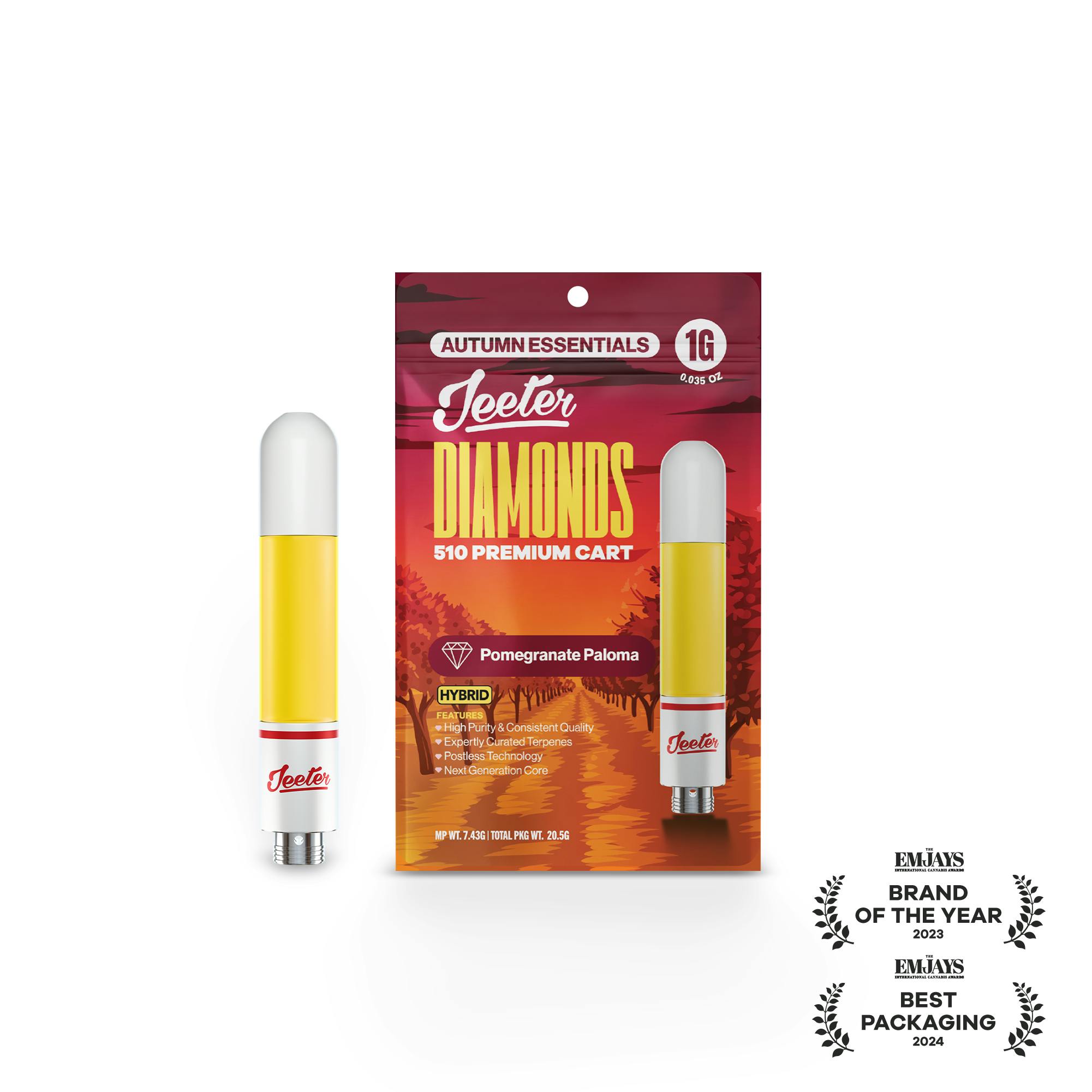
JeeterJeeter Pomegranate paloma Infused W/ Liquid Diamonds, Rosin, Dusted In Kief Preroll - Hybrid · 1g
$20.35
$23after tax

weeddispensarynearme.com
You must be 21 years or older to enter. By entering, you confirm you’re of legal age in your state to purchase cannabis.
For use only by adults 21+ • Keep out of reach of children
3 live products in stock
Quick answer · What is the Pomegranate Paloma cannabis strain?
Pomegranate Paloma arrives at the intersection of fruit-forward brightness and grounded, unhurried ease — a hybrid that earns its name through a tart, citrus-laced aroma reminiscent of the classic Mexican cocktail it evokes. Cultivated for balance, it offers a clear-headed lift that gradually yields to a soft, even-bodied calm. For the discerning New York consumer seeking something both sessionable and distinctive, Pomegranate Paloma occupies a quietly confident space on the shelf.
$23after tax
$45after tax

$96after tax
About Pomegranate Paloma
Pomegranate Paloma is a hybrid variety whose precise lineage has not been fully disclosed by its breeder in widely available public records, placing it among a growing category of proprietary craft cultivars developed primarily for the regulated adult-use market. Based on its documented terpene profile and effect character, it is widely understood to descend from fruit-forward hybrid genetics — likely drawing from lineages associated with strains in the Zkittlez or Cherry family, which are themselves rooted in Grape Ape and Grapefruit parentage, alongside possible contributions from citrus-dominant sativa lines. Some phenotype descriptions suggest a kinship with strains carrying strong limonene and myrcene expression, consistent with a Tangie or Clementine influence on the sativa side of its family tree. The name itself functions as a cultivar identity marker rather than a strict taxonomic descriptor — a branding convention increasingly common among craft and licensed producers releasing regionally exclusive genetics. Pomegranate Paloma appears to have emerged within the post-legalization craft cultivation scene, where breeders prioritize terpene complexity and visual appeal alongside potency. Until the originating breeder publicly names the parent strains, the lineage remains partially speculative. What is not speculative is the consistency of its fruit-forward phenotypic expression, which growers and consumers across multiple markets have noted as reliably reproducible.
Onset for Pomegranate Paloma typically arrives within five to ten minutes when smoked or vaped, beginning as a gentle brightening behind the eyes and a subtle lift in mental tempo. The early phase is predominantly cerebral — thoughts become more fluid, conversation feels less effortful, and there is a mild but pleasant sharpening of sensory detail. This opening window aligns with what researchers associate with limonene-forward profiles, where the terpene's interaction with serotonin-adjacent pathways may contribute to mood elevation without inducing agitation. As the experience matures into its peak — generally between twenty and forty-five minutes in — the hybrid character asserts itself more fully. The initial mental brightness does not disappear but is joined by a spreading physical ease that moves through the shoulders and back without becoming sedating. Myrcene's known muscle-relaxing associations are plausible contributors here. The body and mind feel integrated rather than pulled in competing directions, which distinguishes well-balanced hybrids from their more lopsided counterparts. The comedown is gradual and unhurried, with most consumers reporting a soft return to baseline over one to two hours rather than an abrupt drop. Heavy fatigue is not typically associated with this cultivar at moderate consumption levels, though as with any cannabis product, individual response varies considerably. A slow, considered approach to dosing remains the most prudent entry point, particularly for those newer to hybrid varieties.
The aromatic profile of Pomegranate Paloma opens with a bright, tart citrus note that immediately justifies its name — a quality most attributable to a dominant limonene presence, the monoterpene responsible for the zesty, lemon-grapefruit character found in strains like Lemon Haze and Tangie. Underneath that initial brightness, a layer of ripe red-fruit sweetness emerges — the pomegranate suggestion that gives this cultivar its identity — which aligns with contributions from ocimene and terpinolene, both known to carry sweet, floral, and tropical facets that add depth without heaviness. A secondary earthy grounding note follows on the exhale, consistent with the presence of myrcene — cannabis's most ubiquitous terpene, responsible for the soft herbal base that prevents the citrus-fruit top notes from reading as one-dimensional. Caryophyllene, a sesquiterpene with a mildly spiced, peppery character, adds a subtle backbone to the mid-palate, lending a faint complexity that keeps the overall impression from being purely confectionary. On the palate, the smoke or vapor is notably smooth for a fruit-dominant cultivar. The inhale delivers the citrus and red-fruit notes cleanly, while the exhale opens into a slightly creamy, herbal finish. There is a mild sweetness that lingers without becoming cloying — the hallmark of a well-cultivated, properly cured specimen. Consumers who favor strains with articulate, identifiable flavor arcs will find Pomegranate Paloma particularly rewarding.
Pomegranate Paloma presents with the kind of visual polish that reflects careful cultivation and attentive post-harvest handling. The buds tend toward a medium-dense structure — not the compressed, almost sculptural density of an OG-derived indica, but a cohesive, well-formed bud architecture with enough integrity to hold its shape without feeling brick-like. Calyxes are generously sized and stack with moderate layering. The color palette is one of this cultivar's more striking features: a base of rich, medium green is punctuated by flashes of deep purple or burgundy in cooler-grown phenotypes, an expression consistent with anthocyanin pigment development during the final weeks of the flowering cycle. Amber-to-rust pistils wind through the surface with moderate density, adding warmth to the visual composition. Trichome coverage is even and generous, giving the bud a frosted, slightly luminous quality under direct light that speaks to a well-expressed cannabinoid and terpene profile.
Pomegranate Paloma is understood to perform well in both indoor and outdoor environments, though indoor cultivation under controlled conditions tends to best preserve the terpene expression that defines its character — particularly the volatile limonene and ocimene top notes that are susceptible to heat and UV degradation in unmanaged outdoor settings. Indoor flowering time is typically estimated in the range of eight to nine weeks, consistent with its probable hybrid parentage. Yield potential is moderate to generous indoors with attentive canopy management, such as low-stress training or light defoliation, to ensure light penetration to lower bud sites. Outdoor grows in climates with warm days and cool late-season nights — conditions that favor anthocyanin expression and terpene development — can produce visually striking results. Difficulty level is considered intermediate: the strain does not appear to demand exceptional technical intervention but does reward growers who monitor humidity carefully during late flowering to protect its dense trichome layer from moisture-related issues. Home cultivators approaching this variety for the first time would benefit from prior experience with similarly fruit-forward hybrids.
Pomegranate Paloma is at its most natural in the mid-afternoon to early evening window — that transitional hour when the demands of the workday are receding but the night has not yet fully arrived. Its balanced hybrid profile makes it equally at home in solo settings, where the gentle cerebral lift can accompany creative work, journaling, or unhurried reading, as it does in small social gatherings where ease of conversation is the priority. For food pairings, the strain's citrus and red-fruit terpene profile finds a natural counterpart in dishes built around brightness and acidity — a ceviche, a composed salad with pomegranate seeds and citrus vinaigrette, or a light mezze spread. The subtle spice note from caryophyllene can hold its own alongside mildly seasoned foods without competition. On the music side, the strain pairs intuitively with artists who occupy a similar tonal space: unhurried but engaged, warm but not indulgent — think mid-period Khruangbin, or Sade's quieter recordings. For the active consumer, a post-yoga or post-light-hike context is well-suited, where the body ease is a welcome complement to already-loosened muscles.
Zkittlez
Fans of Zkittlez who prize its layered tropical-fruit sweetness and balanced, body-inclusive hybrid ease will find Pomegranate Paloma a natural next step, with a brighter citrus edge added to the familiar fruit-forward experience.
Tangie
Tangie's signature limonene-driven citrus lift and clear-headed sativa energy share significant common ground with Pomegranate Paloma's opening phase, making it an intuitive recommendation for Tangie enthusiasts.
Clementine
Clementine's clean, zesty aroma and gently euphoric hybrid arc closely parallel Pomegranate Paloma's terpene-forward profile, particularly for consumers who favor citrus-dominant strains with a polished sensory presentation.
Mimosa
Mimosa, itself a fruit-cocktail-named hybrid celebrated for its uplifting brightness and smooth smoke character, shares Pomegranate Paloma's approachable sociability and citrus-accented terpene identity.
Tropicana Cookies
Tropicana Cookies enthusiasts drawn to that strain's orange-citrus nose and balanced cerebral-to-body progression will find Pomegranate Paloma offers a comparable experience with a deeper red-fruit complexity underneath.
Pomegranate Paloma is classified as a hybrid, meaning it carries characteristics associated with both indica and sativa genetics. In practice, consumers typically report an experience that leans slightly sativa-leaning at onset — with a clear, mood-lifting cerebral quality — before settling into a more even, body-inclusive balance as the session progresses. It does not tend toward the heavy sedation associated with indica-dominant varieties.
The flavor profile is defined by bright citrus and tart red-fruit notes — the combination that gives the strain its cocktail-inspired name — with a smooth, mildly herbal finish on the exhale. Secondary notes of subtle spice and floral sweetness add depth. The smoke or vapor is notably clean and easy on the palate, with a gentle sweetness that lingers without becoming cloying, making it a particularly approachable choice for flavor-focused consumers.
Pomegranate Paloma typically opens with a gentle cerebral lift that enhances mood and eases mental flow, followed by a gradual softening into physical ease without significant sedation. The experience tends to feel integrated — mind and body aligned rather than competing. Duration for most consumers falls in the one-to-two-hour range at moderate consumption levels, with a soft, unhurried return to baseline. As with any cannabis product, individual response varies.
Consumers who enjoy Pomegranate Paloma often find common ground with Zkittlez, Tangie, Mimosa, Clementine, and Tropicana Cookies — all fruit-forward hybrids that share its emphasis on terpene complexity, approachable balance, and clean sensory presentation. Each of these cultivars occupies a similar mood-lifting, socially compatible register while offering slight variations in their specific fruit or citrus character.
Pomegranate Paloma's balanced hybrid profile makes it more approachable than many high-potency or heavily indica-sedating cultivars, but it is not without its considerations for first-time or infrequent consumers. A conservative, start-low-go-slow approach is always recommended. Newer consumers may find the cerebral onset more pronounced than expected. Consulting the budtenders at ZenZest before purchase is a practical first step for those building their experience.
Pomegranate Paloma's terpene profile is understood to be led by limonene, which drives the bright citrus and grapefruit top notes, alongside myrcene, which contributes the herbal base and softens the overall experience toward physical ease. Ocimene and terpinolene add the sweet, tropical, and floral nuances that carry the red-fruit suggestion. Caryophyllene rounds out the profile with a mild spiced complexity on the mid-palate and exhale.
Pomegranate Paloma is particularly well-suited to the mid-afternoon through early evening window — after the most demanding portions of the day have passed but before winding fully into nighttime rest. Its balanced profile supports both creative and social engagement without the heavy sedation that would make daytime function difficult, nor the pronounced stimulation that might interfere with relaxation later in the evening.
Pomegranate Paloma is available to adults 21 and older through licensed adult-use dispensaries in New York State. As with all products in the regulated market, inventory varies by location and season. ZenZest's in-store team can speak to current availability, help contextualize the strain within your personal preferences, and guide you toward a format — flower, pre-roll, or otherwise — that fits your intended experience.
Related strains
Pick your store
We'll show pricing, deals, and delivery zones for the store you pick. You can switch any time from the header.