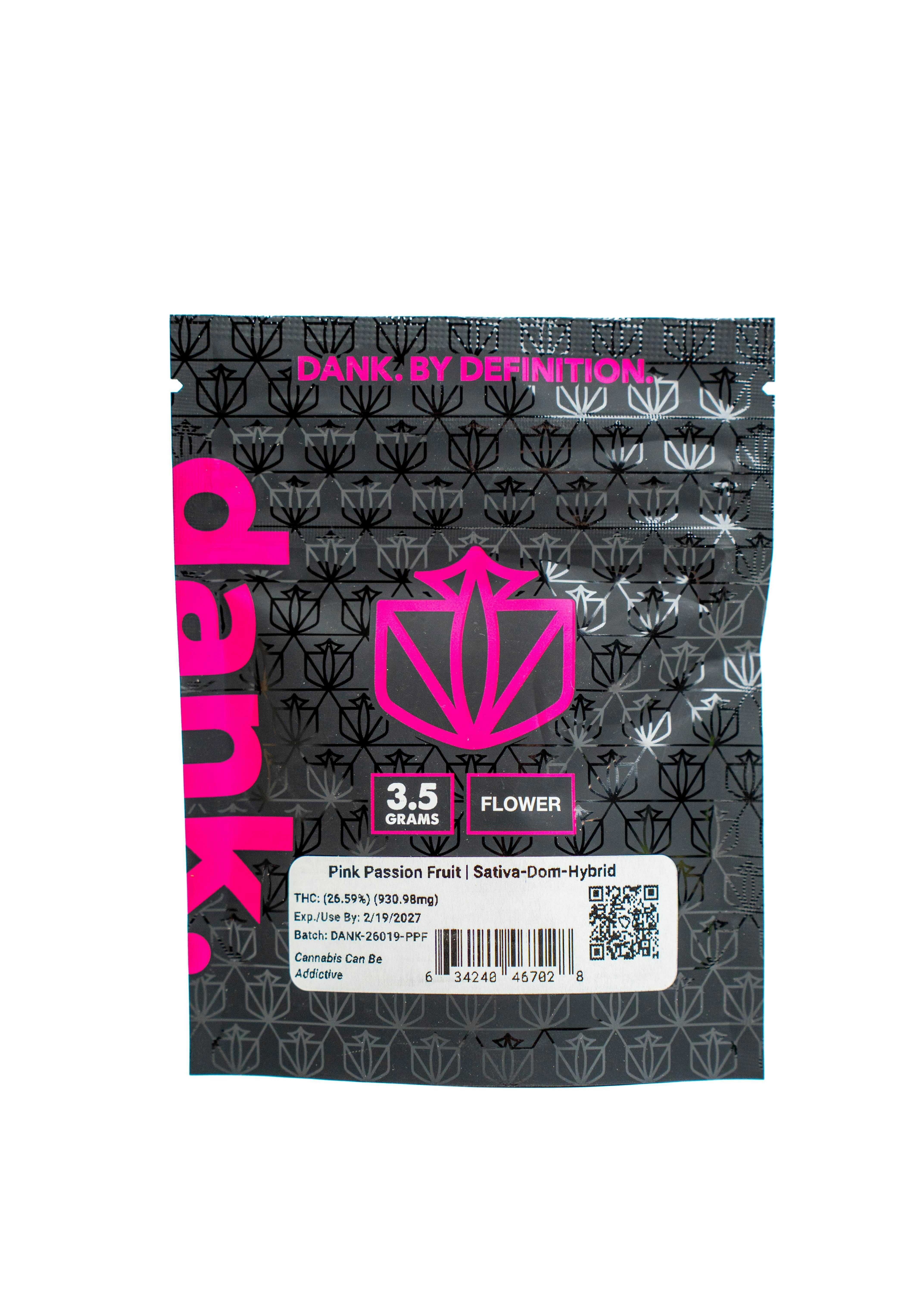
On sale· 25% OFF
THC 26.6%Hybrid
Dank By Definition.PINK PASSION FRUIT (3.5G BAG) · 3.5g
$33.19$44.25
$39after tax

weeddispensarynearme.com
You must be 21 years or older to enter. By entering, you confirm you’re of legal age in your state to purchase cannabis.
For use only by adults 21+ • Keep out of reach of children
1 live products in stock
Quick answer · What is the Pink Passion Fruit cannabis strain?
Pink Passion Fruit arrives as a vibrant, fruit-forward hybrid whose tropical fragrance and balanced disposition make it one of the more quietly captivating offerings on the New York adult-use market. With a terpene profile that leans into sun-ripened stone fruit and guava-adjacent sweetness, it delivers a measured euphoria that neither overwhelms the body nor untethers the mind — a useful quality for those who prefer their evenings edged with pleasure rather than intensity.
$39after tax
About Pink Passion Fruit
Pink Passion Fruit is a hybrid strain whose precise lineage has not been fully disclosed by any single breeder in widely indexed public records; it is most commonly attributed to independent craft cultivators working within the Pacific Northwest and California markets during the mid-2010s, a period when fruit-accented hybrids with exotic terpene profiles were rising sharply in commercial demand. The working consensus among community databases including Leafly and Wikileaf suggests a parentage that draws from tropical-leaning hybrids — likely involving genetics related to Passion Fruit, a sativa-dominant strain known for its guava and mango terpene expression, and a Pink or berry-phenotype indica that contributes both the characteristic rosy pistil coloration and a softening body effect. Some phenotypes circulating in the Northeast market also show structural and aromatic traits consistent with strains in the OG or Cookie lineage, though the breeder has not publicly confirmed this. Because documentation is limited and seed-bank attribution is contested, consumers should understand that the strain name may represent a breeder-specific phenotype or a regional cut rather than a stable, widely released genetic line. What is consistent across reported samples is the prominence of myrcene, terpinolene, and ocimene — a terpene triad that points toward fruity, tropical-leaning parent genetics regardless of the precise family tree.
The onset of Pink Passion Fruit typically manifests within five to fifteen minutes of inhalation, presenting first as a mild brightening of mood and a subtle increase in sensory acuity — colors appear marginally more vivid, conversation flows with less friction, and there is an agreeable lightness behind the eyes that characterizes many terpinolene-forward hybrids. This initial cerebral phase is relatively gentle in character; it is curious and warm rather than driven or anxious, a distinction that makes it approachable for those who tend toward sensitivity with more potent sativa-forward varieties. As the session progresses into the peak window — generally between twenty and forty-five minutes in — the body begins to register a soft, diffuse relaxation that spreads outward from the chest and shoulders without descending into sedation. The dominant terpene myrcene is understood in cannabis literature to contribute to this easing muscular quality, while the lighter lift from terpinolene keeps the mind engaged enough to sustain conversation or creative thought. Duration of noticeable effects is typically two to three hours for moderate consumers, with the comedown being gradual and unhurried rather than abrupt. The latter portion of the experience often settles into a contented, low-key ease — appetite may increase modestly, and a gentle inclination toward rest can emerge without constituting a full sedative effect. As with all cannabis, individual response varies considerably; those new to the plant are well-served by the principle of starting low and going slow.
The aromatic profile of Pink Passion Fruit is its most immediately distinguishing characteristic and the feature most often cited by those encountering it for the first time. The dominant terpene, myrcene, establishes a ripe, slightly musky fruit base — think overripe mango or guava left in afternoon sun — that reads as sweet without being cloying. Layered above this foundation, terpinolene contributes a lifted, almost floral-herbal brightness that is commonly associated with tropical fruit rinds and fresh herbs, pulling the overall nose away from pure sweetness and into something more complex and aromatic. Ocimene, present in several well-documented tropical hybrids, adds a faintly sweet, green, and herbaceous top note that evokes the skin of a passion fruit rather than its pulp — an elegant counterpoint to the heavier base tones. Secondary terpenes that some phenotypes express include a trace of limonene, which imparts a clean citrus brightness and contributes a mild uplifting quality that the research literature associates with mood elevation, and hints of linalool, which rounds the profile with a gentle lavender-adjacent softness and may contribute to the strain's notably unedged body effect. On the palate, smoke produced by dried flower tends to be smooth and medium-bodied, opening with that tropical fruit sweetness and transitioning on the exhale to a faintly herbal, floral finish. Vapor at lower temperatures preserves the terpinolene brightness particularly well, making a controlled-temperature vaporizer an effective delivery method for those who wish to experience the full aromatic complexity.
Pink Passion Fruit buds present with a structure that leans toward medium density — compact enough to indicate careful cultivation and adequate cure time, yet not so tightly packed as to restrict airflow or suggest excessive compression during harvest. The calyx clusters are generously sized and well-defined, giving each bud a slightly swollen, almost luminous quality under direct light. The color palette is one of the strain's more visually striking attributes: a base of mid-to-deep green, ranging from sage to forest depending on phenotype and growing conditions, is punctuated by an abundance of pink-to-rust pistils that curl outward in loose arcs and account for the first half of the strain's name. Trichome coverage is thorough, with a uniform frost of capitate-stalked glands that lends the surface a silvery, slightly iridescent quality. In well-grown examples, the trichome density is sufficient to make the buds feel lightly tacky to the touch and to catch light in a way that reads as visually premium without requiring magnification to appreciate.
Pink Passion Fruit performs reliably in both indoor and outdoor environments, though its tropical terpene profile is best preserved and most fully expressed under controlled indoor conditions where temperature, humidity, and light spectrum can be dialed in with precision. Indoor flowering time is generally estimated at eight to nine weeks, placing it within the mid-range for hybrid varieties. Yield under indoor conditions is moderate to above average when trained with low-stress techniques such as LST or a light screen-of-green setup, which encourages the lateral branching that this plant's structure appears to support. Outdoors, it prefers a warm, Mediterranean-style climate with low humidity during the final weeks of flowering to protect the dense calyx clusters from moisture-related issues; harvest typically falls in early-to-mid October in temperate Northern Hemisphere climates. For the cultivator-curious shopper, this is a strain that rewards patience and attention rather than demanding advanced expertise — difficulty is generally rated as intermediate, making it accessible to growers who have moved past their first season but still benefit from guidance on humidity management and late-stage feeding.
Pink Passion Fruit occupies a particularly agreeable niche in the landscape of hybrid experiences: it is social enough for a relaxed gathering yet internally coherent enough for solo creative work, which makes the early evening its most natural home. Think of a Friday after the workweek has properly concluded — a small dinner party where conversation matters more than noise, or a quiet session before cooking a meal whose ingredients already lean tropical: ceviche, a mango-based salsa, grilled fish with citrus. The strain's terpene profile, with its interplay of myrcene warmth and terpinolene brightness, pairs naturally with music that moves at a similar register — acoustic electronic, ambient jazz, or the kind of unhurried soul that fills a room without demanding attention. For the solitary consumer, it suits activities that benefit from a lightened mental frame without requiring sharp analytical focus: sketching, reading literary fiction, or a slow walk through a neighborhood park as the light shifts. It is not an ideal pairing for high-stakes cognitive tasks or situations that require sustained precision, but for the broad category of pleasurable, low-pressure engagement with the world, it performs with quiet distinction.
Passion Fruit
Shares the core tropical terpene architecture — myrcene and terpinolene-forward — that defines Pink Passion Fruit's aromatic and effect character, making it the most direct genetic and experiential parallel.
Tropicana Cookies
Fans drawn to Pink Passion Fruit's citrus-tropical top notes and mood-lifting onset will find a similarly expressive, fruit-forward profile in Tropicana Cookies, with the added complexity of a Cookie-lineage earthiness on the finish.
Zkittlez
Those who appreciate the balanced, full-spectrum fruit sweetness and the gentle body ease of Pink Passion Fruit will recognize a kindred disposition in Zkittlez, which offers a comparable smoothness with a slightly heavier indica lean.
Mimosa
If the uplifting, socially agreeable quality of Pink Passion Fruit appeals, Mimosa delivers a similarly bright and citrus-accented experience with a comparable hybrid balance and a clean, energized onset.
Guava Gelato
Consumers drawn to Pink Passion Fruit's guava-adjacent aromatic richness and its unhurried body effect will find a parallel in Guava Gelato's tropical fruit depth and the creamy, softening finish that Gelato genetics reliably provide.
Pink Passion Fruit is classified as a balanced hybrid, meaning it expresses qualities associated with both indica and sativa genetics rather than sitting definitively in either camp. In practice, users typically report an initial cerebral lift consistent with sativa-leaning onset, followed by a gradual body ease that reflects the indica side of its lineage. It is neither purely sedating nor purely energizing, which is part of its broader appeal.
Pink Passion Fruit tastes predominantly of ripe tropical fruit — guava, mango, and passion fruit are the most commonly cited descriptors — with a faintly floral, herbal quality on the exhale that keeps the profile from reading as uniformly sweet. The smoke is smooth and medium-bodied, and those who use a temperature-controlled vaporizer often report that the tropical notes are particularly vivid and well-separated at lower heat settings.
Most consumers report an onset of gentle mood elevation and mild sensory brightening within five to fifteen minutes, transitioning into a relaxed, sociable plateau that carries both a light cerebral engagement and a soft body ease. The experience is generally described as balanced and unhurried, lasting two to three hours for moderate consumers, with a gradual and comfortable comedown. Individual responses vary, and new consumers are encouraged to start with a modest amount.
Strains that share Pink Passion Fruit's tropical terpene emphasis and balanced hybrid character include Passion Fruit, Tropicana Cookies, Zkittlez, Mimosa, and Guava Gelato. Each offers a slightly different angle on the fruit-forward, mood-lifting experience: Zkittlez leans slightly more indica, Mimosa runs somewhat more sativa-expressive, and Tropicana Cookies adds a cookie-lineage earthiness that distinguishes it from the cleaner tropical profile of Pink Passion Fruit.
Pink Passion Fruit is considered moderately approachable for newer cannabis consumers, particularly because its balanced hybrid character avoids the sharper edges of highly potent sativa or heavy indica varieties. That said, no cannabis product is without the potential for an uncomfortable experience if consumed in excess. Beginners are advised to follow standard guidance: start with the smallest reasonable amount, allow sufficient time to assess the effects before consuming more, and choose a comfortable, familiar environment.
The dominant terpenes in Pink Passion Fruit are myrcene, terpinolene, and ocimene — a combination commonly associated with tropical, fruit-forward cannabis varieties. Myrcene contributes the ripe, musky fruit base and is understood to support body ease; terpinolene adds a floral-herbal brightness characteristic of exotic fruit varieties; and ocimene provides a green, slightly sweet top note. Secondary terpenes may include limonene and linalool depending on the specific phenotype and growing conditions.
Pink Passion Fruit is generally best suited to late afternoon or early evening use, when its balanced hybrid character can be appreciated without the competing demands of a full workday ahead or the pressure of a late-night schedule. Its social and mildly creative quality makes it a fitting companion for the transitional hours between day and evening — an aperitif of sorts rather than a morning or late-night choice, though individual preference and tolerance naturally shape ideal timing.
Pink Passion Fruit carries a moderately pronounced aroma that is immediately recognizable as tropical and fruit-forward without reaching the near-aggressive intensity of some terpene-heavy varieties. The scent is pleasant and approachable, leaning into ripe guava and mango with a floral undertone. When the bud is broken or ground, the fragrance intensifies noticeably, releasing the fuller terpene profile. Consumers who prefer a more discreet aromatic presence may find vapor at lower temperatures to be a more contained option.
Related strains
Pick your store
We'll show pricing, deals, and delivery zones for the store you pick. You can switch any time from the header.