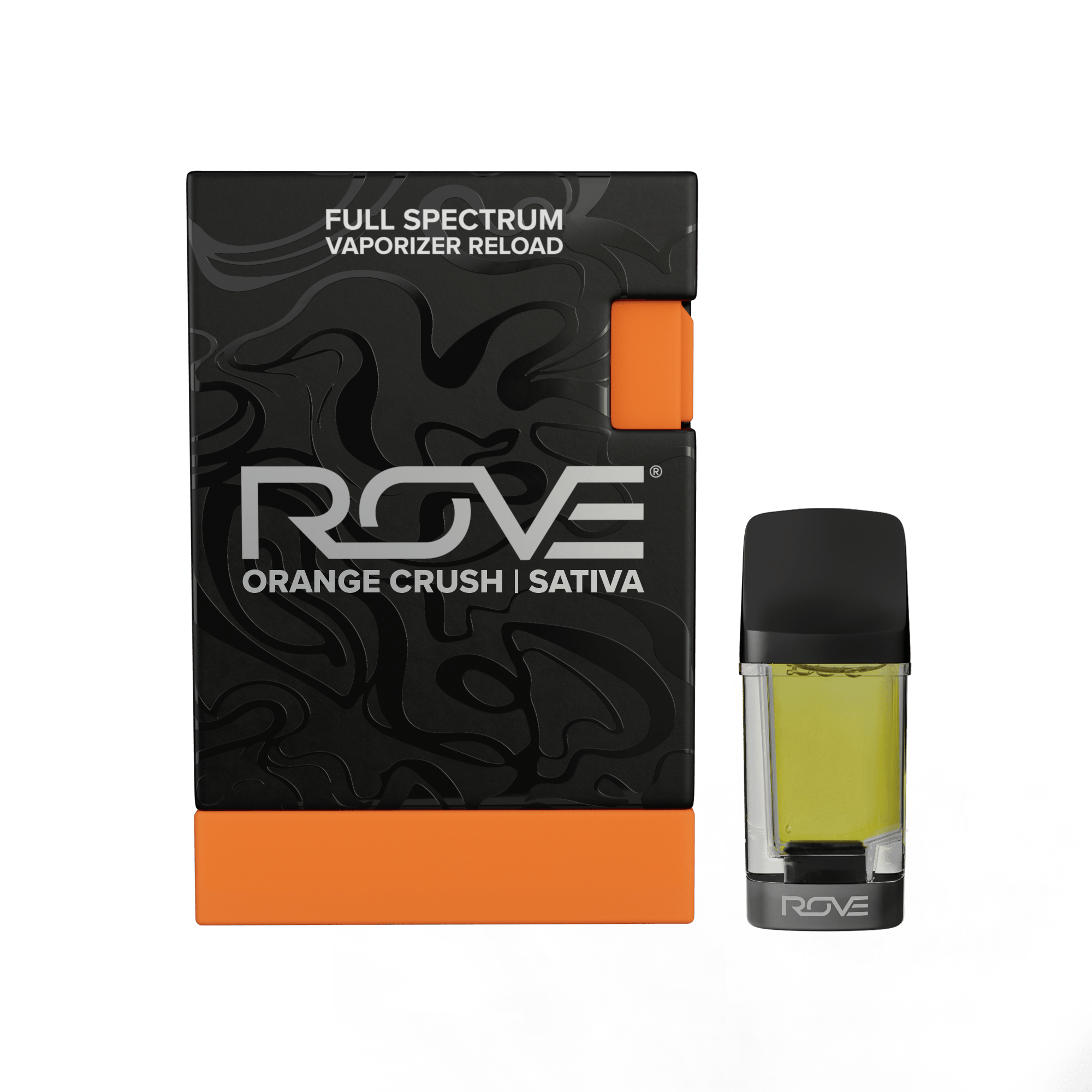
THC 89.15%·CBD 0.19%Sativa
RoveOrange Crush | Melted Diamond Live Resin Vaporizer | 1.0g (Reload) · 1g
$80.00
$90after tax

weeddispensarynearme.com
You must be 21 years or older to enter. By entering, you confirm you’re of legal age in your state to purchase cannabis.
For use only by adults 21+ • Keep out of reach of children
2 live products in stock
Quick answer · What is the Orange Crush cannabis strain?
Orange Crush arrives like a long afternoon in late summer — bright, citrus-laden, and unhurried. A sativa-leaning cultivar with a lineage rooted in West Coast cannabis culture, it delivers a lifted, clear-headed experience wrapped in layers of fresh orange rind and sun-warmed tropical fruit. For those who prefer their cannabis to feel more like a carefully selected natural wine than a blunt instrument, Orange Crush offers finesse alongside its radiant, energizing character.
$90after tax
About Orange Crush
Orange Crush is generally understood to be a cross of California Orange (also known as 'Cal Orange' or 'C.O.B.') and Blueberry, a pairing that brings together two storied chapters of North American cannabis breeding. California Orange is itself a sativa-dominant cultivar that rose to prominence in the 1980s, prized for its remarkably clean citrus aroma and relatively balanced, approachable high. Blueberry, bred by DJ Short and first stabilized in the late 1970s and released more broadly in the 1980s, is an indica-leaning legend that won the High Times Cannabis Cup for Best Indica in 2000 and contributed deep berry sweetness alongside physical relaxation to the cross. The precise breeder behind the Orange Crush name is not universally agreed upon in public cannabis literature, though the strain is most frequently attributed to Canadian breeders operating in British Columbia — a region long associated with quality hybrid development. Some sources credit Civilization Seeds with a version of this cultivar, though multiple phenotypes circulate under the same name. The result of this pairing leans decidedly sativa in its expression, with the citrus genetics of California Orange dominating both aroma and effect profile. Blueberry's influence surfaces more subtly — in a faint sweetness at the back of the palate and a gentle physical ease that prevents the experience from feeling wired or abrupt. The strain does not appear to have produced widely recognized named phenotypes, though variation between cuts is commonly noted.
Orange Crush announces itself with a relatively prompt onset, typically within five to ten minutes when smoked or vaped. The initial impression is cerebral — a brightening of mental focus that feels more like clarity than stimulation. Thoughts organize themselves readily, conversation flows without effort, and there is a perceptible lift in mood that carries a warm, sociable quality rather than an anxious edge. At peak, the experience is predominantly cerebral and energetic, consistent with its sativa classification. The dominant terpenes — particularly limonene and myrcene — are associated in the literature with mood elevation and mild physical ease respectively, which together help explain why Orange Crush tends to feel buoyant without tipping into restlessness. Terpinolene, often present in meaningful amounts, is linked in research to uplifting, slightly euphoric qualities and may contribute to the strain's creative, generative character. The body is not ignored entirely. There is a gentle warmth that settles across the shoulders and chest as the experience matures, a quality likely influenced by the Blueberry parentage. This physical note keeps the session grounded without pulling toward sedation. Duration is moderate — most users report a peak window of sixty to ninety minutes, with a gradual, unhurried comedown that rarely feels abrupt. First-time consumers or those with lower tolerance should approach deliberately; start low and go slow, as with any cannabis product.
The aromatic identity of Orange Crush is dominated by limonene, the terpene responsible for its vivid, fresh-squeezed orange character. This is not a faint citrus suggestion — properly cured flower delivers an assertive burst of orange rind and zest that fills a room on opening the jar. Secondary citrus nuances, sometimes veering toward tangerine or mandarin, add complexity without muddying the primary note. Myrcene plays a supporting role, contributing an earthy, slightly musky undertone that grounds the bright citrus and prevents it from reading as one-dimensional. Terpinolene, when present, adds a whisper of floral and pine that surfaces most clearly in the exhale. Some phenotypes show a trace of humulene, which brings a dry, herbal quality reminiscent of fresh hops — a structural note that adds sophistication to the overall aromatic profile. On the palate, Orange Crush is notably smooth for a sativa. The smoke or vapor opens with sweet citrus, transitions through a mild herbal middle, and closes with a faintly resinous, clean finish. There is very little harshness associated with well-grown, properly flushed examples. The flavor does not linger as a heavy coating but instead resolves cleanly, leaving the palate fresh — an attribute that makes it particularly enjoyable for those who appreciate the subtlety of a session pipe or a quality glass vaporizer set to a moderate temperature. The sweetness contributed by the Blueberry genetics is detectable primarily in the vapor rather than the smoke.
Orange Crush produces medium to large buds with a moderately dense structure — not the compressed, almost brick-like density of some indica-dominant cultivars, nor the airy, wispy formations associated with pure sativa landraces. The architecture sits in an appealing middle ground: well-formed calyxes that hold their shape while retaining a degree of visual openness that speaks to its sativa influence. The color palette leans toward mid to light green, often with subtle yellow-green highlights that evoke the citrus character before the jar is even opened. Pistils are typically vivid orange to amber, adding warmth to the visual profile and providing a pleasing visual echo of the strain's name and flavor. Trichome coverage is generous across the surface of mature, well-cultivated examples — a frosted, resinous coat that signals the robust terpene production responsible for the strain's signature aroma. Under direct light, the buds have a faint luminous quality that distinguishes premium, carefully grown cuts from more utilitarian harvests.
Orange Crush is considered a moderately approachable cultivar for experienced home growers, though not the first choice for a complete novice. It performs well in both indoor and outdoor environments, with a preference for warm, Mediterranean-style climates when grown outdoors — conditions it shares with its California Orange parentage. Indoor flowering time is typically documented at around eight to nine weeks, placing it in a manageable range for most cultivation setups. Indoor yields are considered moderate to generous when the plant receives adequate light and airflow; its sativa structure benefits from training techniques such as low-stress training or a screen of green setup to manage canopy height and maximize light penetration. Outdoor harvests generally come in around mid-October in temperate Northern Hemisphere climates. The plant can stretch meaningfully during the early weeks of flower — a characteristic sativa trait inherited from California Orange — which growers should account for when planning vertical space. Resistance to common molds and pests is considered average; proper humidity management during late flower is advisable given the density that develops in well-fed specimens. For the cultivator-curious consumer, understanding this growth profile helps contextualize why artisan-grown Orange Crush commands attention: it rewards thoughtful cultivation with expressive aromatics.
Orange Crush is, at its core, a daytime companion. Its clear-headed, lifted quality makes it well suited to creative endeavors — writing, sketching, or any pursuit that benefits from a sense of open, unhurried focus. The mild physical ease that accompanies the cerebral lift also makes it a natural fit for light outdoor activity: a walk through a park, a slow morning at a farmers' market, or a leisurely bicycle ride through a neighborhood that deserves closer attention. Socially, Orange Crush performs with quiet distinction at a small gathering where conversation is the main event. It does not impose itself on the room but rather smooths the edges of self-consciousness without dulling the senses. For food pairings, consider citrus-forward dishes — a ceviche, a yuzu-dressed salad, or a plate of fresh tropical fruit — that harmonize with the limonene-driven terpene profile rather than working against it. On the music side, the strain pairs naturally with something melodic and rhythmically clean: West Coast jazz, early Brian Eno, or a well-sequenced soul record. The common thread is that Orange Crush suits moments that call for presence, warmth, and a light but genuine elevation of mood.
Tangie
Tangie shares Orange Crush's dominant citrus terpene profile and sativa-leaning, mood-elevating character, making it a natural next step for fans drawn to the orange-rind aromatic quality.
California Orange
As a direct parent of Orange Crush, California Orange offers a simpler, purer expression of the same citrus-forward identity for those who want to explore the lineage firsthand.
Clementine
Clementine delivers a similarly bright, tangerine-forward aroma with an energetic, clear-headed effect arc that closely mirrors Orange Crush's daytime utility.
Agent Orange
Agent Orange combines citrus sweetness with a balanced sativa lift and mild physical warmth — a profile that will resonate with anyone who appreciates Orange Crush's ability to be sociable without being overwhelming.
Super Lemon Haze
Fans of Orange Crush who want a more pronounced sativa intensity and a citrus profile that veers toward lemon will find Super Lemon Haze a compelling, energetically similar experience.
Orange Crush is classified as a sativa-dominant hybrid. Its parent strains are California Orange, a sativa-leaning cultivar, and Blueberry, an indica-leaning classic. In practice, the sativa characteristics — uplifting mood, cerebral clarity, moderate energy — dominate the experience, while Blueberry contributes a subtle physical ease that keeps the session grounded without shifting into sedative territory.
Orange Crush tastes primarily of fresh citrus — specifically orange rind and zest — with secondary notes of mild earthiness and, in some phenotypes, a faint herbal or floral finish on the exhale. The sweetness contributed by its Blueberry genetics is more apparent in vapor than in smoke. The overall palate impression is clean and refreshing, resolving without a heavy or resinous aftertaste.
Orange Crush typically produces a lifted, clear-headed cerebral experience with a warm sociable quality. Onset is relatively prompt — within five to ten minutes when inhaled. The peak is energetic and mentally bright without feeling anxious or wired. A gentle physical ease accompanies the cerebral effects. The comedown is gradual and unhurried. As with all cannabis, individual experience varies; start low and go slow if you are new to this cultivar.
Strains with a comparable citrus-forward, sativa-dominant profile include Tangie, Clementine, Agent Orange, and Super Lemon Haze. California Orange, one of Orange Crush's parent strains, also offers a closely related aromatic and effect experience. Each of these cultivars shares the limonene-driven brightness and uplifting character that defines Orange Crush's reputation.
Orange Crush can be approachable for beginners given its relatively smooth flavor and absence of a heavy, sedative body effect. However, its sativa character means that in larger amounts it may feel more stimulating than some first-time consumers expect. The standard guidance applies: start with a small amount, allow ample time to assess the experience before consuming more, and choose a comfortable, familiar setting.
The dominant terpene in Orange Crush is limonene, which is responsible for its signature orange-citrus aroma and is associated with mood elevation. Myrcene is typically present as a secondary terpene, contributing an earthy undertone and mild physical ease. Terpinolene appears in some phenotypes, adding a light floral and piney nuance along with an uplifting quality. Humulene may also be present in trace amounts, lending a dry, herbal depth.
Orange Crush is best suited to daytime and early-evening use. Its energetic, cerebral character aligns well with morning or afternoon creative sessions, light outdoor activity, or social gatherings where conversation is central. It is generally not considered an ideal choice immediately before sleep, as its sativa-dominant profile tends to maintain alertness rather than promote the physical and mental relaxation more conducive to winding down.
Orange Crush is most frequently attributed to Canadian breeding, with British Columbia often cited as its region of origin — though the precise breeder is not definitively established in widely available public sources. Civilization Seeds has been associated with a version of the strain. Its genetic parents, California Orange and Blueberry, both have well-documented North American roots, with Blueberry traced to DJ Short's breeding work beginning in the late 1970s.
Related strains
Pick your store
We'll show pricing, deals, and delivery zones for the store you pick. You can switch any time from the header.