THC 44.22%Hybrid
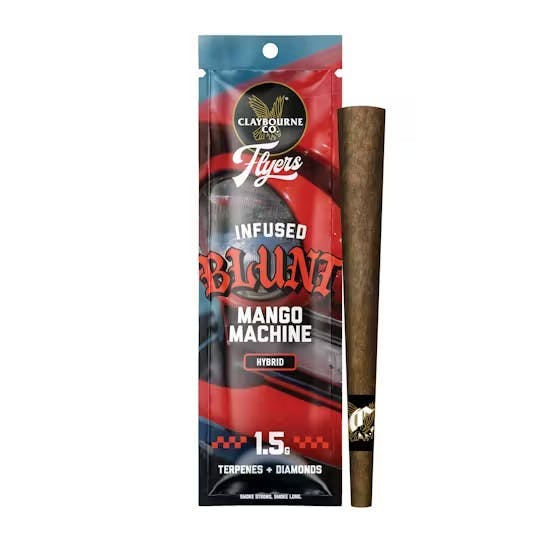
Claybourne Co.Claybourne | Mango Machine | Infused Blunt | Pre-Roll 1ct · 1.5g
$36.28
$41after tax

weeddispensarynearme.com
You must be 21 years or older to enter. By entering, you confirm you’re of legal age in your state to purchase cannabis.
For use only by adults 21+ • Keep out of reach of children
1 live products in stock
Quick answer · What is the Mango Machine cannabis strain?
Mango Machine is a tropical hybrid that carries the warmth of ripe stone fruit into every aspect of its profile — from the sun-kissed aroma that greets you on the break to the even-keeled, sustained elevation it tends to deliver. Cultivated for those who appreciate nuance over blunt force, this strain occupies a comfortable middle ground between cerebral clarity and physical ease, making it a fitting choice for New York's more discerning adult-use consumer.
$41after tax
About Mango Machine
Mango Machine's precise genetic lineage has not been fully disclosed by a single, universally recognized breeder, and documentation in public cannabis databases remains limited, placing it among the newer wave of proprietary hybrids whose origins are still being traced by the enthusiast community. What is broadly reported is that the strain draws from Mango-family genetics — most likely a descendant of the classic Mango (KC Brains), a strain that itself traces back to a complex crossing of KC 33, a Hindu Kush landrace, and Afghani influence developed in the Netherlands during the late 1990s. KC Brains' Mango became a touchstone for fruit-forward breeding programs, lending its distinctive myrcene-heavy, tropical aromatic signature to numerous subsequent crosses. The 'Machine' portion of the name suggests an infusion of genetics associated with potency and structural density — possibly referencing a high-yielding, resin-productive line, though the specific pairing has not been formally confirmed in public breeder documentation. Phenotypically, Mango Machine behaves as a well-balanced hybrid, inheriting the broad-leafed architecture and heavier bract formation common to indica-leaning parentage while retaining the sativa-influenced head effects that Mango-derived strains frequently exhibit. Genetic siblings in the extended Mango family tree include Mango Haze and Mango Kush, both of which share the fruity terpene inheritance but diverge significantly in effect character and structure.
Mango Machine typically announces itself within five to fifteen minutes of inhalation — a relatively prompt onset that begins in the temples and behind the eyes as a gentle pressure that softens rather than sharpens focus. The initial cerebral lift is measured rather than jarring, carrying a quality of mental openness that many users describe as a loosening of habitual thought patterns without a loss of function. This phase is well-suited to creative engagement or social conversation, as the mind remains accessible without racing. As the experience matures — generally between twenty and forty-five minutes in — a body component becomes increasingly apparent. Myrcene's sedative-adjacent contribution begins to layer beneath the cerebral clarity, introducing a warmth that settles into the shoulders and limbs without progressing to immobility in moderate consumption. The peak character is one of balance: present and at ease simultaneously. This is not a strain that demands an activity, nor one that insists on stillness. The comedown is gradual and gentle. Most users report a soft transition toward a rested, calm state rather than an abrupt drop in mood or energy. Duration tends to fall in the two-to-three-hour range for moderate consumers. As with any cannabis product, those new to cannabis or returning after a long absence are encouraged to start with the smallest effective amount and allow ample time before reassessing.
The aromatic profile of Mango Machine is anchored by myrcene, the most abundant terpene in cannabis broadly and the primary carrier of its tropical, overripe-mango character. Myrcene contributes an almost fermented-fruit quality — lush, rounded, and faintly earthy — that gives the dried flower a warm, inviting depth even before combustion or vaporization. This foundational note is well-documented in Mango-lineage genetics and constitutes the strain's most distinctive olfactory signature. Secondary terpenes appear to include limonene, which adds a bright citrus counterpoint — closer to tangerine peel than to sharp lemon — that lifts the profile and prevents the fruit character from reading as heavy. Caryophyllene likely contributes a mild spice that grounds the sweetness, adding the faintest suggestion of black pepper at the back of the nose. Some phenotypes exhibit traces of ocimene, a terpene associated with sweet, herbaceous, and mildly floral top notes that add complexity without dominating. On the palate, Mango Machine tends to deliver a smooth, full-bodied vapor or smoke that carries the tropical fruit character faithfully from aroma to taste. The inhale is soft and sweet, while the exhale introduces a subtle earthiness that lingers pleasantly on the palate. Vaporization at lower temperatures (around 170–185°C) is particularly effective at preserving the citrus and floral nuances before the heavier terpenoid fractions become prominent.
Mango Machine typically presents in medium-to-large, densely packed buds that reflect its indica-leaning structural heritage. The calyxes are broad and well-developed, stacking tightly to form a compact, chunky formation that holds its shape well through the curing process. Trichome coverage is generous, lending the surface a frosted, slightly silvery quality that is visible to the naked eye and speaks to the resin production associated with its likely parentage. The color palette skews toward a deep, forest green with occasional hints of sage and, in phenotypes that have been exposed to cooler finishing temperatures during cultivation, faint purple undertones in the inner leaves. Pistils are characteristically amber to burnt orange, curling tightly across the surface and providing warm contrast against the cooler green of the bract. Overall, the visual presentation is one of substance and maturity — a bud that reads as well-grown and carefully handled rather than rushed to market.
Mango Machine is understood to be a moderately demanding cultivar — approachable for intermediate home growers but perhaps not the most forgiving introduction for those in their first season. It is reported to perform well in both indoor and outdoor environments, though indoor cultivation with careful humidity management during the late flowering stage tends to produce the most expressive terpene profiles and densest bud structure. Flowering time is estimated in the eight-to-nine-week range for indoor cultivation under a standard 12/12 light cycle, placing it within the typical window for indica-dominant hybrids. Yields are considered moderate to generous indoors, with outdoor plants benefiting from long, warm seasons — conditions that New York's climate can provide through a late-summer-into-October finishing window in favorable years. The strain's dense bud structure makes airflow management a priority; growers familiar with defoliation and low-stress training techniques will find those practices particularly rewarding here. Given the limited public documentation of its full genetic background, phenotype variation between seed runs is worth anticipating.
Mango Machine occupies a time of day somewhat between afternoon and early evening — past the demands of a full workday but before the commitment to full rest. It is a strain that rewards a considered pause: the kind of unhurried hour that calls for a comfortable seat, ambient light, and no particular obligation. Solo creative work benefits from its early cerebral lift; a musician revisiting an unfinished recording, a writer returning to a difficult passage, or a visual artist working in their studio might find the mental openness it provides genuinely useful rather than merely pleasant. In a social context, it functions well as a shared experience at a small gathering — intimate enough that conversation can deepen, with the body ease keeping the atmosphere grounded rather than frenzied. For food pairings, the strain's tropical and citrus terpene character finds a natural companion in dishes built around mango, coconut, or yuzu — a Thai green curry, a ceviche with citrus leche de tigre, or simply a well-selected charcuterie board anchored by aged cheeses and dried apricot. In terms of music, the balanced profile pairs intuitively with mid-tempo electronic compositions or neo-soul, where rhythm and texture coexist without urgency.
Mango Kush
Fans of Mango Machine's tropical fruit aroma and balanced hybrid character will find Mango Kush's myrcene-forward, earthy-sweet profile immediately familiar, with a slightly heavier body lean.
Mimosa
Mimosa shares the citrus-adjacent brightness and socially oriented, mood-lifting effect arc that defines Mango Machine's more sativa-expressive moments.
Papaya
Bred with overlapping tropical terpene architecture, Papaya offers a similarly lush fruit profile with a calming body presence that appeals to the same palate.
Tropicana Cookies
Those drawn to Mango Machine's limonene-driven citrus top notes and cerebral onset will appreciate Tropicana Cookies' more pronounced orange and tangerine character within a hybrid structure.
Pineapple Express
A long-established tropical hybrid with a comparable balance of uplifting head effects and smooth body ease, making it a natural reference point for Mango Machine admirers.
Mango Machine is classified as a hybrid strain, meaning it carries characteristics of both indica and sativa lineages. In practice, its experience arc tends to begin with a more cerebral, sativa-influenced onset before transitioning into a warmer, body-oriented ease associated with indica genetics. Neither quality fully dominates, which is precisely the appeal for consumers seeking a versatile, balanced option rather than a strongly directional experience.
Mango Machine tastes much as it smells: tropical, rounded, and gently sweet, with ripe mango at the center and a citrus accent — closer to tangerine than lemon — adding brightness on the exhale. A mild earthy, slightly spiced undertone from caryophyllene grounds the sweetness and prevents it from reading as one-dimensional. The smoke or vapor is smooth and full-bodied, with the fruit character carrying faithfully through both the inhale and the finish.
Mango Machine typically produces a measured cerebral lift on onset, characterized by mental openness and a gentle easing of habitual tension rather than an intense psychoactive surge. As the experience progresses, a warm physical ease layers in, settling into the body without promoting immobility at moderate doses. The overall arc is one of balance — present and relaxed simultaneously — with a gradual, unhurried comedown. Duration generally falls within a two-to-three-hour window for moderate consumers.
Consumers who enjoy Mango Machine often find similar satisfaction in Mango Kush, which shares the tropical terpene foundation with a slightly heavier body character, and in Mimosa, which replicates the citrus brightness and sociable effect quality. Papaya and Pineapple Express occupy comparable aromatic and experiential territory, while Tropicana Cookies appeals to those who particularly value the limonene-driven top notes within a hybrid structure.
Mango Machine's balanced hybrid character and gradual onset make it more approachable than many high-potency, strongly directional strains, but it is not without intensity in larger amounts. For adults new to cannabis or returning after an extended break, the standard guidance applies: begin with the smallest comfortable amount, allow fifteen to thirty minutes before reassessing, and choose a calm, familiar environment for the first experience. New York adult-use cannabis is for consumers 21 and older.
Myrcene is the most prominent terpene in Mango Machine, responsible for its characteristic tropical, overripe-fruit aroma and its contribution to the strain's physical warmth. Limonene adds a citrus brightness — tangerine-adjacent rather than sharp — while caryophyllene introduces a mild spice that grounds the sweetness. Some phenotypes also exhibit ocimene, which contributes delicate floral and herbaceous notes. Together, these terpenes define both the aromatic signature and much of the experiential character.
Vaporization at lower temperature settings — generally in the range of 170 to 185 degrees Celsius — is widely considered the most effective method for preserving the nuanced terpene profile of fruit-forward strains like Mango Machine. This range allows the more volatile terpenes, including limonene and ocimene, to express fully before heat begins to degrade them. Flower vaporizers with precise temperature control offer a perceptibly more complex palate experience compared to higher-temperature combustion methods.
Mango Machine is best suited to the late afternoon or early evening — a transitional window between active engagement and genuine rest. Its balanced hybrid character means it does not impose a strong directional push toward either energy or sleep, making it a fitting companion for unhurried creative work, low-key social gatherings, or the kind of deliberate downtime that deserves a considered ritual rather than a reflexive one. Morning or midday use is less conventional given its body-ease component.
Related strains
Pick your store
We'll show pricing, deals, and delivery zones for the store you pick. You can switch any time from the header.