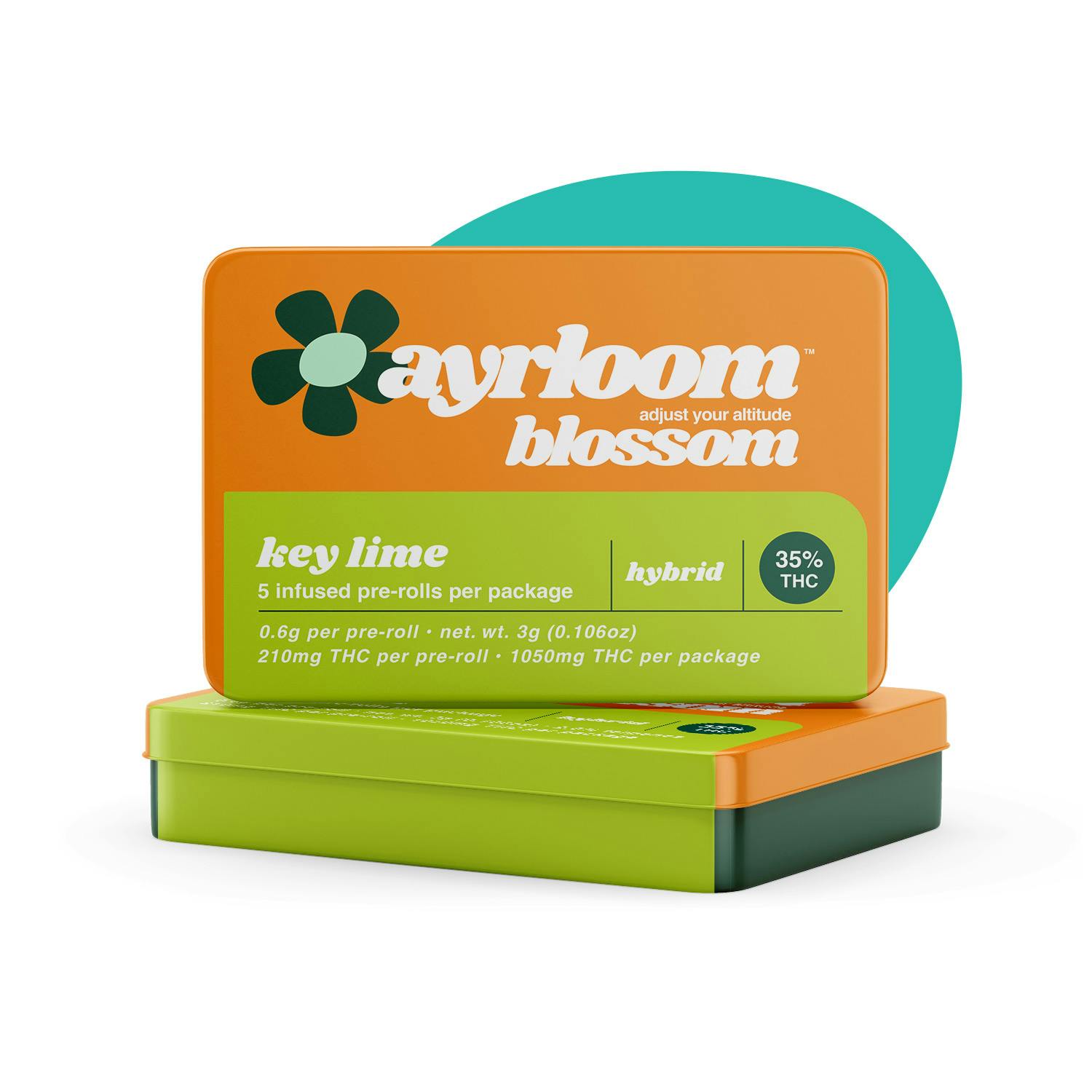
THC 35.21%Hybrid
ayrloomayrloom | Key Lime Infused Pre-Roll | 5 Pack | 3g · 0.6g5pk
$39.82
$45after tax

weeddispensarynearme.com
You must be 21 years or older to enter. By entering, you confirm you’re of legal age in your state to purchase cannabis.
For use only by adults 21+ • Keep out of reach of children
1 live products in stock
Quick answer · What is the Key Lime cannabis strain?
Key Lime arrives on the palate the way its namesake fruit does — bright, tart, and unexpectedly complex beneath a sweet exterior. A well-balanced hybrid with roots in the Pacific Northwest breeding scene, it carries a citrus-forward terpene profile that sharpens the mind without abandoning the body. Equal parts social lubricant and quiet companion, Key Lime is the kind of cultivar that rewards a slow, attentive session.
$45after tax
About Key Lime
Key Lime is most commonly attributed to crossings that involve Key Lime Pie and, in several documented phenotypes, additional hybrid genetics drawn from OG Kush or Durban Poison lines — though the precise parentage varies depending on the breeder and the specific cut in question. The strain should not be confused with Key Lime Pie, its more widely catalogued relative, which is itself a phenotype of Girl Scout Cookies crossed with indica-leaning genetics. Several independent breeders on the West Coast began circulating Key Lime cuts in the mid-2010s, a period when citrus-terpene expressions were commanding serious attention at regional cannabis competitions and cup events. The lineage is debated in some corners of the cultivation community, with certain seed banks listing Skunk or Trainwreck as background contributors to particular phenos. What is consistent across most documented versions is the strong limonene-forward terpene signature and a growth structure that leans slightly toward sativa in its stretch and canopy behavior. The influence of OG Kush ancestry, where present, contributes the strain's characteristic body weight and resinous bud density. As a cultivar, Key Lime has produced several well-regarded sibling expressions — most notably Key Lime Pie and, in some breeder catalogues, a cross with Zkittlez that amplifies the candy-fruit dimension of the aroma. Its place in the modern hybrid lineage tree reflects the broader 2010s shift toward flavor-forward genetics.
Key Lime tends to announce itself with a relatively swift onset — most consumers report noticing the initial cerebral lift within five to ten minutes of inhalation, which places it among the quicker-acting hybrid expressions. The opening wave is bright and mentally clarifying, characterized by a gentle elevation in mood and a loosening of habitual thought patterns. This early phase suits focused tasks that benefit from creative lateral thinking rather than deep, sustained analytical work. As the session progresses into its peak — typically between thirty and sixty minutes in — the body begins to receive its share of the experience. A mild physical ease settles through the limbs without producing the pronounced sedation associated with heavy indica cultivars. The balance between the cerebral and somatic here is one of Key Lime's defining qualities: neither dimension overwhelms the other, which makes the strain functional across a wider range of settings than many of its more one-directional counterparts. The dominant terpene limonene is broadly associated with mood elevation and stress modulation, while myrcene — present in meaningful quantity in most tested samples — contributes the underlying physical ease and arguably extends the duration of the body component. Caryophyllene, where present, adds a subtle grounding quality. The overall duration of a full session runs roughly two to three hours, with the comedown gradual and undemanding, leaving most consumers clear-headed rather than foggy.
The aromatic profile of Key Lime is led emphatically by limonene, the monoterpene responsible for the strain's signature citrus brightness. On the nose, fresh flower carries an immediate impression of lime zest — clean, acidic, and faintly sweet — underscored by a creamy, almost pastry-like note that suggests the Cookies ancestry present in several documented lineages. This duality of tart fruit and baked sweetness is one of the more distinctive olfactory experiences in the contemporary hybrid catalogue. Myrcene contributes an earthy, slightly musky foundation that prevents the citrus notes from reading as one-dimensional. Where caryophyllene is present — a secondary terpene in several tested Key Lime cuts — it introduces a faint spiced or peppery undertone that adds structural complexity to the overall aroma, appearing most clearly on the exhale. Some phenotypes also express a quiet note of ocimene, which layers in a faintly herbal, almost basil-adjacent greenness that bridges the fruit and earth registers. On the palate, the smoke is smooth and medium-bodied — not as heavy or resinous as pure OG expressions, nor as thin and sharp as equatorial sativas. The flavor on the inhale closely mirrors the aroma: lime-forward, with a hint of vanilla cream. The exhale resolves toward a mild, pleasant sweetness with a gentle herbal finish. Vapor at lower temperatures tends to amplify the citrus clarity, while higher-temperature combustion brings the earthy myrcene base into greater prominence.
Key Lime produces buds that tend toward a medium-to-dense structure, reflecting the hybrid balance in its genetics. The calyxes stack in a moderately tight formation with a slight elongation that hints at sativa lineage without fully committing to the airy, spear-like architecture of equatorial varieties. Trichome coverage is generous — a consequence of the Cookies or OG-adjacent background in most cuts — and gives well-cured flower a frosted, almost silvery appearance under direct light. The color palette skews toward a medium to deep forest green, with certain phenotypes developing faint purple or blue hues in the leaves and inner calyxes when exposed to cooler overnight temperatures during the final weeks of flower. Pistils (the hair-like structures visible throughout the bud) are typically a warm amber-orange at maturity, providing a visual contrast against the green and silver base. The overall presentation is one of restrained luxury — dense enough to feel substantial in hand, clean enough to read as carefully cultivated rather than rushed to market.
Key Lime is considered an intermediate-difficulty cultivar — accessible enough for second- or third-season home growers, but rewarding to those who invest in environmental precision. The plant exhibits a moderate stretch during the flowering transition, suggesting its partial sativa heritage, and benefits from low-stress training techniques that open the canopy and allow light to penetrate lower bud sites. Indoor cultivation under controlled conditions typically yields a flowering window of eight to nine weeks. Indoor yields are reported in the mid-to-high range for well-managed grows, with the resinous trichome load responding well to dialed-in humidity — ideally kept below fifty percent during the final two weeks to protect terpene integrity and reduce the risk of mold in the denser bud clusters. Outdoor cultivation is possible in warm, Mediterranean-style climates with long, dry autumns; the plant is not especially cold-tolerant and benefits from harvest timing that avoids early fall rains. For the cultivator-curious shopper, Key Lime represents a strain where the investment in quality inputs — water, light spectrum, late-stage drying and curing conditions — pays perceptible dividends in the final terpene expression.
Key Lime occupies a particularly useful position in the hybrid spectrum: it is animated enough to accompany the early hours of a social evening without demanding to be the center of attention, and grounded enough to serve a solo afternoon of creative or light intellectual work. It is not a strain that benefits from deeply passive settings — its cerebral lift asks gently to be met with some form of engagement, whether that is conversation, a notebook, or a long walk through a neighborhood worth observing. From a terpene-pairing perspective, the limonene-dominant profile finds natural companionship with bright, acid-forward foods — a citrus ceviche, a well-dressed green salad, or a wedge of aged goat cheese with preserved lemon. On the music side, the strain's balance between energy and ease suggests something with harmonic complexity but a steady rhythm: consider jazz-adjacent ambient, or a mid-tempo vinyl session that moves from Sade into something with a bit more percussive texture. The ideal companion is someone who values conversation that goes somewhere unhurried.
Key Lime Pie
The most direct genetic relative, Key Lime Pie shares the citrus-cream terpene architecture but leans slightly more indica in its physical weight, making it a natural next step for those who want a mellower body experience alongside the familiar flavor profile.
Zkittlez
Zkittlez shares the candy-fruit terpene quality and mood-lifting onset, with a similarly smooth palate character that will appeal to anyone drawn to Key Lime's sweeter aromatic dimension.
Lemon Haze
Lemon Haze offers the same citrus-forward, limonene-driven brightness but tilts more fully toward the sativa end of the spectrum, making it an excellent option for Key Lime fans who want to explore a more energetic expression of the citrus terpene profile.
Gelato
Gelato shares the Cookies-lineage creaminess and the measured, balanced hybrid arc that Key Lime fans tend to appreciate, with a richer, more dessert-forward flavor that rewards comparison.
Mimosa
Mimosa's bright citrus and uplifting cerebral character map closely to Key Lime's early-session energy, and its Clementine parentage makes it a compelling companion piece for any terpene-focused exploration of the citrus hybrid family.
Key Lime is a hybrid cultivar with a generally balanced profile, though specific phenotypes may lean slightly in either direction depending on the breeder and cut. Most documented versions are best described as true hybrids: they deliver an initial cerebral lift consistent with sativa-leaning genetics alongside a measured physical ease more associated with indica heritage. Neither effect dominates to the point of defining the strain as one or the other.
Key Lime carries a pronounced citrus flavor led by lime zest, with a secondary sweetness that reads as cream or pastry — an influence attributed to its Cookies-adjacent lineage in many documented cuts. The exhale resolves toward a mild herbal finish with faint earthy undertones contributed by myrcene. The overall palate experience is bright and clean, particularly in vapor form at lower temperatures, where the citrus clarity is most pronounced.
Key Lime typically produces a swift cerebral onset — mood elevation and a loosening of overthought patterns — followed by a gradual physical ease that settles through the body without producing pronounced sedation. The peak experience is balanced between the mental and somatic, making the strain functional across a wider range of settings than more one-directional cultivars. Duration runs roughly two to three hours, with a gradual, clear-headed comedown.
Consumers who enjoy Key Lime frequently appreciate Key Lime Pie for its shared citrus-cream terpene profile, Zkittlez for its candy-fruit quality and uplifting mood character, and Mimosa for its bright, limonene-forward onset. Gelato offers a comparable Cookies-lineage smoothness with a richer dessert note, while Lemon Haze is worth exploring for those drawn to Key Lime's citrus brightness in a more sativa-dominant expression.
Key Lime is generally considered approachable for adult-use consumers who are newer to cannabis, particularly because its hybrid balance tends to avoid the intensity associated with strongly sativa or indica-dominant cultivars. That said, as with any cannabis product, the standard guidance applies: start with a small amount, allow adequate time to assess the experience before continuing, and consume in a comfortable, familiar setting. Individual responses to any cultivar will vary.
Limonene is the primary terpene across most documented Key Lime phenotypes, responsible for the strain's characteristic citrus brightness and broadly associated with mood elevation. Myrcene is consistently present as a secondary terpene, contributing earthy depth and a physical ease component. Caryophyllene appears in many cuts as a tertiary terpene, adding subtle spice and a grounding quality. Some phenotypes also express ocimene, which introduces a faint herbal-green note to the overall profile.
Key Lime and Key Lime Pie share significant terpene overlap — both are citrus-forward with a creamy secondary sweetness — but Key Lime Pie is generally documented as leaning more indica in its physical character, producing a heavier body effect and a somewhat more sedative arc. Key Lime, by contrast, maintains a more balanced hybrid posture with a more sustained cerebral component. Consumers looking for greater physical relaxation may prefer Key Lime Pie; those seeking a more even split will often find Key Lime the more versatile option.
Key Lime's balanced hybrid profile makes it reasonably well-suited to late-morning through early-evening consumption — it carries enough cerebral animation to be engaging during the day while its body component makes it equally appropriate as a transitional strain in the early evening hours. It is less well-suited to late-night use than more sedative indica-dominant cultivars, as its mental brightness may work against winding down. Late afternoon, in particular, tends to suit the strain's terpene-driven character.
Related strains
Pick your store
We'll show pricing, deals, and delivery zones for the store you pick. You can switch any time from the header.