Hybrid
All strains Honey Burst
1 live products in stock
Quick answer · What is the Honey Burst cannabis strain?
Honey Burst arrives like the last warm afternoon of summer — a golden, resinous hybrid whose name proves accurate from the first inhale. Equal parts grounding and expansive, it occupies the rare middle ground where a relaxed body and a quietly luminous mind coexist without competition. With a terpene profile that reads like a beekeeper's tasting notes, Honey Burst rewards the unhurried consumer who prefers depth over immediacy.
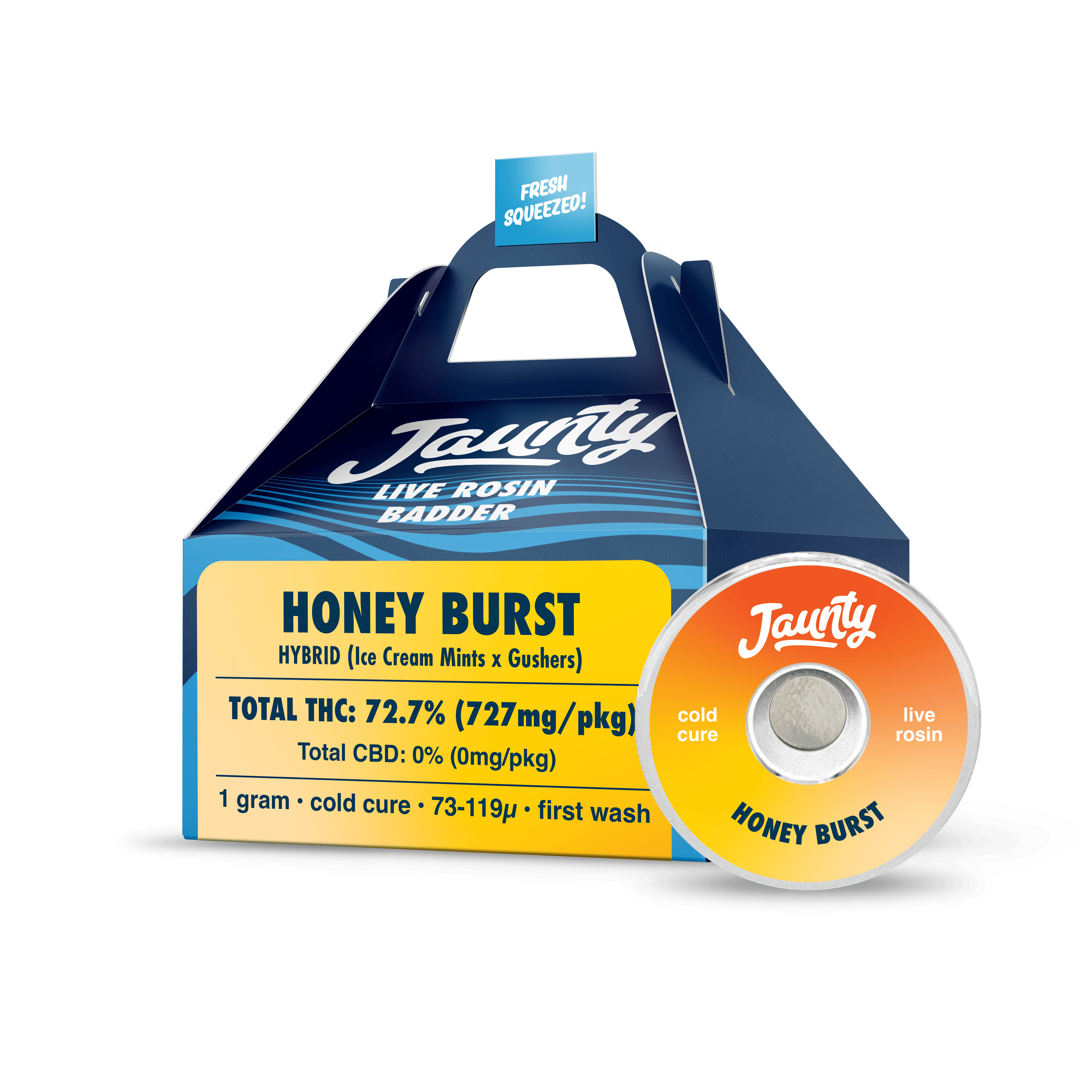
Shop Honey Burst · 1 of 1 live products
About Honey Burst
Everything to know about Honey Burst.
Lineage & origin
Honey Burst is a hybrid whose precise lineage has not been uniformly documented across major cannabis databases, and the breeder has not made a definitive public statement regarding its parentage, leaving some room for interpretation. The most widely circulated account suggests a cross involving a sweet, resin-forward indica — likely rooted in OG Kush or a Kush-adjacent cultivar — and a terpene-rich sativa line that contributes floral and citrus characteristics, possibly tracing back to Haze or a Haze hybrid. This combination would account for the strain's characteristic duality: the weight and warmth associated with Kush genetics alongside the mental lift more commonly tied to equatorial sativa ancestry. The name itself situates the strain within a broader mid-2010s trend of honey- and dessert-themed cultivar branding that emerged alongside the craft cannabis movement in California and Colorado, as small-batch producers sought to distinguish their work through sensory storytelling. Genetic siblings in spirit — if not always in provenance — include Honey Boo Boo, Honey Banana, and the better-documented Honeydew Haze, all of which share a commitment to sweetness as a primary terpene expression. Phenotypic variation has been reported, with some cuts leaning more toward the Kush side in body character and others expressing a brighter, more Haze-forward profile. For the discerning consumer, this means asking about the specific phenotype available at the time of purchase.
Effects
Honey Burst tends to onset gently, with the first signals of the experience arriving within five to ten minutes when smoked or vaped — a warmth that begins at the temples and settles behind the eyes, accompanied by an early mood lift that feels less like a jolt and more like the quiet brightening of a room when afternoon light shifts. This measured onset is consistent with a myrcene-forward profile, which is understood to facilitate a smoother cannabinoid uptake across the blood-brain barrier, tempering the abruptness that some high-limonene strains can produce. At peak, the experience occupies a considered balance: the mind remains engaged and capable of creative or conversational thought, while the body settles into a pleasant ease that does not tip into sedation for most consumers at moderate intake levels. Caryophyllene contributes a grounding, faintly spiced physical quality that reinforces this sense of rootedness without heaviness. The cerebral dimension has been described by experienced consumers as warm rather than electric — conducive to reflection, unhurried conversation, or immersive listening rather than energetic output. The come-down is typically gradual and gentle, with the body note outlasting the mental lift by thirty to sixty minutes in most reported experiences. Duration from onset to full resolution tends to fall in the two-to-three hour range depending on intake method and individual tolerance. As with any potent hybrid, first-time consumers are well-served by the standard start-low, go-slow approach.
Aroma, flavor & terpenes
The aromatic profile of Honey Burst is structured around myrcene as its likely dominant terpene — that warm, faintly musky sweetness that reads simultaneously as ripe tropical fruit and raw honey comb. Myrcene anchors the nose and prevents the sweetness from becoming cloying, lending an earthen base note that keeps the profile grounded. Secondary terpene expression typically includes caryophyllene, whose dry, peppery warmth arrives in the background of the fresh aroma and becomes more pronounced when the flower is broken or ground, adding a subtle spice that elevates the complexity of the overall profile. Limonene, where present, provides a brightening layer — a quiet citrus lift that reads more as orange blossom or candied lemon peel than as fresh-cut fruit, integrating with the honey character rather than competing with it. Some phenotypes also exhibit a trace of linalool, which introduces a lavender-adjacent floral softness to the mid-note of the scent. On the palate, Honey Burst delivers on its olfactory promise: the inhale carries a smooth, almost viscous sweetness that coats the tongue without sharpness, while the exhale reveals the caryophyllene-driven pepper note alongside a lingering floral finish. Vaporized at lower temperatures — roughly in the 170 to 185 Celsius range — the terpene complexity is at its most legible, with the honey and citrus notes emerging more cleanly than in combustion. Smoke from a well-cured flower is described as full-bodied but not harsh, with a sweet aftertaste that persists for several minutes after exhale.
Appearance
Well-grown Honey Burst presents as a medium to moderately dense bud structure — neither the compressed, pellet-like density of a pure Kush phenotype nor the loose, airy architecture of a classic Haze. The calyxes stack in a way that suggests careful cultivation, with individual buds often taking a rounded, slightly elongated form. The base color is a warm, medium green with occasional olive or yellow-green undertones that deepen toward the center of each bud, reinforcing the strain's golden visual identity. Trichome coverage is notably generous, giving properly cured flower a frosted, almost luminous quality in direct light — a characteristic that aligns with its resin-forward heritage. Pistils run amber to deep orange, weaving through the sugar leaves in a density that speaks to a productive, resinous flowering phase. Under close examination, the trichome heads appear predominantly cloudy to amber at peak harvest, suggesting a cultivator preference for a fully matured, richly developed cannabinoid profile.
Growing notes
Honey Burst is understood to perform well in both indoor and outdoor environments, though indoor cultivation under controlled conditions tends to yield the most consistent expression of its signature terpene profile. Flowering time is generally reported in the range of eight to nine weeks under a standard twelve-twelve light cycle, placing it in the moderate category — not a quick finisher, but not an outlier in terms of patience required. Indoor yields are typically described as moderate to above average for a hybrid of this character, rewarding growers who invest in canopy management techniques such as low-stress training or a light defoliation pass in early flower. Outdoor cultivation suits temperate to warm climates with low late-season humidity, as the dense resin production can create conditions favorable to mold if moisture is not managed. Difficulty level is generally assessed as intermediate — accessible enough for a second-season home cultivator, but likely to underperform in the hands of a complete novice without adequate environmental controls. The strain's Kush-adjacent structure responds well to a full flush in the final week before harvest, which is thought to support the clean, sweet finish in the cured flower.
When it's best enjoyed
Honey Burst is at its most eloquent in the transitional hours — late afternoon into early evening, when the day's obligations have resolved but the night has not yet committed to a direction. It is a strain that suits a particular kind of unhurried attention: a solo listening session with a record that rewards close hearing, a slow walk through a neighborhood where the light is doing something interesting, or a dinner gathering among familiar company where the conversation moves without agenda. The terpene profile — honey-sweet, lightly spiced, with a citrus lift — pairs with notable coherence alongside foods that echo those same qualities: a cheese board anchored by aged Gouda or a mild blue, accompanied by wildflower honey and toasted walnuts, would find a natural counterpart in the strain's aromatic register. Musically, producers and consumers with a fondness for neo-soul, warm analog jazz, or ambient electronic work — anything with texture and space rather than urgency — tend to find the experience complementary. This is not a strain that demands productivity. It asks instead for presence.
If you like Honey Burst, also explore
Honey Banana
Shares a pronounced honey-and-fruit terpene profile with a similarly balanced hybrid effect arc, making it a natural point of comparison for consumers drawn to Honey Burst's sweetness.
Mango Kush
Offers the same myrcene-dominant tropical sweetness and Kush-rooted body ease that anchors Honey Burst's lower register, appealing to consumers who favor that grounded warmth.
Golden Goat
Provides a comparable warm, citrus-and-spice aromatic character with a mood-brightening hybrid effect that fans of Honey Burst's cerebral warmth will recognize.
Strawberry Banana
A fellow high-myrcene, dessert-forward hybrid with a smooth, resinous smoke character and a calm, body-inclusive effect profile that mirrors Honey Burst's overall disposition.
Zkittlez
Appeals to the same consumer sensibility — a preference for complex fruit-forward terpenes, a settled and social effect, and flower that rewards slow, attentive consumption.
Common questions
Is Honey Burst indica or sativa?+
Honey Burst is classified as a hybrid, and its effects reflect that balance with reasonable accuracy. Most consumers report a body ease consistent with indica-adjacent genetics alongside a mental warmth and mild uplift more typically associated with sativa lineage. Neither dimension overwhelms the other at moderate intake levels, which is part of what makes it a reliable choice for consumers who prefer a balanced experience over a pronounced lean in either direction.
What does Honey Burst taste like?+
The flavor profile lives up to the name. On the inhale, consumers most commonly describe a smooth, rounded sweetness — honeyed and faintly tropical, with a slight floral note in some phenotypes. The exhale brings a mild peppery warmth from caryophyllene that keeps the sweetness from becoming one-dimensional. The overall palate impression is full-bodied and clean, with a lingering sweet-spice finish that dissipates slowly. Vaporizing at moderate temperatures tends to amplify the honey and citrus nuance.
What are the typical effects of Honey Burst?+
The onset is gradual and warm, beginning at the temples and settling into a full-body ease within ten to fifteen minutes. At peak, consumers typically experience a relaxed but engaged mental state — reflective rather than racing, and social without being stimulating. The body note is grounding without being sedating at moderate consumption levels. Duration is generally in the two-to-three hour range. Individual experience will vary based on tolerance, intake method, and the specific phenotype available.
What strains are similar to Honey Burst?+
Consumers who enjoy Honey Burst's honey-forward terpene profile and balanced hybrid effects often find common ground with Honey Banana, Mango Kush, and Strawberry Banana for their shared myrcene-dominant sweetness. Zkittlez appeals to the same sensibility around dessert-forward complexity and settled social effects, while Golden Goat offers a comparable warm citrus-and-spice aromatic register with a mood-brightening effect profile.
Is Honey Burst good for beginners?+
Honey Burst's gradual, well-paced onset makes it more approachable than many high-potency hybrids, but the depth of its effect profile means that new consumers should still apply a start-low, go-slow approach. Beginning with a single measured inhalation and allowing a full fifteen minutes before assessing the experience is a reasonable starting point. The balanced nature of the strain means the effects are less likely to feel jarring, but individual sensitivity varies considerably and should always be respected.
What are the dominant terpenes in Honey Burst?+
Myrcene is understood to be the primary terpene driver, contributing the warm, honey-and-tropical-fruit sweetness that defines the strain's aromatic identity and supporting the smooth, body-inclusive effect character. Caryophyllene follows as a notable secondary terpene, adding dry pepper warmth on the nose and a grounding physical quality to the effect. Limonene is present in many phenotypes as a brightening citrus layer, and trace linalool contributes a soft floral note in some cuts.
When is the best time of day to enjoy Honey Burst?+
Honey Burst is most naturally suited to the late afternoon or early evening — the transitional window between the activity of the day and the open space of the evening. Its balanced hybrid character means it does not demand passivity the way a heavily sedating indica might, nor does it push toward the focused productivity that a strong sativa can encourage. It is a companion for unhurried, present-moment experiences: an evening walk, a relaxed meal, or an immersive listening session.
How should I store Honey Burst to preserve its terpene profile?+
To maintain the integrity of Honey Burst's aromatic complexity, store flower in an airtight glass container kept away from direct light, heat, and humidity fluctuations. A consistent environment between 60 and 65 percent relative humidity — achievable with a calibrated humidity pack — helps preserve both terpene expression and the structural integrity of the trichomes. Properly stored at room temperature in a dark location, well-cured flower can retain its profile for several weeks without significant degradation.
Related strains