
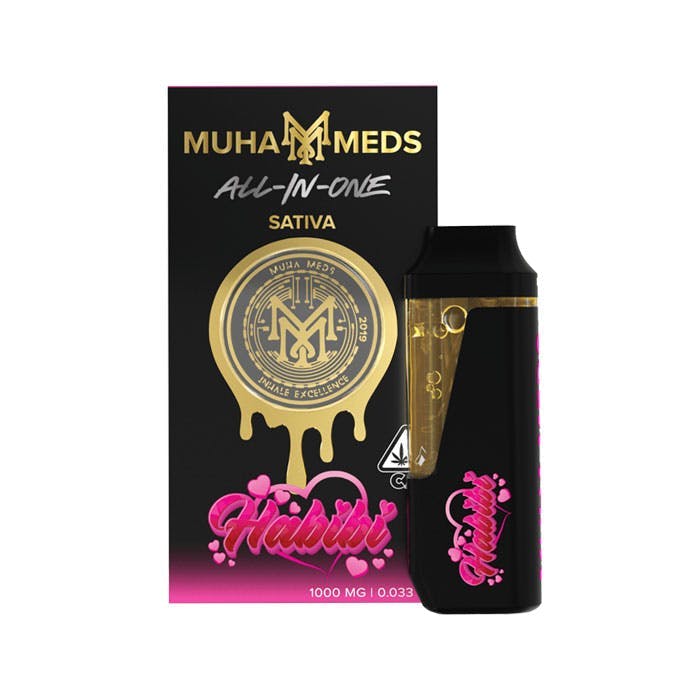
Sativa
All strains Habibi
2 live products in stock
Quick answer · What is the Habibi cannabis strain?
Habibi arrives as a warm, golden-hour sativa — the kind of strain that settles softly into the mind before opening it wide. Its citrus-forward perfume carries a quiet resinous depth, and the effect follows suit: clear-headed, sociable, and unhurried. Named with an Arabic term of endearment meaning 'my love' or 'my darling,' it carries that affection in the experience itself — approachable, generous, and surprisingly nuanced for a strain that looks so effortlessly composed.
Shop Habibi · 2 of 2 live products
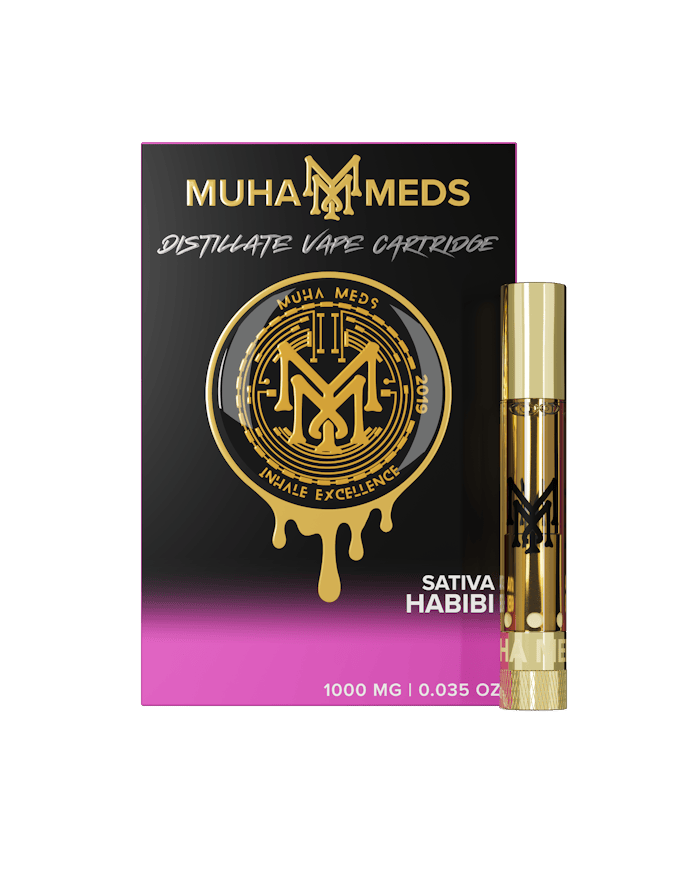
THC 80.27%·CBD 0.72%Sativa
Muha MedsMuha Meds - Habibi - 510 Cartridge | Sativa · 1g
$18.00
$20after tax
About Habibi
Everything to know about Habibi.
Lineage & origin
Habibi is a sativa-leaning cultivar whose precise genetic lineage has not been fully disclosed by a single definitive breeder in the public record. Multiple cannabis seed banks and dispensary catalogs list variations of the name, and the lineage is debated across sources. The most widely referenced interpretation points to a cross rooted in Middle Eastern landrace genetics — consistent with the Arabic-origin name — potentially blended with a Haze-adjacent parent to amplify the sativa character and refine the terpene expression toward citrus and floral notes. Haze genetics, themselves a foundational pillar of modern sativa breeding, trace back to the work of the Haze Brothers in Santa Cruz, California, during the 1970s, and were later refined through Dutch breeding programs in Amsterdam. If Habibi shares that lineage, it inherits a decades-long tradition of cerebral, long-lasting highs and pungent aromatic complexity. Some phenotypes circulating in the New York adult-use market appear to share ancestry with Kush-Haze hybrids, suggesting a possible blending of Middle Eastern hash-plant genetics with the towering sativa architecture of Haze lines. Until a breeder formally publishes a certificate of lineage, shoppers should treat specific parentage claims as provisional. What is consistently reported across sources is the strain's sativa dominance, its aromatic brightness, and its reliable uplifting effect profile — traits that suggest a thoughtful, experienced hand in the breeding process.
Effects
The onset of Habibi typically manifests within five to fifteen minutes of inhalation, beginning as a gentle lift behind the eyes and a loosening of mental tension. This early phase is characterized by a sharpening of attention rather than a buzzing overstimulation — thoughts feel organized, conversation flows more easily, and the world takes on a slightly warmer, more textured quality. The cerebral character is dominant throughout, consistent with the sativa classification and the elevated limonene and terpinolene content often associated with this cultivar. At peak, the experience tends toward social ease and creative momentum. The body remains largely unburdened — there is little of the heaviness associated with indica-dominant varieties — though a mild warmth may settle across the shoulders as the session progresses. This makes Habibi particularly well-suited to daytime or early-evening use, where full mental engagement is still desired. Duration typically runs two to three hours for moderate consumers, with a gradual, graceful comedown that rarely tips into agitation. The terpene caryophyllene, present in secondary quantities, may contribute a mild grounding quality that keeps the experience anchored even as the cerebral effects peak. As always, individual responses vary considerably based on tolerance, consumption method, and personal biochemistry. Those new to sativa-dominant cultivars are encouraged to start low and go slow, allowing adequate time between sessions to gauge their response.
Aroma, flavor & terpenes
Habibi opens with a pronounced citrus brightness — lemon zest and fresh tangerine peel — that speaks directly to a dominant limonene profile. Limonene is among the most studied cannabis terpenes, widely associated with uplifting, mood-elevating aromatic qualities and a clean, acidic top note that cuts through on the first exhale. This citrus layer is not sharp or synthetic; it has a sun-warmed, organic quality, as though the fruit were just broken open rather than expressed under pressure. Beneath the citrus, terpinolene contributes a more complex secondary register — floral, faintly herbaceous, with a subtle piney woody undertone that prevents the profile from reading as one-dimensional. Terpinolene is characteristic of many Haze-lineage and Haze-adjacent cultivars, and its presence here reinforces the strain's likely genetic heritage. A minor myrcene note provides soft, musky depth that rounds the aroma into something richer without pulling it toward earthiness. On the palate, smoked or vaporized Habibi delivers a smooth, light-bodied draw. The citrus comes forward immediately, transitioning into a faintly floral mid-palate before finishing with a clean, resinous exhale. There is no harshness in well-cured flower; the smoke is warm and thin rather than heavy. Vaporizing at mid-range temperatures tends to preserve the terpinolene and limonene brightness most faithfully, allowing the full aromatic architecture of the strain to present itself without combustion obscuring the subtler notes.
Appearance
Habibi's flower structure follows the classic sativa template: elongated, loosely packed calyxes that stack into airy, conical buds rather than the dense, rounded nuggets typical of indica-dominant varieties. The bud architecture allows light to pass through, revealing layers of structure that reward closer inspection. Pistils tend toward a warm amber-orange, threading through the green in a pattern that is generous without being chaotic. The color palette of the flower ranges from medium sage green to a deeper forest green in well-grown specimens, occasionally accented by faint gold or pale yellow hues on the outer calyxes where light exposure has been greatest during the final weeks of flowering. Trichome coverage is consistent across the surface, producing a frosted, silver-white dusting that catches light at oblique angles. The resin glands are fine and dense rather than bulbous, a characteristic often seen in sativa-dominant cultivars with Haze ancestry. Properly dried and cured, the flower retains a tactile stickiness and breaks apart with a satisfying, fibrous resistance.
Growing notes
Habibi's sativa dominance suggests it favors the extended growing conditions that allow tall, stretchy plants to reach their full potential. Indoor cultivators should plan for significant vertical growth during the flowering stretch — a characteristic trait of Haze-influenced genetics — and may benefit from low-stress training or screen-of-green setups to manage canopy height and improve light distribution across the lower bud sites. Flowering time is estimated in the ten to twelve week range indoors, consistent with sativa-dominant varieties of probable Haze heritage. This longer flowering window is the trade-off for the cerebral effect profile and complex terpene expression that make the strain distinctive. Yields indoors are moderate to generous when conditions are well-managed, and the plant rewards growers who invest in environmental consistency — stable humidity, ample airflow, and attentive feeding during the final flowering weeks. Outdoor cultivation in warm, Mediterranean-style climates or long-season temperate environments allows the plant to express its full genetic potential. In a New York context, an outdoor run requires a long, warm growing season and careful attention to late-season humidity, which can stress sativa-structure buds. The difficulty level sits in the intermediate range — manageable for growers with a season or two of experience, but not recommended as a first-time cultivation project.
When it's best enjoyed
Habibi is a strain built for the hours between obligation and rest — that particular window of a weekday afternoon or a slow Saturday morning when the mind is alert but the schedule is loose. Its clear-headed, sociable energy makes it a natural companion for creative work that benefits from a lifted perspective: writing, sketching, working through a design problem, or simply reading with unusual focus. The limonene-forward terpene profile has long been associated with an elevated, communicative mood, and the experience bears this out in practice. For those who prefer a shared setting, Habibi suits a small gathering where conversation is the main event — a pre-dinner session before a meal built around bright, acid-forward flavors. The citrus and floral terpene profile pairs naturally with dishes that share that register: a well-dressed ceviche, a Sicilian-style pasta with lemon and capers, or a cheese course anchored by fresh chèvre. On the musical side, the strain's warm, unhurried energy aligns with mid-tempo soul, jazz with forward melodic lines, or the kind of ambient electronic that rewards attentive listening. Begin with a modest amount, allow the onset to settle fully, and let the experience unfold at its own pace.
If you like Habibi, also explore
Super Lemon Haze
Fans of Habibi's citrus-dominant aroma and clear-headed sativa lift will find a familiar register in Super Lemon Haze, whose Lemon Skunk and Super Silver Haze parentage delivers a comparably bright, energetic experience.
Tangie
Tangie shares Habibi's tangerine-forward terpene profile and uplifting, sociable effect arc, making it a natural recommendation for anyone drawn to citrus-rich sativas.
Durban Poison
Those who appreciate Habibi's landrace-adjacent character and focused, alert high will recognize kindred qualities in Durban Poison, one of the most celebrated pure sativas in the modern market.
Jack Herer
Jack Herer's pine-and-spice complexity and reliably clear-headed euphoria appeal to the same consumer who gravitates toward Habibi's thoughtful, non-sedating sativa experience.
Strawberry Cough
For Habibi fans seeking a similarly smooth, floral-fruity sativa with gentle onset and sociable energy, Strawberry Cough offers a soft, approachable parallel with its own distinctive terpene character.
Common questions
Is Habibi indica or sativa?+
Habibi is classified as a sativa-dominant cultivar. Its effect profile — clear-headed, uplifting, and cerebral — aligns with sativa expression, and its loose bud architecture and extended flowering time are consistent with sativa or sativa-hybrid genetics. The precise lineage is not fully documented in public records, but all available sources point to a plant that behaves and presents as a sativa-leaning variety.
What does Habibi taste like?+
Habibi offers a bright, citrus-forward flavor dominated by fresh lemon zest and tangerine peel, drawn from a likely limonene-rich terpene profile. On the exhale, a faintly floral and woody note — consistent with terpinolene — adds complexity. The smoke or vapor is light-bodied and smooth, finishing with a clean resinous quality. It is a strain whose flavor is elegant rather than loud.
What are the typical effects of Habibi?+
Habibi typically produces a clear-headed, uplifting mental state with a sociable, communicative quality. Onset is gentle and arrives within ten to fifteen minutes of inhalation. The experience tends toward cerebral focus and mood elevation rather than physical sedation, making it well-suited to daytime or early-evening consumption. Duration is generally two to three hours, with a gradual, comfortable comedown. As with any cannabis, individual responses will vary.
What strains are similar to Habibi?+
Consumers who enjoy Habibi often gravitate toward other citrus-forward, sativa-dominant cultivars such as Tangie, Super Lemon Haze, and Jack Herer. Durban Poison shares Habibi's landrace-inflected energy and focused clarity. Strawberry Cough offers a softer, floral-fruity parallel for those who prefer a gentler sativa experience. All five share some combination of uplifting effect and bright, complex aroma.
Is Habibi good for beginners?+
Habibi can be approachable for adults new to cannabis, but its sativa dominance means that those sensitive to cerebral stimulation should proceed with particular care. Starting with a very small amount and waiting a full fifteen to twenty minutes before considering more is strongly advised. The 'start low, go slow' principle applies here as it does with all cannabis. Beginners who prefer a calmer, less heady experience may find indica-leaning cultivars more comfortable initially.
What are the dominant terpenes in Habibi?+
Based on the strain's reported aroma and effect profile, limonene is the likely dominant terpene, contributing the characteristic citrus brightness and uplifting mood quality. Terpinolene appears as a prominent secondary terpene, adding floral, piney, and faintly herbal complexity consistent with Haze-lineage genetics. Myrcene is likely present in smaller quantities, providing a soft musky base note. Caryophyllene may also contribute a mild grounding quality to the experience.
When is the best time of day to enjoy Habibi?+
Habibi's clear-headed, non-sedating sativa profile makes it best suited to daytime or early-evening consumption — morning creative sessions, a pre-activity ritual, or the relaxed hours of a slow afternoon. Its social, communicative energy can enhance a gathering or a walk through the city. Evening use is possible for experienced consumers, though those sensitive to stimulation may find the cerebral clarity interferes with winding down toward sleep.
Does Habibi have Middle Eastern origins?+
The name Habibi is Arabic for 'my love' or 'my darling,' and some sources associate the strain with Middle Eastern landrace genetics, which would be consistent with the aromatic warmth and resinous depth present in the profile. However, the breeder has not publicly confirmed a specific lineage, and the precise genetic origin remains debated. What is clear is that the name reflects an affectionate cultural reference, and the strain carries that warmth in its character.
Related strains