
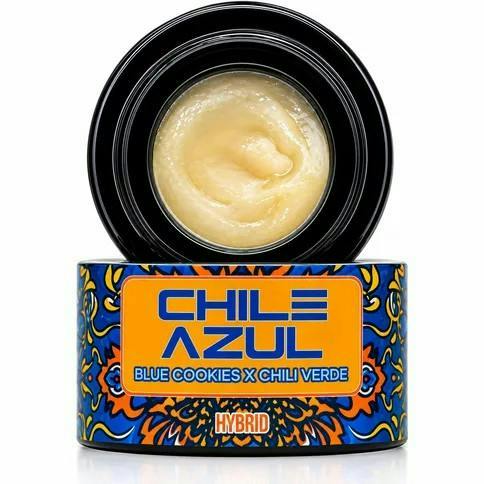
Hybrid
All strains Chili Azul
1 live products in stock
Quick answer · What is the Chili Azul cannabis strain?
Chili Azul arrives with the quiet confidence of a well-aged spirit — deep, resinous, and layered in ways that reward a slow, attentive approach. An indica-leaning hybrid shaped by rich, earthy undercurrents and faint spice, it is the kind of cultivar that settles the room rather than electrifying it. For those who favor grounded presence over cerebral brightness, Chili Azul offers an evening of considered calm.
Shop Chili Azul · 1 of 1 live products
About Chili Azul
Everything to know about Chili Azul.
Lineage & origin
Chili Azul's precise genetic lineage has not been fully disclosed by a single, universally recognized breeder, and documentation in major public databases such as Leafly and Leafly's community entries treats its origins as partially debated. The name suggests parentage in the broader Azul or Blue family — a loose collection of cultivars descending from the legendary Blueberry lineage first stabilized by DJ Short in the late 1970s and early 1980s — crossed with a pepper-forward or spice-accented genetic contributor that accounts for its distinctive chili-like aromatic notes. DJ Short's Blueberry, itself a complex cross drawing on Highland Thai, Purple Thai, and Afghani landrace genetics, has been a foundational building block in scores of indica-dominant hybrids developed through the 1990s and 2000s, lending deep body effects, berry-tinted flavor, and striking violet-to-blue coloration to its descendants. The 'Chili' component of the name most plausibly points toward a caryophyllene-heavy contributor — possibly a Kush-adjacent variety or an OG-lineage cultivar known for its peppery bite — though this remains speculative in the absence of a confirmed breeder statement. Phenotypic siblings in the Azul family would include Blue Cheese, Blue OG, and various Blueberry-derived selections, all sharing that familiar interplay of sweet fruit and earthy depth. Shoppers should understand that boutique and craft-market strains in this naming convention sometimes vary between sources.
Effects
Chili Azul's experience tends to unfold gradually, which is characteristic of many indica-leaning hybrids with a terpene profile weighted toward myrcene and caryophyllene. Onset typically arrives within five to fifteen minutes when smoked or vaped — a gentle pressure behind the eyes and at the temples that signals the session has begun in earnest. This early phase carries a mild mental softening: thoughts slow and become more deliberate rather than racing, and peripheral tension in the shoulders and jaw tends to release without dramatic sedation. The peak character is predominantly physical, settling into the body with a weighted, warm quality that most consumers describe as grounding rather than incapacitating. There is often a quiet mood elevation accompanying this body state — a contented, low-key sense of ease rather than euphoria. Experienced consumers may notice a creative or reflective quality during the mid-session window, though Chili Azul does not strongly favor heady or cerebral output. As the session matures — typically across a two-to-three-hour arc — the physical weight deepens and the eyelids may grow heavy, making the later portion of the experience well-suited to evening hours. The comedown is characteristically smooth, easing toward rest without abrupt shifts. Myrcene's sedating properties and caryophyllene's documented interaction with the endocannabinoid system's CB2 receptors both contribute to this measured, body-forward profile. As always, new consumers are encouraged to start low and go slow.
Aroma, flavor & terpenes
Chili Azul presents an aromatic profile that is immediately distinctive — a layered composition where sweet, jammy fruit notes from its Blueberry heritage meet an unexpected dry spice that calls to mind cracked black pepper and, faintly, dried chili skin. This interplay is not jarring; rather, it resembles the balance one finds in a well-composed dark fruit preserve seasoned with warming spice. Myrcene is almost certainly the dominant terpene, given the strain's indica-leaning character and its heritage in the Blueberry lineage. Myrcene contributes the musky, earthy-sweet undertone that forms the aromatic base — herbal and faintly tropical when fresh, deeper and more resinous once the bud is broken apart. Caryophyllene provides the strain's signature peppery bite, both on the nose and on the exhale, and this sesquiterpene's presence accounts for much of the spice complexity the strain is named for. Secondary contributions from linalool — if present, as is common in Afghani-descended genetics — add a soft floral quality that rounds out the harsher edges of the pepper note. Pinene may contribute a subtle background freshness, preventing the profile from becoming overly dense or one-dimensional. On the palate, whether smoked or vaporized, Chili Azul tends to deliver a smooth initial draw dominated by berry sweetness, transitioning on the exhale to the more pronounced spice and earth character. The smoke is typically full-bodied without being acrid, and the flavor lingers pleasantly.
Appearance
Chili Azul presents buds that reflect its indica-dominant architecture: compact, densely packed calyxes that form medium-to-large formations with a satisfying heft. The structure leans toward the tight, conical or rounded shapes associated with Kush and Blueberry lineages rather than the elongated, looser formations common in sativa-dominant cultivars. Coloration is one of the strain's most immediately striking qualities. True to its Azul designation, well-grown specimens display deep violet and indigo tones within the inner leaves and calyxes — coloration produced by anthocyanin expression, which is encouraged by cooler nighttime temperatures during the final weeks of flowering. This purple and blue palette is set against a backdrop of forest green, with amber-to-rust pistils weaving through the structure. The trichome coverage is generous and consistent, lending the surface a silver-white frost that contrasts richly against the darker underlying hues. Under proper lighting, the resin heads appear almost luminous — a visual indicator of the cultivar's aromatic density.
Growing notes
Chili Azul's indica-leaning structure and Blueberry-adjacent genetics suggest it would perform well under conditions typical of compact, resin-focused cultivars. Indoor cultivation is likely where this strain shows its most controlled expression, with a flowering window that, based on comparable Blueberry-derived hybrids, is estimated to fall in the eight-to-nine-week range. Indoor yields for well-managed indica-dominant hybrids in this lineage tend to be moderate to generous, rewarding growers who invest in canopy management techniques such as low-stress training. Outdoor cultivation in a temperate climate — one with warm summers and cool autumn nights — would likely draw out the anthocyanin expression responsible for the strain's characteristic violet coloration, making outdoor-grown specimens visually striking at harvest. The plant's dense bud structure does require attentive airflow management to guard against moisture retention in humid conditions. Difficulty is considered moderate, making it a reasonable choice for cultivators with a season or two of experience, though novice growers should research the strain-specific phenotype they are working with carefully before committing. As a cultivar with partially undisclosed lineage, individual seed or clone stock may vary.
When it's best enjoyed
Chili Azul is well-suited to the slower, more deliberate hours of an evening — the period after responsibilities have been set aside and genuine leisure begins. Its body-forward, grounding character makes it a natural companion for a long dinner at home, particularly one built around rich, savory courses where the strain's spice and earth notes find harmonious counterparts on the table. Think braised lamb with dark fruit reduction, or a well-aged cheese board with fig and walnut — flavors that echo the cultivar's own complexity without competing with it. Solitary creative work of the reflective variety — journaling, sketching, working slowly through a long-form playlist — aligns well with the mid-session window before the deeper sedation sets in. Musically, low-tempo works reward the experience: late-period John Coltrane, Nick Drake's catalog, or the considered minimalism of Nils Frahm offer a tempo and texture that complement rather than disrupt Chili Azul's internal rhythm. It is also a natural fit for a small, unhurried gathering of close companions who prefer depth of conversation to social performance. The strain does not demand participation — it enables presence.
If you like Chili Azul, also explore
Blueberry (DJ Short)
As the foundational ancestor of most Azul-family cultivars, Blueberry shares the sweet berry aroma, deep body relaxation, and violet coloration that define Chili Azul's character.
Blue Cheese
Blue Cheese occupies a similar indica-dominant, layered-aroma space — combining sweet Blueberry genetics with a pungent, savory edge that parallels Chili Azul's spice complexity.
Granddaddy Purple
Fans drawn to Chili Azul's deep purple aesthetics and grounding, body-centered evening experience will find a familiar sensibility in Granddaddy Purple's grape-and-berry profile.
OG Kush
If the caryophyllene-driven pepper and earth notes of Chili Azul resonate most strongly, OG Kush's classic fuel-and-spice profile offers a complementary but distinct expression of that same aromatic family.
Zkittlez
For consumers who appreciate Chili Azul's sweet fruit foundation and indica lean but prefer a slightly more approachable, candy-forward expression, Zkittlez provides a gentle parallel.
Common questions
Is Chili Azul indica or sativa?+
Chili Azul is classified as an indica-leaning hybrid. Its experience reflects that designation: the onset carries a mild mental softening, but the dominant character is physical and grounding, settling into the body with a warm, weighted quality that becomes more pronounced as the session progresses. It is most comfortably situated in evening use rather than daytime activity.
What does Chili Azul taste like?+
Chili Azul offers a layered palate that opens with sweet berry and dark fruit — a hallmark of its likely Blueberry heritage — before transitioning on the exhale to dry spice and earth, reminiscent of cracked black pepper and faintly dried chili. The smoke or vapor is typically full-bodied and smooth, with a lingering finish that balances fruit sweetness against the more resinous, peppery base notes.
What are the typical effects of Chili Azul?+
Consumers typically describe a gradual onset characterized by mental softening and a release of physical tension, followed by a warm, grounding body effect at the peak. There is often a quiet sense of ease or low-key contentment accompanying the physical state. As the session matures, sedation tends to deepen, making Chili Azul most appropriate for evening hours. New consumers should start low and go slow.
What strains are similar to Chili Azul?+
Chili Azul shares qualities with several well-regarded cultivars. Blueberry by DJ Short is likely an ancestral relative, offering similar berry notes and body relaxation. Blue Cheese adds a savory complexity comparable to Chili Azul's spice element. Granddaddy Purple echoes the violet aesthetics and evening-use profile, while OG Kush satisfies consumers drawn to the peppery, earth-forward aromatic character.
Is Chili Azul good for beginners?+
Chili Azul's indica-leaning profile and gradual onset make it more approachable than high-potency sativa-dominant cultivars, but its body-forward depth means newer consumers should exercise care. The standard guidance applies: begin with a modest amount, allow sufficient time to assess the experience before consuming more, and choose a comfortable, familiar setting for the first session. Evening timing is advisable.
What are the dominant terpenes in Chili Azul?+
Based on its likely lineage and aromatic profile, myrcene is expected to be the dominant terpene — contributing the earthy, musky-sweet base that grounds the experience. Caryophyllene provides the characteristic pepper and spice notes and is the terpene most responsible for the 'Chili' dimension of the name. Linalool and pinene may appear as secondary contributors, adding floral softness and subtle freshness respectively.
When is the best time of day to consume Chili Azul?+
Chili Azul is most naturally an evening cultivar. Its body-forward effects, gradual descent toward sedation, and warm, grounding character align with winding down after a full day. It suits the hours between a late dinner and sleep — a period of deliberate leisure rather than active engagement. Daytime use is not advised for most consumers, as the deepening physical weight may interfere with focus and mobility.
Is Chili Azul's lineage well-documented?+
Chili Azul's precise genetic lineage has not been fully confirmed by a single, publicly recognized breeder as of current documentation. The name strongly suggests roots in the Blueberry-descended Azul genetic family, with a spice-forward crossing partner — possibly Kush-adjacent — accounting for the chili and pepper aromatic character. Consumers seeking confirmed lineage documentation should consult the specific cultivator or brand providing the product.
Related strains