On sale· 25% OFF
THC 79.27%·CBD 0.19%Hybrid
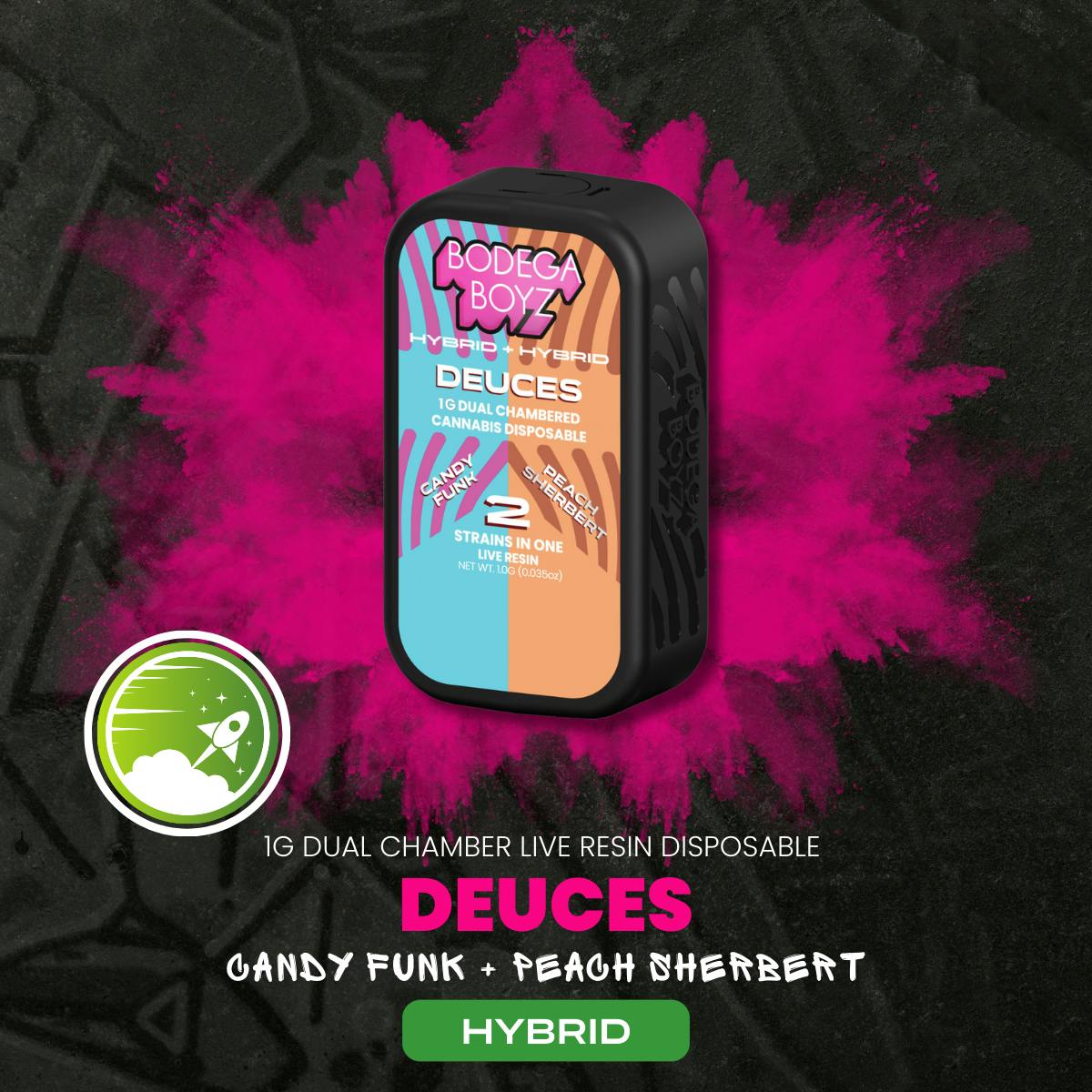
BODEGA BOYZBodega Boyz Candy Funk X Peach Sherbert Live Resin Dual Chamber AIO | Deuces | Hybrid X Hybrid · 1g
$36.50$48.67
$43after tax

weeddispensarynearme.com
You must be 21 years or older to enter. By entering, you confirm you’re of legal age in your state to purchase cannabis.
For use only by adults 21+ • Keep out of reach of children
1 live products in stock
Quick answer · What is the Candy Funk cannabis strain?
Candy Funk arrives at the intersection of sweetness and depth, a hybrid whose name telegraphs its character with surprising accuracy. Ripe stone-fruit candied notes give way to an earthy, almost funky undercurrent — the olfactory equivalent of a well-aged confection. The experience balances a clear-headed lift with gradual physical ease, making it a considered choice for those who prefer their evenings unhurried and their palates engaged.
$43after tax
About Candy Funk
Candy Funk's precise lineage is not uniformly documented across public cannabis databases, and the breeder has not made a definitive public statement naming both parents. What is broadly cited in community sources points toward a cross involving Candy-family genetics — likely tracing back to the Candy Kush or Candyland lineage — blended with a funky, terpene-forward indica-leaning strain whose OG or Kush heritage contributes the earthier, diesel-adjacent qualities that define its secondary aromatic layer. The Candyland side of the family carries its own distinguished pedigree, descending from Granddaddy Purple and Bay Platinum Cookies, a cross developed in Northern California that earned considerable recognition in competitive cannabis circles in the early 2010s. That lineage brought structured sweetness and a moderate, sociable cerebral effect into the Candy Funk profile. The 'Funk' component — that dank, almost cheese-adjacent earthiness — is more difficult to trace without confirmed breeder documentation. Some phenotypic expressions suggest a possible connection to strains carrying heavy myrcene and caryophyllene loads, which would be consistent with OG Kush derivatives. Until the originating breeder releases confirmed lineage information, this portion of Candy Funk's family tree remains appropriately labeled as debated. Collectors seeking a specific phenotype should consult directly with the source cultivator.
Candy Funk tends toward a moderate onset window of roughly ten to twenty minutes when smoked or vaped, with the initial expression manifesting as a gentle brightening of mood and a subtle sharpening of sensory awareness. The cerebral phase is the more pronounced opening act — thoughts move with a loose, associative quality that is engaging without veering into restless overstimulation. This quality aligns with the limonene and terpinolene presence often noted in Candy-family strains, both of which are associated in the literature with lighter, uplifting cerebral character. As the session progresses into its peak, typically between thirty and sixty minutes in, the body begins to register the influence of the heavier terpenes — myrcene chief among them. Muscles soften perceptibly, and a warm, settled quality moves through the limbs without fully anchoring the consumer to the couch. This balanced hybrid arc is one of Candy Funk's more appealing characteristics: neither a purely cerebral sativa sprint nor a deeply sedating indica conclusion. The comedown is gradual and gentle, with most consumers reporting a return to baseline over two to three hours without the abrupt drop associated with higher-THC varieties. As with any cannabis experience, individual response varies considerably based on tolerance, consumption method, and setting. The general principle of starting low and going slow applies here, particularly for those newer to hybrid varieties.
The aromatic profile of Candy Funk opens with an immediately recognizable sweetness — overripe tropical fruit and candied citrus that recall a well-made hard confection. This top note is primarily shaped by terpinolene, a terpene common in Candy-family strains known for its fresh, slightly floral, and fruit-forward character. Limonene reinforces the citrus brightness, adding a clean, almost zesty layer that keeps the sweetness from becoming cloying. Beneath that initial brightness lives the 'Funk' — a grounding base note of damp earth, subtle diesel, and faintly fermented stone fruit. Myrcene is largely responsible for this musky, herbal depth, and it integrates with caryophyllene's peppery, slightly woody quality to create a complexity that rewards a slower, more attentive inhale. Together, these two terpenes give Candy Funk its characteristic counterpoint: sweetness anchored by something earthier and more serious. On the palate, the vapor or smoke opens with the candied fruit and citrus dominant, transitioning through a mid-palate that reveals the earthier funk clearly. The exhale is smooth and slightly spiced, with caryophyllene's warmth lingering on the back of the throat. Well-cured flower tends to preserve the terpinolene brightness most faithfully; older or improperly stored product will flatten toward the myrcene base, losing much of the nuanced sweetness that distinguishes this strain.
Candy Funk presents in medium to moderately dense buds with a structure that leans toward the hybrid middle ground — neither the tight, compressed calyxes of a pure indica nor the airy, elongated clusters of a sativa-dominant variety. The surface is generously frosted with trichomes, giving even mid-tier phenotypes a silvery shimmer under direct light that signals resin density. The color palette runs from a deep forest green in the core leaves to lighter, almost sage-toned sugar leaves at the periphery. Amber to burnt-orange pistils weave through the bud structure with moderate density, providing warm contrast against the cool green backdrop. Phenotypic variation is noted across different cultivation environments — some expressions show faint purple hues in the larger fan leaves when grown in cooler overnight temperatures, though this is not a consistent characteristic across all harvests.
Candy Funk is considered a moderately approachable hybrid for cultivators with some experience, though it rewards attentive environmental management more than a purely hands-off approach. Indoors, it performs well under both HID and LED lighting setups, with a flowering window typically cited between eight and nine weeks. Indoor yields are moderate to generous when canopy training techniques such as LST or light topping are applied to manage the plant's natural tendency toward uneven vertical growth. Outdoor cultivation suits climates with warm, dry finishing periods — the resinous nature of the flower makes it susceptible to botrytis in humid, late-season conditions. The Northern California and Mediterranean climate profiles that shaped much of its genetic heritage remain natural reference points for outdoor growers. For the cultivator-curious shopper, it is worth noting that Candy Funk's terpene complexity tends to express most fully when the plant experiences a modest temperature drop in the final two weeks of flower — a detail that indoor growers can replicate with deliberate climate management.
Candy Funk occupies that well-defined middle space between the social and the solitary, making it a thoughtful choice for late-afternoon sessions that transition into evening. Its initial cerebral lift pairs naturally with creative work that benefits from a lighter, more fluid thought process — writing, sketching, or the kind of unhurried music listening that demands genuine attention rather than passive background noise. A playlist weighted toward jazz fusion or experimental soul would complement the strain's own structural interplay between bright sweetness and earthy depth. On the culinary side, Candy Funk's terpene profile — particularly the interaction between terpinolene's fruit character and caryophyllene's spice — finds a natural pairing in dishes with contrasting sweet and savory notes. A well-composed charcuterie selection, or dark chocolate with a high cacao percentage and dried apricot accompaniment, mirrors the strain's own internal tension between confection and funk. This is a strain for those who prefer their leisure pursuits layered rather than linear, and who bring the same discernment to their cannabis selection that they apply to wine or coffee.
Candyland
As one of the probable ancestral lines behind Candy Funk, Candyland shares the structured sweetness and sociable cerebral lift that define Candy Funk's opening phase.
Gelato
Gelato's dessert-forward terpene profile and balanced hybrid arc — bright onset softening into body ease — will feel immediately familiar to Candy Funk enthusiasts.
Zkittlez
Zkittlez shares the confection-style fruit aromatics and smooth, moderate hybrid effects that make Candy Funk approachable without sacrificing complexity.
Wedding Cake
Wedding Cake's earthy-sweet profile and pronounced caryophyllene presence echo Candy Funk's own interplay between sugary top notes and a grounding, slightly spiced base.
Sunset Sherbet
Sunset Sherbet's layered citrus and berry aromatics combined with its gentle, full-body hybrid finish align closely with the experience arc that Candy Funk delivers.
Candy Funk is classified as a hybrid, and its effects reflect that balance well. The experience typically opens with a lighter, mood-elevating cerebral quality associated with sativa-leaning effects, then transitions into a more grounded, physically relaxed state as the session progresses. Neither extreme dominates, which makes it a suitable choice for consumers who find purely indica or purely sativa expressions too one-dimensional.
The flavor profile leads with candied tropical fruit and citrus brightness on the inhale, shaped primarily by terpinolene and limonene. The mid-palate reveals earthier, slightly funky notes contributed by myrcene, while caryophyllene adds a mild spiced warmth on the exhale. The overall impression is a sweet confection with genuine depth — think candied fruit over damp earth rather than a one-dimensional dessert flavor.
Candy Funk typically begins with a gentle mood lift and a loose, associative cerebral quality that most consumers find pleasant and engaging rather than overwhelming. As the session develops, a warm physical ease settles through the body without producing heavy sedation. The experience is well-suited to relaxed social settings or solo creative pursuits, with a gradual, unhurried comedown. Individual experiences vary; starting low and going slow is always advisable.
Consumers who enjoy Candy Funk frequently appreciate Gelato for its dessert terpene profile and balanced arc, Zkittlez for its fruit-forward sweetness and smooth effects, and Wedding Cake for the earthy-sweet complexity it shares with Candy Funk's base notes. Candyland, a likely ancestral strain, offers a brighter, more purely cerebral version of the same confection-leaning aromatic signature.
Candy Funk is a reasonably approachable hybrid for adults new to cannabis, provided they follow the universal guidance of starting with a small amount and waiting to assess effects before continuing. Its balanced profile — neither extremely sedating nor intensely cerebral — makes the experience more forgiving than some higher-potency specialty cultivars. New consumers should be mindful of their environment and have no obligations following the session.
The terpene profile most consistently associated with Candy Funk centers on terpinolene, which drives the sweet, fruit-forward aroma; myrcene, which contributes the earthy, musky base often described as the 'funk' component; limonene, which adds citrus brightness; and caryophyllene, which delivers a mild spiced, woody warmth. This combination is responsible for the strain's distinctive aromatic interplay between confection and earthiness.
The name is a direct reference to the strain's aromatic duality. 'Candy' reflects the pronounced sweetness — candied citrus and tropical fruit — that leads both the nose and the palate. 'Funk' describes the earthy, dank, and faintly fermented base notes that ground the sweeter top layer. Together, the name captures the tension between confection and depth that defines the strain's character more precisely than either word could alone.
For most consumers, the experience arc of Candy Funk spans roughly two to three hours from onset to a gradual return to baseline. The peak — where the interplay between cerebral lift and physical ease is most pronounced — typically occurs between thirty and ninety minutes in, depending on consumption method and individual metabolism. Edible formats, if available, would extend this window considerably, though flower and vapor remain the most common delivery methods.
Related strains
Pick your store
We'll show pricing, deals, and delivery zones for the store you pick. You can switch any time from the header.