
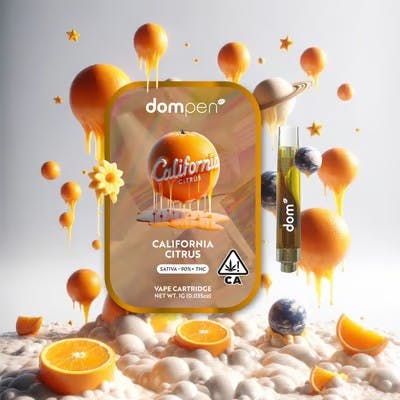
Sativa
All strains California Citrus
2 live products in stock
Quick answer · What is the California Citrus cannabis strain?
California Citrus is a sun-drenched sativa whose name needs little elaboration. Bright lemon peel and ripe mandarin greet the senses before the first draw, giving way to a clean, energizing cerebral lift that recalls long Pacific-coast mornings. Cultivated for its luminous terpene expression and steady, focused uplift, this strain has earned a quiet following among those who favor daytime cannabis with genuine character and a palate refined enough to match its aroma.
Shop California Citrus · 2 of 2 live products

About California Citrus
Everything to know about California Citrus.
Lineage & origin
California Citrus is widely attributed to the prolific California breeding scene of the early 2000s, a period defined by a collective obsession with citrus-forward terpene profiles and vigorous sativa growth patterns. The strain is generally understood to descend from a cross of Orange Skunk and a California Orange phenotype — both themselves carrying the warm citrus and sweet-funk heritage of the original Skunk No. 1 lineage developed in the 1970s by the Sacred Seeds collective. Some sources on Leafly and AllBud list the parentage simply as a California Orange derivative, acknowledging that the precise cross has not been formally documented by a single named breeder, making definitive attribution difficult. California Orange, one of the suspected parents, rose to prominence in the 1980s as an unusually sweet, orange-scented anomaly in a landscape dominated by earthy, resinous cultivars. Its influence on the modern citrus-sativa category is well documented. Orange Skunk, similarly, blends the skunky backbone of Skunk No. 1 with the tangerine-like brightness that breeders on both the West Coast and in the Netherlands worked to refine through select pheno-hunting during that same era. No single breeder has publicly claimed California Citrus as an exclusive release, which places it firmly in the tradition of community-developed West Coast genetics — strains shaped by regional climate, cultivator preference, and repeated selection rather than formal seed-bank cataloguing. Its continued relevance in dispensary lineups speaks to the enduring appetite for daytime sativas with a clean, fruit-forward identity.
Effects
The onset of California Citrus tends to arrive within five to ten minutes of inhalation, beginning as a mild pressure behind the eyes and temples before broadening into a clear, upward mental shift. The experience is characterized primarily by cerebral activation — a sharpened attentiveness and a mild elevation of mood that feels less like sedation avoidance and more like genuine mental brightening. For most consumers, the peak settles into a productive, talkative headspace that invites engagement with tasks, conversations, or creative projects. This sativa-dominant expression is consistent with its terpene and cannabinoid character. The presence of limonene, a terpene associated in early research with mood elevation and stress modulation, likely contributes to the strain's notably upbeat quality. Myrcene, present in smaller quantities, softens any sharp edges without tipping the experience toward heaviness, which helps sustain functional clarity through the peak duration of roughly ninety minutes to two hours. The comedown is gradual and relatively gentle. As the cerebral peak recedes, most consumers report a mild relaxation settling through the body — comfortable without being immobilizing. Because California Citrus is a sativa-leaning cultivar with a stimulating onset, those new to cannabis or with lower tolerance should approach it thoughtfully; starting with a modest amount and allowing adequate time before reassessing remains the standard guidance. The overall arc is well-suited to daytime use, offering a purposeful quality that distinguishes it from heavier hybrid counterparts.
Aroma, flavor & terpenes
California Citrus announces itself with an immediate burst of fresh lemon zest and sweet mandarin orange — an aroma that is bright, clean, and unambiguous. The dominant terpene responsible for this character is limonene, among the most recognizable citrus-associated compounds in cannabis, known for its crisp, almost-cleaning-product-like sharpness when isolated but considerably warmer and rounder when expressed through a full-spectrum cultivar. Beneath the citrus top note, myrcene contributes a subtle earthiness — closer to fresh mango skin than damp soil — that grounds the profile and prevents it from reading as purely synthetic or one-dimensional. Secondary aromatic notes include a light floral sweetness, likely attributable to modest ocimene content, which adds a kind of herbal brightness reminiscent of fresh basil or sweet anise. Trace amounts of terpinolene round out the bouquet with a faintly woody, almost pine-adjacent undertone that appears primarily in the exhale rather than the initial sniff. Caryophyllene, while not dominant in most reported phenotypes of this strain, may contribute a very faint peppery warmth on the back palate. On the palate, whether smoked or vaporized, California Citrus delivers a smooth, citrus-forward draw. The smoke is generally light-bodied and not particularly harsh, with the lemon and orange character remaining legible through the full inhale. The exhale carries a slightly sweeter, almost candy-like quality — closer to citrus peel confection than fresh-squeezed juice — leaving a clean, pleasant aftertaste that dissipates quickly.
Appearance
California Citrus produces buds that are characteristically sativa in structure — elongated, slightly airy calyxes that stack loosely rather than packing into the dense, rounded formations typical of indica-leaning cultivars. This open architecture is a functional trait: it allows airflow during the long flowering periods that sativa genetics often require and reduces the risk of moisture retention in humid climates. The color palette leans toward bright, medium greens with occasional yellow-lime undertones that reflect the cultivar's citrus-forward identity in a visual as well as olfactory sense. Pistils — the hair-like structures winding through the flower — are typically a warm amber-orange at harvest maturity, adding a complementary warmth to the overall presentation. Trichome coverage is moderate to generous, giving cured buds a frosted, slightly luminous appearance under direct light without the extreme resin density associated with high-THC concentrate-focused cultivars. The overall impression is of a refined, elegant flower — purposeful rather than maximalist.
Growing notes
California Citrus is considered a moderately approachable cultivar for home growers, though its sativa heritage means it rewards patience and vertical space. Flowering time typically runs between nine and eleven weeks under a standard indoor light cycle, somewhat longer than indica-dominant strains, which should factor into any cultivator's planning. Indoors, yields are described across community grow reports as moderate to above-average, with proper canopy management — techniques such as low-stress training or screen-of-green — helping to maximize light penetration through its characteristically open bud structure. Outdoors, California Citrus performs well in warm, Mediterranean-style climates with ample sunshine and low ambient humidity — conditions that mirror its West Coast origins. In regions with shorter growing seasons, the later finish time may require careful timing or supplemental light management to ensure full maturity before autumn temperatures drop. The strain is generally noted as moderately resistant to common molds and pests, though its open calyx structure means airflow remains important in any growing environment. For the cultivator-curious dispensary shopper, it represents a rewarding if unhurried project — one that repays attentiveness with expressive, aromatic flower.
When it's best enjoyed
California Citrus finds its most natural expression in the earlier hours of the day — late morning through mid-afternoon — when its clear-headed, energizing character aligns with productive momentum rather than working against it. It is particularly well-suited to solo creative endeavors: writing, sketching, designing, or any task that benefits from a sharpened sense of possibility without the restlessness that more overtly stimulating sativas can introduce. The citrus-dominant terpene profile seems to set a tone of quiet optimism that pairs well with focused, unhurried work. For a food pairing, the strain's bright limonene and ocimene character harmonizes naturally with dishes that share its citrus and herbal registers — a Provençal-style salad with lemon vinaigrette, grilled fish with fresh herbs, or a simple citrus tart. On the musical side, the alert, sun-warmed quality of the experience aligns with clean, melodic compositions: mid-period Coltrane, Brazilian bossa nova, or a well-sequenced indie-folk record. As a social strain, it works best in smaller, relaxed gatherings where conversation flows freely — a late brunch or a casual afternoon on a roof terrace — rather than in louder, more stimulation-heavy environments.
If you like California Citrus, also explore
Tangie
Tangie shares California Citrus's dominant tangerine-and-orange terpene profile and sativa-leaning cerebral uplift, making it a natural companion for fans of citrus-forward daytime cultivars.
Super Lemon Haze
With its limonene-rich, lemon-dominant aroma and energizing, mood-elevating effects, Super Lemon Haze offers a similar daytime arc with slightly more psychedelic intensity from its Haze parentage.
Clementine
Clementine's Tangie-derived citrus brightness and focused, functional sativa high make it an obvious sibling experience to California Citrus for shoppers who prize clarity and aromatic elegance.
Orange Creamsicle
Orange Creamsicle delivers a sweeter, creamier interpretation of the orange citrus profile that California Citrus fans will recognize, with a slightly more balanced, hybrid-leaning body component.
Lemon Skunk
Lemon Skunk shares the Skunk-lineage backbone suspected in California Citrus's genetics, offering a familiar citrus-funk interplay alongside an upbeat, social energy that parallels the California Citrus experience.
Common questions
Is California Citrus indica or sativa?+
California Citrus is a sativa-dominant strain. Its growth structure, flowering timeline, and effect profile all reflect its sativa lineage — specifically its descent from California Orange and Orange Skunk genetics. Consumers can expect a primarily cerebral, energizing experience rather than the body-heavy relaxation more commonly associated with indica-leaning cultivars. It is broadly regarded as a daytime-appropriate strain.
What does California Citrus taste like?+
California Citrus tastes primarily of fresh lemon zest and sweet mandarin orange, driven by a dominant limonene terpene profile. The initial draw is bright and citrus-forward, while the exhale shifts toward a slightly sweeter, candy-like quality — closer to citrus peel confection than raw juice. A subtle herbal undertone from ocimene and a faint woody note on the finish add complexity to what is otherwise a clean, fruit-forward palate.
What are the typical effects of California Citrus?+
California Citrus typically produces a clear-headed, cerebral uplift with onset within five to ten minutes of inhalation. The peak character is focused and gently energizing, often described as mood-brightening and conducive to creative or conversational engagement. A mild body relaxation accompanies the comedown without inducing heaviness. The experience generally lasts one and a half to two hours, making it well-suited to daytime use.
What strains are similar to California Citrus?+
Consumers who enjoy California Citrus tend to appreciate other citrus-forward sativas such as Tangie, Super Lemon Haze, and Clementine, all of which share a limonene-dominant aromatic profile and daytime-appropriate cerebral uplift. Orange Creamsicle offers a sweeter, slightly more balanced interpretation, while Lemon Skunk mirrors the Skunk-lineage citrus-funk backbone that likely underlies California Citrus's genetic foundation.
Is California Citrus good for beginners?+
California Citrus can be approachable for newer consumers, but its sativa-dominant, cerebrally activating character warrants some caution. Those sensitive to mental stimulation or anxiety should start with a modest amount and allow adequate time — at least fifteen to twenty minutes — before reassessing. The standard guidance of starting low and going slow applies here, as with any cannabis product. Vaporizing at lower temperatures can offer additional control over intensity.
What are the dominant terpenes in California Citrus?+
The dominant terpene in California Citrus is limonene, which accounts for its characteristic lemon and orange citrus aroma and is associated in early research with mood elevation. Myrcene is present as a secondary terpene, contributing a soft earthiness that tempers the brightness. Ocimene adds a herbal, floral sweetness, while terpinolene provides a faint woody, pine-adjacent note that surfaces primarily on the exhale.
When is the best time of day to consume California Citrus?+
California Citrus is best suited to morning or early afternoon use. Its energizing, focus-oriented effect profile makes it a natural fit for productive daytime hours — creative work sessions, social brunches, or outdoor activities in temperate weather. Evening use is not contraindicated, but consumers seeking wind-down or sleep-adjacent effects would likely find a more indica-leaning cultivar better aligned with those intentions.
How does California Citrus compare to Tangie?+
Both California Citrus and Tangie are sativa-dominant, limonene-forward cultivars with strong orange and mandarin aromatic profiles. Tangie, bred by DNA Genetics from a California Orange and Skunk hybrid, has more thoroughly documented lineage and tends toward a slightly more intense, complex citrus depth. California Citrus is often described as cleaner and more lemon-forward by comparison, making it a refined alternative for those who prefer brightness over richness in their citrus expression.
Related strains