
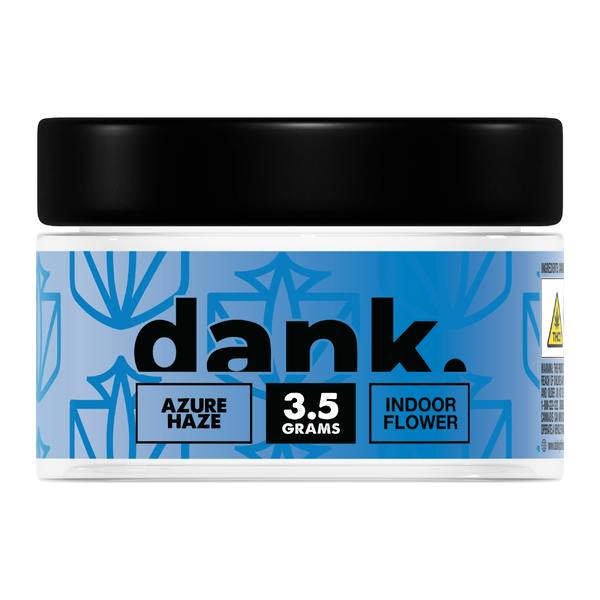
Sativa
All strains Azure Haze
1 live products in stock
Quick answer · What is the Azure Haze cannabis strain?
Azure Haze arrives like a clear morning sky over the Hudson — expansive, luminous, and unhurried. A sativa-dominant cross born from two legendary haze lineages, it carries the cerebral lift that made its ancestors famous while adding a cool, almost herbal sweetness that sets it apart. For those who appreciate cannabis as an experience rather than merely an effect, Azure Haze offers a thoughtful, elevating session well suited to the pace of a New York afternoon.
Shop Azure Haze · 1 of 1 live products
About Azure Haze
Everything to know about Azure Haze.
Lineage & origin
Azure Haze is a sativa-dominant hybrid developed by Barney's Farm, the Amsterdam-based seed company with decades of influence on the modern cannabis landscape. The strain is a cross of Blue Silver — itself a Silver Haze phenotype — and AK-47, though some catalogued descriptions characterize the Blue Silver parent more broadly as a Blue-family hybrid. Barney's Farm introduced Azure Haze as part of their Haze-forward collection in the mid-2000s, a period when the company was producing some of its most celebrated sativa-leaning work, including Pineapple Chunk and Liberty Haze. Silver Haze, one parent's dominant ancestor, traces its own lineage to the classic cross of Haze and Northern Lights — a pairing refined extensively by Sensi Seeds and later popularized through the Dutch coffeehouse circuit. AK-47, bred by Serious Seeds and released in 1992, contributes a well-documented genetic complexity of Colombian, Mexican, Thai, and Afghani ancestry. That combination gives Azure Haze a remarkably layered genetic foundation: old-world tropical sativa character from the Haze side, grounded by AK-47's slightly more compact and resinous expression. Genetic siblings and close phenotypes within Barney's Farm's catalog share the same appetite for light and warmth, and collectors have noted that Azure Haze exhibits less variability than some open-pollinated Haze crosses, suggesting careful selection at the F1 or early stabilization stage.
Effects
Azure Haze tends to announce itself with a clear, ascending cerebral onset that most consumers notice within the first few minutes of inhalation. The initial character is distinctly cognitive — a gentle brightening of focus, an easing of mental static, and what many describe as an enhanced appreciation for sensory detail. This phase aligns well with the strain's high myrcene and terpinolene content, two terpenes associated with mood elevation and a lighter, more electric mental state when paired with a sativa-dominant cannabinoid profile. As the session progresses into its peak, the experience broadens slightly. A mild, diffuse body warmth becomes present without becoming sedative, a quality attributable in part to the AK-47 lineage's modest Afghani influence. The overall character remains firmly cerebral and social rather than couch-bound. Most consumers report a duration of two to three hours for the active phase, with a gradual, gentle comedown that lacks the abruptness sometimes associated with high-THC sativa cultivars. Because of its sativa dominance and potentially elevated terpinolene levels — a terpene associated with anxious-adjacent arousal in sensitive individuals — those newer to cannabis are well advised to follow a start-low, go-slow approach. The experience rewards patience and intentionality, offering more depth on a measured intake than a rushed one.
Aroma, flavor & terpenes
The aromatic profile of Azure Haze opens with a bright, slightly resinous sweetness that recalls fresh pine and a faint citrus peel — an expression of its pinene and limonene content working in concert. Pinene, one of the most common terpenes in the cannabis genus, contributes a clean, forest-floor clarity, while limonene layers in a lifted, zesty quality that keeps the overall impression from tipping into earthiness. Beneath these top notes lies a more complex secondary profile. Myrcene, present in most Haze descendants, adds a soft, herbal muskiness — subtle here rather than dominant, as is characteristic of sativa-leaning expressions where myrcene rarely achieves the density found in indica-heavy cultivars. Terpinolene, a terpene Barney's Farm strains have historically expressed well, introduces a floral and faintly woody nuance that gives Azure Haze its slightly unusual, almost herbal-tea-like quality on the exhale. On the palate, whether smoked or vaporized, the strain delivers a smooth, relatively clean draw. Vaporization at moderate temperatures (roughly in the floral-to-woody terpene range, approximately 320–356°F) tends to accentuate the pine and citrus foreground. Combustion reveals more of the earthy, spiced undertone that traces to the AK-47 heritage. The finish is light and relatively dry, without the heavy resin coat more common in indica-forward varieties.
Appearance
Azure Haze produces buds that reflect their sativa lineage in structure: elongated, somewhat airy calyxes arranged in a loose but defined formation that is characteristic of Haze-descended cultivars grown under optimal conditions. The internodal spacing is generous, and the overall bud architecture leans toward the spear-shaped rather than the rounded, compact form typical of indica hybrids. The colour palette is a study in cool green — medium to pale sage tones dominate, occasionally punctuated by faint traces of silver-blue on phenotypes that experience a slight temperature drop late in flower, a quality that may have contributed to the strain's name. Pistils are pale amber to burnt orange, threading through the structure with moderate density. Trichome coverage is generous across both the calyxes and the sugar leaves, lending the dried flower a frosted, almost luminescent appearance under direct light — a visual signature of its Silver Haze ancestry.
Growing notes
Azure Haze performs best in controlled indoor environments where its light cycle, temperature, and humidity can be managed precisely, as befits its Haze heritage. The strain has a flowering window of approximately nine to eleven weeks — longer than many contemporary hybrids, a trade-off cultivators familiar with Haze genetics accept in exchange for the cultivar's distinctive aromatic and experiential profile. Indoor yields are moderate, typically falling within the mid-range for sativa-dominant strains, and the plants can stretch considerably during the early flowering phase, requiring growers to account for vertical space. Outdoor cultivation is viable in warm, Mediterranean-like climates with long, dry autumns — conditions not native to New York but achievable in controlled greenhouse settings. The strain is rated as moderately challenging by most cultivation references, primarily due to its extended flower time and its sensitivity to humidity fluctuations, which can invite mold pressure in dense canopy areas. For the cultivator-curious shopper, Azure Haze represents the kind of patience-rewarding project that Haze enthusiasts have pursued for decades — a strain where the growing process mirrors the contemplative quality of the finished experience.
When it's best enjoyed
Azure Haze is at its most coherent during the daylight hours — a morning or early afternoon session before a creative endeavor, a long walk through a museum, or a leisurely browse through a weekend market. The strain's cerebral clarity and sensory enhancement make it particularly well suited to solo creative work: writing, sketching, or any practice that benefits from a loosening of habitual mental patterns without a loss of functional presence. For a food pairing, the strain's pine and citrus terpene profile finds a natural complement in dishes built around fresh herbs, light acids, and green produce — a well-dressed arugula salad, a plate of citrus-cured fish, or a cold-brew tea with jasmine or bergamot. On the musical side, Azure Haze pairs elegantly with recordings that reward attentive listening: late-period Miles Davis, Brian Eno's ambient work, or the more expansive corners of contemporary jazz. The common thread is a tempo and texture that matches the strain's own unhurried, open-skied character — experiences that expand rather than compress the sense of time.
If you like Azure Haze, also explore
Silver Haze
As one of Azure Haze's direct genetic ancestors, Silver Haze shares its cerebral, uplifting arc and pine-forward aroma, making it the most natural step for anyone seeking a slightly more classic, uncut Haze experience.
AK-47
The other parent in Azure Haze's lineage, AK-47 offers a comparable balance of mental clarity and mild body warmth, appealing to consumers who enjoy Azure Haze's grounded sativa character.
Super Silver Haze
A three-time Cannabis Cup winner and close Silver Haze relative, Super Silver Haze delivers a similarly energetic, terpene-rich profile that will feel immediately familiar to Azure Haze admirers.
Amnesia Haze
Amnesia Haze shares the long-flowering, terpinolene-forward profile of Haze-descended sativas and offers the same kind of expansive, daylight-appropriate elevation that defines Azure Haze's appeal.
Ghost Train Haze
For Azure Haze consumers who appreciate the strain's cerebral intensity and want to explore a more potent, trichome-heavy expression of Haze genetics, Ghost Train Haze is a considered next step.
Common questions
Is Azure Haze indica or sativa?+
Azure Haze is a sativa-dominant hybrid developed by Barney's Farm. Its lineage — rooted in Silver Haze and AK-47 — skews heavily toward the cerebral, uplifting character associated with sativa-dominant cultivars. While the AK-47 parentage introduces a modest body component, the overall experience is energetic and mentally active rather than sedative, placing it firmly in the sativa-leaning category for most consumers.
What does Azure Haze taste like?+
Azure Haze offers a clean, layered palate anchored by pine and citrus on the inhale, with a secondary floral and faintly woody quality that emerges on the exhale — a contribution of its terpinolene content. Vaporization tends to highlight the brighter, citrus-forward notes, while combustion brings out a slightly earthier, spiced undertone inherited from the AK-47 side of its lineage. The finish is light and relatively dry.
What are the typical effects of Azure Haze?+
Azure Haze typically produces a clear, ascending cerebral onset characterized by enhanced focus, mood elevation, and heightened sensory appreciation. The peak phase is mentally active with a diffuse, non-sedative body warmth. Most consumers describe a two-to-three-hour active window with a gradual, gentle comedown. The experience is generally described as social and creative rather than couch-oriented, consistent with its sativa-dominant genetic profile.
What strains are similar to Azure Haze?+
Consumers who enjoy Azure Haze often appreciate Silver Haze and Super Silver Haze for their shared cerebral lift and pine-forward terpene profile. AK-47, as a direct parent strain, offers a comparable balance of mental clarity and mild body warmth. Amnesia Haze provides a similarly expansive, terpinolene-rich sativa experience, while Ghost Train Haze appeals to those seeking a more potent expression of the same Haze-forward character.
Is Azure Haze good for beginners?+
Azure Haze can be enjoyed by newcomers, but its sativa dominance and terpinolene content — a terpene that can feel activating in some individuals — warrant a measured approach. A start-low, go-slow method is advisable: beginning with a small amount and allowing adequate time to assess the onset before continuing. Those who find high-energy, cerebrally active experiences comfortable will find Azure Haze accessible; those sensitive to mental stimulation may prefer a more balanced hybrid.
What are the dominant terpenes in Azure Haze?+
Azure Haze is characterized primarily by terpinolene, myrcene, pinene, and limonene. Terpinolene contributes a floral, faintly woody quality; myrcene adds a soft herbal muskiness; pinene provides clean, resinous forest-floor notes; and limonene layers in a lifted citrus brightness. Together, these terpenes produce the strain's distinctive cool, herbal-sweet aromatic signature and contribute to its energetic, mood-elevating effect profile.
Who bred Azure Haze and when was it released?+
Azure Haze was developed by Barney's Farm, the Amsterdam-based seed company with a long record in sativa-forward breeding. The strain was introduced as part of Barney's Farm's Haze-oriented catalog during the mid-2000s, a particularly productive period for the company that also yielded Liberty Haze and several other influential cultivars. The precise release year has not been formally documented in publicly available breeder records, but mid-2000s is the widely cited period.
What is the best time of day to consume Azure Haze?+
Given its sativa-dominant, cerebral character, Azure Haze is most coherently enjoyed during daylight hours — morning through early afternoon is the window most consumers find optimal. Its energetic, focus-enhancing profile suits creative work, social engagement, or active leisure. Evening or late-night use may interfere with sleep for those sensitive to stimulating terpenes such as terpinolene, making it a less ideal choice as a wind-down cultivar compared to more indica-leaning options.
Related strains