

Hybrid
All strains Zoap
4 live products in stock
Quick answer · What is the Zoap cannabis strain?
Zoap arrives as a study in contemporary California breeding — a hybrid whose name telegraphs its character before the jar even opens. Dense, resinous, and rooted in two of the West Coast's most celebrated genetic lines, it delivers a layered experience that moves from bright cerebral clarity into a measured, grounding calm. For the discerning New York consumer seeking something both expressive and composed, Zoap rewards patience and attention.
Shop Zoap · 4 of 4 live products

About Zoap
Everything to know about Zoap.
Lineage & origin
Zoap is the work of Rainbow Farms, a Northern California breeding operation that has earned a devoted following for its meticulous phenotype selection. The strain is a cross of Rainbow Sherbet and Pink Guava, two cultivars that together form one of the more harmonious pairings in recent West Coast breeding. Rainbow Sherbet itself descends from Champagne and Blackberry, lending Zoap a sweet, fruit-forward foundation; Pink Guava contributes a tropical, floral complexity that lifts the overall aromatic profile considerably. The strain entered wider public consciousness in the early 2020s, a period during which the California craft market was placing a premium on exotic terpene expressions and visually striking bud structures. Zoap fit that moment precisely — it offered both the aesthetics and the experience that consumers and competition judges were seeking, earning recognition on the emerald cup circuit and in boutique dispensary circles alike. Among documented phenotypes, some cuts lean more heavily on the tropical fruit character of Pink Guava, while others emphasize the creamy, dessert-adjacent qualities inherited from Rainbow Sherbet. No widely distributed sibling crosses have been formally released by Rainbow Farms under the Zoap name, though the cultivar has inspired numerous independent breeders to incorporate its genetics into their own programs. The lineage is well-documented and not meaningfully contested.
Effects
The onset of Zoap is relatively prompt by indica-leaning hybrid standards, typically manifesting within five to fifteen minutes of inhalation. The initial impression is cerebral — a gentle sharpening of focus accompanied by an elevation of mood that is bright without being disorienting. This opening phase has a clarity to it that many consumers find unexpected given the strain's indica classification, a quality attributable in part to the limonene and terpinolene content inherited through its Rainbow Sherbet parentage. As the session progresses into its mid-phase, the body component becomes more pronounced. A warmth settles through the limbs and torso, softening tension without producing the pronounced sedation associated with more emphatically indica-dominant cultivars. The peak is characterized by a pleasant duality — the mind remains engaged and conversational while the body is held in a state of measured ease. Duration for most consumers ranges between ninety minutes and two and a half hours, contingent on individual tolerance and consumption approach. The comedown is notably smooth. There is little of the abrupt drop that can accompany higher-myrcene indicas; instead, Zoap eases its consumer into a relaxed, settled state that is conducive to rest without being strictly soporific. As with any potent hybrid, those newer to cannabis are well served by the standard guidance: start with a modest amount, allow adequate time before reassessing, and approach the experience without an agenda.
Aroma, flavor & terpenes
Zoap's aromatic profile is among its most discussed attributes, and with good reason. The dominant terpenes are myrcene, limonene, and caryophyllene, with secondary contributions from terpinolene and ocimene that add distinct top notes. Myrcene provides the earthy, faintly herbal foundation that anchors the more volatile aromatic compounds — it is the reason the bouquet reads as grounded rather than simply fruity. Limonene, present in meaningful quantity, contributes a clean citrus brightness that initially suggests fresh grapefruit or mandarin zest. Terpinolene adds a dimension that is harder to name but immediately recognizable: a slightly floral, faintly piney quality with overtones of fresh orchard fruit. Ocimene, often described as sweet, herbaceous, and mildly tropical, is the compound responsible for Zoap's distinctive guava and passionfruit character — a direct inheritance from the Pink Guava parent. Caryophyllene introduces a subtle spice on the exhale, rounding the profile and adding a slight peppery punctuation that prevents the sweetness from becoming cloying. On the palate, well-cured Zoap flower delivers a smooth smoke with minimal harshness. The flavor arc begins with tropical fruit and citrus on the inhale, transitions through a creamy, almost sherbet-like middle register, and finishes with that quiet caryophyllene spice on the exhale. Vaped at moderate temperatures, the fruit notes sharpen considerably and the floral qualities become more distinct. The finish is clean, and the aftertaste lingers pleasantly without becoming oppressive.
Appearance
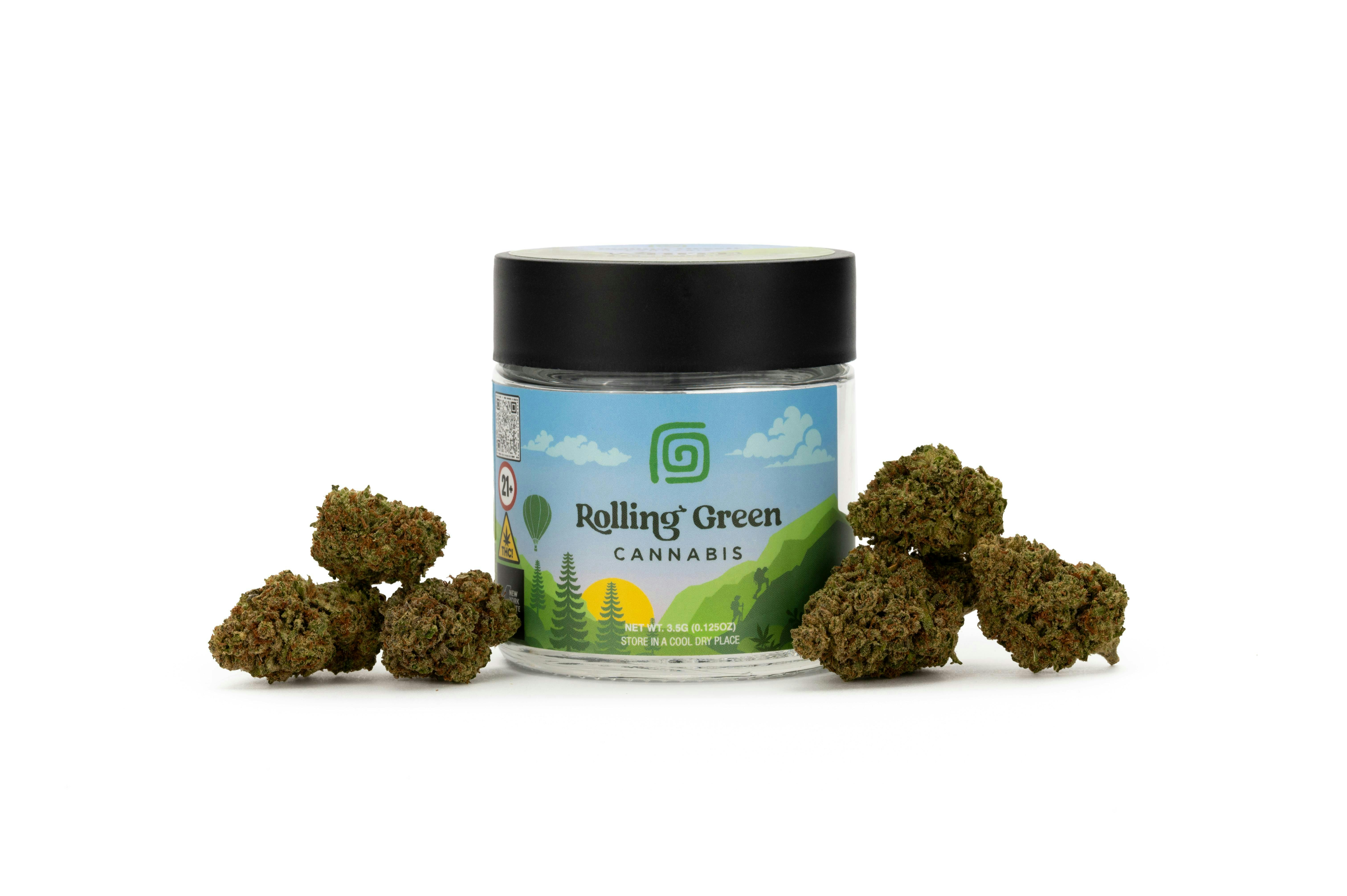
Zoap produces buds that are structurally dense and generously sized, reflecting the indica influence in its architecture. The calyxes stack tightly, forming compact, rounded formations rather than the elongated, airy structures more common in sativa-leaning cultivars. Trichome coverage is notable — a thick, even blanket of milky to amber glandular trichomes gives well-grown Zoap a frosted, almost luminescent quality under light that signals both potency and careful cultivation. The color palette is one of Zoap's more visually striking attributes. A foundation of deep forest and olive green is punctuated by generous areas of purple and lavender, particularly evident in the leaves and where the calyxes meet — a pigmentation response to cooler finishing temperatures that skilled cultivators deliberately elicit. Pistils range from burnt orange to deep rust, weaving through the bud in dense, curling formations that add textural contrast to the overall presentation. The visual effect is, in the best sense, ornate.
Growing notes
Zoap is considered a moderately demanding cultivar, better suited to growers with some prior experience than to those attempting their first cycle. Its tendency toward dense bud structure demands vigilant airflow management — without it, the risk of moisture retention and the issues that follow increases meaningfully. Indoor cultivation under controlled lighting is the most common approach, and growers working with Zoap typically report a flowering window of approximately nine to ten weeks. Indoor yields are respectable rather than exceptional, reflecting the strain's prioritization of quality — trichome density, aroma, and bud structure — over sheer volume. Outdoor cultivation is viable in climates that replicate Northern California's long, dry summers, where the plant can express its full genetic potential. Cooler nighttime temperatures in the finishing weeks are actively beneficial, encouraging the purple and lavender pigmentation for which the strain is prized. Rainbow Farms has not publicly released detailed cultivation specifications, so most grower data is derived from independent cultivators and community forums rather than official documentation.
When it's best enjoyed
Zoap occupies an interesting position on the occasion spectrum — it is versatile enough for social settings yet sufficiently grounding to serve a solitary evening well. Its initial cerebral lift makes it a natural companion for creative work: the kind of focused, generative session where the goal is ideation rather than execution. Writers, visual artists, and musicians who work with cannabis as a loosening agent rather than a sedative often find Zoap's early phase particularly productive. As the session deepens into its body-dominant middle phase, the strain becomes well suited to the kind of unhurried, attentive leisure that New York evenings can accommodate — a long meal, a measured conversation, or simply the experience of listening carefully to music. Given the pronounced tropical fruit and citrus terpene profile, Zoap pairs elegantly with food that shares those registers: a ceviche with citrus-forward acidity, a mango or passion fruit dessert, or a well-made cocktail built around fresh citrus. Musically, the strain's balance of brightness and warmth suits jazz with a contemporary production sensibility — the kind of album that rewards repeated listening. The overall recommendation is an evening with room to breathe.
If you like Zoap, also explore
Rainbow Sherbet
As Zoap's direct parent, Rainbow Sherbet shares the creamy, fruit-forward terpene foundation and the balanced hybrid arc that Zoap fans consistently seek.
Gelato
Gelato's dessert-adjacent sweetness, dense bud structure, and euphoric-then-grounding effect profile make it a natural recommendation for consumers drawn to Zoap's character.
Wedding Cake
Wedding Cake's rich terpene complexity, pronounced caryophyllene presence, and measured body effect parallel the mid-to-late session qualities that define the Zoap experience.
Runtz
Runtz offers a similarly tropical and candy-like aromatic profile with a smooth, well-balanced high that appeals to the same palate that gravitates toward Zoap.
Mimosa
Mimosa's bright citrus terpene expression and uplifting onset mirror Zoap's opening cerebral phase, making it a suitable daytime alternative for consumers who appreciate that initial clarity.
Common questions
Is Zoap indica or sativa?+
Zoap is classified as an indica-leaning hybrid. Its parentage — Rainbow Sherbet crossed with Pink Guava — produces a cultivar that opens with a notably bright, cerebral onset more typical of hybrid or sativa-dominant strains, before settling into a grounding body effect that reflects its indica classification. Consumers should expect both qualities across the arc of the experience rather than a single-note response.
What does Zoap taste like?+
Zoap tastes primarily of tropical fruit and citrus on the inhale, with a creamy, sherbet-like quality in the middle of the palate. The exhale introduces a mild spice from caryophyllene that balances the sweetness. Terpinolene and ocimene contribute guava and passionfruit notes that are particularly distinct when the flower is consumed via vaporizer at moderate temperatures. The finish is clean and lingers without being heavy.
What are the typical effects of Zoap?+
Zoap typically begins with a mood-elevating, mildly focusing cerebral effect that sets in within five to fifteen minutes. As the experience develops, a warm body component emerges that eases physical tension without producing strong sedation. The peak balances mental engagement with physical comfort, and the comedown is smooth. Duration generally falls between ninety minutes and two and a half hours depending on individual tolerance and the amount consumed.
What strains are similar to Zoap?+
Consumers who enjoy Zoap tend to also appreciate Rainbow Sherbet, given their direct genetic relationship. Gelato and Runtz share Zoap's dessert-fruit terpene profile and balanced hybrid arc. Wedding Cake is a strong parallel for those drawn to Zoap's body effect and caryophyllene presence. Mimosa offers a similar citrus-forward opening experience for those who favor the strain's brighter early phase.
Is Zoap good for beginners?+
Zoap can be approachable for newer consumers when treated with appropriate care. The standard guidance applies: begin with a modest amount, allow sufficient time — ideally fifteen to twenty minutes — before considering additional inhalations, and choose a comfortable, familiar setting. The strain's potency and its balance of cerebral and physical effects can be more intense than expected for those with limited tolerance. There is no obligation to consume the full session at once.
What are the dominant terpenes in Zoap?+
Zoap's dominant terpenes are myrcene, limonene, and caryophyllene. Myrcene provides an earthy, grounding base; limonene contributes citrus brightness and is associated with elevated mood; caryophyllene adds a peppery, spicy note on the exhale and is the only terpene known to interact with the endocannabinoid system's CB2 receptors. Secondary terpenes include terpinolene and ocimene, which together account for the strain's distinctive tropical fruit and floral complexity.
Who bred Zoap and where does it come from?+
Zoap was bred by Rainbow Farms, a Northern California-based operation known for its rigorous phenotype selection and fruit-forward genetic programs. The strain emerged in the early 2020s as part of a broader California craft market movement toward exotic terpene expressions. It is a cross of Rainbow Sherbet and Pink Guava, and its lineage is well-documented and not meaningfully disputed in public cannabis reference sources.
When is the best time of day to consume Zoap?+
Given its hybrid arc — an uplifting, cerebrally engaging onset that transitions into a grounding body effect — Zoap is best suited to late afternoon or evening consumption. It can support a creative or social early phase and then ease naturally into rest. Morning or midday use is less common, as the body-dominant later phase can interfere with productivity-oriented tasks. The strain is not strictly nocturnal, but it rewards occasions where the consumer has time to move through its full experience.
Related strains