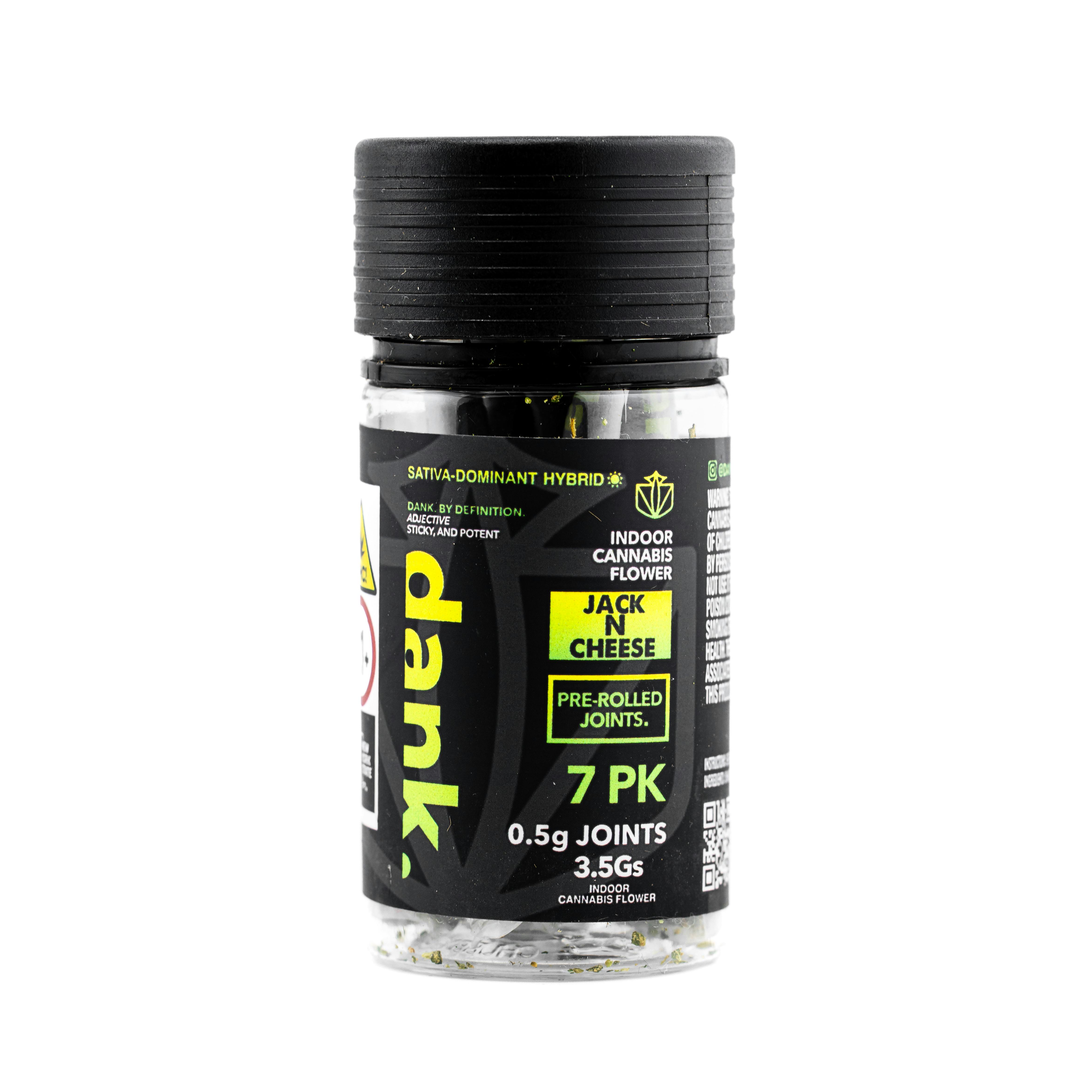
THC 31.3%Sativa-Hybrid
Dank By Definition.JACK AND CHEESE (7 PACK PRE-ROLL) · 0.5g/7pk
$39.82
$45after tax

weeddispensarynearme.com
You must be 21 years or older to enter. By entering, you confirm you’re of legal age in your state to purchase cannabis.
For use only by adults 21+ • Keep out of reach of children
1 live products in stock
Quick answer · What is the Jack And Cheese cannabis strain?
Jack and Cheese is a sativa-leaning hybrid that marries the electric, cerebral clarity of Jack Herer with the pungent, funky depth of UK Cheese. The result is a strain that defies easy categorization — bright and focused on the surface, with an earthy, almost savory undertow that keeps the experience grounded. It is the kind of cultivar that rewards a slow, attentive session, revealing new facets of aroma and character as the bowl or joint progresses.
$45after tax
About Jack And Cheese
Jack and Cheese is generally understood to be a cross of two landmark strains: Jack Herer and UK Cheese. Jack Herer, named after the celebrated cannabis activist and author, was developed in the Netherlands during the mid-1990s by Sensi Seeds. It is itself a complex four-way hybrid thought to involve Haze, Northern Lights No. 5, and Shiva Skunk, though Sensi Seeds has never fully disclosed the exact formula. Jack Herer became one of the most decorated cultivars in European cannabis history, winning multiple High Times Cannabis Cup awards and setting a benchmark for sativa-dominant, terpene-rich breeding. UK Cheese emerged from the British underground scene in the late 1980s and early 1990s, reportedly descending from a Skunk No. 1 phenotype selected by the collective known as Exodus in Luton, England. That particular phenotype — often called Exodus Cheese — became the genetic foundation for a wide family of Cheese-descended varieties prized for their unmistakable sharp, aged-dairy aroma. The specific breeder who first stabilized the Jack and Cheese cross has not been publicly identified with certainty across major cannabis databases, and the release date remains loosely documented. Nonetheless, the pairing makes intuitive genetic sense: Jack Herer contributes elevation and complexity, while Cheese grounds the experience in resinous, funky earthiness. Genetic siblings in the broader Jack Herer family include Jack the Ripper and Super Lemon Haze, while Cheese relatives include Blue Cheese and Chiesel.
The onset of Jack and Cheese tends to arrive with characteristic sativa-leaning speed — many experienced consumers notice an initial shift in mood and mental tempo within five to fifteen minutes of inhalation. The early phase is predominantly cerebral: thoughts quicken, sensory detail becomes more vivid, and a sense of sociable openness often accompanies the initial wave. This quality is largely attributed to the Jack Herer parentage, which contributes terpene and cannabinoid profiles associated with uplifting, focused states. As the session deepens into its peak, the Cheese genetics begin to assert themselves with a subtle but unmistakable body component. The experience does not become sedating in the way of a classic indica, but rather settles into a comfortable, warm equilibrium — alert yet at ease, curious yet unhurried. Myrcene's contribution here is worth noting: even at moderate concentrations, it tends to soften sharper sativa edges without dulling the overall experience. The comedown of Jack and Cheese is, for most consumers, gradual and gentle. The cerebral brightness dims slowly over two to three hours, leaving a calm, relaxed baseline rather than an abrupt or taxing crash. As with any sativa-leaning cultivar, those with sensitivity to THC-driven mental stimulation are well advised to start low and go slow — the early onset can feel swift and pronounced before the body component arrives to temper it. Overall, the experience arc is one of balanced engagement: stimulating without being frenetic, and relaxing without inducing lethargy.
The terpene profile of Jack and Cheese is where this cultivar earns its name most literally. On the nose, the first impression is a bright, almost citrus-tinged sharpness — a contribution likely from terpinolene and trace limonene carried through from the Jack Herer lineage. Terpinolene is associated with floral, herbal, and faintly piney aromas, and here it lends a clean, resinous top note that lifts what might otherwise be a very dense, funk-forward profile. Underneath that brightness lies the signature of the Cheese parentage: a sharp, fermented earthiness that many describe as reminiscent of aged cheddar or a well-ripened rind. This quality is widely associated with elevated concentrations of myrcene alongside the specific expression of sulfur-containing compounds and caryophyllene that characterize Cheese-descended genetics. Beta-caryophyllene, a spicy and woody terpene that is also found in black pepper and cloves, contributes both to the savory sharpness of the aroma and to an underlying warmth on the palate. When smoked or vaporized, Jack and Cheese delivers a notably complex flavor progression. The inhale tends to present the citrus-herbal brightness first, followed quickly by an earthy, cheesy body note on the mid-palate. The exhale is where the caryophyllene-driven spice and a faint sweetness — possibly influenced by ocimene or pinene — round out the profile. Vapor tends to express the terpene nuance more cleanly than combustion, making a temperature-controlled device a worthwhile consideration for those who want to explore the full aromatic range of this cultivar.
Jack and Cheese typically presents buds of moderate density — firmer than many classic sativa-dominant cultivars, yet not as tightly compressed as a pure indica. The structure reflects the hybrid balance in its parentage: calyxes stack with sativa-length internodal spacing but are wrapped in a noticeably resinous coating that speaks to the Cheese heritage. Trichome coverage tends to be generous and evenly distributed, giving the dried flower a frosted, slightly hazy quality under direct light. The color palette leans toward classic forest and sage greens, occasionally punctuated by deeper olive or yellow-green tones depending on the phenotype and growing conditions. Pistils are typically amber to rust-orange at full maturity, weaving through the canopy of the bud in a way that adds warmth to the overall visual. Some phenotypes express subtle purple or lavender undertones in the sugar leaves when grown at cooler finishing temperatures, though this is not consistent across all expressions of the cultivar.
Jack and Cheese is generally considered a moderately challenging cultivar for home growers, owing to the sometimes-demanding environmental preferences it inherits from both parent lines. Jack Herer genetics are known to produce tall, branchy plants with a tendency toward stretch during the early flowering phase — a trait that can require some experience with training techniques such as low-stress training or screen of green to manage canopy height effectively. Flowering time indoors typically falls in the range of nine to eleven weeks, reflecting the longer finish associated with haze-influenced genetics. Outdoor cultivation is well-suited to mild, temperate climates with a long, warm autumn — the kind of conditions where the full terpene expression of the Cheese parentage can fully develop. Indoor yields are generally described as moderate to generous, and outdoor plants can become quite large when given adequate space and root volume. The cultivar responds well to a moderately humid vegetative environment, but growers typically reduce humidity during late flowering to protect the dense, resinous bud structure from moisture-related issues. For the cultivator-curious shopper, Jack and Cheese represents a rewarding project for those with some prior growing experience.
Jack and Cheese occupies a particular niche in the canon of sativa-leaning hybrids: it is sociable enough for a gathering, yet focused enough for a solo creative session. Its early cerebral uplift makes it a natural companion for activities that benefit from elevated attention and gentle curiosity — writing, sketching, an afternoon of record browsing, or a long walk through a neighborhood that rewards close looking. The body ease that follows as the session matures ensures that the experience does not tip into overstimulation. For food pairings, the savory, fermented quality of the Cheese terpene profile finds an intuitive resonance with aged, umami-forward flavors: a well-curated charcuterie spread, sharp aged cheddar (an almost too-perfect mirror of the strain's own aromatic character), or a bowl of deeply seasoned roasted nuts. In terms of music, the layered complexity of the terpene arc — bright and citrus-herbal at the top, earthy and spiced underneath — pairs naturally with music that rewards attentive listening: jazz with harmonic depth, or post-rock that builds slowly toward resolution. Jack and Cheese is, at its core, a cultivar for those who appreciate texture and nuance over simple, single-note experiences.
Chiesel
A direct cross of NYC Diesel and UK Cheese, Chiesel shares the same funky, sharp Cheese backbone alongside a sativa-leaning fuel note that appeals to fans of complex, savory profiles.
Blue Cheese
For those drawn to the Cheese lineage in Jack and Cheese but who prefer a slightly more body-forward, relaxed experience, Blue Cheese offers a familiar funky earthiness softened by Blueberry sweetness.
Super Lemon Haze
Sharing the Jack Herer genetic family via its Haze parentage, Super Lemon Haze delivers a comparable citrus-bright, uplifting sativa arc for consumers who favor the cerebral side of Jack and Cheese.
Jack the Ripper
A Jack Herer descendant from TGA Subcool Seeds, Jack the Ripper carries the same resinous, terpene-forward quality and sativa-leaning focus that defines the Jack side of this cultivar's character.
Exodus Cheese
As the foundational Cheese phenotype from which UK Cheese descends, Exodus Cheese speaks directly to the pungent, aged-dairy earthiness that gives Jack and Cheese its distinctive savory depth.
Jack and Cheese is classified as a sativa-leaning hybrid. It draws its uplifting, cerebral character from Jack Herer — itself a sativa-dominant cultivar with Haze lineage — while the UK Cheese parentage contributes a grounding body quality that prevents the experience from feeling purely stimulating. Most consumers report an experience that is predominantly active and mentally engaged, with a comfortable physical ease arriving as the session progresses.
The flavor profile of Jack and Cheese is notably layered. The inhale tends to present citrus-herbal brightness and a faint piney quality from terpinolene and limonene inherited through the Jack Herer lineage. The mid-palate and exhale reveal the sharp, savory, almost fermented earthiness characteristic of UK Cheese genetics, with caryophyllene adding a warm, spiced finish. Vapor delivery tends to express these nuances more clearly than combustion.
Jack and Cheese typically delivers a swift, cerebral onset marked by elevated mood, increased mental engagement, and a sociable openness. As the session matures, the Cheese genetics introduce a gentle body warmth that balances the sativa-leaning stimulation. The comedown is generally gradual and comfortable. Because the initial onset can be pronounced, those newer to sativa-dominant cultivars are encouraged to start low and go slow to find a comfortable experience.
Consumers who enjoy Jack and Cheese often find similar appeal in Chiesel (Cheese meets NYC Diesel), Blue Cheese (a more relaxed Cheese expression), Super Lemon Haze (a citrus-bright Jack Herer relative), Jack the Ripper (a focused Jack-family sativa), and Exodus Cheese (the foundational Cheese phenotype). Each shares either the sativa-forward brightness or the funky, savory earthiness — or both — that define the Jack and Cheese experience.
Jack and Cheese can be an approachable choice for curious beginners who enjoy sativa-leaning effects, but the onset tends to be relatively swift and the cerebral stimulation can be pronounced. Those new to cannabis or to sativa-dominant cultivars should approach with the standard guidance of starting with a very small amount and allowing ample time — at least thirty minutes — before considering any additional consumption. The balanced hybrid character does provide a measure of body ease that tempers the experience.
Jack and Cheese is generally understood to be rich in terpinolene, which contributes its floral, herbal, and piney top notes; myrcene, which provides earthy warmth and a softening body quality; and beta-caryophyllene, which lends the characteristic spiced, savory depth associated with the Cheese lineage. Secondary contributions from limonene (citrus brightness) and potentially pinene or ocimene add complexity and dimension to the overall terpene architecture.
The Cheese character in this cultivar derives directly from its UK Cheese parent, which traces its lineage to a specific Skunk No. 1 phenotype selected by the Exodus collective in Luton, England, during the late 1980s and early 1990s. That phenotype expressed an unusually sharp, fermented, dairy-like aroma that became the defining characteristic of the entire Cheese genetic family. It is one of the most recognizable and imitated aromatic signatures in modern cannabis cultivation.
Given its sativa-leaning character and tendency toward cerebral activation, Jack and Cheese is generally best suited to daytime or early-evening use, when mental engagement and sociability are welcome rather than disruptive. Its body-easing qualities make it a reasonable choice for a relaxed late afternoon as well. Most consumers find it less compatible with pre-sleep routines than indica-dominant cultivars, as the early cerebral uplift can delay the onset of restfulness for those with sensitivity to stimulating effects.
Related strains
Pick your store
We'll show pricing, deals, and delivery zones for the store you pick. You can switch any time from the header.