On sale· 30% OFF
THC 33.9%Hybrid
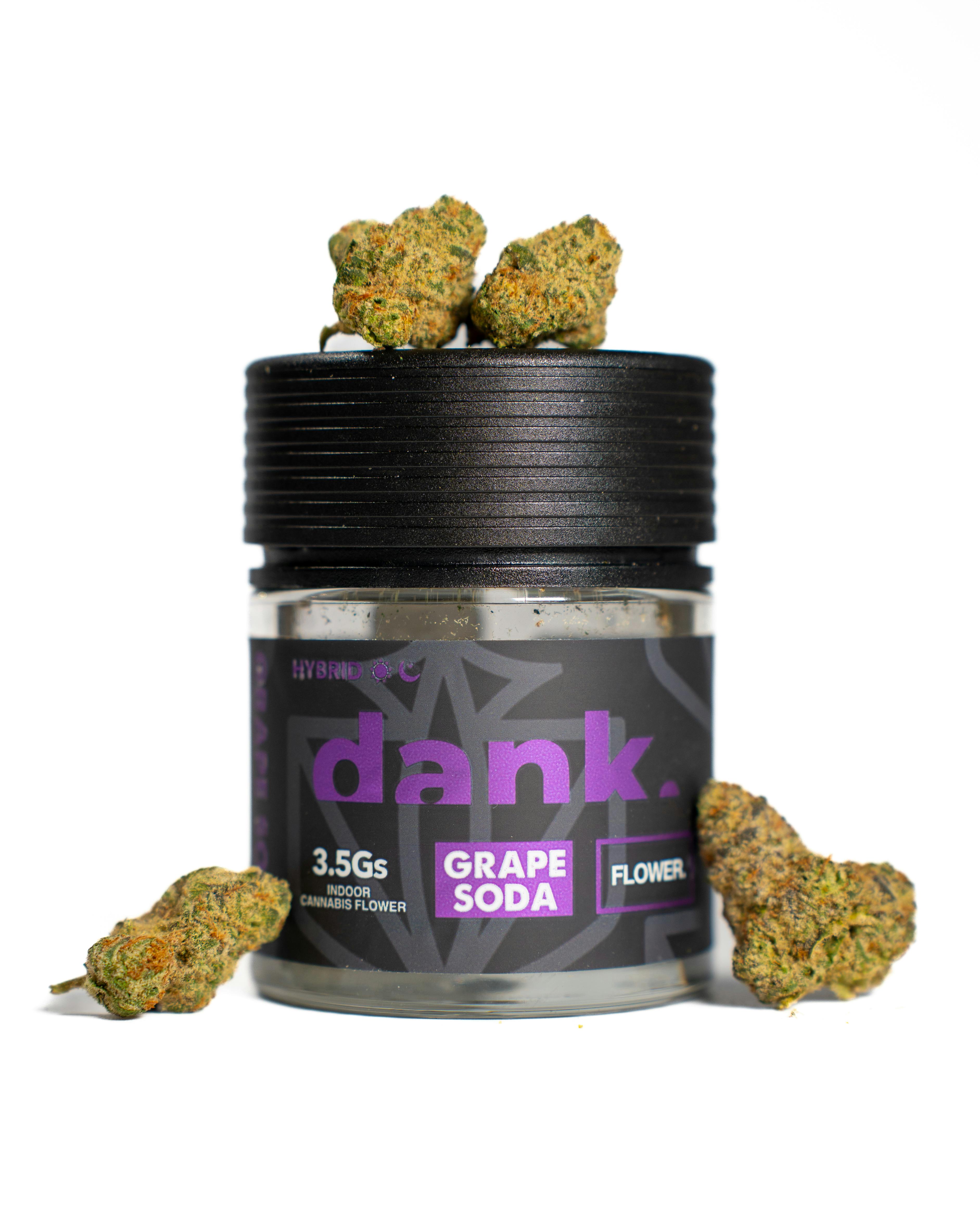
Dank By Definition.Dank | Grape Soda | Flower | Jar · 3.5g
$37.17$53.10
$44after tax

weeddispensarynearme.com
You must be 21 years or older to enter. By entering, you confirm you’re of legal age in your state to purchase cannabis.
For use only by adults 21+ • Keep out of reach of children
1 live products in stock
Quick answer · What is the Grape Soda cannabis strain?
Grape Soda arrives with the kind of immediate sensory recognition that stops a room mid-conversation — a dense, violet-touched bud exhaling sweet concord grape and a faint effervescent lift that earns the name before the first draw. This hybrid carries a warm, sociable energy, threading a gentle cerebral brightness through a body that gradually settles into ease. For the considered New York cannabis enthusiast, it represents an afternoon well chosen.
$44after tax
About Grape Soda
Grape Soda's lineage is a point of some friendly debate within cannabis cultivation circles. The strain is most commonly attributed to Archive Seed Bank, the Portland, Oregon breeder known for its methodical approach to fruit-forward genetics. Archive's version is widely understood to be derived from Tahoe OG Kush crossed with an undisclosed grape-phenotype female — a proprietary parent the breeder has not publicly named in full. This intentional opacity is consistent with Archive's broader practice of guarding its elite mother plants. The Tahoe OG Kush side of the family traces back to the Lake Tahoe region of California, where a distinct OG Kush phenotype emerged sometime in the mid-2000s, celebrated for its heavy resin production and deeper body sedation relative to standard OG expressions. Paired with Archive's grape-lineage female — suspected by some cultivators to carry Grape Ape or Mendocino Purps ancestry, though this remains unconfirmed — the resulting offspring leaned into purple coloration, sweet terpene expression, and a balanced hybrid effect profile. Genetic siblings and close relatives within the Archive catalog, such as Face Off OG and various Cookies-cross phenotypes, share the dense trichome architecture that defines Grape Soda's bag appeal. The strain gained wider cultural traction in the mid-2010s as purple and grape-forward varieties became highly sought after on both West Coast shelves and in emerging legal markets eastward.
Onset for Grape Soda typically arrives within five to ten minutes of inhalation — a measured window that belies the strain's eventual completeness. The initial register is cerebral: a brightening of attention accompanied by a mild elevation in mood that feels more like a cleared horizon than an energetic push. Conversation flows with less friction; creative thoughts surface with relative ease. This opening phase is often described as sociable and warm without the anxious edge that can accompany more sativa-dominant genetics. As the first twenty minutes give way to the peak, a body component begins to assert itself — unhurried and diffuse, settling across the shoulders and lower back with a quality that invites stillness without demanding it. The dual-register character is consistent with Grape Soda's hybrid classification: neither pole dominates entirely. Myrcene's contribution to this body quality is well-documented in terpene literature, reinforcing the mild physical ease that distinguishes this strain from purely heady varieties. The comedown is gradual and relatively gentle by hybrid standards — a slow tapering that eases users toward a comfortable baseline rather than an abrupt drop. Total duration for most experienced consumers runs between ninety minutes and two and a half hours, with the body warmth lingering longest. Those newer to cannabis are advised to approach measured sessions with a start-low, go-slow mindset, as the full body component can become more pronounced at higher consumption levels.
The dominant terpene in most well-grown Grape Soda phenotypes is myrcene, which anchors the aromatic profile in ripe, musky fruit — the olfactory equivalent of a split concord grape, sweet and slightly fermented at the edges. Myrcene's known contribution to cannabis aroma aligns precisely here: earthy sweetness with a juice-like fullness that registers immediately on the nose. Secondary to myrcene, caryophyllene introduces a faint peppery underpinning on the exhale, grounding the sweetness and preventing the profile from reading as cloying. Caryophyllene's interaction with the body is also among the better-studied terpene mechanisms, adding a subtle warmth to the physical experience. Limonene often appears in a supporting role across tested Grape Soda samples, lending a faint citrus brightness that lifts the grape note without redirecting it — functioning less as a distinct lemon presence and more as a sharpening agent for the primary fruit character. Some phenotypes also carry detectable linalool, which introduces a floral, almost violet quality that deepens the grape impression and contributes to the strain's overall sense of calm. On the palate — whether smoked through quality glass or vaped at a mid-range temperature — Grape Soda delivers its aromatic promise with reasonable fidelity. The draw is smooth, the grape character front-loaded on the inhale, and the caryophyllene-driven spice more apparent on the exhale. The finish is clean and relatively short-lingering, leaving the palate with a faint sweetness rather than an acrid or resinous aftertaste.
Grape Soda presents with the visual confidence of a strain bred as much for the display case as for the experience. Buds are characteristically dense and moderately compact — not the airy, wispy structure of a classic sativa, nor the rock-hard compression of a Kush-dominant cultivar, but a pleasing middle density that holds its shape while still yielding to gentle pressure. The color palette leans into the name: deep forest green calyxes are interrupted by patches of indigo and muted violet, particularly in phenotypes that have been exposed to cooler nighttime temperatures during the final weeks of flower. Trichome coverage is generous and even, producing a frosted visual quality across both the calyxes and the smaller sugar leaves that frame the bud. Under direct light, the resin heads catch and scatter with a luminous quality that signals potency without requiring a label to confirm it. Pistils range from amber to a deeper rust orange and are distributed in moderate density, threading through the violet-green structure in a way that adds visual contrast. The overall impression is one of considered cultivation — a bud that has been brought to maturity with attention.
Grape Soda is generally regarded as an intermediate-level cultivar — approachable enough for a second or third grow, but rewarding of the patience and environmental control that more experienced cultivators bring. Indoors, flowering typically completes in approximately eight to nine weeks, with indoor yields described as moderate to generous under optimized light and nutrient conditions. The strain responds well to low-stress training techniques, which help manage its tendency toward lateral branching and promote even canopy light distribution. Outdoors, Grape Soda performs best in a temperate, Mediterranean-style climate with warm days and meaningfully cooler nights during late flower — the temperature differential being an important factor in encouraging the violet and indigo pigmentation that defines the strain's visual identity. In the outdoor Northeast context, this may limit ideal outdoor production to specific microclimates. Humidity management during the final weeks of flowering is important, as the dense bud structure can create conditions hospitable to mold if airflow is insufficient. Harvest in outdoor northern climates typically falls in early to mid-October.
Grape Soda occupies a particular niche among hybrid varieties: it is social without being insistent, physical without being sedating, and flavorful enough to reward deliberate attention rather than habitual consumption. It is a natural companion to the early evening hours — the window after the workday has concluded but before the commitments of night have fully assembled. A small gathering on a well-lit terrace, a gallery opening that doesn't demand intense focus, or a solo session before settling into a long-form film all sit comfortably within the strain's character. On the culinary pairing front, the grape and light citrus terpene profile aligns naturally with a cheese board anchored by aged manchego or a mild blue, where the sweetness of the strain finds a savory counterpoint. For a music pairing, the warm, slightly hazy body effect and gently elevated mood suit mid-tempo soul or early jazz — Erykah Badu's live recordings or Miles Davis's Kind of Blue occupy a similar emotional register. The strain asks, in its quiet way, for presence rather than multitasking.
Grape Ape
Fans of Grape Soda's deep grape aromatics and gently sedating body feel will find Grape Ape a logical companion, as it shares a similarly dominant myrcene-driven fruit profile and Indica-leaning physical ease.
Tahoe OG Kush
As a likely parent of Grape Soda, Tahoe OG offers familiar resin density and body warmth for consumers who appreciate the physical grounding component but want to explore the less fruit-forward side of the lineage.
GDP (Granddaddy Purple)
GDP shares the violet coloration, sweet grape terpene expression, and relaxed hybrid character that define Grape Soda's appeal, making it a natural adjacent choice.
Purple Punch
Purple Punch's dessert-sweet, grape-and-berry profile mirrors Grape Soda's aromatic richness, and both strains deliver a comparable arc from sociable onset to comfortable physical ease.
Mendocino Purps
A possible ancestral connection gives Mendocino Purps a kindred terpene character — earthy, sweet, and gently euphoric — for consumers who enjoy tracing Grape Soda back toward its Northern California roots.
Grape Soda is classified as a hybrid. Most attributions place it as a cross rooted in OG Kush genetics on one side and a grape-lineage female on the other, producing a balanced experience that opens with a mild cerebral lift and settles into a gentle physical ease. It leans neither strongly indica nor strongly sativa, making it a versatile choice for consumers who want both qualities represented in one session.
The flavor profile is anchored by sweet, ripe grape — concord rather than wine-grape in character — with a faint effervescent quality that suits the name. On the exhale, a mild peppery warmth from caryophyllene provides contrast, and some phenotypes carry a light floral note attributed to linalool. The smoke is smooth and relatively clean-finishing, leaving a pleasant residual sweetness without harshness.
Consumers typically report a gentle cerebral lift at onset — an easing of social friction and a mild brightening of mood — that transitions over twenty to thirty minutes into a diffuse body relaxation. The experience is balanced: neither intensely heady nor deeply sedating. Duration generally runs between ninety minutes and two and a half hours. Those newer to cannabis should approach with measured sessions, as the body component can deepen with higher consumption.
Consumers drawn to Grape Soda's profile often find comparable satisfaction in Granddaddy Purple, Purple Punch, and Grape Ape — all of which share the grape-forward terpene character and gentle hybrid or indica-leaning ease. Tahoe OG Kush, considered a likely parent, offers the resinous depth without the fruit overlay. Mendocino Purps appeals to those interested in the broader Northern California purple-strain tradition from which Grape Soda arguably descends.
Grape Soda is a reasonable choice for adults newer to cannabis who are seeking a balanced, approachable experience, provided they follow a start-low, go-slow approach. The onset is measured rather than abrupt, and the effect profile is not overwhelmingly cerebral. However, the body component can become more pronounced with larger sessions, so those with limited tolerance are advised to allow adequate time between inhalations to gauge their response before continuing.
Myrcene is the primary terpene in most Grape Soda samples, responsible for the ripe, musky fruit character and a meaningful contribution to the body ease in the effect profile. Caryophyllene appears as a consistent secondary terpene, adding a peppery warmth on the exhale and a subtle physical grounding quality. Limonene and linalool are present in many phenotypes, contributing citrus brightness and a faint floral violet note respectively, which deepen the overall aromatic complexity.
Grape Soda is most widely attributed to Archive Seed Bank, a Portland, Oregon breeding operation known for methodical work with OG Kush and fruit-forward genetics. The strain is commonly described as a cross of Tahoe OG Kush with an undisclosed grape-lineage female whose full identity Archive has not publicly confirmed. This is consistent with Archive's broader approach to protecting its proprietary mother plants and elite genetic lines.
Grape Soda's balanced hybrid character places it most naturally in the late afternoon or early evening — after the demands of the day have settled but before the intention of a full night's rest. Its sociable, mood-lifting onset suits gathering contexts, while the gradual body ease that follows makes it equally fitting for a contemplative solo session. It is less suited to early-morning use, when clarity of focus may be a priority, or as a reliable late-night sedative.
Related strains
Pick your store
We'll show pricing, deals, and delivery zones for the store you pick. You can switch any time from the header.