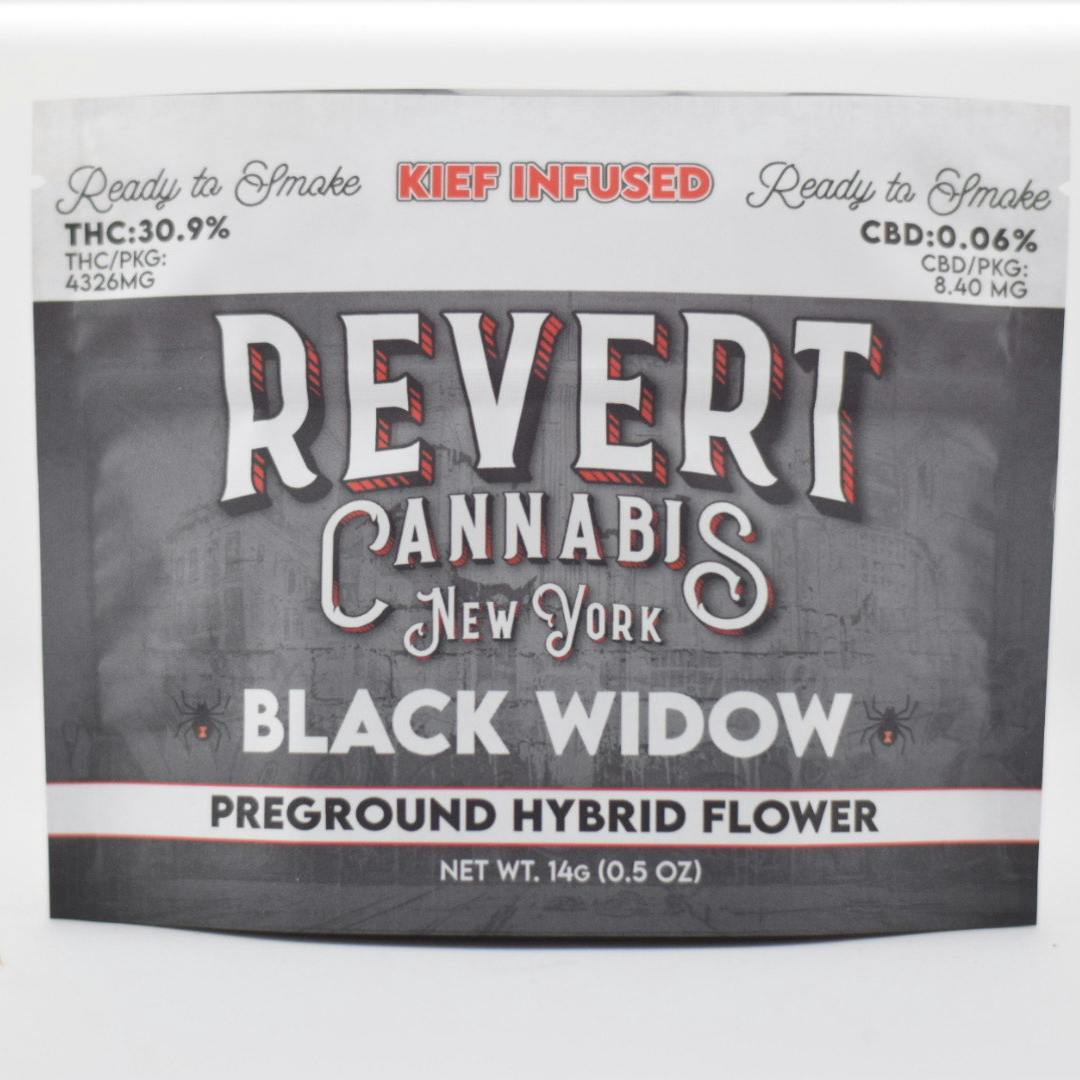
THC 25.17%Hybrid
Revert CannabisRevert | Black Widow | Infused Pre Ground Flower · 14g
$60.00
$68after tax

weeddispensarynearme.com
You must be 21 years or older to enter. By entering, you confirm you’re of legal age in your state to purchase cannabis.
For use only by adults 21+ • Keep out of reach of children
2 live products in stock
Quick answer · What is the Black Widow cannabis strain?
Black Widow is a balanced hybrid whose reputation precedes it across three decades of cannabis culture. Descended from South American and South Indian landrace genetics, this strain delivers a luminous, resin-drenched experience that moves fluidly between cerebral lift and physical ease. Its pale, trichome-frosted buds and complex white-pepper-meets-citrus aroma have made it a quiet fixture in serious collections — a strain that rewards patience and considered consumption in equal measure.
$68after tax
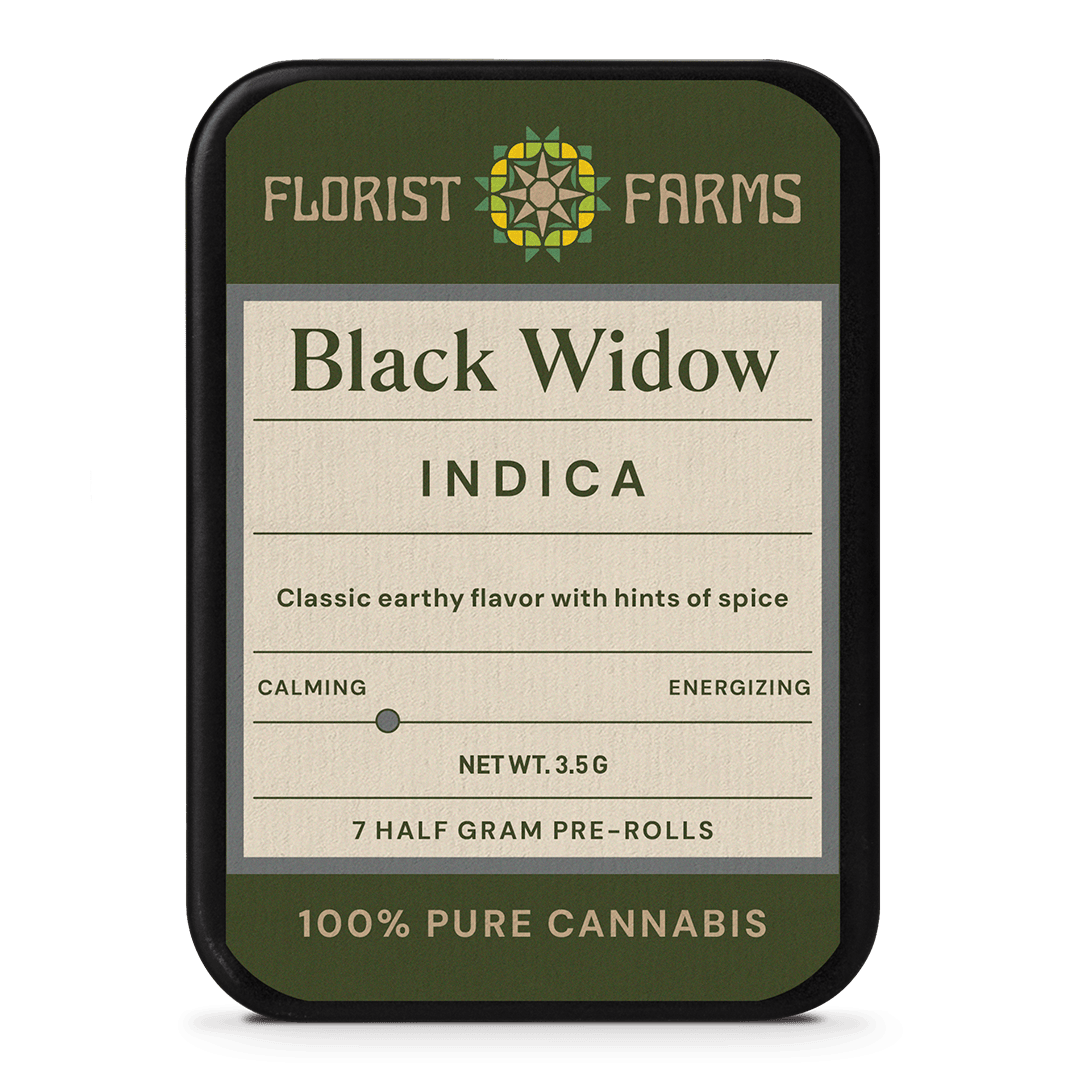
About Black Widow
Black Widow was developed by Shantibaba, the Dutch breeder who founded Mr. Nice Seedbank alongside Neville Schoenmakers and Howard Marks. The strain is widely understood to be a direct genetic predecessor — or close sibling — of White Widow, sharing the same core cross of a Brazilian sativa landrace and a South Indian indica landrace. Shantibaba has spoken publicly about working with this specific genetic combination during his tenure at Green House Seeds in the early-to-mid 1990s, and Black Widow is generally considered the Mr. Nice Seedbank's proprietary expression of that work following his departure from Green House. The Brazilian sativa parent contributes an energetic, equatorial character — long-flowering, cerebral, and aromatic — while the South Indian indica brings resinous density and a grounding physical presence. This pairing produced one of the most influential hybrid templates of the 1990s Dutch seed scene, and Black Widow won the High Times Cannabis Cup in 1995, a result that cemented its standing in the broader cannabis community. Genetic siblings and phenotypic cousins include White Widow (Green House Seeds' parallel expression), White Russian (a cross of AK-47 and White Widow-adjacent genetics), and several Mr. Nice Seedbank offerings that draw from the same South American and South Indian foundation. Some breeders and seed banks have released their own interpretations under the Black Widow name, so lineage can vary slightly outside Mr. Nice's original stock.
Black Widow typically announces itself within five to ten minutes of consumption, opening with a clarifying cerebral shift that sharpens sensory perception without tipping into anxiety. The onset is characteristically clean — thoughts feel organized rather than scattered, and a mild brightening of mood accompanies the initial wave. This sativa-forward opening phase is often attributed to the strain's limonene and terpinolene content, both of which are associated in preliminary research with uplifting, alert-leaning effects. As the experience deepens over the following thirty to forty-five minutes, the South Indian indica heritage asserts itself through a gentle but distinct body warmth. The peak is notably balanced: the mind remains engaged and conversational while the body settles into ease. This duality is the quality that long-time enthusiasts return to — Black Widow rarely feels like two competing forces but rather a single, well-integrated arc. Myrcene, present in moderate concentrations, is believed to facilitate this transition toward physical calm. The comedown is gradual and unhurried, trailing into a relaxed, grounded state that most consumers find comfortable rather than sedating. Total duration typically spans two to three hours, depending on individual factors and method of consumption. Given its heritage and resin density, those new to cannabis or high-potency hybrids are well advised to approach with a conservative, start-low-go-slow posture, as the balanced character can obscure how substantial the experience ultimately becomes.
The aromatic profile of Black Widow is one of its most immediately recognizable qualities. On the nose, it leads with a sharp, almost crystalline note of white pepper and dried earth — a signature likely driven by elevated caryophyllene, a sesquiterpene known for its spicy, herbal character and its status as the only terpene confirmed to interact with the endocannabinoid system's CB2 receptors. Beneath that initial pepper impression, a secondary wave of citrus peel and fresh pine emerges, attributable to limonene and pinene respectively, lending a brightness that prevents the earthiness from feeling heavy. Terpinolene, a terpene common to several Dutch hybrid descendants, adds a floral-herbal dimension — faintly reminiscent of fresh herbs or light wood shavings — that gives the strain an almost botanical complexity. Myrcene rounds out the bouquet with subtle mango and damp soil undertones, tying the brighter citrus and spice notes together into something cohesive and distinctly resinous. On the palate, whether consumed via flower or vapor, Black Widow delivers a smooth, slightly thick smoke with a pronounced spice-and-citrus midpalate. The exhale carries a clean, woody finish that lingers pleasantly without harshness. Vaporization at moderate temperatures tends to open up the floral and citrus registers more clearly, making it a particularly rewarding choice for those who prefer to explore the aromatic range of a well-grown batch.
Black Widow's visual identity is anchored by its extraordinary trichome density — the buds appear almost silvery-white under direct light, a quality that aligns with its name and its genetic relationship to the White Widow lineage. The underlying calyx structure is moderately dense, leaning toward the compact, rounded formations typical of indica-influenced hybrids, though well-grown phenotypes often show slightly elongated, sativa-influenced bud architecture. The color palette beneath the trichome blanket ranges from medium to deep forest green, occasionally showing faint blue-green or grey undertones in cooler growing environments. Pistils are typically burnt orange to deep amber, threading through the frosted calyxes in a pattern that creates visual contrast against the pale resin layer. Trim quality in premium cuts reveals clearly articulated sugar leaves that are themselves heavily coated, making even the periphery of a well-cured bud visually striking. The overall impression is of restrained abundance — dense with resin, precise in structure, and quietly commanding.
Black Widow is considered a moderately challenging strain for home cultivators, owing to the attentive environmental management its resin production demands. It performs well both indoors under controlled conditions and outdoors in warm, Mediterranean-style climates with low humidity, particularly during the late flowering phase when moisture control becomes critical for protecting trichome integrity. Indoors, flowering typically concludes within eight to nine weeks, and the strain responds well to screen-of-green (SCROG) techniques that allow the canopy to receive even light distribution. Indoor yields are generally moderate — the plant prioritizes resin output over raw volume. Outdoors, harvest typically falls in mid-to-late October in the Northern Hemisphere, with yields that can be more generous given adequate space and sun. The strain's South Indian indica heritage makes it somewhat resilient to temperature variation, though it benefits from attentive monitoring for mold in humid conditions. For the cultivator-curious shopper, Black Widow is best understood as a strain that rewards careful hands — its output is quality-forward rather than quantity-forward.
Black Widow occupies an appealing middle ground for those seeking a strain that can accompany a range of considered activities. Its balanced onset — cerebral and engaged, then physically warm — makes it well suited to late-afternoon creative sessions: writing, sketching, or working through a complex design problem. The clarity of its early phase supports focus without the edge that more sativa-dominant strains can introduce, while the body ease that follows provides a sense of sustained comfort rather than distraction. Socially, Black Widow holds its own at a small dinner gathering or a quiet evening with close company — its conversational quality encourages engagement without overstimulation. For food pairings, the strain's pepper-and-citrus terpene profile harmonizes naturally with dishes that share those registers: a well-seasoned charcuterie board, aged hard cheese, or a citrus-forward cocktail. In terms of music, something textured and mid-tempo — acoustic jazz, chamber pop, or a carefully assembled vinyl playlist — suits the strain's arc without competing with it. It is, ultimately, a strain for the thoughtful evening rather than the late night.
White Widow
Sharing the same foundational Brazilian-South Indian lineage, White Widow offers a nearly parallel terpene profile and resin density, making it the most natural reference point for any Black Widow enthusiast.
White Russian
A cross of White Widow and AK-47, White Russian carries the same resinous, balanced character with a slightly more pronounced cerebral edge that will appeal to those who enjoy Black Widow's sativa-forward onset.
Blue Widow
A hybrid of Blueberry and White Widow genetics, Blue Widow preserves the creamy, resin-rich body of the White lineage while adding a softer, fruit-forward aromatic dimension that Black Widow fans often find complementary.
Super Silver Haze
For those drawn to Black Widow's clarifying cerebral lift, Super Silver Haze offers a comparably luminous and socially engaging experience with a more sativa-dominant arc.
Trainwreck
Sharing the pepper-and-citrus terpene character alongside a balanced-to-sativa effect profile, Trainwreck appeals to the same consumer who values aromatic complexity and a clean, engaged onset.
Black Widow is a balanced hybrid, descended from a Brazilian sativa landrace and a South Indian indica landrace. In practice, its experience arc tends to open with a sativa-leaning cerebral clarity before transitioning into a more grounded, indica-influenced body ease. Most consumers find it neither strictly one nor the other, which is precisely what makes it a versatile choice across a range of settings and times of day.
Black Widow presents a distinctive palate of white pepper, citrus peel, and fresh pine, with softer undertones of dried earth and faint floral herbs. On the exhale, a clean woody finish lingers without harshness. Vaporization tends to amplify the citrus and botanical registers, while traditional flower consumption emphasizes the spice and earth notes. The overall flavor profile is complex and resinous, reflecting the strain's dense trichome production.
Black Widow typically begins with a focused, clarifying mental lift that arrives within five to ten minutes. Over the following half-hour, a gentle but noticeable body warmth develops alongside the continued mental engagement, creating a balanced peak. The experience generally lasts two to three hours before tapering into a relaxed, grounded state. Those new to cannabis or high-potency hybrids should approach conservatively, as the smooth onset can understate the experience's depth.
The closest relatives and stylistic parallels include White Widow, which shares the same core lineage, and White Russian, which builds on that foundation with added cerebral intensity. Blue Widow offers a fruitier variation on the same resinous template. For those drawn specifically to Black Widow's uplifting onset, Super Silver Haze and Trainwreck both deliver comparable aromatic complexity and engaged, clear-headed effects.
Black Widow is worth approaching with care if you are new to cannabis. Its balanced character and smooth onset can feel approachable, but the strain's resin density and potency potential mean the experience can deepen considerably beyond initial impressions. A start-low, go-slow approach is always sensible — taking time between sessions to assess where you are before continuing. In the right setting and at a considered pace, it can be a genuinely rewarding introduction to quality hybrid cannabis.
Black Widow's terpene profile is typically led by caryophyllene, which contributes the strain's distinctive white-pepper and spice character. Limonene follows with citrus brightness, while pinene adds a clean, resinous pine note. Terpinolene provides a floral-herbal dimension, and myrcene rounds the profile with earthy, subtly fruity undertones. Together, these terpenes produce an aromatic complexity that is at once bold and balanced, and they are closely linked to the strain's characteristic effect arc.
Black Widow was developed by Shantibaba, the prominent Dutch breeder who later co-founded Mr. Nice Seedbank. The strain emerged from the same Brazilian-South Indian genetic work that produced White Widow in the early-to-mid 1990s. Black Widow won the High Times Cannabis Cup in 1995, which brought it significant international attention. Mr. Nice Seedbank remains the primary associated source for the original genetic line, though other breeders have released strains under the same name.
Black Widow performs well across most consumption methods, but vaporization is particularly well suited to showcasing its terpene complexity — moderate temperatures allow the citrus, pepper, and floral notes to express clearly before the heavier, earthy undertones emerge. For those who prefer flower, a well-cured, properly stored batch delivers a smooth, resin-rich smoke. Regardless of method, measured, intentional consumption best honors both the strain's nuance and its potency. Starting with a single, modest session is always advisable.
Related strains
Pick your store
We'll show pricing, deals, and delivery zones for the store you pick. You can switch any time from the header.