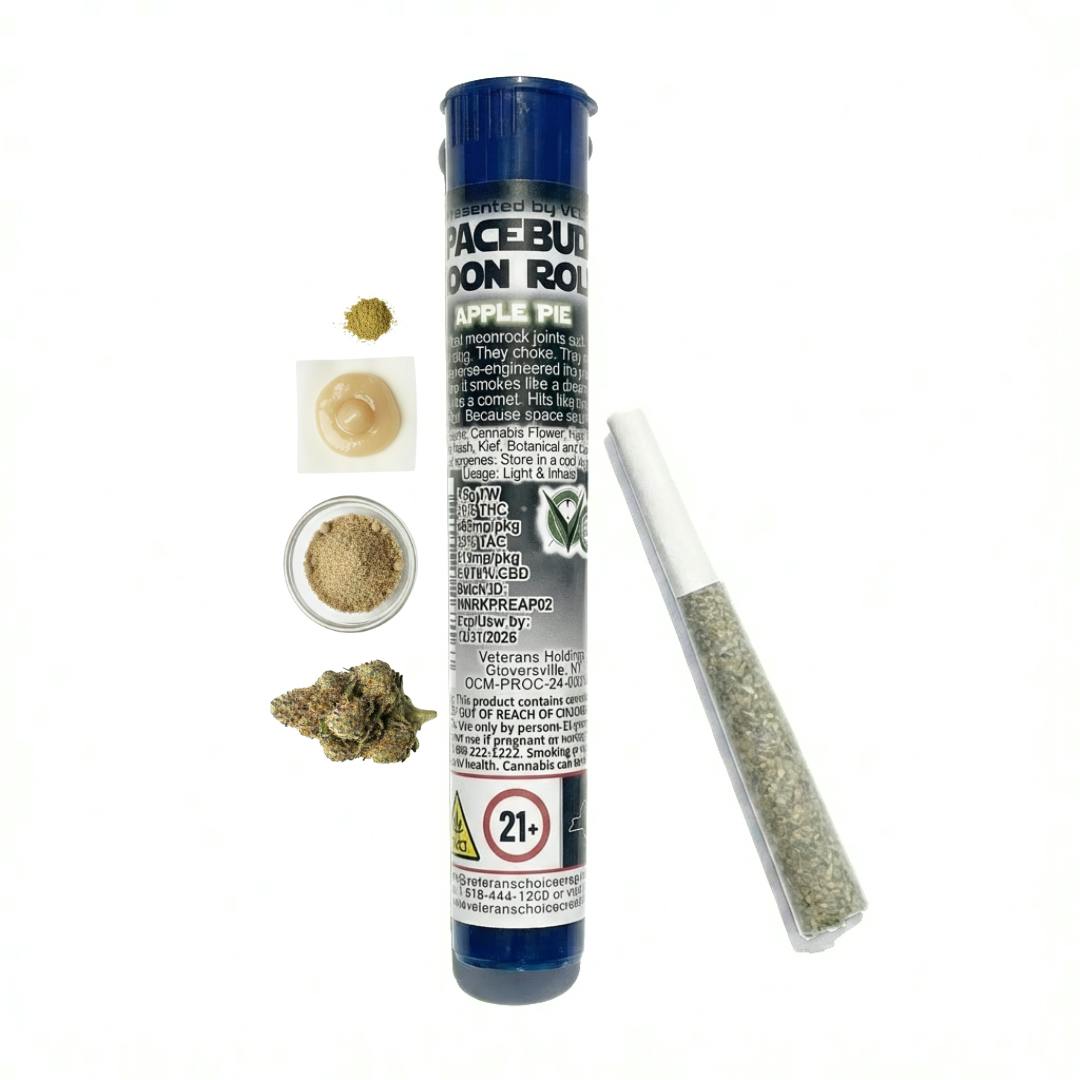
THC 30.98%Hybrid
Spacebuds MoonrocksSPACEBUDS | 1.5G | MOON ROLL | APPLE PIE · 1.5g
$30.00
$34after tax

weeddispensarynearme.com
You must be 21 years or older to enter. By entering, you confirm you’re of legal age in your state to purchase cannabis.
For use only by adults 21+ • Keep out of reach of children
2 live products in stock
Quick answer · What is the Apple Pie cannabis strain?
Apple Pie is a warmly balanced hybrid that evokes the comfort of a familiar dessert without sacrificing the clarity one expects from a thoughtfully cultivated flower. Its terpene profile leans toward sweet orchard fruit and baked spice, while the experience itself settles into a gentle, sociable equilibrium — neither too stimulating nor too sedating. For the discerning New York consumer seeking an approachable yet nuanced session, Apple Pie occupies a satisfying middle ground.
$34after tax

About Apple Pie
Apple Pie's lineage is a subject of some debate across public cannabis databases, though the most widely cited account credits the strain to Apothecary Genetics, who are said to have crossed Cinderella 99 with Tre Dawg — two strains with considerable pedigrees of their own. Cinderella 99, bred by Mr. Soul of Brothers Grimm Seeds in the late 1990s, was itself derived from a Princess (a Jack Herer phenotype) crossed with Shiva Skunk, celebrated for its fast-cycling, cerebral sativa character. Tre Dawg, a complex hybrid rooted in Chemdawg genetics, contributed earthier, more resinous qualities to the union. The combination was designed to balance Cinderella 99's bright, uplifting tendencies against Tre Dawg's grounding density, producing a hybrid profile that reads as dessert-forward on the nose and even-keeled in the body. Some sources suggest alternative parentage, with mentions of Granddaddy Purple or other sweet-leaning cultivars occasionally appearing, though these claims lack consistent corroboration across reputable databases. Apple Pie does not appear to have generated widely documented named phenotypes, though individual growers have selected for variations ranging from more fruit-forward to spice-dominant expressions. Its influence has been felt in the wave of dessert-themed hybrids that became commercially prominent through the 2010s, helping establish the cultural appetite for strains that marry approachability with complexity.
The onset of Apple Pie tends to arrive within minutes of inhalation, beginning as a subtle elevation of mood and a gentle brightening of mental focus — qualities consistent with the cerebral heritage of Cinderella 99 in its lineage. This initial phase carries little in the way of anxiety or edge, making the opening moments feel measured and composed rather than jarring. As the session progresses into its peak, the experience shifts toward a sociable, even-tempered equilibrium. The body registers a mild warmth and ease without the heavy sedation associated with more indica-dominant cultivars. Conversation tends to flow naturally, sensory engagement with music or food is often heightened, and creative thinking may become more fluid without sacrificing coherence — a balance tied in part to caryophyllene's modulating influence on the endocannabinoid system and myrcene's contribution of physical ease. The duration of a typical session runs between one and two hours before a gentle tapering begins. The comedown is generally smooth and gradual rather than abrupt, with most consumers reporting a soft return to baseline rather than fatigue or cloudiness. Those newer to cannabis are advised to begin with a conservative amount, as the strain's balanced profile can still be more potent than its approachable character initially suggests. The overall arc is one of warmth, social comfort, and mild creative lift.
Apple Pie's aromatic identity is anchored by myrcene, the most prevalent terpene across a broad range of cannabis cultivars and the compound most responsible for the strain's ripe, slightly musky fruit quality. Here, myrcene reads less tropical than it might in, say, a mango-forward hybrid, instead presenting as a cooked apple note — warm, sweet, and faintly fermented at the edges, as if the fruit has spent time in a warm oven. Caryophyllene arrives as a secondary but significant presence, lending the dry spice and subtle pepperiness that gives Apple Pie its structural depth. Without this counterpoint, the profile might lean cloying; caryophyllene keeps the sweetness honest and adds a dimension that experienced palates often associate with pastry dough or winter baking spices. Limonene, where present, contributes a brightness that lifts the mid-register of the aroma and provides a clean citrus accent — less obvious than in lemon-forward strains, but perceptible as a kind of zest. On the palate, Apple Pie smokes smoothly, with a vapor character that carries the sweet-spice profile faithfully from nose to exhale. The inhale is soft and fruit-forward, while the exhale tends to reveal the caryophyllene-driven spice more clearly. The finish is clean with a slight earthiness — a quality likely inherited from the Tre Dawg side of the lineage — that grounds the sweetness and leaves a pleasant, lingering warmth on the palate.
Apple Pie presents as a medium-dense hybrid flower, its buds tending toward compact, rounded calyxes rather than the elongated, airy structures more typical of sativa-leaning cultivars. The color palette leans into the warmer end of the cannabis spectrum: a base of sage and medium green is frequently punctuated by amber to russet-toned pistils that curl across the surface like brushstrokes, reinforcing the autumnal, harvest-season aesthetic the name suggests. Trichome coverage is generous without being extraordinary — a frosty, resinous layer catches light and signals potency while remaining approachable in appearance. Under close inspection, the trichome heads are often milky with occasional amber notes depending on harvest timing, which speaks to the cultivator's role in shaping the final effect character. Overall, Apple Pie presents as a well-groomed, inviting flower — one that communicates quality through density and resin production rather than through dramatic coloration alone.
Apple Pie is generally considered a moderately accommodating cultivar for those with some prior growing experience, though it is not typically recommended as a first project for absolute beginners due to its preference for attentive environmental management. It performs reliably both indoors and outdoors, with indoor cultivation allowing the grower greater control over humidity and temperature — factors that meaningfully influence the expression of its dessert terpene profile. Indoors, the strain is typically reported to flower within approximately eight to nine weeks, with yields described as moderate to above-average depending on growing method and canopy management. Outdoor cultivators in climates with warm, dry autumns — a reasonable analog to New York's late-season windows — tend to see harvest in early to mid-October. The plant's structure is compact enough to manage in confined indoor spaces, though some lateral training is often recommended to maximize light penetration and flower development. For the cultivator-curious shopper, Apple Pie represents an interesting study in how a warm, spice-forward terpene profile can be shaped by harvest timing and post-harvest curing practices.
Apple Pie is at its most eloquent during the transitional hours of the day — late afternoon into early evening, when the pace of a New York day begins to soften without fully surrendering to night. Its balanced hybrid character makes it well-suited to unhurried social settings: a small dinner gathering where conversation is the centerpiece, or a quiet creative hour before the evening properly begins. Given its terpene profile of myrcene, caryophyllene, and limonene, Apple Pie pairs naturally with foods that echo its own register. A charcuterie selection featuring aged cheeses, membrillo, and toasted walnut bread would mirror the strain's sweet-spice-earth arc in a satisfying way. On the listening end, warm acoustic recordings — think early Norah Jones, Bill Frisell's Americana work, or low-key indie folk — complement the strain's unhurried, grounded energy without demanding the kind of attention that a more stimulating cultivar might invite. For solo use, Apple Pie serves well as a companion to reflective creative work: journaling, light sketching, or the kind of reading that benefits from an open but not overactive mind.
Cinderella 99
As a parent strain, Cinderella 99 shares Apple Pie's cerebral brightness and sweet fruit character, making it a natural next step for consumers who want to explore the sativa-leaning side of Apple Pie's lineage.
Chemdawg
Inherited through the Tre Dawg lineage, Chemdawg offers Apple Pie fans a deeper dive into the earthy, resinous foundation that grounds the strain's sweeter aromatic qualities.
Wedding Cake
Wedding Cake shares Apple Pie's dessert-forward terpene profile and balanced hybrid character, appealing to consumers who appreciate sweetness and spice in equal measure.
Strawberry Cough
For consumers drawn to Apple Pie's uplifting sociability and fruit-forward aroma, Strawberry Cough offers a comparable experience with a brighter, berry-driven aromatic identity.
Gelato
Gelato's creamy, dessert-inflected profile and smooth, well-rounded hybrid effects make it an intuitive recommendation for those who enjoy Apple Pie's approachable sweetness and balanced body sensation.
Apple Pie is classified as a hybrid, drawing from both the cerebral, uplifting qualities associated with sativa-leaning genetics — via Cinderella 99 — and the earthier, more physically grounding qualities of its indica-influenced Tre Dawg parent. The result is a balanced experience that avoids the extremes of either category, making it a versatile choice across a range of settings and times of day.
True to its name, Apple Pie delivers a palate of warm baked fruit, subtle cinnamon-adjacent spice, and a clean, slightly earthy finish. Myrcene drives the cooked-apple sweetness, caryophyllene introduces a dry, pastry-like spice quality, and limonene adds a faint citrus brightness on the inhale. The smoke is smooth and the vapor character translates the dessert profile faithfully from aroma to aftertaste.
Apple Pie typically produces a measured, sociable lift — beginning with a gentle mood elevation and mental brightening, then settling into a warm, easy-bodied equilibrium. It rarely tips into sedation or anxiety under moderate use, and its arc tends to be smooth from onset through a gradual, comfortable comedown. As with all cannabis, individual experience varies, and a conservative approach is always advisable.
Consumers who enjoy Apple Pie often find common ground with Wedding Cake, Gelato, and Cinderella 99, all of which share some combination of dessert-forward terpene profiles and balanced hybrid effects. Strawberry Cough appeals to those drawn to Apple Pie's sociable, fruit-forward character, while Chemdawg speaks to the earthy, resinous depth that the Tre Dawg lineage contributes.
Apple Pie's balanced hybrid character and smooth experiential arc make it more approachable than many high-potency cultivars, but it is not without weight. New adult-use consumers in New York are encouraged to start with a small amount, allow adequate time between sessions, and assess their response before proceeding. The strain's warmth and sociability tend to be forgiving, but individual sensitivity to cannabis varies considerably.
Myrcene is the most commonly cited dominant terpene in Apple Pie, contributing the strain's characteristic ripe, cooked-fruit warmth. Caryophyllene follows as a prominent secondary terpene, adding a dry, spiced quality that gives the profile structural depth. Limonene is often present in supporting amounts, lending a subtle citrus brightness that keeps the overall aromatic experience from reading as overly heavy or one-dimensional.
Apple Pie is most at home during the late afternoon or early evening — the transitional hours when the demands of the day have eased but the night has not yet fully arrived. Its balanced hybrid effects support social engagement, gentle creative activity, and unhurried leisure without the heavy sedation that would cut a session short. Morning or high-productivity use is possible but less intuitive given its mild body warmth.
The most widely cited account attributes Apple Pie to Apothecary Genetics, a respected name in craft cannabis breeding, who reportedly crossed Cinderella 99 with Tre Dawg. The exact year of release is not consistently documented across public sources, though the strain gained visibility during the broader mid-2010s wave of dessert-themed hybrid development. Some databases list alternative or unconfirmed parentage, so lineage details should be considered as generally accepted rather than definitively settled.
Related strains
Pick your store
We'll show pricing, deals, and delivery zones for the store you pick. You can switch any time from the header.