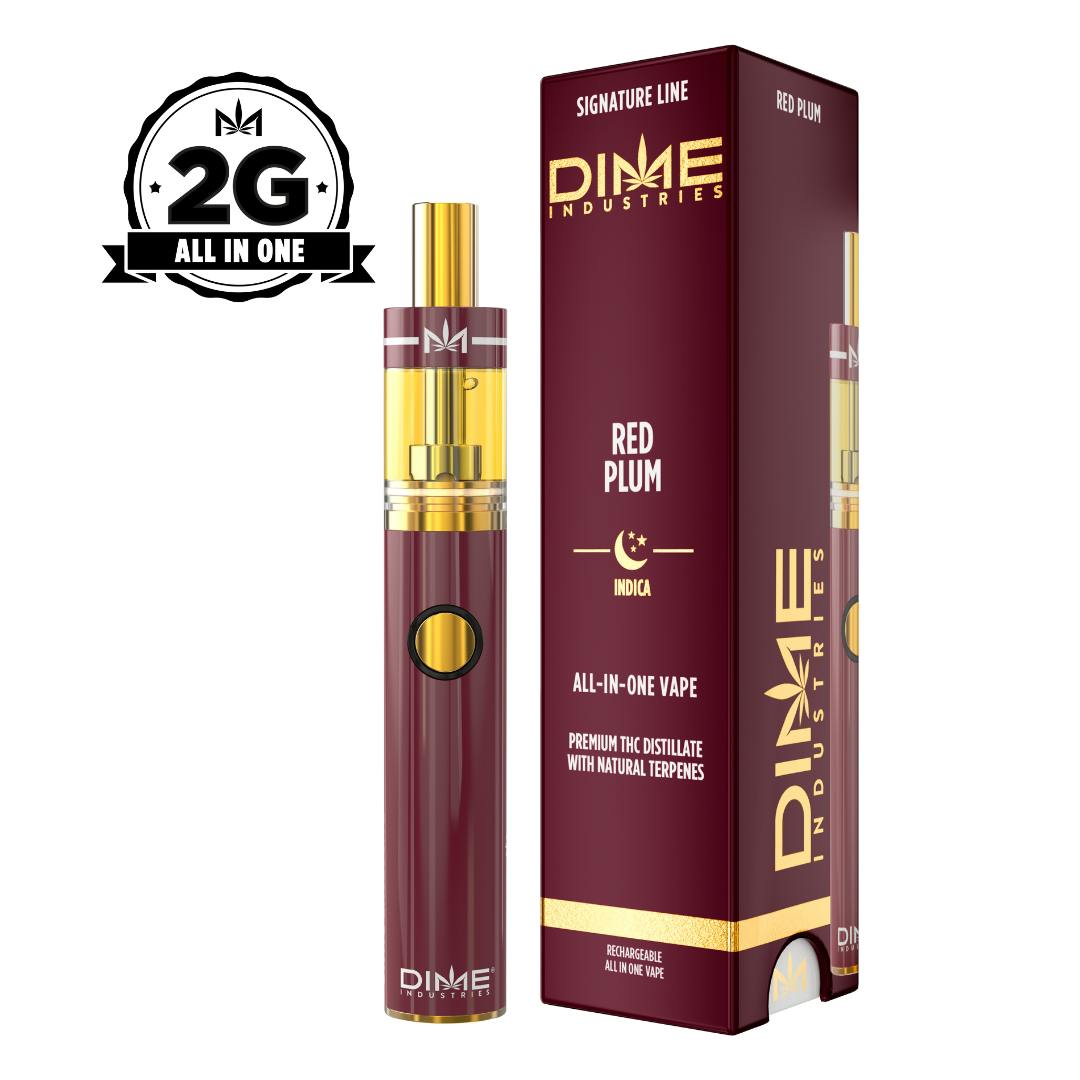
THC 85.67%·CBD 0.23%Indica
Dime IndustriesRed Plum Signature Line All In One | 2g · 2g
$79.65
$90after tax

weeddispensarynearme.com
You must be 21 years or older to enter. By entering, you confirm you’re of legal age in your state to purchase cannabis.
For use only by adults 21+ • Keep out of reach of children
1 live products in stock
Quick answer · What is the Red Plum cannabis strain?
Red Plum arrives like the last warm evening of autumn — deep, unhurried, and faintly sweet on the air. This indica-leaning cultivar draws the body into a state of deliberate ease, its berry-forward terpene profile underscored by an earthy, stone-fruit richness that lingers well past the final exhale. For those who appreciate cannabis the way a sommelier appreciates a well-cellared Burgundy, Red Plum rewards patience and attentiveness in equal measure.
$90after tax
About Red Plum
Red Plum's precise lineage has not been fully disclosed by any single breeder operating under that name in mainstream catalogues, and the strain appears across several regional markets under conditions that suggest multiple independent selections may share the label. The most commonly cited interpretation connects Red Plum to a Purple-family ancestry — likely drawing from strains such as Granddaddy Purple and an undisclosed Plum or berry-phenotype indica, both of which contribute the characteristic anthocyanin expression and stone-fruit aromatics that define the cultivar's identity. Granddaddy Purple itself, developed by Ken Estes in Northern California around 2003, brought together Big Bud and Purple Urkle, establishing a genetic template for visually striking, deeply relaxing indicas that would influence an entire generation of breeders. Some phenotype expressions of Red Plum also suggest a possible Blueberry lineage contribution — DJ Short's foundational Blueberry strain from the late 1970s and 1980s introduced the berry-terpene signature that resonates strongly in Red Plum's flavor profile. Whether this connection is direct or convergent remains publicly undocumented. Genetic siblings in spirit, if not always in verified lineage, include strains like Purple Punch, Forbidden Fruit, and Black Cherry Punch — all indicas that balance floral sweetness with sedative body weight. Shoppers seeking verified third-party lineage documentation should consult their dispensary's certificate of analysis and batch notes, as phenotype selection can vary meaningfully between cultivators.
The onset of Red Plum tends to arrive within five to fifteen minutes of inhalation — a gentle pressure gathering behind the eyes and across the shoulders that signals the body's transition toward a quieter register. The initial phase carries a modest cerebral warmth: thoughts slow to a more deliberate pace, sensory details gain a pleasant softness, and social anxiety, if present, tends to recede without disappearing entirely. This is not the sharp, clarifying lift of a sativa-dominant cultivar; it is closer to the feeling of lowering oneself into a warm bath at the end of a long day. The peak experience, typically reached within thirty to forty-five minutes, is characterized by a pronounced body effect — a heaviness that settles into the limbs and lower back in a manner that most consumers describe as comfortable rather than immobilizing at moderate consumption. Myrcene, present in high concentrations in most Red Plum phenotypes, is broadly understood to contribute to this sedative, muscle-relaxing quality. The duration of peak effects generally spans ninety minutes to two hours for most consumers, with a gradual comedown that eases naturally into drowsiness. As with any potent indica, those newer to cannabis or sensitive to THC are well served by the standard approach: start low, go slow, and allow each session ample time to unfold before reassessing.
The aromatic profile of Red Plum opens with an immediate wave of ripe stone fruit — plum skin, dark cherry, and a faint note of black grape that together recall the inside of a well-stocked summer fruit stall. This top-note character is largely attributed to myrcene, the most abundant terpene in most indica cultivars of this family, which delivers both the musky-fruity base and a significant portion of the strain's sedative reputation. Caryophyllene adds a secondary layer of dry, peppery warmth beneath the sweetness — a spice-cabinet nuance that keeps the profile from reading as simple or one-dimensional. On closer inspection, terpinolene and ocimene appear in supporting roles in certain phenotypes, contributing a floral, almost herbaceous brightness that lifts the heavier stone-fruit notes and gives the nose a subtle complexity. Linalool, where present, deepens the floral aspect with a faint lavender quality that rounds the edges of the aroma considerably. On the palate, Red Plum delivers its promise with relative faithfulness. The smoke or vapor opens with that characteristic berry-plum sweetness on the front of the tongue, transitioning through a light earthiness at mid-palate before settling into a clean, slightly spiced finish that the caryophyllene provides. Vapor at lower temperatures tends to emphasize the fruit and floral notes; combustion at higher temperatures draws out the earthier, woodier undertones. The exhale is smooth, and the aftertaste — a faint jammy sweetness — tends to linger pleasantly.
Red Plum presents visually in a manner consistent with its Purple-family heritage: dense, tightly wound calyxes that stack into compact, tapered buds with a structural solidity that communicates careful cultivation. The color palette is among the cultivar's most immediately striking qualities — deep forest greens give way across the surface to burgundy and violet hues that intensify toward the interior of the flower, a consequence of anthocyanin pigmentation triggered by cooler overnight temperatures during the final weeks of flowering. Pistils run in shades of burnt orange to deep amber, threading through the canopy of the bud in a way that adds warmth to what might otherwise read as a cool-toned palette. Trichome coverage is generous and even, giving cured flower a frosted, almost luminous quality under direct light. The overall visual impression is one of density and restraint — this is not a loud, sprawling flower, but a composed, concentrated one that repays close examination.
Red Plum is generally considered a moderately demanding cultivar — accessible enough for an attentive intermediate grower, but not ideally suited as a first-time project. Indoor cultivation is the more widely practiced approach, offering the environmental control needed to coax out the violet and burgundy coloration that defines this phenotype's visual identity. A deliberate drop in overnight temperature to the low sixties Fahrenheit during the final two weeks of flowering is the most reliable method for encouraging anthocyanin expression. Flowering time typically falls in the range of eight to nine weeks under standard twelve-hour light cycles. Indoor yields are moderate, reflecting the cultivar's emphasis on density and resin production over raw volume. Outdoor cultivation in temperate climates with a defined autumn season is viable, with harvest typically falling in late September to mid-October in the Northern Hemisphere. The plant's compact indica structure keeps height manageable, though growers should anticipate the need for adequate airflow and attentive humidity management given the density of the canopy. Organic living-soil environments are reported anecdotally to enhance the terpene complexity of the finished flower.
Red Plum occupies a very particular niche in the evening repertoire. It is best suited to the hours between dinner and sleep — a transitional space where the demands of the day have receded but the desire for gentle sensory engagement persists. Solo listening sessions with music that rewards close attention pair particularly well with the strain's ability to deepen perception without sharpening anxiety: think late-period jazz, ambient electronic, or acoustic recordings with textural detail that benefits from an unhurried ear. At the table, Red Plum finds an elegant counterpart in foods that share its tonal range — a cheese board anchored by aged Gouda or a ripe, washed-rind variety alongside dark-fruit preserves and walnut crackers would echo and extend the strain's stone-fruit and earthy notes in a satisfying way. For those who prefer activity to contemplation, a slow evening walk through a neighborhood that rewards quiet observation — the kind where the light is transitioning and the temperature carries the first suggestion of the season changing — provides an ideal physical context. This is not a strain for productivity or social performance; it is a strain for being present in a moment you have already decided to enjoy.
Granddaddy Purple
Sharing likely ancestral roots and a comparable berry-grape aromatic profile, Granddaddy Purple delivers a similar deep-body indica experience with the same visual drama of purple-toned flower.
Purple Punch
Purple Punch mirrors Red Plum's stone-fruit sweetness and evening-oriented sedation, making it a natural point of reference for consumers who enjoy the candy-grape end of the indica spectrum.
Forbidden Fruit
The cherry and tropical-fruit terpene character of Forbidden Fruit appeals to the same palate as Red Plum, while offering a slightly more complex, resinous finish.
Black Cherry Punch
Blending purple-family genetics with a dark-cherry aromatic signature, Black Cherry Punch is a logical next step for a Red Plum enthusiast seeking greater terpene intensity.
Blueberry
DJ Short's foundational Blueberry strain shares the berry-forward sweetness and languid body effect that define Red Plum's core character, and offers a more historically documented point of comparison.
Red Plum is classified as an indica-dominant cultivar. Its physical profile — dense bud structure, broad-leaf plant architecture, and a deeply relaxing body effect — aligns closely with classic indica characteristics. The experience is weighted toward physical ease and evening use rather than the energizing, cerebral quality more commonly associated with sativa-dominant varieties. Most consumers find it best suited to late-afternoon or nighttime sessions.
Red Plum carries a ripe stone-fruit sweetness on the palate — plum skin, dark cherry, and a background note of black grape — supported by a mild earthiness and a faint peppery spice on the finish. The flavor is most expressive at lower vaporization temperatures, where the fruit and floral top notes come forward clearly. Combustion tends to bring out the earthier, woodier undertones while retaining a jammy sweetness on the exhale.
Red Plum produces a body-forward experience characterized by physical relaxation, limb heaviness, and a gentle mental softening that does not typically lead to acute sedation at moderate consumption. Onset arrives within ten to fifteen minutes, building toward a sustained, comfortable peak over the following thirty to forty-five minutes. The experience tends to transition naturally into drowsiness over time, making it well suited to evening unwinding rather than daytime activity.
Consumers drawn to Red Plum's stone-fruit aromatics and indica body effect tend to find common ground with Granddaddy Purple, Purple Punch, Forbidden Fruit, Black Cherry Punch, and Blueberry. Each of these cultivars shares some combination of berry-forward terpene character and a deeply relaxing physical profile, though the precise balance of cerebral and body effects differs across phenotypes and individual grows.
Red Plum can be a suitable choice for adult-use consumers who are newer to cannabis, provided they approach it with appropriate caution. Its potency as an indica-dominant cultivar means that overconsumption can lead to pronounced sedation or disorientation. The standard guidance applies: start with a very small amount, allow a full thirty to forty-five minutes to assess the effects before consuming further, and choose a comfortable, familiar setting for the first experience.
Myrcene is typically the dominant terpene in Red Plum phenotypes, contributing the musky stone-fruit base note and a significant portion of the cultivar's sedative quality. Caryophyllene appears as a prominent secondary terpene, adding dry, peppery warmth and complexity. Depending on the specific phenotype and cultivation approach, linalool, terpinolene, and ocimene may also be present, offering floral, herbaceous, and fruity supporting notes.
Red Plum is best positioned as an evening or late-afternoon cultivar. Its indica-dominant effect profile — physical relaxation, a quieting of mental activity, and a natural drift toward drowsiness — does not lend itself to daytime productivity or demanding social situations. Most consumers find it most rewarding in the window between the end of the day's obligations and sleep, when its capacity for deep, unhurried ease can be fully appreciated.
Red Plum does not currently have a single, widely documented breeder origin in major public cannabis databases. The name appears across multiple regional markets with phenotype variation that suggests independent selections by different cultivators. Consumers seeking specific genetic provenance are encouraged to consult their dispensary's batch documentation and certificates of analysis, which may include cultivator notes that provide additional context about the specific cut being offered.
Pick your store
We'll show pricing, deals, and delivery zones for the store you pick. You can switch any time from the header.