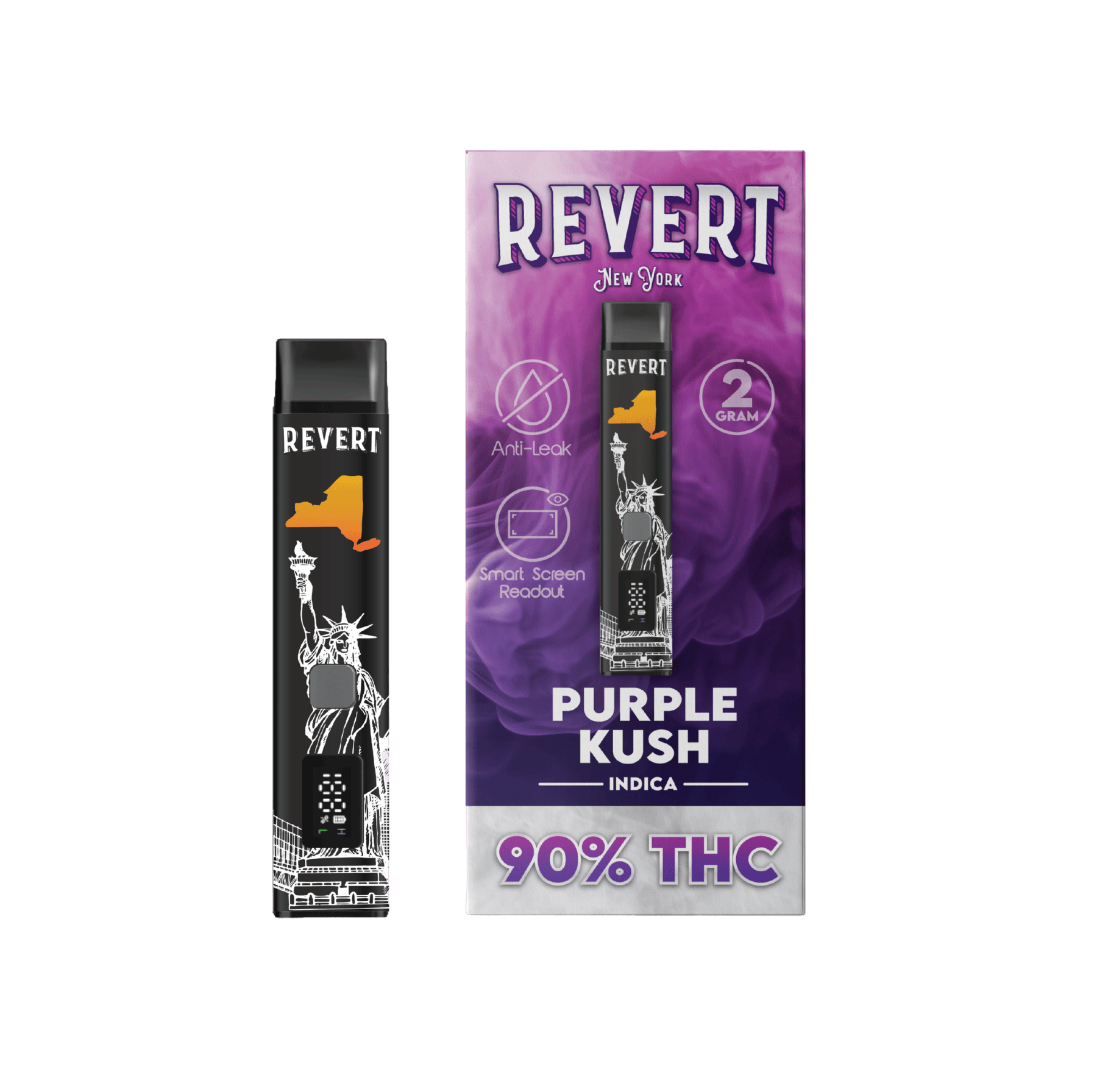
THC 80.06%·CBD 0.78%Indica
Revert CannabisRevert | Purple Kush | Disposable Vape · 2g
$64.60
$73after tax

weeddispensarynearme.com
You must be 21 years or older to enter. By entering, you confirm you’re of legal age in your state to purchase cannabis.
For use only by adults 21+ • Keep out of reach of children
1 live products in stock
Quick answer · What is the Purple Kush cannabis strain?
Purple Kush is a pure indica of West Coast lineage that has earned its place as one of the defining strains of the modern cannabis canon. Its deep violet-tinged buds, earthy grape-and-sandalwood aromatics, and profoundly sedating character make it a natural choice for those who approach the evening with intention. Unhurried and enveloping, Purple Kush rewards patience and deliberate consumption in equal measure.
$73after tax
About Purple Kush
Purple Kush is widely documented as a pure indica cross of Hindu Kush and Purple Afghani, both landrace-derived varieties with roots in the mountainous regions of Central Asia and the Hindu Kush corridor. The strain is understood to have originated in the Oakland, California area — specifically in the community sometimes called the Oaksterdam neighborhood — during the late 1990s and into the early 2000s, a period when West Coast breeders were actively hybridizing Afghani landraces with regional purple phenotypes to stabilize color expression and potency simultaneously. Hindu Kush, one of the parent strains, is a classic unadulterated landrace from the mountain range that shares its name, spanning the Pakistan-Afghanistan border. It contributes the dense, resinous bud structure and the deep, hash-like earth tones that define Purple Kush's body. Purple Afghani, the other parent, brings the anthocyanin-driven pigmentation responsible for the strain's signature coloring, as well as an added layer of grape and berry sweetness. Purple Kush became influential not simply for its aesthetics but because it demonstrated that pure indica genetics could produce a highly consistent, commercially reproducible phenotype with stable color, aroma, and effect profiles. It appears on Leafly's canonical strain lists and has given rise to numerous offspring, including Purple Cadillac and various 'Purple Kush' phenotype selections offered by seed banks such as Kannabia and others. Its genetic siblings in the broader Kush family — Bubba Kush, Master Kush — share structural DNA but each expresses a meaningfully different aromatic and experiential character.
The onset of Purple Kush is characteristically gradual for an indica of its potency, typically manifesting within five to fifteen minutes of inhalation as a gentle warmth behind the eyes and a softening of muscular tension across the shoulders and upper back. This initial wave is quiet rather than forceful, inviting rather than demanding — a quality that distinguishes it from more abrupt heavy indicas. The peak, which tends to settle in around twenty to forty minutes, is predominantly physical. The cerebral component is present but subdued: a mild mental quietude that empties the mental chatter without producing significant creative elevation or cognitive stimulation. This is not a strain that generates ideas so much as it creates the conditions in which ideas cease to feel urgent. Myrcene, the dominant terpene in most Purple Kush phenotypes, is associated in the scientific literature with sedating, muscle-relaxing qualities, and its prominence here directly correlates with the strain's signature body-forward character. Duration typically runs two to three hours for most consumers, with the comedown being notably smooth — a slow diminishing rather than an abrupt drop. As the peak recedes, a heavy-lidded drowsiness often follows, making late-evening timing a natural fit. New consumers and those with lower tolerance should exercise the standard "start low, go slow" approach, as the sedating depth of Purple Kush can be disorienting when encountered without preparation.
The aromatic profile of Purple Kush is structured around myrcene as its anchor terpene, which contributes the warm, herbal, slightly overripe fruit quality that gives this strain much of its immediate recognizability. Beneath myrcene, caryophyllene adds a subtle spiced earthiness — a faint peppery note that gives the nose some structural complexity and prevents the overall profile from tipping into pure sweetness. Together these two terpenes account for much of the strain's candied-earth quality on first impression. Secondary terpenes typically include pinene, which introduces a faint resinous pine note that reads almost like incense or sandalwood rather than a sharp forest character — appropriate given the strain's Afghani hash heritage. Linalool, present in smaller concentrations, lends a distant floral softness that integrates with the grape and berry sweetness contributed by the Purple Afghani parentage. The overall aromatic impression is of a dark, warm, slightly sweet earthiness — grape candy resting in a cedar drawer, or the interior of a well-aged wine cellar. On the palate, whether consumed via dry-herb vaporizer or traditional combustion, Purple Kush delivers a smooth, full-bodied draw. The grape and berry sweetness arrives first on the exhale, followed by a lingering earthy, sandalwood finish that coats the palate gently. At lower vaporizer temperatures the fruit notes are more precise and articulate; combustion rounds them into a deeper, more resinous register. The finish is long and clean, with minimal harshness.
Purple Kush produces dense, tightly packed buds consistent with its pure indica structure — compact, broad calyxes that stack closely together into chunky, almost conical formations. The most immediately striking visual feature is the coloration: deep violet and indigo hues suffuse the leaves and, in well-cured phenotypes, the calyxes themselves, the result of anthocyanin pigment expression encouraged by cooler nighttime temperatures during the late flowering stage. Set against this dark canvas, the pistils run a warm amber to burnt orange, creating a color contrast that is genuinely arresting at close range. Trichome coverage is generous and even, a fine crystalline frost that gives the buds a dusty, almost powdered appearance under direct light. The overall impression is of something dense and considered — heavy in the hand relative to its visual size, a reliable indicator of the resin density cultivated from its Kush landrace ancestry.
Purple Kush is considered a moderately accessible strain for home cultivators, though achieving its full color expression requires some environmental management. The violet and indigo pigmentation that defines the strain's visual identity is triggered by exposing plants to cooler nighttime temperatures — generally in the range of 10 to 15 degrees Celsius — during the final two to three weeks of flowering. Without this temperature differential, plants may express predominantly green foliage, though potency and aroma are not meaningfully affected. Indoors, Purple Kush typically finishes flowering in approximately eight weeks, which is on the shorter end for an indica and makes it attractive to cultivators operating on tighter cycles. Indoor yields are moderate rather than exceptional, reflecting the compact bud structure of pure indica genetics. Outdoors, the strain performs well in dry, temperate climates that approximate its Central Asian landrace origins — humidity management is advisable, as the dense bud structure can create conditions favorable to mold in wetter environments. Its relatively short stature makes it well-suited to space-constrained indoor setups. Overall, it is a reliable, forgiving cultivar that rewards attentive environmental control.
Purple Kush is a strain that belongs unmistakably to the later hours — ideally the two to three hours between the end of the evening's obligations and the beginning of sleep. Its sedating, body-forward character is best encountered when there is genuinely nothing left to do: no correspondence to answer, no decisions to make, no errands outstanding. For solo consumption, it pairs naturally with music that rewards passive listening rather than active engagement — late-period John Coltrane, ambient works by Brian Eno, or the quieter recordings of Nick Drake all match the strain's introspective, unhurried tempo. For food pairings, Purple Kush's dark berry and earthy aromatic profile finds a natural counterpart in similarly structured flavors: aged dark chocolate, dried figs, or a small pour of a well-structured Zinfandel or Syrah echo the grape and spice notes in the terpene profile. It is not, by design, a social or conversational strain, though a quiet evening shared between two people who have no need to fill silence will find it entirely appropriate. Those curious about vaporizer temperature are generally best served exploring the lower-to-mid range to preserve the fruit and floral terpene notes before they volatilize.
Granddaddy Purple
Shares the anthocyanin-driven purple aesthetics, grape-and-berry terpene profile, and deeply sedating indica body effect that define the Purple Kush experience.
Bubba Kush
A closely related Kush-family indica with similar earthy, hash-forward aromatics and a heavy, enveloping body effect, appealing to the same preference for deep physical relaxation.
Master Kush
Another pure indica with shared Kush landrace ancestry that delivers the same earthy, resinous character and calm, body-centered effect arc without the purple color expression.
Afghan Kush
A direct landrace ancestor in Purple Kush's broader lineage, offering the same dense resin production and hash-like earthiness for consumers who want an even more elemental expression of the Kush profile.
Grape Ape
Delivers a comparable grape-forward aromatic sweetness paired with a similarly tranquilizing body effect, making it a natural next step for consumers drawn to Purple Kush's fruit-and-earth balance.
Purple Kush is a pure indica, one of the relatively few commercially prominent strains with no meaningful sativa admixture in its documented lineage. Descended from Hindu Kush and Purple Afghani — both landrace or landrace-derived indica varieties — it expresses the compact structure, dense resin production, and heavily physical, sedating effect profile that are characteristic of pure indica genetics. It is not a balanced hybrid and should be approached accordingly.
Purple Kush carries a dark, layered flavor profile anchored by grape and sweet berry on the exhale, followed by a warm, earthy finish that evokes sandalwood and subtle spice. The sweetness is candied rather than fresh — closer to dried fruit or grape candy than to anything bright or citrus-adjacent. A faint resinous, incense-like quality on the back palate reflects its Afghani hash heritage and lingers pleasantly after the draw has finished.
The effects are predominantly physical and sedating. Onset is gradual, typically producing a soft warmth and muscular ease within ten to fifteen minutes, followed by a deeper body relaxation at peak. Mental activity quiets without being eliminated entirely. The experience is enveloping and unhurried, lasting roughly two to three hours before a natural drowsiness sets in. It is not well-suited to active, goal-oriented contexts and is best reserved for the later hours of the evening.
Consumers who appreciate Purple Kush tend to respond well to Granddaddy Purple for its comparable grape aromatics and sedating body effect, Bubba Kush for its shared Kush-family earthiness, and Master Kush for a similar pure indica experience without the color expression. Afghan Kush offers a more elemental take on the same landrace-derived profile, while Grape Ape provides a fruit-forward alternative with a similarly tranquilizing character.
Purple Kush can be appropriate for beginners who are specifically seeking a calm, evening-oriented experience, but its depth of sedation warrants care. The standard guidance — start with a single, small inhalation, wait a full fifteen to twenty minutes before considering more, and consume only in a comfortable, low-obligation setting — applies here with particular relevance. Its potency is not trivial, and consumers without established tolerance should approach it with deliberate patience rather than enthusiasm.
Myrcene is the primary terpene in most Purple Kush phenotypes, contributing the herbal, slightly overripe fruit quality and the sedating body character the strain is known for. Caryophyllene follows as a secondary terpene, adding a subtle peppery spice and structural earthiness. Pinene and linalool typically appear in smaller concentrations, contributing a faint resinous or sandalwood note and a soft floral background respectively. Together these four terpenes define the strain's distinctive dark, warm aromatic signature.
Purple Kush is an evening and night strain without meaningful qualification. Its sedating, body-forward effect profile is misaligned with any context requiring focus, mobility, or social engagement. It is most naturally suited to the final two to three hours before sleep, consumed in a comfortable, low-stimulation environment. Attempting to use it during daytime or in contexts with pending responsibilities is likely to produce a frustrating rather than pleasant experience for most consumers.
Purple Kush is documented as a cross of Hindu Kush, a Central Asian landrace from the mountain range spanning Afghanistan and Pakistan, and Purple Afghani, an Afghani-derived variety selected for anthocyanin color expression. The strain is understood to have originated in Oakland, California in the late 1990s to early 2000s. It does not carry a single widely credited named breeder in the public record, having emerged from the broader West Coast cannabis cultivation community of that era.
Related strains
Pick your store
We'll show pricing, deals, and delivery zones for the store you pick. You can switch any time from the header.