
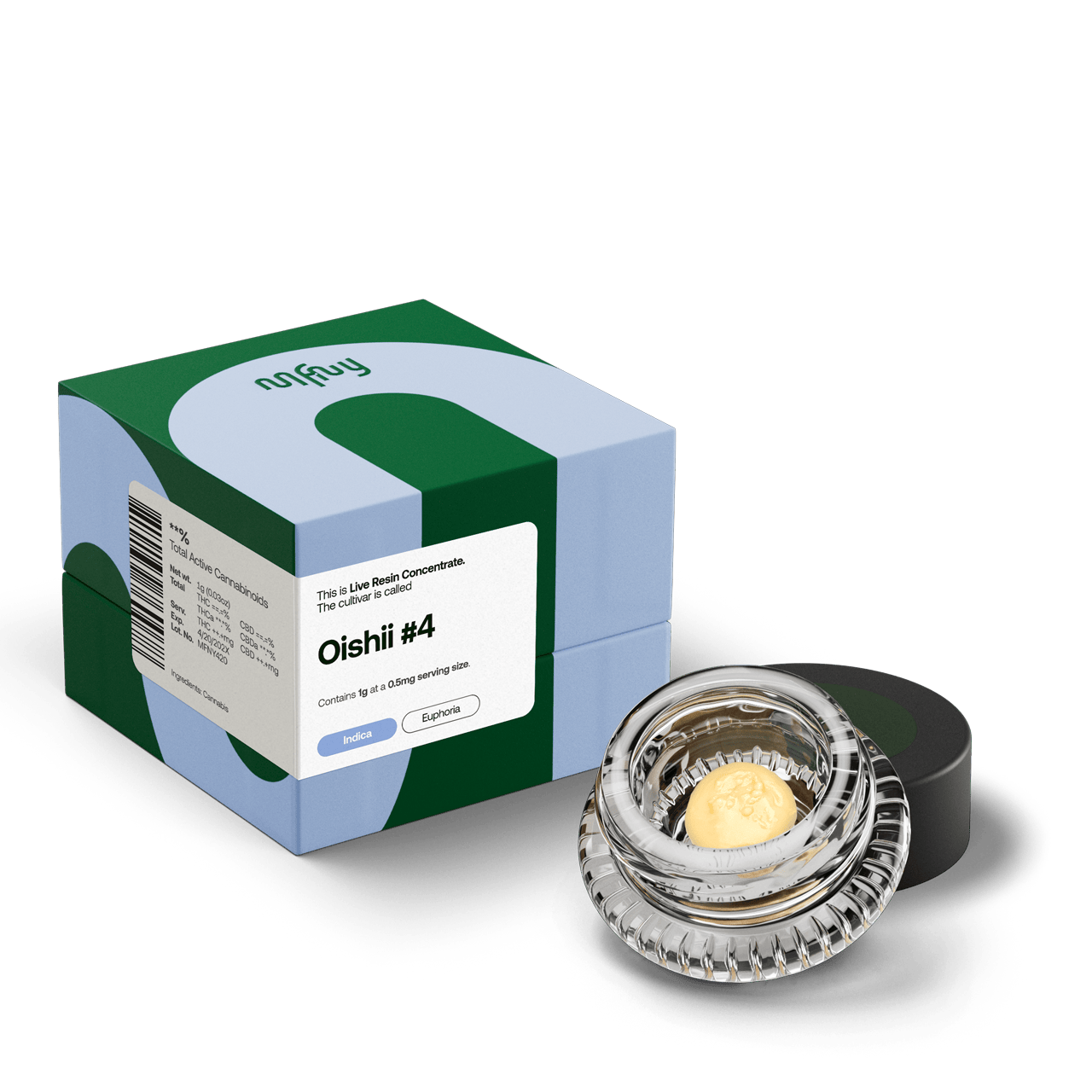
Indica
All strains Oishii #4
1 live products in stock
Quick answer · What is the Oishii #4 cannabis strain?
Oishii #4 is a contemplative indica whose name — borrowed from the Japanese word for 'delicious' — announces its intentions with quiet confidence. Dense, resinous, and anchored by an earthy sweetness that lingers well past the exhale, this cultivar invites a measured pace and a darkened room. It is the kind of flower that rewards those who slow down, offering a grounded, full-body experience suited to New York evenings when the city's noise finally deserves to be set aside.
Shop Oishii #4 · 1 of 1 live products
About Oishii #4
Everything to know about Oishii #4.
Lineage & origin
Oishii #4 is a proprietary cultivar whose precise lineage has not been fully disclosed by its breeder in publicly available sources, placing it among a growing class of boutique selections where the phenotype hunt matters as much as the documented pedigree. What is broadly understood is that the 'Oishii' line draws from indica-dominant heritage consistent with Afghani and OG Kush-adjacent genetics, which would account for its compact structure, heavy resin production, and characteristic sedative terpene profile. The '#4' designation indicates that it is the fourth selected phenotype from a deliberate breeding or pheno-hunting run, a practice common among small-batch American craft breeders who release only the most expressive individual plants from a larger population. The name 'Oishii' has appeared within boutique cannabis circles in the United States, particularly in markets where Japanese aesthetic influence — minimalism, precision, the elevation of the everyday — resonates with cultivators and consumers alike. Without confirmed breeder documentation, the exact release year and parentage remain debated within online cannabis communities. Shoppers curious about confirmed lineage are encouraged to ask their ZenZest floor associate for the most current certificate of analysis or cultivator notes, as batch-level documentation may clarify origin details that are not part of the public record.
Effects
As with most indica-dominant cultivars, Oishii #4 tends to announce itself gradually. The onset window typically falls within five to fifteen minutes of inhalation, beginning with a soft warmth that settles first behind the eyes and at the base of the skull — a gentle unwinding rather than a sharp shift in perception. This initial phase carries a mild mood elevation, a quiet contentment that does not demand engagement with the world so much as offer permission to release it. The peak character of Oishii #4 is emphatically physical. Myrcene, the most commonly cited dominant terpene in heavily indica-leaning cultivars, is widely associated with sedation and muscle relaxation, and the experience here aligns with that profile: a heaviness in the limbs, a softening of tension across the shoulders and chest, and a drift toward stillness. The cerebral component remains present but recedes into the background — thoughts slow and become less insistent without disappearing entirely, which many experienced consumers describe as one of the more pleasant qualities of a well-grown indica. Duration runs toward the longer end of the spectrum for flower, with effects commonly reported at ninety minutes to two-plus hours. The comedown is typically smooth, easing rather than dropping the consumer back to baseline. Those newer to cannabis or to indica-forward cultivars are encouraged to start with a modest amount and allow adequate time before reassessing.
Aroma, flavor & terpenes
The nose on Oishii #4 opens with a pronounced earthiness — damp soil, aged wood, and a faint herbal bitterness — that is consistent with a myrcene-forward terpene profile. Myrcene is the most abundant terpene in the majority of indica-dominant cultivars and carries the characteristic musk that anchors strains in this lineage. On closer inspection, there is a secondary layer of sweetness, faintly fruity and almost floral, which suggests the presence of linalool or a minor ocimene expression contributing softness and lift to what would otherwise be a one-dimensional earthen palette. Caryophyllene, a terpene found widely in black pepper and cloves, lends a subtle spice to the aroma — a dry, woody heat that makes itself known especially as the flower is broken apart or ground. This terpene is notable not only for its aromatic contribution but for its documented interaction with CB2 receptors, which some researchers associate with a calming, anti-inflammatory character, though no medical claims are made here. On the palate, Oishii #4 delivers a smoke or vapor that is smooth and full-bodied, coating the mouth with that same earthy sweetness detected in the initial nose. A faint pine note, possibly attributable to trace alpha-pinene, appears on the mid-palate before resolving into a long, quietly spiced finish. The flavor is cohesive and unhurried — a single, well-composed chord rather than a series of competing notes.
Appearance
Oishii #4 presents with the compact, tightly wound bud structure characteristic of its indica heritage. Calyxes stack densely upon one another, producing a chunky, almost sculptural silhouette that speaks to the plant's Afghani-influenced architecture. The color palette skews toward deep forest greens with occasional passages of muted olive, and in well-cultivated specimens that have experienced a cool late-stage finishing period, subtle purple and blue-violet hues can emerge in the deeper recesses of the bud. Pistils are a warm amber to rust-orange, weaving visibly through the dense canopy of the flower and providing a contrast that reads as almost autumnal. Trichome coverage is heavy and uniform, giving the exterior a frosted, slightly silver appearance under direct light — a reliable visual indicator of the resin density one would expect from a cultivar in this lineage. When handled, the buds leave a noticeable tackiness on the fingers, further confirming a robust trichome presence.
Growing notes
Oishii #4's compact indica structure makes it well-suited to indoor cultivation, where canopy control is straightforward and environmental variables — temperature, humidity, light spectrum — can be dialed in to bring out the cultivar's full terpene expression. Indica-dominant plants of this type typically flower within eight to nine weeks under a twelve-twelve light cycle, a timeline that appeals to cultivators looking for a reliable, relatively short production window. Indoor yields tend toward moderate to generous when trained properly, with techniques such as low-stress training or screen-of-green complementing the plant's natural tendency toward lateral branching. Outdoor cultivation is viable in temperate climates with a reliable warm season, and harvest in the Northern Hemisphere typically falls in late September to early October. The plant's dense bud structure does require attentive airflow management — either through defoliation or spacing — to reduce the risk of moisture accumulation in the canopy. Difficulty is best characterized as intermediate: straightforward enough for a cultivator with one or two seasons of experience, but rewarding in quality and quantity for those who attend to the details. As always, state and local regulations govern home cultivation eligibility.
When it's best enjoyed
Oishii #4 belongs to the quieter hours of the day — the window after a demanding week has finally closed and the apartment is entirely one's own. Its measured, body-forward character makes it a natural companion for solo evenings spent with intention rather than stimulation: a long bath, a slow meal prepared without urgency, or an early evening on a terrace as autumn light drops behind the Hudson. The earthy, spiced terpene profile pairs naturally with foods that share its grounding character — a bowl of miso ramen, aged cheese alongside dark bread, or a cup of roasted hojicha tea, whose toasty bitterness echoes the strain's own aromatic warmth. For music, the contemplative, unhurried tempo of artists like Nils Frahm or late-period Bill Evans suits the experience: compositions that ask nothing of the listener beyond presence. Oishii #4 is less suited to high-energy social settings or tasks requiring sustained verbal output, and more aligned with the kind of evening where doing very little, very well, feels like enough.
If you like Oishii #4, also explore
Granddaddy Purple
Fans of Granddaddy Purple will recognize Oishii #4's deep earthiness, physical sedation, and the faint sweetness that softens an otherwise grounded indica profile.
Bubba Kush
Bubba Kush shares the dense bud structure, coffee-and-earth aroma, and unhurried body-heavy experience that defines Oishii #4's character.
Afghani
As one of the foundational indica landraces, Afghani offers a similarly earthy, resinous, and deeply physical experience for those who appreciate Oishii #4's heritage-forward profile.
Northern Lights
Northern Lights' smooth, pine-tinged earthiness and reliable full-body relaxation make it a natural bridge for consumers exploring Oishii #4.
OG Kush
OG Kush lovers drawn to the fuel-and-earth duality and the settled, introspective headspace will find familiar comfort in Oishii #4's indica-forward construction.
Common questions
Is Oishii #4 indica or sativa?+
Oishii #4 is an indica-dominant cultivar. Its growth structure, terpene profile, and reported effects all align with indica-leaning genetics — dense buds, a myrcene-forward aroma, and a physical, body-centered experience that tends toward relaxation and stillness rather than stimulation. Consumers seeking an energizing or cerebral session may find this cultivar better suited to evening rather than daytime use.
What does Oishii #4 taste like?+
Oishii #4 tastes of damp earth and wood, softened by a faint sweetness that develops on the mid-palate. A subtle spice note — consistent with caryophyllene's peppery warmth — threads through the experience, and a trace of pine offers a clean resolution on the finish. The overall flavor is cohesive and smooth, with none of the sharpness that can characterize less carefully grown indica-dominant flower.
What are the typical effects of Oishii #4?+
Oishii #4 typically delivers a gradual onset of physical warmth and ease, beginning in the upper body before spreading through the limbs. The peak experience is grounded and calming, with a mild mood elevation that recedes as the body-heavy quality takes precedence. Most consumers report a smooth, unhurried duration of one-and-a-half to two or more hours, followed by a gentle return to baseline. Start low and go slow, particularly if you are newer to indica-dominant cultivars.
What strains are similar to Oishii #4?+
Consumers who enjoy Oishii #4 tend to appreciate other resinous, indica-dominant cultivars with earthy and spiced profiles. Granddaddy Purple, Bubba Kush, Northern Lights, and Afghani are all reasonable points of comparison, sharing the body-forward character and grounding terpene palette that define this cultivar. OG Kush, while slightly more cerebral, offers a similar earthy depth for those who want a mild bridge between indica and hybrid territory.
Is Oishii #4 good for beginners?+
Oishii #4 can be approachable for beginners who are specifically seeking a relaxing, body-forward experience, but its indica-dominant potency warrants caution. New consumers are strongly encouraged to start with a very small amount, wait a full fifteen to twenty minutes to assess the onset, and avoid combining with alcohol or other substances. Evening use, in a comfortable and familiar environment, is advisable for anyone exploring a cultivar of this character for the first time.
What are the dominant terpenes in Oishii #4?+
Based on its aroma, flavor, and effect profile, Oishii #4 appears to be led by myrcene, which contributes the characteristic earthy musk and is widely associated with sedative, body-relaxing qualities in indica cultivars. Caryophyllene, with its spiced, peppery warmth, presents as a prominent secondary terpene. Linalool and trace pinene likely round out the profile, adding subtle floral softness and a clean pine finish respectively. Batch-level terpene data is available on the certificate of analysis.
What is the origin of the name Oishii #4?+
'Oishii' is the Japanese word for 'delicious,' a name that reflects the premium, aesthetically considered ethos common in small-batch American craft cannabis breeding. The '#4' designation indicates it is the fourth phenotype selected from a deliberate pheno-hunting run — a process where breeders grow out multiple individuals from a seed lot and select only the most expressive specimen for production and release. The breeder has not publicly documented full lineage details.
When is the best time of day to enjoy Oishii #4?+
Oishii #4 is best suited to late afternoon or evening use given its indica-dominant, body-forward character. Its sedative terpene profile and the physical ease it tends to produce make it less compatible with tasks requiring sustained focus, physical coordination, or social energy. It is well-suited to quiet solo evenings, unhurried meals, or the deliberate wind-down that precedes rest — moments where slowing down is not a compromise but the entire point.
Related strains