THC 82.73%·CBD 0.19%Indica
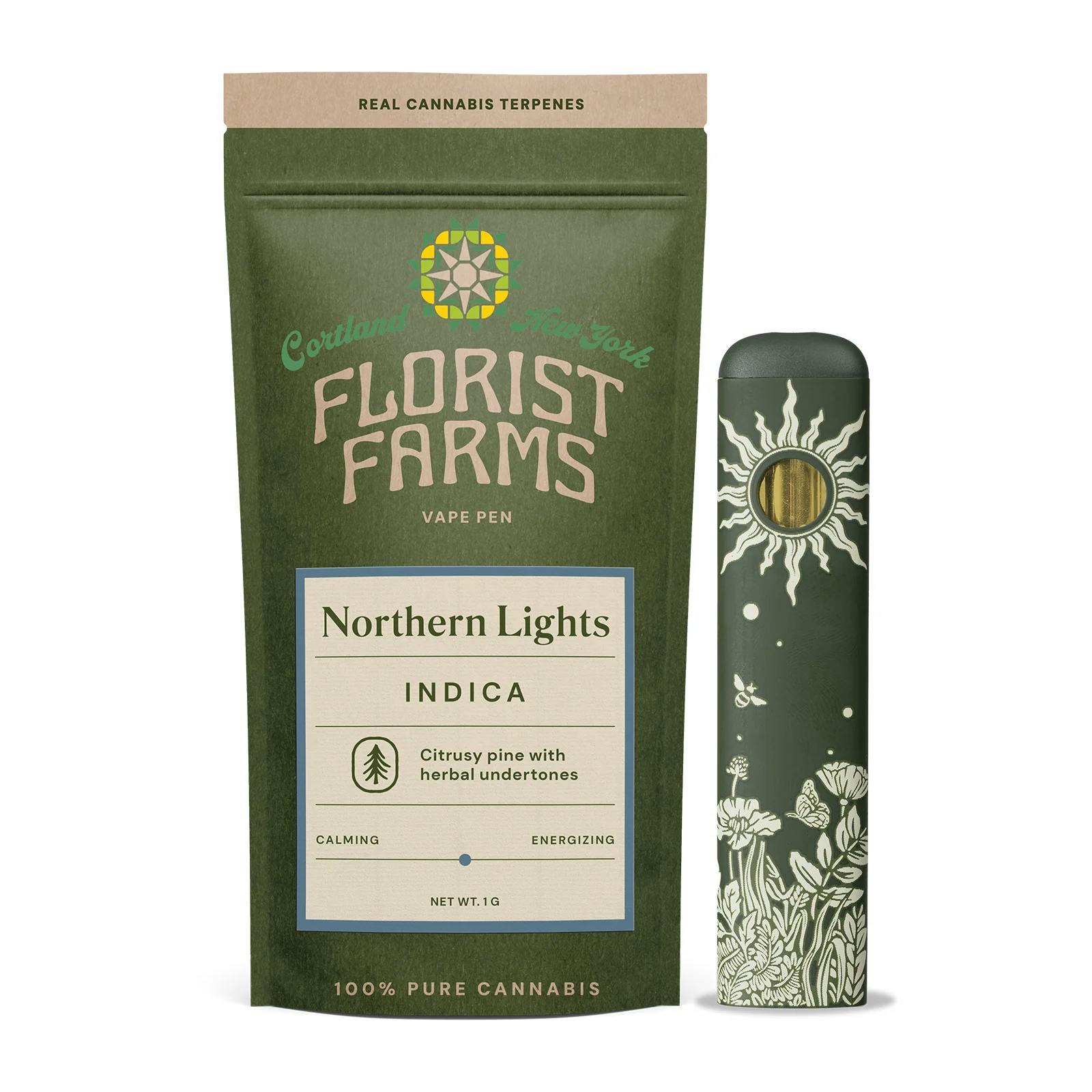
Florist FarmsFlorist Farms | Northern Light | Rechargeable · 1g
$50.00
$57after tax

weeddispensarynearme.com
You must be 21 years or older to enter. By entering, you confirm you’re of legal age in your state to purchase cannabis.
For use only by adults 21+ • Keep out of reach of children
1 live products in stock
Quick answer · What is the Northern Light cannabis strain?
Northern Lights is the quiet archetype against which most modern indicas are measured — a resinous, earthy cultivar with roots tracing back to the Pacific Northwest and the Netherlands' golden era of cannabis breeding. Its dense, frost-covered buds carry an unmistakably sweet, piney musk, and the experience it delivers is one of deliberate, full-body ease. For the discerning New York consumer who values heritage over novelty, Northern Lights remains a foundational choice.
$57after tax
About Northern Light
Northern Lights is widely regarded as one of the most influential indica-dominant cultivars in modern cannabis history. Its origins are somewhat mythologized: the strain is generally believed to have been developed in the Pacific Northwest — most accounts point to the Seattle, Washington area — sometime in the late 1970s or early 1980s, from Afghani landrace genetics. Some lineage accounts also suggest Thai sativa ancestry contributed a trace of cerebral brightness, though this parentage is debated among historians and breeders. The strain achieved its legendary status after Nevil Schoenmakers of the Seed Bank of Holland — later affiliated with Sensi Seeds — acquired the genetics and refined them through rigorous selection in the Netherlands during the mid-1980s. Sensi Seeds went on to stabilize and popularize several numbered phenotypes, most notably Northern Lights #1 and Northern Lights #5, with #5 becoming the definitive expression: compact, fast-flowering, and extraordinarily resinous. It is Northern Lights #5, crossed with Haze, that produced Shiva Shanti, and its union with Skunk #1 yielded the equally iconic Shiva Skunk — demonstrating the strain's outsized genetic influence on the wider cannabis canon. Northern Lights won multiple Cannabis Cup awards through the late 1980s and 1990s, cementing its place in the global seed trade and in the vocabulary of serious cultivators and consumers alike. Today's commercial offerings largely descend from Sensi's stabilized #5 phenotype.
Northern Lights is a textbook indica in its effect arc — measured, deliberate, and deeply physical without being abrupt. Onset typically arrives within five to ten minutes of inhalation, beginning as a gentle warmth behind the eyes and a softening of the shoulders. There is a mild initial cerebral quality — a quiet clearing of mental static — before the experience migrates decisively downward into the body. At its peak, Northern Lights delivers a pronounced physical heaviness that many consumers describe as a full-body embrace rather than sedation. Myrcene, the dominant terpene in most phenotypes, is associated in the literature with relaxing, muscle-easing qualities, and its presence here is evident. The experience tends to plateau at a place of calm alertness rather than complete incapacitation — unless the session is extended or the consumer is particularly sensitive. Caryophyllene adds a subtle grounding note that may temper anxious overstimulation, which is one reason this strain has a reputation for being relatively smooth for experienced indica consumers. Duration runs roughly two to three hours for most, with a gentle descent into drowsiness rather than an abrupt drop. The comedown is characteristically easy — a slow fade rather than a crash — making Northern Lights a natural fit for evening use. New consumers are encouraged to start with a modest amount, as the physical weight can be disorienting for the uninitiated.
The aroma of Northern Lights is one of its most immediately recognizable qualities. Myrcene anchors the profile with a damp, herbal earthiness that recalls fresh soil after rain, undercut by the faint sweetness of ripe fruit — a quality some describe as subtle mango or overripe berry held at arm's length. Pinene lifts the nose with a clean, resinous pine that sharpens the earthier tones and adds a brightness that keeps the overall profile from becoming too flat or musty. Caryophyllene introduces a dry, faintly spiced undercurrent — think black pepper or dried clove — which adds complexity without aggression. In some phenotypes, a trace of humulene is detectable, lending a woody, almost hoppy note that botanical enthusiasts may find reminiscent of aged cedar or dry herbaceous hay. Together these terpenes produce a profile that is simultaneously classic and refined — earthy and grounded, but with enough aromatic dimension to reward a slow, attentive inhale. On the palate, Northern Lights smokes smoothly for a heavy indica — the vapor is dense but not harsh. The initial draw tends to present pine and sweet earth, with the spiced caryophyllene note emerging on the exhale. Flower consumed at lower temperatures in a quality vaporizer often reveals the sweeter, fruitier register of the myrcene more clearly, while combustion tends to emphasize the earthier, woodier base. The finish is clean and faintly resinous, lingering pleasantly without becoming cloying.
Northern Lights produces buds that are immediately recognizable to anyone familiar with classic indica architecture. The flowers are notably compact and dense — tightly wound calyxes stack into chunky, elongated colas that feel substantial in hand. The structure reflects the strain's Afghani heritage: resilient, tightly packed, and built to retain moisture in the trichome matrix rather than allow it to escape. The color palette leans toward deep forest green, often with faint olive undertones in the lower leaf material. Phenotypes grown in cooler temperatures occasionally develop soft purple flushes along the sugar leaves, though this is more phenotype- and environment-dependent than consistent. Pistils are a warm amber-orange, standing out vividly against the dark foliage. Trichome coverage is dense and evenly distributed — a fine, silvery frost that gives ripe Northern Lights an almost luminescent quality under good lighting, consistent with its reputation as one of the resin-rich benchmarks of the indica world.
Northern Lights has earned a reputation as one of the more forgiving cultivars for home growers, which has contributed significantly to its enduring presence in the seed market. Its Afghani heritage translates into a compact, bushy plant that manages humidity and resists mold and pests with relative ease compared to more finicky modern hybrids — a meaningful advantage in variable climates. Indoors, Northern Lights typically finishes flowering in seven to nine weeks, which is relatively fast for a resin-heavy indica. Indoor yields are generally solid, rewarding attentive light and nutrient management without demanding expert-level intervention. The plant stays short enough for modest grow spaces, though some lateral branching benefits from low-stress training. Outdoors, it performs well in temperate, Mediterranean-style conditions and is typically ready for harvest in early to mid-October in the Northern Hemisphere. The strain is widely listed as beginner-to-intermediate in difficulty across reputable cultivar databases, and its genetic stability — the product of decades of Sensi Seeds selection — means phenotype consistency is notably higher than in many modern cultivars.
Northern Lights is, almost by definition, an evening strain — its physical weight and gradually deepening calm are best appreciated when the agenda is open and unhurried. It is well-suited to solitary unwinding: a long bath, a slow reread of a favorite novel, or a dim-lit hour with a carefully chosen record. The piney, earthy terpene profile has a grounding quality that pairs naturally with activities that reward sensory attention without demanding cognitive output. For a food pairing, the myrcene-forward earthiness finds a natural counterpart in umami-rich, mushroom-based dishes — a slow-cooked risotto or a simple roasted root vegetable plate, for example. On the music side, the strain's tempo suits something unhurried and textural: late-period John Coltrane, ambient Brian Eno, or the quieter end of contemporary jazz. For those who consume with company, Northern Lights works best in small, familiar gatherings where conversation is welcome but silence is equally comfortable. It is not a strain that demands performance — it rewards simply being present.
Afghan Kush
As a direct Afghani landrace, Afghan Kush shares Northern Lights' deep body-forward profile and earthy, resinous aroma, making it a natural follow-on for consumers who appreciate the heritage indica character.
Blueberry
DJ Short's Blueberry occupies a similar indica-dominant, deeply relaxing register but layers in a sweeter, more pronounced fruit character for those who want Northern Lights' calming arc with added aromatic complexity.
Granddaddy Purple
GDP offers the same full-body physical ease and evening-use disposition, with a more overtly sweet and grape-forward flavor profile that appeals to consumers who enjoy classic indicas but prefer a fruitier palate.
Sensi Star
A compact, resin-heavy indica with strong Afghani lineage, Sensi Star delivers a similarly grounding, physical experience with comparable terpene earthiness and is often recommended to Northern Lights enthusiasts seeking comparable potency.
White Widow
For Northern Lights fans curious about a more balanced hybrid that retains the piney, resinous character while introducing a cleaner, more alert quality, White Widow — which shares Dutch Golden Era origins — offers a natural bridge.
Northern Lights is an indica-dominant cultivar, classified consistently as such across major cannabis reference databases including Leafly and Wikileaf. Its genetic foundation is Afghani landrace cannabis, which is the definitive indica archetype. Some accounts suggest a trace of Thai sativa in the lineage, but the overall character — compact structure, body-forward effects, and relatively short flowering time — is unmistakably indica in expression.
Northern Lights carries a flavor profile that is earthy, piney, and faintly sweet, with a dry, lightly spiced finish on the exhale. The dominant terpenes — myrcene, pinene, and caryophyllene — contribute herbal earthiness, clean resinous pine, and a subtle black pepper note respectively. The smoke is smooth and dense, with a clean resinous finish. Consumers using a vaporizer at lower temperatures often detect a softer, slightly fruity sweetness beneath the earthier base.
Northern Lights produces a primarily physical, body-forward experience that begins with a mild mental clearing before settling into full-body ease and warmth. Most consumers report onset within five to ten minutes, a peak characterized by comfortable heaviness and calm, and a gradual descent toward drowsiness over two to three hours. It is widely regarded as a smooth, reliable indica — grounding without being abrupt. New consumers should approach with measured amounts, as the physical weight can be pronounced.
Consumers who appreciate Northern Lights often find common ground with Afghan Kush for its shared Afghani heritage and earthy depth, Granddaddy Purple for comparable body-forward relaxation with added fruit character, Blueberry for a similarly calming arc with a sweeter profile, and Sensi Star for resin-heavy indica density. White Widow offers a more balanced alternative that retains the piney, Dutch Golden Era character while introducing a cleaner, slightly more alert quality.
Northern Lights is often cited as a approachable indica for those new to cannabis, given its smooth onset and even, predictable character — but its physical potency warrants respect. Beginners are encouraged to follow standard guidance: start with a small amount, wait to fully assess the effects before consuming more, and choose a comfortable, familiar setting. The strain's relaxing body effect can be disorienting for the completely uninitiated if approached without care. It is available at ZenZest to adults 21 and over only.
The most consistently reported dominant terpenes in Northern Lights are myrcene, pinene, and caryophyllene. Myrcene is the primary terpene, contributing the herbal, earthy, and faintly fruity aroma the strain is known for. Pinene adds a resinous, forest-fresh brightness to the nose. Caryophyllene introduces a dry, spiced note on the finish. Some phenotypes also show detectable levels of humulene, which adds a woody, hoppy undertone to the overall aromatic structure.
Northern Lights is believed to have originated in the Pacific Northwest — most commonly attributed to the Seattle area — in the late 1970s or early 1980s, from Afghani landrace genetics. Its legendary status was largely established after Nevil Schoenmakers of the Seed Bank of Holland brought the genetics to the Netherlands in the mid-1980s, where Sensi Seeds stabilized and popularized multiple phenotypes, most notably Northern Lights #5. The strain won multiple Cannabis Cup awards through the late 1980s and 1990s.
Northern Lights is best suited to late afternoon or evening use, given its body-forward, progressively sedating character. Its physical weight and tendency to deepen into drowsiness over the session make it a natural choice for winding down after work, preparing for rest, or spending a quiet evening at home. Consuming it earlier in the day is possible for experienced, high-tolerance consumers, but most find its grounding heaviness incompatible with tasks that require sustained focus or physical activity.
Related strains
Pick your store
We'll show pricing, deals, and delivery zones for the store you pick. You can switch any time from the header.