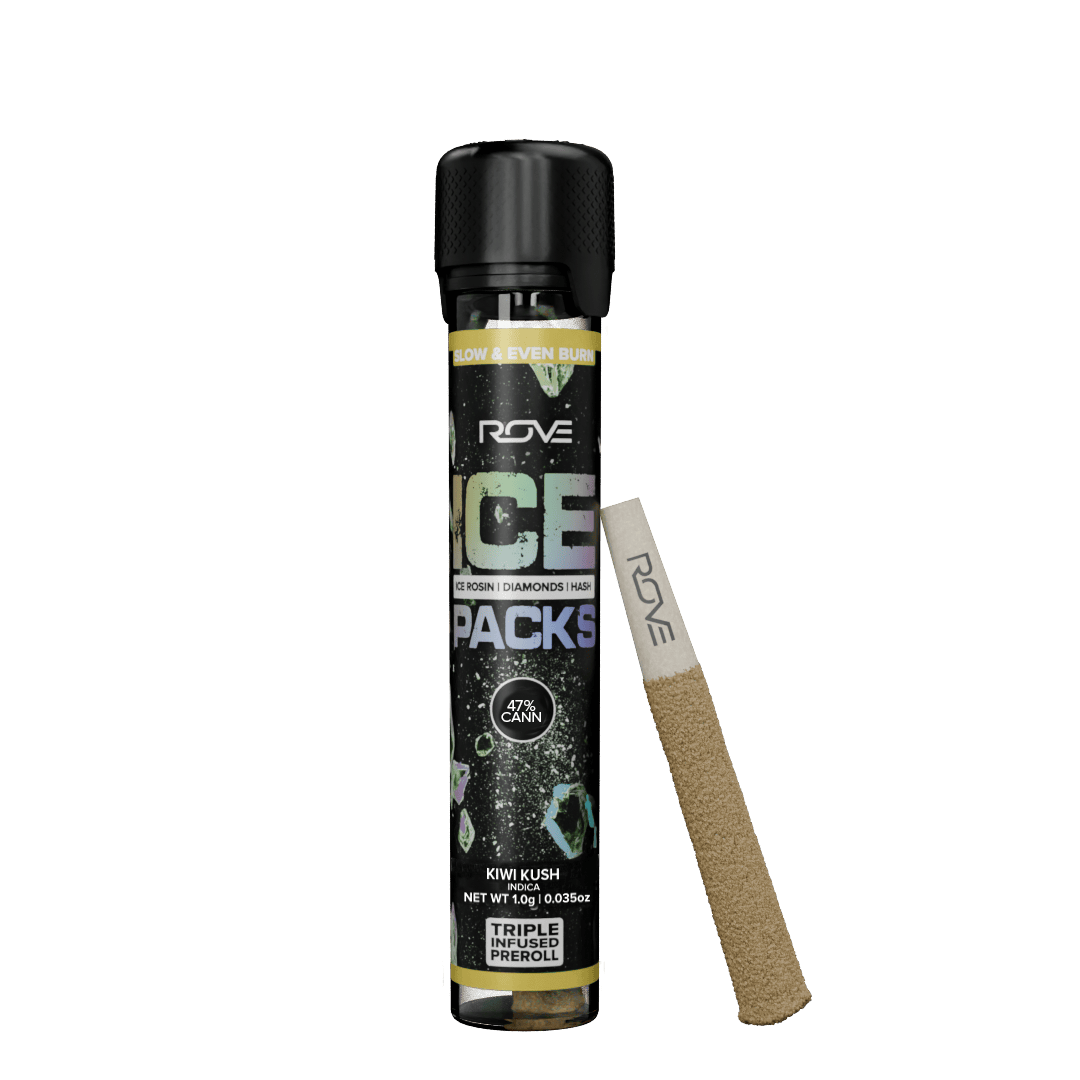
THC 43.2%Indica
RoveKiwi Kush - Infused Ice Packs (Rosin, Hash, and Diamonds) 1g · 0.5g/5pk
$60.00
$68after tax

weeddispensarynearme.com
You must be 21 years or older to enter. By entering, you confirm you’re of legal age in your state to purchase cannabis.
For use only by adults 21+ • Keep out of reach of children
2 live products in stock
Quick answer · What is the Kiwi Kush cannabis strain?
Kiwi Kush arrives with the quiet confidence of a well-traveled indica — its dense, resinous buds carrying an unexpectedly bright tropical note beneath the expected earthy Kush foundation. Born from storied Afghani genetics and touched with a fruity twist that distinguishes it from its more austere cousins, this is an evening strain that rewards patience and a comfortable seat. New York's cooler autumn air seems almost tailor-made for the slow, grounding warmth it reliably delivers.
$68after tax
$28after tax
About Kiwi Kush
Kiwi Kush is generally attributed to Reserva Privada, a boutique seed bank operating under the DNA Genetics umbrella, though detailed documentation of its precise release date is not uniformly cited across public sources. The consensus on lineage points to a cross of OG Kush and a Kiwi-phenotype mother — the latter being a proprietary or loosely described fruiting cultivar whose exact genetics Reserva Privada has not formally disclosed in public-facing materials. OG Kush itself carries a lineage that is well-documented as debated: most accounts credit a cross of Chemdawg, Lemon Thai, and a Hindu Kush landrace, popularized in Southern California throughout the 1990s. The OG Kush parentage lends Kiwi Kush its structural backbone — the compact internodal spacing, heavy resin production, and the characteristic fuel-and-earth aroma that OG descendants reliably carry. The unnamed Kiwi parent appears to contribute the tropical brightness that softens the Kush character and gives this cultivar its distinguishing identity. Several growers and reviewers on platforms including Leafly and Wikileaf note that the tropical note reads more as a secondary terpene expression than a dominant one, suggesting the Kush genetics remain architecturally primary. Genetic siblings within the Reserva Privada catalog — strains such as Confidential Cheese and LA Confidential crosses — share a similar philosophy of anchoring classic Kush structure with a distinctive aromatic twist, placing Kiwi Kush within a coherent creative lineage even where precise documentation is limited.
Kiwi Kush follows the measured, deliberate arc that experienced indica enthusiasts have come to appreciate. Onset typically arrives within five to fifteen minutes of inhalation, beginning as a gentle pressure behind the eyes and temples — a subtle cue that the body is beginning to shift registers. The cerebral component in the early phase is mild rather than stimulating; thoughts slow and soften without inducing anxiety or racing ideation, which distinguishes it from more sativa-forward hybrids. As the session deepens into its peak — generally between twenty and forty-five minutes in — the body effect becomes increasingly pronounced. A familiar Kush heaviness settles into the limbs and lower back, encouraging stillness. The dominant cannabinoids in OG-lineage indicas typically skew toward higher myrcene expression, which research has associated with sedative and muscle-relaxing qualities, though individual chemistry varies considerably. The experience is best described as grounded and interior rather than socially expansive. The comedown from Kiwi Kush is gradual and gentle, fading over one to two hours without the abrupt drop that some users associate with more potent hybrid indicas. Drowsiness is a plausible outcome for many users in the later stages, particularly in lower-light or quieter environments. As always, those new to cannabis or to indica-dominant cultivars are well served by starting with a conservative quantity and observing how their physiology responds before continuing.
The aromatic profile of Kiwi Kush is layered in a way that rewards a slow, deliberate nose. On first encounter — whether through a sealed jar or a freshly broken bud — the dominant register is classic Kush earthiness: damp soil, compressed wood, and a faint petroleum undertone consistent with the myrcene and caryophyllene expression common to OG-lineage cultivars. Myrcene, the most prevalent terpene in many indica strains, contributes that recognizable musky, herbal quality and softens the overall aromatic impression. Beneath the earth layer, a secondary brightness emerges that gives the strain its name. Terpinolene and ocimene — both associated with floral, fresh, and lightly tropical aromatic signatures — appear to be responsible for the citrus-adjacent, almost stone-fruit quality that reviewers frequently describe. This tropical note is delicate rather than assertive; it reads more as an accent than a headline, which gives the strain an air of understated complexity. Hints of linalool, a terpene also found in lavender, may contribute a barely perceptible floral softness in the mid-register. On the palate, Kiwi Kush smokes with a smoothness that its resin density would suggest. The inhale carries the earthy, slightly spiced character — a contribution from caryophyllene, which also brings a mild peppery warmth — while the exhale delivers a lingering sweetness that echoes the tropical nose. Vapor expression at lower temperatures tends to accentuate the fruity secondary notes, making a temperature-controlled vaporizer a worthwhile consideration for those wishing to explore the full aromatic range.
Kiwi Kush produces buds that are immediately identifiable as Kush-descended: compact, densely packed calyxes arranged in tight, roughly ovoid clusters that feel heavier than their size suggests. The bud structure is notably solid, with minimal airy pockets between the sugar leaves — a characteristic that speaks to the Afghani landrace ancestry running through its OG Kush parent. The color palette leans toward deep forest greens in the core of the bud, occasionally punctuated by muted olive and sage tones in the outer leaves. Autumn-style phenotypes, particularly those grown in cooler finishing temperatures, can develop faint purple or indigo bruising along the leaf margins — a visually compelling trait that varies considerably between individual grows. Amber and burnt-orange pistils wind through the structure in moderate density. The trichome coverage is generous and evenly distributed, giving the dried flower a frosted, slightly silver appearance that catches light well and signals the resin production characteristic of this lineage.
Kiwi Kush reflects its Kush heritage in cultivation: it is a relatively compact, manageable plant that stays within height parameters well-suited to indoor grows with standard ceiling clearance. Flowering time is typically cited in the range of eight to nine weeks under controlled indoor conditions, placing it within a conventional harvest window for indica-dominant cultivars. Yields are described across grower forums as moderate to above average indoors, with the dense bud structure contributing meaningfully to dry weight totals. The cultivar prefers a warm, dry climate during flowering — high ambient humidity during the late flower stage increases the risk of mold within those tightly packed calyxes, a consideration that experienced cultivators manage through careful airflow and defoliation. Outdoors, it performs well in Mediterranean-style climates and should be harvested before the first hard frost. For the cultivator-curious shopper, Kiwi Kush represents a strain of intermediate difficulty: forgiving enough for a careful first-time grower, yet expressive enough to reward the experienced hand who can coax out its purple phenotype through a deliberate temperature drop in the final weeks of flower.
Kiwi Kush occupies an ideal position in the early-to-mid evening — after obligations have resolved but before the intention of sleep has fully arrived. It is a strain suited to solitary introspection or the kind of quiet, unhurried company where conversation drifts naturally rather than being directed. Think a slow Sunday in autumn: the day's commitments behind you, a low-lit room, no particular agenda. For food pairing, the earthy, lightly fruited terpene profile finds a natural counterpart in umami-forward, gently spiced dishes — miso-glazed root vegetables, a simple ramen with slow-cooked broth, or aged cheeses with honey and walnut. The myrcene-forward character of the strain has a known affinity with similar aromatic compounds found in cloves and earthy teas, making a cup of aged pu-erh or a clove-spiced chai a considered companion. For music, the body-heavy, tempo-slowing character of this cultivar pairs well with something unhurried and textural — ambient electronic music, late-period jazz, or fingerpicked acoustic guitar work all allow the strain's interior quality to deepen rather than compete.
OG Kush
As the primary genetic ancestor of Kiwi Kush, OG Kush shares the earthy, fuel-laced foundation and the body-heavy indica arc that defines the experience, minus the tropical brightness.
Bubba Kush
Bubba Kush delivers a similarly dense, sedative body effect with an earthy and lightly sweet palate, making it a natural companion for those drawn to Kiwi Kush's grounding character.
Skywalker OG
Skywalker OG shares the OG Kush lineage and the slow, limb-heavy onset that Kiwi Kush fans appreciate, with a comparably smooth, earthy-herbal smoke character.
Papaya
Papaya offers a similar tropical-meets-earthy aromatic signature within an indica-dominant structure, appealing to those who appreciate Kiwi Kush's fruited complexity alongside a Kush foundation.
Mango Kush
Mango Kush mirrors the conceptual premise of Kiwi Kush — a Kush backbone brightened by tropical fruit terpene expression — and suits the same early-evening, body-relaxing occasion.
Kiwi Kush is an indica-dominant cultivar, reflecting its OG Kush lineage and the Afghani landrace genetics embedded within that parent. The experience it delivers aligns with the typical indica profile: a body-forward, grounding, and progressively sedative arc rather than a stimulating or cerebral one. It is best suited to the evening or any occasion where stillness and relaxation are the intended outcome.
Kiwi Kush presents a layered palate that opens with damp earth and a faint peppery warmth from its caryophyllene content, then resolves on the exhale into a soft, lightly sweet tropical note that echoes the fruited quality suggested by its name. The overall flavor impression is earthy-dominant with a secondary brightness — more a pleasant complexity than a literal fruit candy experience.
Kiwi Kush typically produces a measured, progressive body relaxation that begins as a gentle cranial softening and deepens into limb-heavy stillness over thirty to forty-five minutes. It is not known as a strongly cerebral or energizing cultivar. Many users report a calm, unhurried sense of ease at the peak, with drowsiness becoming more plausible in the later stages, particularly in quiet or dim settings.
Consumers who enjoy Kiwi Kush frequently find common ground with OG Kush, Bubba Kush, and Skywalker OG for their shared Kush-lineage body effects and earthy palates. Those drawn specifically to the tropical-fruited aromatic layer may also appreciate Papaya and Mango Kush, both of which combine indica-dominant structure with a lightly sweet, fruit-accented terpene character.
Kiwi Kush can be approachable for beginners who are seeking a calm, body-focused experience, but its indica potency warrants a cautious start. The general principle of starting with a small quantity and waiting a full thirty minutes before assessing effect applies here, perhaps more than with milder cultivars. Those sensitive to sedative effects or new to cannabis should approach with deliberate patience.
Kiwi Kush's terpene profile is understood to be led by myrcene, which contributes its characteristic earthy, musky foundation and is associated with the sedative body quality common to Kush-lineage indicas. Caryophyllene adds peppery warmth and depth. Terpinolene and ocimene are believed to be responsible for the tropical and lightly floral secondary notes, while linalool may contribute a subtle, almost lavender-adjacent softness.
Kiwi Kush is most at home in the early to mid-evening — the window between the close of daytime obligations and the intention of sleep. Its progressive body-heaviness makes it poorly suited to mornings or any occasion requiring sustained alertness, coordination, or social performance. It rewards unstructured time: a quiet evening at home, a slow meal, or a long and unhurried conversation with someone whose company requires no effort.
Kiwi Kush is generally attributed to Reserva Privada, the boutique seed division operating within the DNA Genetics family. The precise release year has not been uniformly documented across public cannabis sources. Its lineage is understood to involve OG Kush as a primary parent, with the second parent described loosely as a Kiwi-phenotype cultivar whose specific genetics Reserva Privada has not publicly detailed.
Related strains
Pick your store
We'll show pricing, deals, and delivery zones for the store you pick. You can switch any time from the header.