
Indica
All strains King Louis OG
2 live products in stock
Quick answer · What is the King Louis OG cannabis strain?
King Louis OG carries the quiet authority of its name — a dense, resinous indica that settles into the evening like a well-aged Burgundy finding its finish. Rooted in the storied OG Kush lineage of Southern California, it offers an earthy, pine-driven character that devotees of the classic West Coast canon recognize immediately. This is a strain for those who appreciate tradition, depth, and the kind of unhurried relaxation that does not announce itself loudly.
Shop King Louis OG · 2 of 2 live products
THC 47.63%Indica
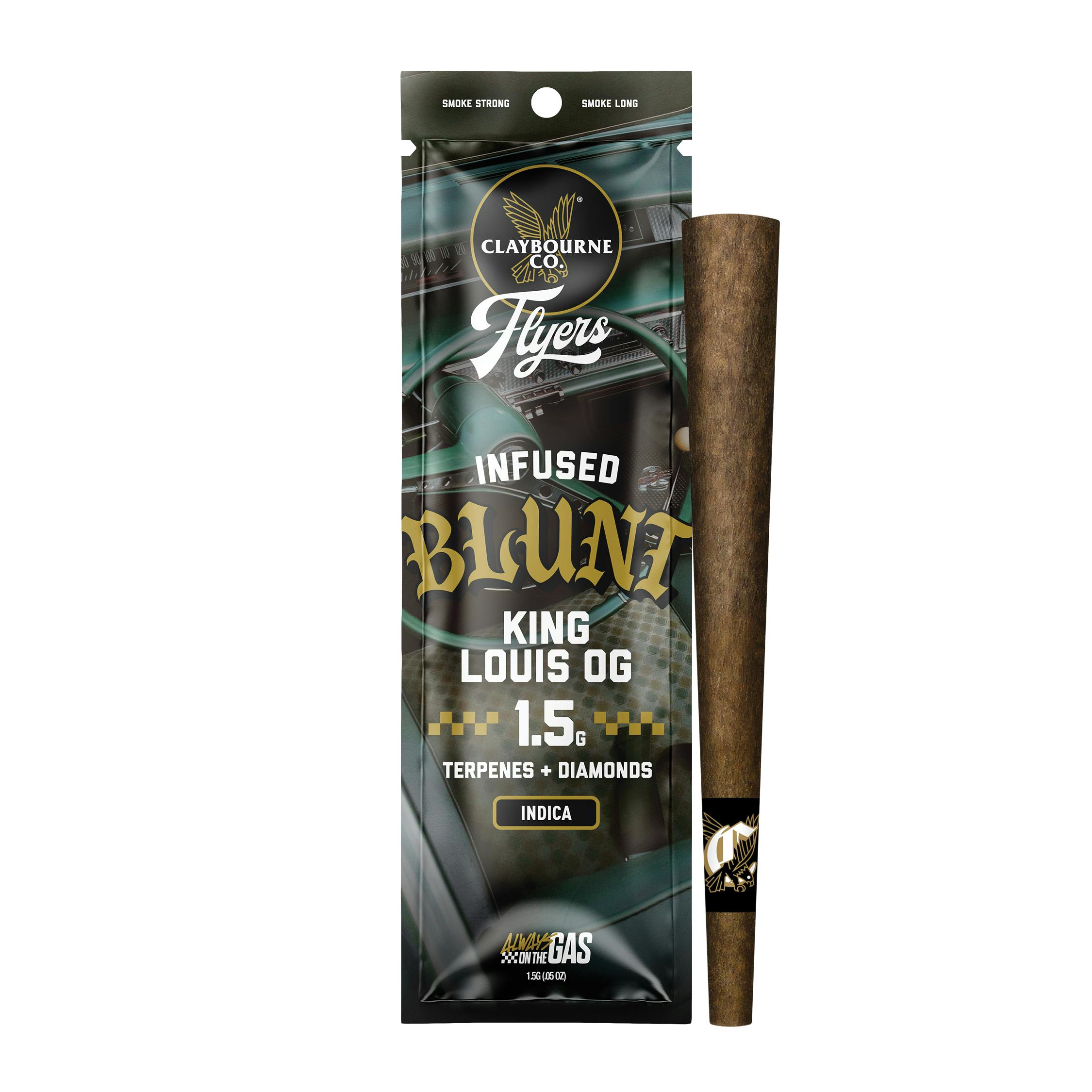
Claybourne Co.Claybourne | King Louis OG | Infused Blunt 1ct · 1.5g
$36.28
$41after tax
About King Louis OG
Everything to know about King Louis OG.
Lineage & origin
King Louis OG — also written King Louis XIII OG — is a product of California's OG Kush breeding culture, which flourished in Los Angeles during the late 1990s and early 2000s. The strain is widely documented as a cross between OG Kush and LA Confidential, two pillars of the West Coast indica tradition. OG Kush itself carries famously debated ancestry, generally attributed to a cross of Chemdawg, Lemon Thai, and a Hindu Kush landrace, though the precise lineage remains contested among long-time breeders. LA Confidential, developed by DNA Genetics, contributes a cleaner, more sedative body character and a noticeably refined trichome structure. The exact originating breeder of King Louis OG has not been publicly named with full documentation, which is common for strains that emerged through the informal clone-only networks of Southern California dispensary culture. The strain gained its regal moniker within that scene and spread via clones before seed-form versions became more widely available through various producers. Its royal naming convention — echoing the French monarchy — was likely a nod to the strain's commanding, stately effect profile. Genetic siblings and close relatives within the OG family include Tahoe OG, SFV OG, and Ghost OG, each representing distinct phenotypic expressions of the broader OG Kush lineage. King Louis OG is generally regarded as sitting toward the heavier, more sedative end of the OG spectrum, a characteristic it inherits most directly from its LA Confidential parentage.
Effects
The onset of King Louis OG is measured and deliberate — typically arriving within five to ten minutes of inhalation with a mild cerebral warmth that does not overwhelm. This initial phase has a grounding quality rather than an energizing one; thoughts slow gently rather than racing, and there is often a pleasant heaviness that begins behind the eyes and at the temples, consistent with the myrcene-forward terpene profile common to this strain. As the experience deepens into its peak — usually within fifteen to thirty minutes — the body component becomes the dominant character. Muscles ease, tension in the shoulders and jaw tends to release, and the overall sensation is one of physical stillness paired with a quietly contented mental state. This body-forward effect is a hallmark of the OG Kush and LA Confidential heritage, both of which are associated with elevated myrcene content, a terpene linked in early research to sedative-adjacent qualities when present in quantity alongside THC. The duration of King Louis OG's effects tends toward the longer end for an indica, with many experienced consumers reporting a two-to-three-hour arc before a gentle, unhurried comedown that does not typically produce abrupt shifts in mood. The transition into the comedown is gradual, often described as a natural drift toward sleep or restful quiet. Newcomers to cannabis and those with lower tolerance should approach this strain with care — the phrase 'start low, go slow' applies here with particular sincerity.
Aroma, flavor & terpenes
King Louis OG presents a terpene profile that reads almost like a Pacific coastal forest after a late rain: dominant notes of damp earth, pine resin, and a faintly skunky musk that is immediately recognizable to OG enthusiasts. Myrcene is the anchor terpene in most phenotypes of this strain, contributing the characteristic herbal, earthy base that softens the edges of the pine without diminishing it. It is myrcene that gives King Louis OG its particular 'wet soil' quality — rich and grounding rather than sharp. Caryophyllene, a sesquiterpene also found in black pepper and cloves, typically appears as a secondary force in this strain's profile, adding a subtle spice that sharpens the exhale and contributes a gentle warmth. Some phenotypes show a notable presence of pinene — both alpha and beta — which reinforces the coniferous character and lends a faint brightness that keeps the aroma from feeling solely heavy or dank. A minor linalool signature occasionally surfaces in select cuts, offering the quietest suggestion of florality that softens the more resinous top notes. On the palate, whether smoked or vaporized, King Louis OG delivers a full, coating smoke with a long finish. The first impression on the inhale is pine and wood; the exhale opens into earthier, spicier territory. Vaporization at moderate temperatures tends to preserve the pinene top notes with greater clarity, making the profile feel slightly more nuanced and less aggressively dank than combustion.
Appearance
King Louis OG produces buds that reflect its indica heritage in every visible detail: compact, tightly wound calyxes that form dense, golf-ball-adjacent colas with very little airy space between the nodes. The structure is typically heavy for its size, with a satisfying resistance when gently pressed — a quality cultivators and discerning consumers alike associate with well-flushed, properly cured OG material. The color palette leans into deep forest greens with occasional olive and sage undertones, punctuated by amber-to-rust pistils that curl generously across the surface of the bud. Trichome coverage is one of the strain's most striking visual signatures: a thick, almost silvery white frost blankets both the calyxes and the sugar leaves, giving the flower a luminous, almost frosted quality under direct light. In cooler growing environments, some phenotypes develop subtle purple or violet hues at the leaf margins, though the primary expression remains firmly in the green spectrum.
Growing notes
King Louis OG is considered a moderately challenging strain for home cultivators, primarily because of its OG Kush heritage, which carries a well-documented sensitivity to environmental stress, humidity fluctuation, and nutrient imbalance. It is best suited to controlled indoor environments where temperature and relative humidity can be managed with consistency — the dense bud structure that makes this strain visually appealing also makes it susceptible to mold and bud rot if airflow is inadequate. Indoors, King Louis OG typically finishes its flowering cycle in approximately eight to nine weeks, yielding moderate quantities that reward attentive growers with high-quality, resin-dense flower rather than sheer volume. Outdoor cultivation is possible in warm, Mediterranean-style climates with low late-season humidity, and harvest outdoors generally falls in mid-to-late October in the Northern Hemisphere. The plant tends toward a compact, bushy structure consistent with its indica classification, making it manageable in terms of vertical space but benefiting from regular defoliation to improve light penetration and airflow to the lower canopy.
When it's best enjoyed
King Louis OG is an evening strain in the truest sense — not one that demands a particular occasion so much as one that rewards the deliberate choice to end the day well. It is best suited to the hours after dinner, when the practical obligations of the day have concluded and there is genuine space to simply exist without agenda. Solo contemplation — reading, listening to music with full attention, or sitting with the particular quietude of a late New York night — suits this strain's character more naturally than social settings, though a small, close gathering with shared comfort as the aim is not out of place. For food pairings, King Louis OG's earthy pine and spice profile finds a natural counterpart in aged hard cheeses, charcuterie with black pepper notes, or a simple roasted mushroom dish — flavors that echo rather than compete with the strain's terpene language. In terms of music, the strain's measured, enveloping body effect pairs thoughtfully with slow jazz, ambient electronic music, or the longer movements of modern classical composers. The common thread is unhurried depth — this is not a strain for anything that requires speed or sharp edges.
If you like King Louis OG, also explore
Tahoe OG
A fellow heavy-hitting OG phenotype with a comparable earthy-pine character and pronounced body effect, Tahoe OG appeals to the same consumer who values the classic West Coast indica experience with slightly more cerebral warmth at onset.
SFV OG
San Fernando Valley OG shares the resinous, fuel-and-pine aroma profile and OG Kush lineage, offering a closely related experience that tends toward slightly more functional clarity before the body effect takes hold.
LA Confidential
As one of King Louis OG's parent strains, LA Confidential offers a direct lineage connection and a similarly sedative, earthy profile for those who want to understand the building blocks of this strain's character.
Ghost OG
Ghost OG sits within the same OG family tree and is valued for its exceptional trichome density and clean, classic OG flavor, making it a natural recommendation for King Louis OG enthusiasts seeking a slightly more refined expression.
Skywalker OG
For those drawn to King Louis OG's deep relaxation and indica-forward arc who also appreciate a touch more sweetness in the flavor profile, Skywalker OG offers a complementary experience with its OG Kush and Skywalker parentage.
Common questions
Is King Louis OG indica or sativa?+
King Louis OG is classified as an indica, and its character lives up to that designation in nearly every dimension. Descended from OG Kush and LA Confidential, both well-established indica-leaning varieties, it produces the compact bud structure, heavy body sensation, and evening-oriented effect profile associated with the indica classification. It is not a strain that encourages physical activity or social energy — it is, by temperament, a strain for stillness.
What does King Louis OG taste like?+
King Louis OG tastes like a walk through a Pacific Northwest conifer forest with an undercurrent of damp earth and mild spice. The dominant flavor notes are pine resin and woody earthiness, contributed largely by its pinene and myrcene terpenes, with a caryophyllene-driven pepper warmth on the exhale. The smoke is full and coating on the palate, with a long, resinous finish that lingers pleasantly without becoming harsh.
What are the typical effects of King Louis OG?+
The effects of King Louis OG arrive gradually and settle deeply. The onset brings a grounding cerebral warmth that quickly gives way to a pronounced body effect — muscle relaxation, a reduction in physical tension, and a sense of full-body ease. The mental state is quiet and content rather than stimulated. The overall arc leans heavily sedative, making this a strain most consumers associate with late evenings and restful transitions toward sleep.
What strains are similar to King Louis OG?+
Consumers who appreciate King Louis OG tend to also enjoy other OG-family indicas such as Tahoe OG, SFV OG, and Ghost OG, which share its pine-and-earth terpene profile and heavy body character. LA Confidential — one of King Louis OG's parent strains — offers a direct lineage reference point. Skywalker OG provides a comparable depth of relaxation with a slightly sweeter flavor dimension for those open to a mild variation on the theme.
Is King Louis OG good for beginners?+
King Louis OG is a potent, indica-dominant strain with a strong body effect, and it warrants genuine caution for those new to cannabis or those with a lower tolerance. The sedative character can feel overwhelming for unprepared consumers, and the experience is not easily modulated once it is underway. The principle of starting low and going slow applies here with particular weight. Beginners are advised to approach this strain in a safe, comfortable environment with no obligations remaining in the evening.
What are the dominant terpenes in King Louis OG?+
Myrcene is the dominant terpene in most King Louis OG phenotypes, responsible for the strain's characteristic earthy, herbal musk and its association with heavier body sensations. Caryophyllene appears as a consistent secondary terpene, contributing spice and warmth. Pinene — typically alpha-pinene — reinforces the strain's signature pine-resin quality. Some cuts show trace linalool, adding a faint floral softness to an otherwise firmly earthy and resinous profile.
Where does the name King Louis OG come from?+
The name King Louis OG emerged from Southern California's informal dispensary and clone-sharing culture, where strains often received names that reflected their perceived stature or effect profile. The royal reference — evoking the French monarchy — is generally understood as a nod to this strain's commanding, authoritative indica character. The 'OG' suffix connects it clearly to the broader OG Kush family. The exact individual or collective responsible for the naming has not been publicly documented.
How long do the effects of King Louis OG typically last?+
Most experienced consumers report a full effect arc of approximately two to three hours with King Louis OG, followed by a gradual, unhurried comedown. The onset is measured rather than abrupt, the peak body effect is sustained rather than fleeting, and the transition out of the experience tends to feel natural rather than jarring. Individual duration varies based on tolerance, consumption method, and quantity — those new to this strain should allow ample time before making any commitments.
Related strains