
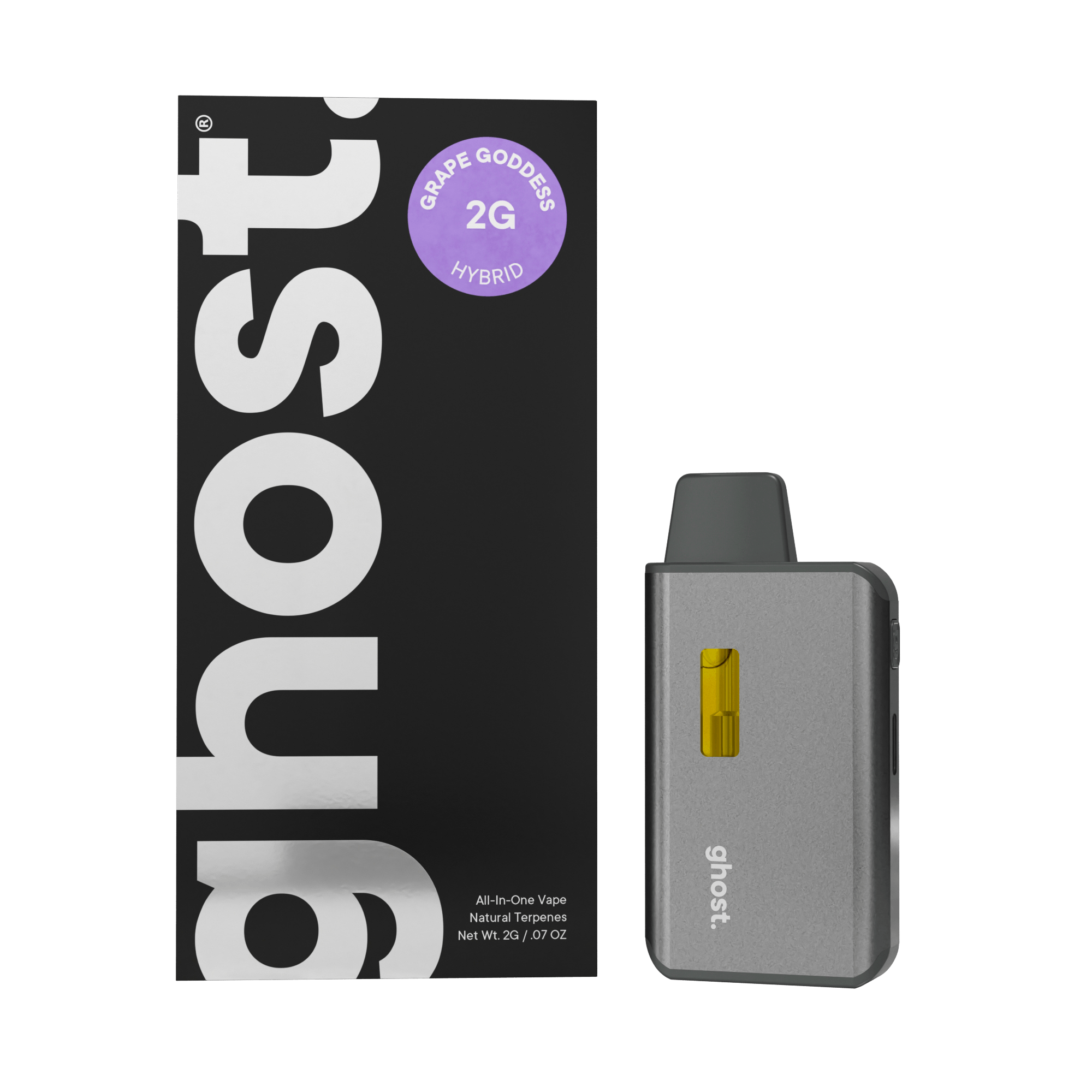
Hybrid
All strains Grape Goddess
1 live products in stock
Quick answer · What is the Grape Goddess cannabis strain?
Grape Goddess arrives with the quiet authority of a well-aged Burgundy — deep violet hues, a perfume that lingers in the room long after the jar is opened, and an effect profile that settles over the shoulders like a cashmere wrap on a cool autumn evening. A hybrid of balanced temperament, she rewards those who take their time, offering a creative lift that gradually softens into a composed, full-body ease without ever losing its sense of occasion.
Shop Grape Goddess · 1 of 1 live products
About Grape Goddess
Everything to know about Grape Goddess.
Lineage & origin
Grape Goddess is a hybrid whose precise lineage remains somewhat debated among cultivators and seed banks, though the most widely cited parentage points to a cross of Grapefruit and an OG Kush-adjacent indica, with some phenotypes suggesting influence from Purple Urkle or Grape Ape in the broader grape-terpene family tree. The breeder has not publicly named every contributing parent with full documentation, which is common in the craft cannabis space where proprietary cuts circulate informally before formal release. What is well established is that Grape Goddess belongs to the lineage of grape-forward hybrids that gained momentum on the West Coast through the early 2010s, as cultivators began deliberately selecting for anthocyanin-rich phenotypes that expressed purple coloration and myrcene-linalool terpene stacking. This aesthetic and aromatic direction ran parallel to the popularity of Granddaddy Purple, bred by Ken Estes in Northern California circa 2003, and the broader Purple family that influenced nearly every grape-named cultivar that followed. Genetic siblings and closely related expressions include GDP (Granddaddy Purple), Grape Ape (Apothecary Genetics), and Grape Stomper — each occupying a distinct corner of the grape-terpene spectrum while sharing the characteristic floral-fruit aromatic signature. Grape Goddess phenotypes can vary meaningfully, with some leaning toward a more cerebral, Grapefruit-dominant expression and others presenting the heavier, more sedative character associated with their indica heritage.
Effects
The onset of Grape Goddess is generally reported within five to fifteen minutes when smoked or vaped, arriving first as a gentle pressure behind the eyes and a mild brightening of sensory focus — the kind of attentive calm that makes a conversation feel more considered. This initial cerebral quality is frequently attributed to the limonene and terpinolene content present in the more sativa-leaning phenotypes, which tend to produce an uplifted, lightly euphoric headspace without the restless energy of a pure sativa. As the session progresses into the fifteen-to-forty-minute window, the body begins to register the strain's indica heritage more clearly. Muscle tension eases, breath deepens, and the mental brightness softens into a more diffuse contentment. This is the phase where Grape Goddess earns its reputation as a social-yet-relaxed hybrid — present enough to hold a thread of conversation, grounded enough to prevent anxious overthinking. The myrcene and linalool backbone contributes to this transition, as both terpenes are associated with sedative and anxiolytic properties in the existing literature. Duration typically ranges from two to three hours for most consumers at a moderate serving, with the comedown gentle and gradual rather than abrupt. Late-evening or end-of-day use is common among those who appreciate the strain's full arc. As always, starting low and observing individual response before increasing any serving is the prudent approach.
Aroma, flavor & terpenes
The aromatic character of Grape Goddess is dominated by myrcene, the most abundant terpene in cannabis broadly, which here expresses as a rich, slightly earthy grape must — less the sharp sweetness of fresh fruit and more the complex fermented depth of dark berry preserves. Linalool, the terpene also found in lavender, threads through the profile as a soft floral note that keeps the aroma from becoming too heavy, lending it the refined quality that distinguishes this cultivar from more bluntly sweet grape varieties. Secondary terpenes of note include caryophyllene, which contributes a subtle spice — almost like cracked black pepper at the back of the nose — and provides a grounding counterpoint to the fruit-forward opening. Some phenotypes also express measurable ocimene, which adds a faint herbal, almost woody sweetness that rounds the profile. Terpinolene, present in lighter concentrations in select cuts, introduces a citrus-floral complexity that connects back to the Grapefruit parentage. On the palate, Grape Goddess smoke or vapor is smooth and medium-bodied, with the grape and berry character arriving most clearly on the exhale. The floral linalool note becomes more pronounced mid-palate, and the caryophyllene spice lingers briefly on the finish. Vapor delivery at lower temperatures tends to accentuate the fruit and floral notes, while combustion brings the earthier, more resinous qualities of the myrcene base to the foreground.
Appearance
Grape Goddess buds present with a dense, tightly packed structure typical of indica-dominant genetics, though certain phenotypes produce a slightly more elongated calyx that hints at the sativa influence in the heritage. The color palette is among the strain's most immediately striking qualities: deep forest green serves as the base, overlaid with purple hues that range from soft lavender in some harvests to a near-aubergine intensity in cold-finished crops where anthocyanin production is maximized. Trichome coverage is generous and even, giving the surface a frosted, almost silvery quality that catches light at various angles. Pistils are predominantly deep amber to rust-orange, threading through the dense floral clusters in a way that reinforces the warm, autumnal visual tone. When properly cured, the structure holds its density without feeling compressed, and the break reveals an interior that maintains color depth throughout rather than only on the outer leaves — a marker of genuine genetic expression rather than light-dependent coloring alone.
Growing notes
Grape Goddess performs well in both indoor controlled environments and outdoor gardens in temperate climates, though cultivators seeking maximum purple expression typically manipulate nighttime temperatures downward during the final two weeks of flowering to trigger anthocyanin development — a technique that requires indoor control or a naturally cool autumn finish outdoors. Flowering time sits in the range of eight to nine weeks when grown indoors under standard photoperiod conditions. Yields are considered moderate, reflecting the trade-off between dense, resin-heavy bud structure and raw volume. Indoor cultivators working with quality lighting and canopy management can expect reasonable returns per square meter, while outdoor plants in a long, warm season with cool nights — conditions approximating Northern California or Oregon's Willamette Valley — tend to produce robust plants that finish in late September to mid-October. Difficulty is rated intermediate: the strain is not particularly finicky about nutrients but benefits from attentive humidity management during late flower to protect the dense bud structure from moisture-related issues. The grape terpene profile deepens with a proper slow cure of two to four weeks minimum.
When it's best enjoyed
Grape Goddess occupies a particular niche in the day's later hours — not the punctuation mark at the end of the evening, but the comfortable transition period between afternoon activity and genuine rest. It suits the person who has finished the substantive work of the day and is settling into something slower: a long dinner with close friends where conversation meanders pleasantly, or an evening of music listened to with more than casual attention. For food pairing, the strain's dark fruit and floral terpene profile aligns naturally with aged cheeses, roasted beet preparations, or dishes with a touch of warm spice — think Moroccan lamb or a mushroom risotto finished with truffle. Musically, the balanced arc of Grape Goddess pairs well with albums that share its structure: an engaging, slightly complex opening that resolves into something warm and unhurried. Artists in the jazz-soul or neo-soul space — Kamasi Washington, Hiatus Kaiyote — tend to complement the strain's sensory register. Solo creative work, particularly writing or visual art that benefits from relaxed focus rather than manic energy, is another context where this cultivar earns consistent appreciation.
If you like Grape Goddess, also explore
Granddaddy Purple
Fans of GDP will recognize the same deep grape-berry terpene signature and indica-leaning body ease, with Grape Goddess offering a slightly more cerebral opening act.
Grape Ape
Grape Ape shares the myrcene-linalool aromatic foundation and purple aesthetic, though it leans more heavily sedative — an easy next step for those seeking a deeper body experience.
Purple Punch
Purple Punch overlaps in its dessert-fruit aroma and relaxed hybrid character, making it a natural recommendation for Grape Goddess devotees who want a sweeter, more candy-forward palate.
Grape Stomper
Grape Stomper occupies a similar grape-terpene space but with more pronounced sativa energy at onset, suiting those who want the aromatic profile with a longer cerebral phase.
Forbidden Fruit
Sharing the exotic fruit depth and lush terpene density of Grape Goddess, Forbidden Fruit appeals to the same palate with a tropical-citrus dimension layered beneath the berry base.
Common questions
Is Grape Goddess indica or sativa?+
Grape Goddess is a hybrid, meaning it carries genetic influence from both indica and sativa lineages. In practice, most phenotypes present with a mildly uplifting onset that gradually transitions toward a more relaxed, body-centered experience — a profile that makes it versatile across the later portion of the day without being classified as purely one or the other. The balance tends to lean slightly indica in the later stages of the experience.
What does Grape Goddess taste like?+
The flavor profile centers on dark grape and mixed berry, with a depth closer to berry preserves than fresh fruit. A soft floral note — contributed by linalool — carries through mid-palate, while a subtle spice from caryophyllene lingers on the finish. On exhale, the grape character is most pronounced, and vapor delivery at moderate temperatures tends to accentuate the floral and fruit layers more clearly than combustion.
What are the typical effects of Grape Goddess?+
Grape Goddess typically opens with a gentle cerebral lift — attentive, slightly euphoric, and socially comfortable — before transitioning over thirty to sixty minutes into a fuller body ease. Most consumers describe a relaxed but coherent state that is well suited to calm social settings or quiet creative focus. The experience generally lasts two to three hours, with a gradual and unhurried comedown. Individual responses vary, and a measured starting point is always recommended.
What strains are similar to Grape Goddess?+
Those who appreciate Grape Goddess tend to also enjoy Granddaddy Purple for its shared grape terpene depth, Purple Punch for a sweeter fruit-forward alternative, Grape Ape for a more sedative body experience, and Grape Stomper for a version with a longer cerebral phase. Forbidden Fruit is another close neighbor, adding a tropical dimension to the same lush, fruit-heavy aromatic register that defines this flavor family.
Is Grape Goddess good for beginners?+
Grape Goddess is approachable for adults new to cannabis, provided they begin with a conservative serving and allow adequate time to assess before continuing. Its hybrid balance means it is less likely to produce the disorientation of a high-potency sativa or the immobility of a heavy indica, but the myrcene-dominant terpene profile can amplify sedation if overconsumed. The general guidance of starting low and going slow applies here as it does with any cultivar.
What are the dominant terpenes in Grape Goddess?+
Myrcene leads the terpene profile, delivering the earthy grape-berry aromatic foundation the strain is known for. Linalool follows closely, contributing the floral softness that distinguishes Grape Goddess from blunter fruit-forward varieties. Caryophyllene adds spice and depth, while secondary expressions of terpinolene and ocimene appear in select phenotypes, introducing citrus and herbal complexity. Together these terpenes create a layered, cohesive aromatic profile that holds through both the nose and the palate.
When is the best time of day to enjoy Grape Goddess?+
Grape Goddess is most at home in the late afternoon or early evening — the transitional hours after the day's obligations have wound down but before full rest is desired. Its balanced onset supports relaxed conversation and sensory engagement, while the gradual body component makes it a natural companion to a long dinner or quiet creative session. Most consumers find it less suited to morning or high-focus daytime use, where a more energizing cultivar might serve better.
Does Grape Goddess have a strong smell?+
Yes — the aroma is notably expressive, particularly when the jar is first opened or the flower is broken apart. The myrcene and linalool combination produces a rich, grape-and-lavender perfume that carries well in an enclosed space. Properly cured flower amplifies this considerably. Those who are sensitive to strong cannabis aromas should be aware that Grape Goddess is among the more aromatic cultivars in the grape-terpene family, with a presence that lingers after handling.
Related strains