On sale· 20% OFF
THC 38.36%Hybrid
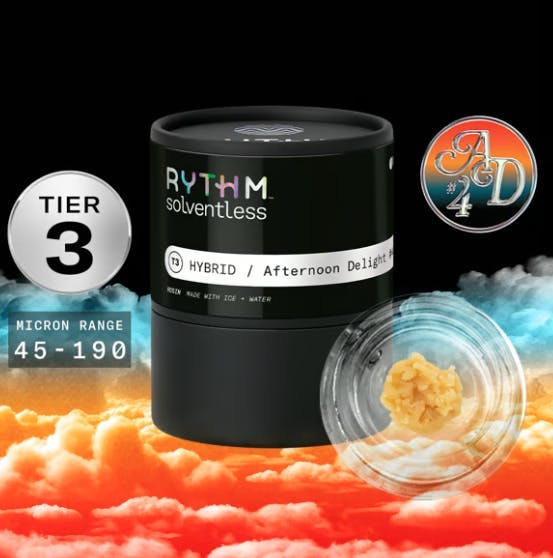
RYTHMRythm | Afternoon Delight #4 Live Resin Concentrate · 2g
$70.80$88.50
$82after tax

weeddispensarynearme.com
You must be 21 years or older to enter. By entering, you confirm you’re of legal age in your state to purchase cannabis.
For use only by adults 21+ • Keep out of reach of children
Islip's unhurried rhythm along Montauk Highway and the quiet marina edge of South Bay Avenue sets an unexpectedly refined backdrop for one of cannabis's most technically sophisticated formats. Live resin — extracted from fresh-frozen flower to preserve a full terpene profile — suits the discerning shopper who wants more than potency alone, and 11751 has the calm, considered pace to appreciate every note.
About Live Resin
Live resin occupies a distinct tier within the broader cannabis extract category, and understanding why begins with the harvest moment itself. Unlike conventional concentrates derived from dried and cured cannabis, live resin is produced from flower that is frozen immediately after cutting — often within hours — locking in volatile aromatic compounds that would otherwise evaporate during the drying process. The result is an extract that is notably richer in terpenes, the organic molecules responsible for scent, flavor, and the nuanced modulation of how cannabinoids interact with the body's endocannabinoid system. New York's licensed adult-use market, governed by the Office of Cannabis Management, requires all concentrate products sold in the state to undergo rigorous third-party testing for potency, residual solvents, heavy metals, and microbial contaminants. When you purchase live resin from a licensed dispensary in Suffolk County or through a licensed delivery network, those lab results must be publicly accessible — a meaningful assurance in a product category where quality variation can be significant. Shoppers should look for a certificate of analysis (COA) dated within the current harvest cycle and confirming terpene percentages alongside cannabinoid data. In terms of form factor, live resin arrives in several expressions: a viscous, saucy consistency often called "live resin sauce," a more crystalline THCA-rich structure with a terpene-heavy liquid layer ("diamonds and sauce"), and a uniform badder or budder texture that has been whipped for easier handling. Each format offers a slightly different experience on the palate and at the nail or in a vaporizer cart, so the format decision is worth as much consideration as the strain selection itself. For adult-use consumers aged 21 and older shopping under New York law, live resin represents an opportunity to engage with cannabis at a level of botanical fidelity that flower alone cannot always deliver. The category rewards patience, quality hardware, and a willingness to start with modest quantities — seasoned concentrate consumers and curious newcomers alike benefit from the familiar "start low, go slow" approach.
Live Resin for Islip shoppers
Islip, tucked into the south shore of Suffolk County along the Great South Bay, carries a particular quality of life that tilts toward the unhurried. Residents along Main Street and Montauk Highway tend to value craft over convenience, whether in the form of a well-sourced dinner or a thoughtfully selected bottle of wine from a local cellar. That same sensibility translates naturally to live resin: a format that rewards attention to provenance, process, and flavor in a way that mass-market pre-rolls simply do not. The coastal geography matters here, too. South Bay Avenue and the waterfront it leads toward mean that Islip residents spend meaningful time outdoors — on boats, at the marina, in the salt-tinged air that softens even a humid July afternoon. Terpene-forward concentrates tend to complement that sensory environment rather than overwhelm it, offering clean, aromatic draws that read less like combustion and more like an extension of the landscape itself. A well-preserved live resin from a cultivar high in myrcene or linalool can feel almost native to that setting. Commuting realities in 11751 also shape purchasing habits. Many Islip residents travel west toward the city via the Long Island Rail Road's Babylon Branch or along the Southern State Parkway, and the relative distance from Manhattan's denser retail corridors makes the quality and breadth of a local — or delivery-accessible — licensed market more consequential. Choosing a format like live resin, with its shelf-stable sealed packaging and concentrated potency, suits a shopper who purchases deliberately rather than impulsively and wants each gram to deliver a consistent, memorable experience.
What to look for
Evaluating live resin begins with the terpene report on the certificate of analysis, not the THC percentage printed on the label. A concentrate reading 75 percent total THC but carrying only trace terpenes has lost much of what makes the "live" designation meaningful. Look instead for total terpene content above two percent — ideally between three and six percent — and note which specific compounds dominate. Myrcene adds an earthy, subtly herbal weight that many find grounding; limonene lifts the profile with citrus brightness; caryophyllene contributes a dry, peppery note while also interacting with the body's CB2 receptors in ways that distinguish it from purely aromatic terpenes. Format trade-offs deserve careful thought. Live resin sauce — the loose, liquidly expressive form — requires a dab rig or a compatible concentrate vaporizer and rewards the user with the most immediate terpene expression, but it demands some hardware investment and a degree of comfort with the process. Live resin badder is more forgiving for newer concentrate consumers: it scoops cleanly, vaporizes across a slightly wider temperature range, and stores well in the sealed glass jars common in New York's licensed market. Live resin cartridges, where the oil is suspended in a vape cart, offer the greatest portability and discretion but sacrifice some aromatic complexity due to the dilution required for cartridge viscosity. For Islip shoppers specifically, the season shapes the decision meaningfully. In the cooler months from late autumn through early spring, concentrate consistency can shift — badder may firm up, sauce may thicken slightly in transit. Purchasing through a licensed source that stores product at appropriate temperatures and ships in insulated packaging preserves the integrity of a format that is genuinely sensitive to thermal fluctuation. When browsing strain options, sativa-leaning profiles with terpinolene or pinene can complement active coastal afternoons, while indica-forward cultivars with higher myrcene content tend to suit the quieter end of an Islip evening.
Why ZenZest for live resin in Islip
ZenZest Cannabis Dispensary brings a level of editorial curation to the New York licensed market that aligns well with the considered preferences of Islip's south shore community. The nearest physical location — ZenZest Queens, at 272-06 Union Tpke in Bellerose, NY 11004 — sits approximately 26.5 miles from the heart of 11751, making it a viable destination for a deliberate weekend outing westward along the Southern State Parkway or the Belt Parkway corridor. The Queens store's floor staff are known for their fluency with concentrate categories, including live resin, and can walk shoppers through current COA data and cultivar sourcing in the kind of unhurried, informed conversation that a product this nuanced warrants. For Islip residents who prefer to shop from Main Street rather than drive to Queens, it is worth noting that ZenZest's same-day delivery program — available free on orders over $100 across more than 80 New York ZIP codes — covers a substantial portion of the licensed delivery footprint across the region. Islip's 11751 ZIP should be confirmed directly with ZenZest for current eligibility, as delivery coverage continues to expand with OCM licensing approvals. Whether visiting in person or exploring the online menu, ZenZest provides the transparent lab documentation and premium product selection that live resin shoppers in this category rightly expect.
ZenZest Queens · 272-06 Union Tpke, Bellerose, NY 11004 · 26.5 miles from Islip.
$82after tax
The defining difference is the starting material. Live resin is produced from cannabis flower that is frozen immediately after harvest, before the plant undergoes any drying or curing. That process preserves the full spectrum of volatile terpenes and minor cannabinoids that would otherwise degrade or evaporate during conventional post-harvest handling. The result, relative to wax, shatter, or distillate, is a concentrate with a noticeably more complex aromatic profile and a flavor that more closely reflects the living plant. New York's licensed producers must disclose this distinction on labeling, so shoppers in Islip can verify the designation before purchasing.
Yes. New York's Marijuana Regulation and Taxation Act, administered by the Office of Cannabis Management, permits the licensed sale of cannabis concentrates including live resin to adults aged 21 and older. In Suffolk County, licensed retail dispensaries and licensed delivery operators are the legally authorized channels. Purchasing from an unlicensed source — regardless of proximity — does not provide the third-party lab testing, regulated potency limits, or consumer protections that New York's licensed market guarantees. Always confirm that the retailer or delivery service holds a current OCM license before completing a purchase.
The answer depends on the intended occasion and personal preference rather than any one-size-fits-all recommendation. For active coastal pursuits near the Great South Bay — time on the water, walks along South Bay Avenue, or an afternoon on a boat — many consumers find that terpinolene, pinene, and limonene contribute a brighter, more energizing aromatic character. For quieter evenings at home after a commute on the Babylon Branch, myrcene and linalool tend toward more grounding, tranquil profiles. Reviewing the certificate of analysis and noting which terpenes rank highest by percentage is the most direct way to align a specific product with a specific occasion.
Live resin is sensitive to heat, light, and air exposure, all of which accelerate terpene degradation and can alter the concentrate's consistency. Store your sealed jar in a cool, dark location — a drawer or cabinet away from south-facing windows — and aim for temperatures between 55 and 70 degrees Fahrenheit. On warm summer days typical of Islip's coastal climate, avoid leaving product in a parked car or direct sunlight for any period. Once opened, use the original sealed jar and return it promptly to storage after each use. Properly stored live resin maintains its terpene integrity and consistency for several weeks to a few months.
The most commonly used hardware is a dab rig — a water pipe designed for concentrates — paired with a quartz banger heated to the appropriate temperature using a torch, or an electronic temperature-controlled device called an e-nail. Electronic concentrate vaporizers, sometimes called e-rigs or dab pens with a concentrate chamber, offer a more accessible entry point with less learning curve. For Islip residents new to the format, a quality electronic vaporizer with adjustable temperature settings is often the more practical starting point. Lower temperatures, generally between 315 and 450 degrees Fahrenheit, preserve terpene expression better than higher-heat applications.
Live resin concentrates typically test between 65 and 90 percent total cannabinoids, compared to the 15 to 30 percent range common in licensed New York flower products. That concentration difference makes careful, incremental consumption especially important. The general guidance for any cannabis product applies with added emphasis here: start low, go slow. A first-time concentrate consumer should begin with an amount roughly the size of a grain of rice, wait a full 15 to 20 minutes before considering any additional amount, and approach each session as an exercise in calibration rather than volume. There are no medical claims attached to this guidance — it is simply practical advice for a high-potency category.
Live resin cartridges — vape carts filled with live resin oil — offer the most portable and low-profile format within the category and are well-suited to the on-the-go rhythms of a commute or an afternoon on Montauk Highway. They pair with standard 510-thread batteries widely available through licensed New York retailers. The trade-off relative to sauce or badder is some loss of terpene complexity, since the oil must be thinned to achieve proper cartridge viscosity. That said, quality live resin carts from licensed New York producers still deliver a meaningfully more nuanced experience than standard distillate cartridges, and the COA should confirm live resin sourcing as well as the absence of cutting agents.
Licensed cannabis delivery in New York is conducted by OCM-licensed operators, and coverage maps continue to expand as licensing approvals progress across Long Island and Suffolk County. ZenZest Cannabis Dispensary offers free same-day delivery on orders over $100 across more than 80 New York ZIP codes and is actively growing its delivery footprint. Islip residents in 11751 should confirm current delivery eligibility directly with ZenZest, as availability can change with each new licensing cycle. Always verify that any delivery operator presenting to your address holds a valid OCM delivery license — unlicensed delivery does not provide the lab-tested, regulated product that the licensed market guarantees.
Live resin in New York's licensed market generally ranges from approximately $40 to $80 per gram depending on the producer, the cultivar, and the format, with diamonds-and-sauce expressions often at the higher end of that range. Compared to an eighth of premium flower at $40 to $55, the per-session cost of live resin is higher, but the quantity required per session is substantially smaller due to concentration levels. For the Islip consumer who values botanical fidelity, terpene complexity, and a format that stores cleanly in a sealed jar for extended periods, the value proposition is a genuine one — particularly if the alternative is purchasing multiple eighths to achieve comparable sessions.
A certificate of analysis from a licensed New York testing laboratory will list cannabinoid percentages — primarily THCA, THC, CBD, and minor cannabinoids — alongside a terpene panel, a residual solvent screen, a heavy metals panel, and a microbial safety section. For live resin evaluation, the terpene panel is the most meaningful differentiator: total terpene content above two percent signals a product that has preserved the aromatic complexity the live resin process is designed to deliver. Confirm that the solvent screen shows no detectable residual hydrocarbons above OCM thresholds, and verify the test date to ensure the analysis reflects the current batch rather than an archived result.
Pick your store
We'll show pricing, deals, and delivery zones for the store you pick. You can switch any time from the header.