
THC 43.01%Hybrid
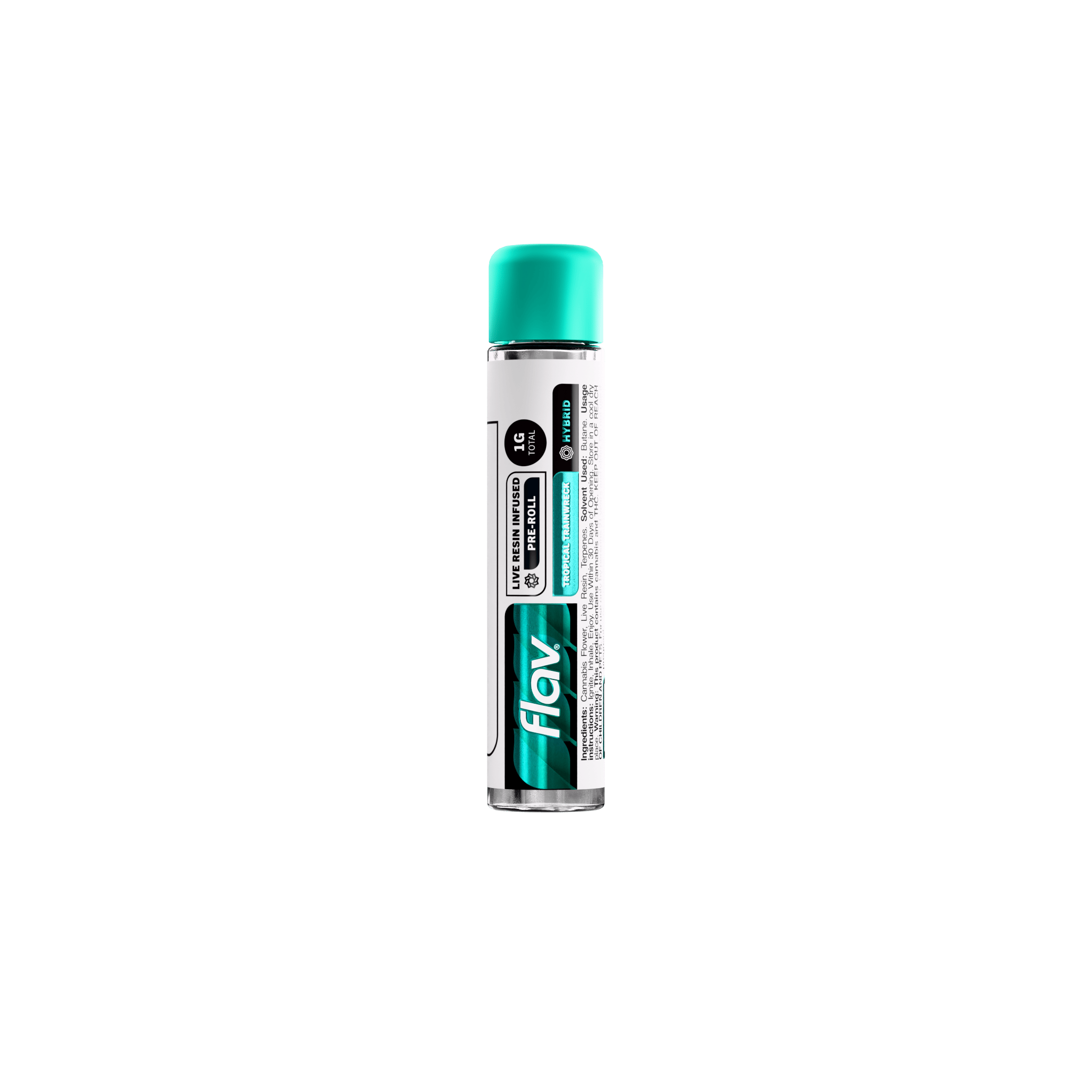
FlavFlav - Preroll - Duo - 8Pk - Live Resin Infused - Tropical Trainwreck (Hybrid) x Pink Lobster (Hybrid) · 4g
$39.82
$45after tax

weeddispensarynearme.com
You must be 21 years or older to enter. By entering, you confirm you’re of legal age in your state to purchase cannabis.
For use only by adults 21+ • Keep out of reach of children
2 live products in stock
Quick answer · What is the Tropical Trainwreck cannabis strain?
Tropical Trainwreck arrives like a warm coastal breeze colliding with raw, electric energy — a sativa-dominant experience that balances sun-drenched fruit notes with the cerebral momentum that made its legendary parent a cornerstone of West Coast cannabis culture. Lush, aromatic, and quietly complex, this is a strain for those who appreciate sunshine in a jar and clarity in the mind.
$45after tax
About Tropical Trainwreck
Tropical Trainwreck is widely understood to be a phenotype or hybrid descendant of the iconic Trainwreck, a Northern California landrace-derived sativa that has circulated in the Emerald Triangle since at least the late 1970s and early 1980s. Trainwreck itself carries a lineage rooted in Mexican and Thai sativas crossed with an Afghani indica — a combination that gave it the cerebral lift of equatorial varieties tempered by physical ease. Tropical Trainwreck builds on that foundation by selecting or crossing phenotypes that emphasize fruity, citrus-forward terpene expression, drawing the aromatic profile closer to tropical rather than the sharp pine-and-menthol character of classic Trainwreck cuts. The precise breeder origin of Tropical Trainwreck as a named variety is not uniformly documented in public cannabis literature. Some sources attribute specific tropical phenotype selections to independent West Coast breeders working with Trainwreck stock throughout the 2000s, though no single breeder has publicly staked a definitive claim. It is distinct from Trainwreck in terpene emphasis and is sometimes listed as a separate cultivar on databases such as Leafly and Wikileaf, where it is catalogued as a sativa-dominant hybrid. Genetic siblings and related expressions in this family tree include Jack Herer, which shares some Thai sativa ancestry, and Ghost Train Haze, which takes the Trainwreck line in a higher-octane, high-terpene direction. Tropical Trainwreck sits between these poles — familiar in its lineage, distinctive in its fruited, accessible character.
The onset of Tropical Trainwreck typically arrives within minutes of inhalation, announcing itself as a gentle but unmistakable pressure behind the eyes and a brightening of sensory awareness. The experience leans unambiguously cerebral in its early stages: thoughts quicken, conversation flows with ease, and there is a quality of heightened engagement with the surrounding environment that is characteristic of well-expressed sativa genetics. This phase tends to peak somewhere between fifteen and forty minutes in, depending on individual sensitivity and consumption method. At its height, Tropical Trainwreck delivers an energized, sociable headspace that many consumers describe as creatively stimulating without tipping into anxious territory. This relative smoothness is often attributed to the myrcene content inherited from its Afghani ancestry, which rounds the sharper edges of the more stimulating terpenes and contributes a mild physical ease that accompanies the mental lift. The body remains functional and light — grounded without sedation. The comedown is gradual and gentle by sativa standards. Over the course of one to two hours, the cerebral clarity softens into a relaxed, contented state that does not typically demand sleep. Duration from onset to resolution generally falls in the two-to-three-hour range for most consumers. As with any potent sativa-leaning cultivar, those newer to cannabis are encouraged to start with a small amount and allow adequate time before reassessing.
The aromatic profile of Tropical Trainwreck is one of its most defining qualities, distinguishing it clearly from the more resinous, pine-forward character of classic Trainwreck cuts. On the nose, the dominant impression is of ripe tropical fruit — mango, papaya, and occasionally a faint lychee note — underpinned by a bright citrus thread that keeps the overall aroma lively and clean. This profile is consistent with elevated concentrations of myrcene and limonene, two of the most prevalent terpenes documented in this family of cultivars. Myrcene, found broadly in mango and hops, contributes the deep, slightly musky tropical sweetness and is understood to complement the permeability of the blood-brain barrier, potentially contributing to the strain's smooth onset. Limonene brings the citrus brightness and a quality of mood elevation that many consumers associate with the strain's sociable, uplifting character. Secondary terpenes including terpinolene and ocimene add floral and herbal complexity — a faint sweetness reminiscent of fresh flowers and light herbs that surfaces particularly on the exhale. When consumed via a clean glass piece or a well-calibrated vaporizer, the vapor is notably smooth, carrying the tropical fruit notes cleanly across the palate before finishing with a faint, pleasant spice. Combustion retains much of the aroma with a slightly earthier undertone on the finish. The smoke is rarely harsh when the flower is properly cured, making it approachable for a range of consumption styles.
Tropical Trainwreck typically presents with the open, somewhat elongated bud structure characteristic of its sativa-dominant genetics. The calyxes tend to be loosely stacked rather than tightly compressed, giving the buds an airy, almost cascading architecture when viewed up close. This structure is a visual signal of the strain's equatorial ancestry, where plants evolved for airflow rather than density. The colour palette skews bright and vivid: a medium-to-deep green base is punctuated by amber and rust-orange pistils that weave generously through the flower. In well-grown specimens, hints of pale yellow-green appear where the calyxes catch light, adding dimension to the overall appearance. Trichome coverage is substantial, lending the surface a frosty, almost glassy quality that belies the airy structure. The resin glands appear rounded and luminous under magnification — an indicator of the terpene-rich profile the strain is known for.
Tropical Trainwreck is generally considered a moderately challenging cultivar for home growers, inheriting from its Trainwreck lineage a tendency toward vigorous, fast-stretching growth that can require active training and canopy management. The plant expresses strong sativa phenotype characteristics — tall stature, long internodal spacing, and a preference for warmth — which make it particularly well-suited to outdoor cultivation in climates that replicate its West Coast origins: warm days, low humidity, and ample direct sunlight. Indoors, it performs reliably under high-intensity lighting with consistent environmental control, typically completing its flowering cycle in approximately nine to eleven weeks. Indoor yields are considered moderate to generous when the canopy is managed with low-stress training or light defoliation. Outdoor plants, given sufficient space and a long growing season, can reach considerable height and produce abundant harvests, typically ready for collection in mid-to-late October in the Northern Hemisphere. Cultivators with an eye for terpene expression may benefit from a slight reduction in nighttime temperatures during the final weeks of flowering, which can encourage more vivid colour development and aromatic intensity.
Tropical Trainwreck is at its finest in the hours between morning and mid-afternoon — those stretches of time that call for engagement rather than rest. It suits solo creative sessions particularly well: the kind of afternoon spent writing, sketching, or moving through a curated music playlist with fresh ears. The strain's terpene profile, led by myrcene and limonene, pairs naturally with activities that benefit from both physical ease and a lifted, open mental state. For a food pairing, consider ripe tropical fruits served simply — a plate of sliced mango or papaya with a squeeze of lime plays directly into the strain's aromatic register, creating a sensory conversation between palate and profile. Musically, the strain aligns well with something rhythmically dynamic but melodically warm: Afrobeat, early ambient electronic, or the looser end of jazz fusion. It also holds its own as a companion for a casual outdoor walk or a social gathering where conversation is the main event — the kind of setting where a subtle shift in perspective is welcome and the social instinct runs easy.
Trainwreck
As the foundational parent, Trainwreck offers the same cerebral sativa energy and resinous character, though with a sharper pine and menthol profile in place of Tropical Trainwreck's fruit-forward warmth.
Pineapple Express
Pineapple Express shares the tropical fruit aromatic register and uplifting sativa-leaning effects, making it a natural recommendation for consumers drawn to Tropical Trainwreck's sunlit, fruited profile.
Jack Herer
Jack Herer draws on overlapping Thai sativa ancestry and delivers a similarly clear-headed, creative headspace, appealing to the same consumer who values functionality alongside elevation.
Mango Haze
Mango Haze mirrors the tropical terpene emphasis and sativa-dominant structure of Tropical Trainwreck while offering its own distinct Haze lineage depth for consumers seeking aromatic complexity.
Super Silver Haze
Super Silver Haze delivers the long-duration, energized sativa arc that Tropical Trainwreck fans often seek, with a celebrated resin production and a comparably social, uplifting character.
Tropical Trainwreck is a sativa-dominant hybrid. It inherits its primary character from the Trainwreck line, which itself descends from Mexican and Thai sativas crossed with an Afghani indica. The overall experience leans clearly toward the energized, cerebral side of the spectrum, though the mild Afghani influence contributes a degree of physical ease that prevents the experience from feeling purely stimulating.
Tropical Trainwreck presents a palate of ripe tropical fruit — mango and papaya are most frequently cited — brightened by a citrus thread consistent with its limonene content. On the exhale, a faint floral and herbal note emerges, likely contributed by terpinolene and ocimene. Combustion adds a light earthiness on the finish, while vaporization tends to render the fruit notes most clearly and cleanly.
The effects are primarily cerebral and energizing. Onset is relatively quick, bringing a brightened awareness, sociability, and a sense of creative engagement. The peak is characterized by mental clarity and a light physical ease. The experience tapers gradually over two to three hours into a relaxed, contented state. It is not typically associated with sedation, making it better suited to daytime or early-evening use.
Consumers who enjoy Tropical Trainwreck often gravitate toward Pineapple Express for its shared tropical fruit profile, Trainwreck for its parent-strain energy, Jack Herer for its clear-headed creative lift, Mango Haze for aromatic depth, and Super Silver Haze for its sustained, sociable sativa arc. Each offers a slightly different interpretation of the energized, fruit-adjacent sativa experience.
Tropical Trainwreck can be approachable for newer consumers because of its relatively smooth onset and manageable physical character, but its sativa potency warrants respect. Those newer to cannabis should start with a small amount, allow adequate time to assess the effect before consuming more, and be mindful that stimulating sativas can occasionally amplify sensitivity to sensory input. A calm, familiar setting is recommended for a first experience.
The dominant terpenes in Tropical Trainwreck are generally understood to be myrcene and limonene, which together produce the strain's characteristic tropical fruit and citrus aromatic profile. Secondary terpenes including terpinolene and ocimene contribute floral and herbal complexity. The myrcene content is also associated with the mild physical ease that tempers the more stimulating qualities of this sativa-dominant cultivar.
Given its energizing, cerebral character, Tropical Trainwreck is best suited to daytime or early-afternoon use — moments that invite engagement, creativity, or social interaction rather than rest. It is generally not considered an ideal choice for late evening if restful sleep is the goal, as its sativa-dominant effects may sustain alertness for two to three hours following consumption.
The precise breeder of Tropical Trainwreck as a named variety is not definitively documented in public cannabis literature. It is broadly understood as a phenotype or hybrid descended from the Trainwreck line — itself a cross of Mexican and Thai sativas with Afghani — selected or developed to emphasize tropical, fruit-forward terpene expression. No single breeder has publicly claimed definitive credit for this cultivar by this name.
Related strains
Pick your store
We'll show pricing, deals, and delivery zones for the store you pick. You can switch any time from the header.