On sale· 25% OFF
THC 37.2%THC
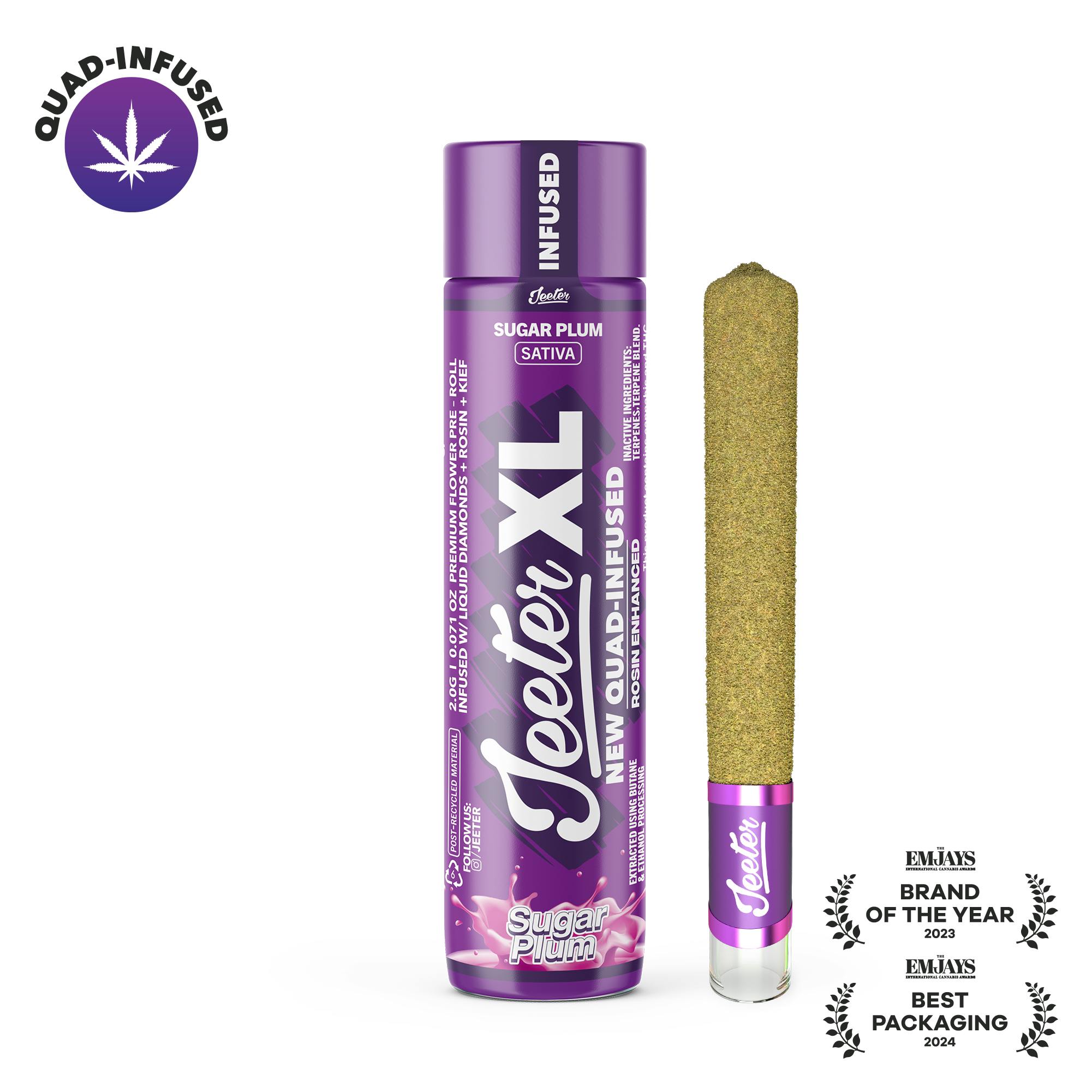
JeeterSugar Plum Quad-Infused XL Jeeter Joint | 2g · 2g
$29.86$39.82
$35after tax

weeddispensarynearme.com
You must be 21 years or older to enter. By entering, you confirm you’re of legal age in your state to purchase cannabis.
For use only by adults 21+ • Keep out of reach of children
2 live products in stock
Quick answer · What is the Sugar Plum cannabis strain?
Sugar Plum arrives with the quiet confidence of a late-autumn orchard — its name earning every syllable through a terpene profile that layers sweet stone fruit over a gently resinous base. A balanced, moderately potent cultivar suited to unhurried afternoons, it appeals equally to the seasoned connoisseur seeking nuance and the curious newcomer who wants something approachable, aromatic, and decidedly refined.
$35after tax

$49after tax
About Sugar Plum
Sugar Plum's precise lineage is not universally agreed upon across public cannabis databases, and the breeder has not issued a definitive public statement pinning down every parent. The most frequently cited genealogy traces the strain to a cross between Plum and an undisclosed indica-leaning partner, with some phenotype descriptions suggesting influence from the broader Purple family of cultivars — strains historically associated with Mendocino and Humboldt County breeding scenes in California during the 1990s and early 2000s. The 'Plum' side of the heritage is itself a somewhat diffuse category, referencing a loose cluster of phenotypes bred for their anthocyanin expression — the pigment responsible for violet and burgundy hues — and their characteristic stone-fruit aromatics. This lineage thread connects Sugar Plum to a longer tradition of flavor-forward breeding that prioritized sensory complexity over raw potency, a philosophy that gained significant traction as the craft cannabis movement matured through the 2010s. A handful of seed banks in Europe and North America have offered Sugar Plum seeds under various iterations, which has introduced some phenotypic variability into the market. Shoppers may encounter cuts that lean slightly more cerebral or slightly more sedating depending on the specific phenotype in cultivation, so it is worth consulting your dispensary staff about the particular expression available at any given time.
The onset of Sugar Plum tends to be gentle and unhurried, typically manifesting within five to fifteen minutes of inhalation as a soft brightening of mood and a mild sharpening of sensory perception. The initial wave is predominantly cerebral in character — thoughts feel more fluid, conversation comes easily, and there is a pleasant sense of being present in the room without the edge of anxiety that more potent sativa-dominant cultivars can occasionally provoke. This makes the early window well-suited to social settings or light creative tasks. As the experience develops over the following thirty to sixty minutes, the body component becomes more pronounced. A gentle physical warmth settles through the limbs without crossing into heaviness or immobility, reflecting the balanced indica-sativa architecture of the strain. The dominant terpene myrcene is widely associated with this kind of relaxed muscular ease, while any limonene present contributes to the uplifted emotional register that characterizes the peak. The comedown is typically gradual and soft. Most accounts describe a slow return toward baseline over two to three hours, with fatigue being the most common lingering quality. This arc makes Sugar Plum a strain that rewards pacing — the well-known 'start low, go slow' principle applies here, particularly for newer consumers unfamiliar with their own tolerance. The overall experience is measured, the kind of cannabis that does not demand attention so much as reward it.
The aromatic signature of Sugar Plum is anchored by myrcene, the most abundant terpene in the majority of documented samples. Myrcene contributes the dense, slightly musky stone-fruit foundation — think ripe plum skin, a hint of dark cherry — that gives the strain its name and much of its initial appeal on the nose. It is the terpene most associated with the soft, pillowy quality of the aroma, rounding edges that might otherwise read as sharp. Layered above that base, caryophyllene adds a whisper of warm spice — subtle pepper and clove — that keeps the sweetness honest and prevents the profile from becoming cloying. Caryophyllene is the only terpene known to interact with the endocannabinoid system's CB2 receptors directly, and it is broadly associated with a grounding, anti-edge quality in the overall experience. Linalool, present in meaningful but secondary quantities in many Sugar Plum phenotypes, contributes a faint floral note — lavender-adjacent — that lifts the mid-register of the scent. On the palate, Sugar Plum delivers with consistency. The inhale carries the sweet-fruit promise of the aroma, while the exhale introduces a more resinous, slightly earthy finish that grounds the sweetness. Vapor tends to be smooth and relatively cool-tempered; smoke is full-bodied without being harsh, making it a strain that shows well through quality glassware or a well-maintained dry herb vaporizer set to moderate temperatures between roughly 185 and 200 degrees Celsius, where the terpene spectrum expresses most completely.
Sugar Plum produces buds that are medium to moderately dense in structure — not the tight, golf-ball compression of a classic OG phenotype, nor the airy looseness of some haze-influenced cultivars. The calyxes are well-formed and somewhat rounded, stacking in a manner that suggests balanced hybrid architecture. Trichome coverage is generous and even, lending the surface a frosted, almost powdered appearance that holds up under close inspection and justifies the 'sugar' in its name. The color palette is one of this strain's more visually distinctive qualities. Deep forest green forms the base, but anthocyanin expression — encouraged by cooler night temperatures during the final weeks of flowering — frequently introduces shades of violet, burgundy, and muted purple across the outer leaves and occasionally the calyxes themselves. Pistils range from a warm amber to a deeper burnt orange at full maturity, threading through the trichome layer in a way that adds visual warmth to an otherwise cool-toned bud. Under proper curing conditions, the structure is firm but yields with appropriate pressure.
Sugar Plum is considered a moderately approachable cultivar for home growers, falling somewhere between a beginner-friendly strain and one that truly rewards experience. Its flowering time indoors typically falls between eight and nine weeks, which is standard for a balanced hybrid. Yields are described as moderate, neither the heaviest producer in a garden nor particularly stingy — indoor cultivators working in controlled environments can expect returns consistent with a well-tended hybrid of its class. The strain responds well to both soil and hydroponic setups, though many cultivators report that soil — particularly living or amended organic soil — tends to amplify the complexity of the terpene profile at harvest. Training techniques such as low-stress training or light topping are compatible with its growth structure and can improve light penetration and canopy evenness. Outdoors, Sugar Plum prefers a temperate to mild climate with cool nighttime temperatures in the final weeks of flower, as this encourages the anthocyanin expression responsible for its signature purple tones. It is not considered particularly mold-sensitive, though adequate airflow remains advisable in humid conditions. Harvest timing outdoors in the Northern Hemisphere typically falls in mid to late October.
Sugar Plum occupies a flattering middle ground in the temporal landscape of cannabis consumption — too balanced and relaxed for high-focus morning work, but too gently cerebral and mood-elevating to function purely as an evening sedative. It occupies the golden hours: a late afternoon session as daylight shifts quality, a quiet Sunday before any obligations have formed, or an unhurried social gathering where conversation is the primary entertainment. The stone-fruit and floral terpene profile makes it a thoughtful pairing with food and drink. A charcuterie arrangement featuring aged cheeses, dried figs, and a restrained glass of Burgundy or a good Lambrusco complements the plum-forward aromatics without competition. For musical accompaniment, the measured pace of the experience aligns well with something lush but unhurried — late-period Bill Evans, or the more pastoral passages of Joni Mitchell's 'Hejira' — music that rewards attentiveness without demanding it. Solo creative work, particularly in the visual arts or writing where lateral thinking is an asset but sustained anxiety is not, represents another context in which Sugar Plum tends to earn its place.
Granddaddy Purple
Fans of Sugar Plum's anthocyanin-rich appearance and sweet, berry-inflected terpene profile will find familiar visual and aromatic ground in Granddaddy Purple, though GDP leans more heavily into physical sedation.
Purple Punch
Purple Punch shares the stone-fruit and grape-candy aromatic register that defines Sugar Plum's appeal, and both cultivars offer a similarly gentle, mood-warming onset before settling into body relaxation.
Zkittlez
Those drawn to Sugar Plum's fruit-forward flavor complexity and balanced hybrid arc will appreciate Zkittlez's similarly layered sweet terpene profile and its reputation for calm, focused elevation.
Do-Si-Dos
Do-Si-Dos appeals to Sugar Plum enthusiasts who want to stay within the sweet, floral-meets-earthy terpene family while exploring a slightly more indica-weighted physical experience.
Plushberry
A close relative in spirit if not always in direct lineage, Plushberry offers a comparably sweet berry-and-floral profile with purple bag appeal that speaks directly to what Sugar Plum does well.
Sugar Plum is generally classified as a balanced hybrid, drawing from both indica and sativa heritage. In practice, this means the experience tends to open with a mild cerebral brightness before transitioning into a more relaxed physical state. The specific phenotype available at any dispensary may lean slightly in one direction or the other, so it is worth asking staff about the particular cut in stock before purchasing.
True to its name, Sugar Plum delivers a palate dominated by sweet stone fruit — ripe plum and dark cherry are the most prominent notes. On the exhale, a resinous, subtly earthy finish grounds the sweetness. Secondary hints of spice and light florals, contributed by caryophyllene and linalool respectively, add depth to what might otherwise be a straightforwardly sweet flavor profile, lending it the kind of complexity that holds interest across a full session.
Sugar Plum typically produces a gentle lift in mood and a mild brightening of sensory awareness during onset, transitioning into a warm, relaxed body state as the experience matures. It is considered balanced in character — neither heavily sedating nor sharply energizing. The comedown is gradual. As with all cannabis, individual responses vary based on tolerance, consumption method, and setting, so new consumers are advised to start with a modest amount and allow sufficient time before redosing.
Consumers who enjoy Sugar Plum tend to gravitate toward other cultivars in the sweet, fruit-forward hybrid category. Granddaddy Purple, Purple Punch, and Zkittlez are frequently cited as comparable experiences, sharing the stone-fruit and berry terpene register along with balanced-to-indica-leaning effect profiles. Plushberry and Do-Si-Dos round out the category for those who appreciate the interplay of floral and earthy notes beneath a sweet aromatic foundation.
Sugar Plum's balanced profile and relatively measured onset make it a reasonable choice for newer consumers compared to high-potency sativa or heavy indica cultivars. That said, no strain is without the potential to overwhelm someone unfamiliar with their own tolerance. The standard guidance applies: begin with a small amount, wait a full fifteen minutes before assessing, and choose a comfortable, familiar environment for first-time use. Consulting a knowledgeable dispensary team member is always a sensible starting point.
Myrcene is the most commonly identified dominant terpene in Sugar Plum, contributing its characteristic stone-fruit muskiness and soft, pillowy aromatic quality. Caryophyllene follows as a notable secondary terpene, adding warmth and spice while providing a grounding counterpoint to the sweetness. Linalool, when present, introduces a delicate floral register. The relative proportions of these terpenes can vary by phenotype and growing conditions, which is part of what gives different cuts of Sugar Plum their individual character.
Sugar Plum is well-suited to late afternoon or early evening consumption — a window when the day's primary obligations have wound down but full sedation is not yet the goal. Its balance of mild cerebral elevation and creeping physical relaxation makes it less ideal for demanding morning tasks and better suited to leisurely social occasions, creative pursuits that benefit from an unhurried mind, or simply the transition between the active and restful portions of the day.
Yes. Sugar Plum is considered visually distinctive within the hybrid category. Its buds frequently display a layered color palette of deep forest green punctuated by violet and burgundy tones, the result of anthocyanin expression encouraged by cool late-flowering temperatures. A generous trichome coating gives the surface a frosted, sugary appearance that aligns with its name. Amber to burnt-orange pistils thread through the bud structure, adding warmth to the overall presentation.
Pick your store
We'll show pricing, deals, and delivery zones for the store you pick. You can switch any time from the header.