Staff Pick
THC 0.15%·CBD 0.17%Hybrid
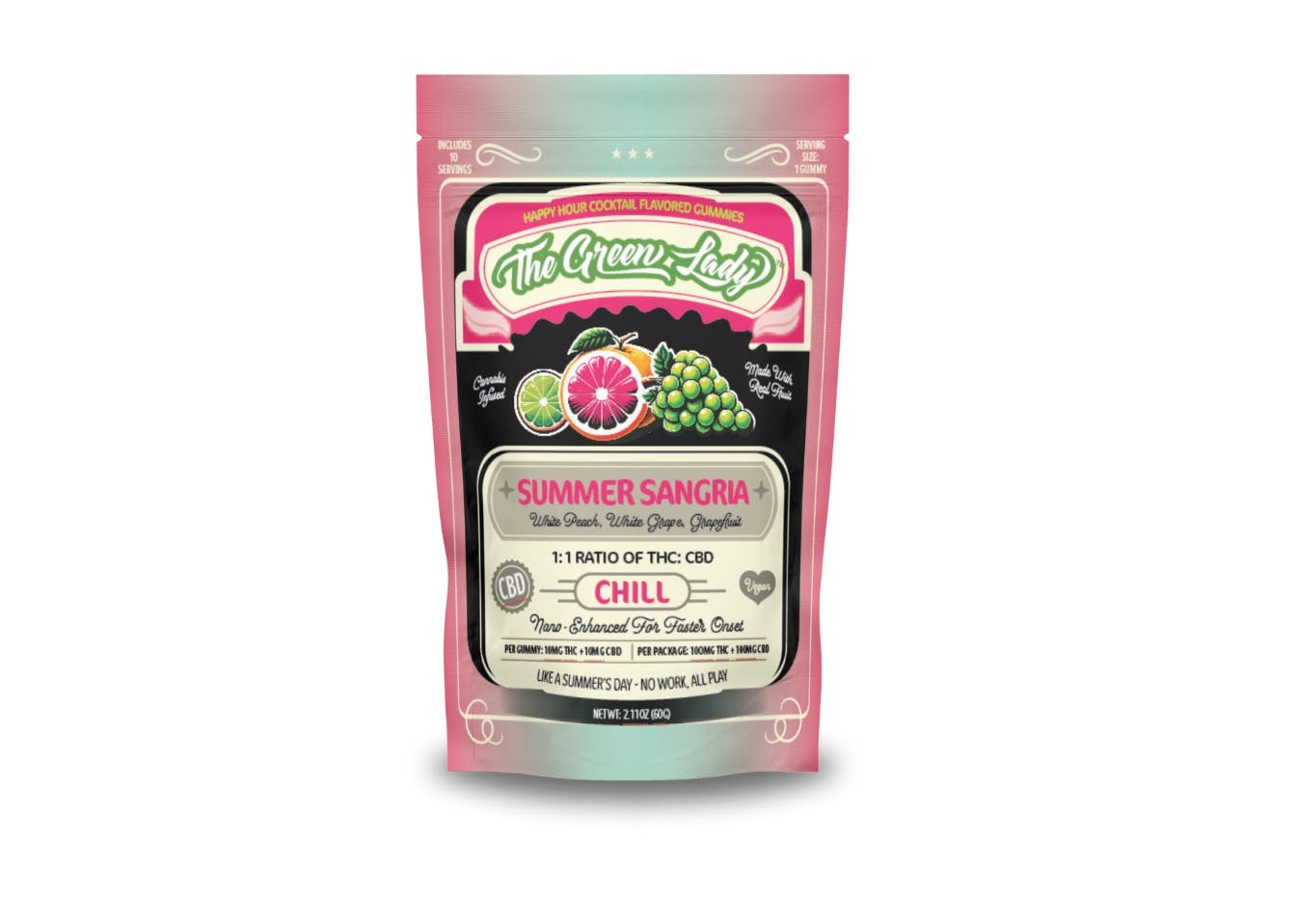
The Green LadyThe Green Lady - 10mG Gummy Chill Summer Sangria · .1g
$30.00
$34after tax

weeddispensarynearme.com
You must be 21 years or older to enter. By entering, you confirm you’re of legal age in your state to purchase cannabis.
For use only by adults 21+ • Keep out of reach of children
1 live products in stock
Quick answer · What is the Sangria cannabis strain?
Sangria is a sun-drenched sativa whose name evokes exactly what it delivers: a bright, fruit-forward experience layered with berry and citrus notes that open into an uplifting, socially expansive state of mind. Bred for daytime engagement, it carries the kind of vivid, clear-headed energy that suits a long afternoon rather than a quiet evening. For the discerning New York consumer seeking a refined lift without the ragged edge, Sangria offers a well-composed, thoughtful session.
$34after tax
About Sangria
Sangria's lineage is not exhaustively documented in the public domain, and multiple phenotypes carry the name across different regional markets, which creates some ambiguity in tracing a single authoritative breeder origin. The most widely referenced version is understood to descend from a cross involving berry-forward genetics — commonly cited influences include strains in the Blueberry family, originally developed by DJ Short in the Pacific Northwest during the late 1970s and early 1980s, and a citrus-leaning sativa parent that contributes the strain's characteristic brightness. Some phenotypes are also associated with breeders working in the California craft scene during the 2000s cannabis renaissance, when fruit-forward sativas were being actively developed and refined for the dispensary market. The Blueberry lineage itself traces back to Afghani indica, Thai, and Purple Thai genetics, which helps explain the underlying sweetness that balances Sangria's more volatile top notes. The sativa side brings terpinolene and limonene-forward character to the profile, giving the cultivar its upward, effervescent quality that distinguishes it from its earthier relatives. Genetic siblings and related phenotypes include other DJ Short Blueberry descendants such as Blue Dream — itself a cross of Blueberry and Haze that achieved broad market recognition — and strains like Berry White, which share the sweet-to-floral terpene architecture. Sangria occupies its own distinct lane, however, leaning more decisively into the sativa arc than most berry hybrids.
Onset with Sangria typically arrives within five to ten minutes of inhalation, presenting first as a gentle pressure behind the eyes and a brightening of sensory focus. Unlike more abrupt sativas, the opening movement is measured and welcoming, a quality attributed in part to the Blueberry genetics softening the sharper edges that pure sativas sometimes carry. Within fifteen to twenty minutes, the cerebral character becomes more pronounced — thoughts quicken, conversation flows with less friction, and a generalized sense of lightness settles across the mood. The peak experience is predominantly cerebral rather than somatic, though a mild ease through the shoulders and upper body is commonly reported. This is consistent with the strain's terpene profile: limonene has been studied for its association with elevated mood, while terpinolene contributes an uplifting, almost effervescent mental quality. The body component remains subordinate throughout, which makes Sangria well-suited to active, engaged contexts rather than sedation. Duration runs in the range of two to three hours for most adults, with the peak intensity concentrated in the first ninety minutes. The comedown is gentle and gradual — a slow lowering of the elevated state rather than an abrupt drop — leaving most consumers feeling clear and composed rather than fatigued. Newcomers and those with lower tolerance should observe the standard counsel: start low and give the session time to develop before reassessing.
The aromatic profile of Sangria announces itself with an immediacy that lives up to its name. On first opening, dominant notes of mixed berry — dark cherry, ripe blueberry, and a thread of raspberry — present with enough clarity to read as almost juicy. This is the Blueberry inheritance at its most expressive, amplified by the presence of myrcene, which in lower concentrations serves as a carrier compound that deepens and rounds fruit notes rather than pushing toward sedation. Secondary terpenes introduce complexity as the aroma opens. Limonene contributes a bright citrus lift — closer to blood orange peel than fresh lemon — that sits just above the berry foundation and prevents the profile from becoming cloying. Terpinolene adds a faintly floral and almost piney top note, a quality sometimes described as reminiscent of wildflower honey or fresh orchard air. Trace amounts of caryophyllene introduce a subtle spice at the very back of the inhale, providing just enough structural contrast to keep the palate engaged. On the smoke or vapor, Sangria delivers a smooth, sweet draw with the berry and citrus notes registering most clearly on the exhale. The finish is clean and lightly resinous, without the harsh or acrid quality that sometimes accompanies high-terpinolene cultivars when combusted. Vapor at lower temperatures — in the 170 to 185 degrees Celsius range — preserves the delicate fruit esters most faithfully, rewarding those who explore it through a quality vaporizer.
Sangria presents with the elongated, loosely structured bud formation characteristic of sativa-dominant cultivars. The calyxes stack in open, spear-shaped clusters rather than the dense, compacted format associated with indica phenotypes, giving each flower a somewhat airy visual quality that belies the resin content within. Under direct light, a generous coat of trichomes — predominantly capitate-stalked, lending a crystalline frost — becomes apparent across both the sugar leaves and the bud faces. The color palette draws from the warmer end of the cannabis spectrum: a base of medium sage green is interrupted by patches of deeper forest green, with occasional phenotypes expressing faint lavender or burgundy undertones in the upper leaves when exposed to cooler temperatures during the final weeks of flowering. Pistils run a vivid burnt orange to amber, winding through the calyxes in dense, curling clusters that provide visual contrast against the frosted green base. Overall, the appearance communicates craft cultivation — well-flushed, properly dried, and presented with the structural integrity that distinguishes premium flower from commodity.
Sangria performs well in both indoor and outdoor environments, though the strain shows particular reward under controlled indoor conditions where humidity and temperature can be managed precisely. Flowering time runs approximately nine to ten weeks from the onset of the flower cycle, which is consistent with its sativa-leaning genetics and places it at the longer end of the mid-range spectrum. Indoor yields are moderate to generous when trained using low-stress techniques such as topping or a screen-of-green setup, which helps manage the plant's naturally upward growth tendency. Outdoors, Sangria flourishes in temperate climates with long, warm summers — think Mediterranean or Northern California-style conditions — and can be harvested in the Northern Hemisphere around mid to late October. The plant's open structure provides good airflow through the canopy, reducing susceptibility to mold and mildew, which is a practical advantage in more humid cultivation environments. Difficulty is rated as moderate: the plant is forgiving enough for attentive intermediate growers but rewards the kind of careful environmental dialing-in that experienced cultivators bring. For the cultivator-curious shopper, Sangria represents the kind of craft project that produces a distinctive, terroir-expressive result.
Sangria is, by character, a daytime and early-evening strain — one that earns its place in unhurried, socially animated settings rather than quiet, contemplative solitude. Its uplifting cerebral arc and fruit-forward warmth make it a natural companion for an outdoor gathering: a rooftop gathering in the hours before sunset, a walk through a farmers market, or a long Sunday afternoon in Prospect Park where conversation can drift without agenda. The strain's social openness makes it a considered choice for creative collaboration or early dinner with company. The terpene profile suggests natural affinities in the culinary realm. The berry and citrus notes find resonance alongside charcuterie with stone-fruit accompaniments, aged Spanish manchego, or a well-balanced rosé with enough acidity to mirror the strain's own brightness. For a musical pairing, Sangria's rhythm corresponds with mid-tempo, warmly produced music — Latin jazz, bossa nova, or the kind of indie pop that moves without urgency. It rewards presence and light engagement rather than deep inward focus, making it one of those rare strains that functions as a social lubricant without sacrificing clarity.
Blue Dream
Sharing Blueberry parentage, Blue Dream offers a comparable sweet berry aroma with a similarly uplifting, cerebral sativa arc that appeals to those drawn to Sangria's smooth, mood-elevating character.
Strawberry Cough
Strawberry Cough's fruit-forward terpene profile and expansive, socially energizing effects make it a close experiential neighbor for anyone who appreciates Sangria's bright, uplifting quality.
Tropicana Cookies
The citrus-dominant, limonene-rich character of Tropicana Cookies resonates with the blood-orange lift embedded in Sangria's aromatic profile, appealing to fans of bright, mood-elevating sativas.
Mimosa
Mimosa's blend of Clementine and Purple Punch genetics produces a similarly fruit-layered, daytime-oriented sativa experience that shares Sangria's balance of cerebral clarity and gentle warmth.
Cherry AK
Cherry AK offers dark-fruit sweetness over a focused, energetic sativa backbone that mirrors Sangria's berry-forward palate and engaged, upward-moving effect profile.
Sangria is classified as a sativa-dominant cultivar. Its effect profile — characterized by uplifting cerebral energy, heightened sociability, and a relatively gentle body component — reflects that sativa orientation. While the Blueberry genetics in its lineage introduce a slight indica softness that rounds out the experience, the overall arc leans decidedly toward daytime, active use rather than sedation or deep physical relaxation.
Sangria delivers a smooth, fruit-forward palate centered on mixed berry — blueberry and dark cherry are the most prominent notes — followed by a secondary brightness of blood orange citrus. A faint floral quality from terpinolene and a whisper of spice from caryophyllene appear on the finish. The overall impression on the exhale is clean, lightly sweet, and gently resinous, with no harsh or acrid aftertaste when properly cured.
Sangria produces an uplifting, primarily cerebral experience. Most consumers report a brightening of mood, increased sociability, and a light physical ease that develops within the first fifteen to twenty minutes. The peak is clear-headed and engaged rather than heavy or sedating. Duration typically runs two to three hours, with a gentle, gradual comedown. Those new to cannabis or to sativa-dominant varieties are encouraged to start low and allow the session to develop slowly.
Consumers who appreciate Sangria often find similar satisfaction in Blue Dream, which shares the Blueberry lineage and uplifting sativa character; Strawberry Cough, for its fruit-forward aroma and social energy; Mimosa, for its citrus-and-berry daytime profile; and Tropicana Cookies, which mirrors Sangria's limonene-driven brightness. All four offer comparable fruit-rich terpene landscapes paired with mood-elevating, clear-headed effects.
Sangria is approachable for beginners relative to many sativa-dominant cultivars, thanks to the softening influence of its Blueberry genetics. That said, no sativa should be underestimated by those new to cannabis. The standard guidance applies: start with a very modest amount, allow a full fifteen to twenty minutes to assess the onset before continuing, and choose a comfortable, familiar setting for the first session. Having water and a light snack nearby is always a sensible precaution.
The dominant terpenes in Sangria are myrcene, limonene, and terpinolene. Myrcene provides the round, fruity base and helps carry the berry notes. Limonene introduces the bright citrus lift associated with elevated mood. Terpinolene adds a floral, orchard-fresh top note that gives the strain its effervescent aromatic character. Secondary terpenes include caryophyllene, which contributes a subtle spice, and trace amounts of linalool, which adds a faint floral softness to the overall profile.
Sangria is best suited to daytime and early-evening use. Its uplifting, cerebral character makes it a natural fit for late mornings, long afternoons, or the social hours preceding dinner. The strain's clarity and gentle energy support engagement with the world rather than withdrawal from it, making it a poor candidate for winding down before sleep. Most consumers find the experience most harmonious in the hours between mid-morning and early evening, when its brightness can be fully appreciated.
The name Sangria is an homage to the Spanish wine punch made from red wine, fresh fruit, and citrus — a reference that maps directly onto the strain's aromatic profile. The deep berry notes and citrus brightness of the cultivar mirror the sensory character of the beverage, and the strain's social, warm, and uplifting disposition echoes the convivial context in which sangria is traditionally enjoyed. It is a name that functions as a credible tasting note as much as a label.
Related strains
Pick your store
We'll show pricing, deals, and delivery zones for the store you pick. You can switch any time from the header.