THC 29.3%Sativa
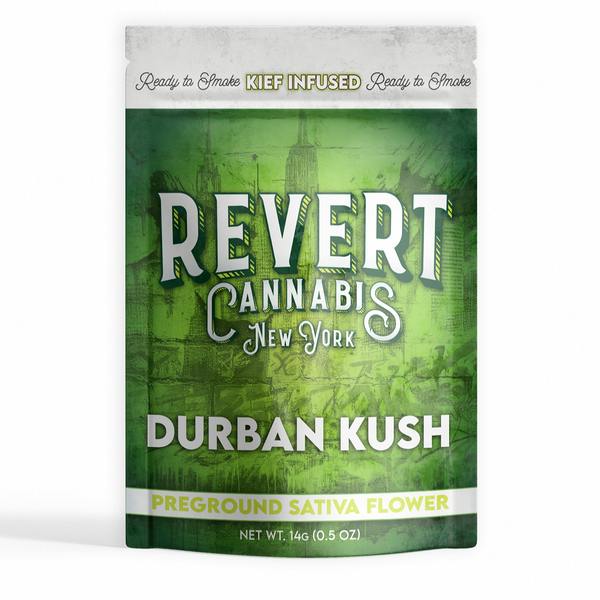
Revert CannabisRevert Kief Infused Pre-Ground Flower Durban Kush · 14g
$70.00
$79after tax

weeddispensarynearme.com
You must be 21 years or older to enter. By entering, you confirm you’re of legal age in your state to purchase cannabis.
For use only by adults 21+ • Keep out of reach of children
1 live products in stock
Quick answer · What is the Durban Kush cannabis strain?
Durban Kush arrives as a study in contrasts — the sun-drenched luminosity of a legendary South African landrace married to the grounded, resinous depth of Kush genetics. The result is a sativa-leaning cultivar that opens with a bright, citrus-touched clarity before settling into something warmer and more contemplative. For those who appreciate nuance in their cannabis, Durban Kush offers a layered experience that rewards patience and a discerning palate.
$79after tax
About Durban Kush
Durban Kush draws its genetic foundation from two of the cannabis world's most storied lineages. On one side stands Durban Poison, the celebrated South African landrace that has been cultivated in and around the port city of Durban for generations. Durban Poison was popularized in the United States largely through the work of Ed Rosenthal and activist Mel Frank, who sourced seeds from South Africa in the late 1970s and early 1980s. Its influence on modern sativa breeding is difficult to overstate — it is a direct ancestor of strains like Girl Scout Cookies, contributing the bright, anise-touched energy that many associate with that family of cultivars. On the other side sits Kush, a broad designation typically referencing OG Kush or Hindu Kush-descended genetics originating from the Hindu Kush mountain range spanning Afghanistan and Pakistan. These indica-leaning plants introduced the resinous density, earthy depth, and physical weight that temper Durban Poison's soaring tendencies in this cross. The specific breeder responsible for the Durban Kush cross has not been universally agreed upon in public cannabis literature, and multiple breeders have released cuts operating under this name. Shoppers should note that phenotypic variation is possible between different producers' versions. Despite this ambiguity, the general character of the cross — sativa-dominant, aromatic, and moderately complex — remains relatively consistent across reputable sources.
The onset of Durban Kush tends to arrive with notable promptness, particularly when consumed via inhalation. Within the first five to fifteen minutes, most consumers report an uplift in mood and a gentle sharpening of focus — qualities characteristic of Durban Poison's sativa lineage and its elevated terpinolene and ocimene content. Thoughts may feel more fluid, conversation more engaging, and sensory details — colour, sound, texture — more present without becoming overwhelming for those with moderate tolerance. As the experience deepens into its peak, roughly thirty to sixty minutes after consumption, the Kush parentage begins to assert itself in a manner that is complementary rather than competing. A mild body warmth settles in around the shoulders and chest, softening the cerebral brightness into something more balanced and sustainable. This is where the strain distinguishes itself from a pure sativa: the mental engagement remains, but it is anchored, preventing the restlessness or anxious edge that some consumers associate with high-terpinolene cultivars. The duration of the experience typically ranges from ninety minutes to two and a half hours, with a gentle, gradual tapering rather than an abrupt conclusion. The comedown is generally smooth — a quiet return to baseline that many describe as pleasantly relaxed rather than sedated. As always, individual response varies considerably, and those new to cannabis or this cultivar are encouraged to start low and go slow.
The aromatic profile of Durban Kush is one of its most distinctive attributes. Terpinolene, often cited as a primary terpene in Durban Poison-descended cultivars, contributes the characteristic floral-herbaceous lift — something between fresh pine needles and dried wildflowers — that greets the nose on first encounter. This is layered almost immediately with ocimene's sweet, slightly tropical herbaceousness, which gives the bouquet an exotic, almost perfumed quality. Myrcene, inherited largely from the Kush side of the lineage, rounds out the top notes with an earthy, faintly musky undertone that grounds the aroma and prevents it from reading as purely sweet. Caryophyllene adds a subtle spiced quality — think cracked black pepper or a touch of clove — that adds sophistication to the blend and contributes a mild interplay with the body. Pinene may also be present in some phenotypes, offering a clean, resinous brightness that reinforces the Durban Poison character. On the palate, Durban Kush tends to open with the sweet, slightly anise-tinged flavour inherited from its landrace parent, transitioning mid-exhale into earthier, woodier notes that reflect the Kush foundation. The smoke is generally smooth, with a clean finish that does not linger heavily. Vapor production at moderate temperatures tends to accentuate the floral-tropical upper register, while higher temperatures bring the earthier tones more prominently forward.
Durban Kush typically presents buds that lean toward the elongated, somewhat tapered structure associated with sativa genetics, though the Kush parentage introduces a denser calyx formation than one would expect from a pure landrace. The overall bud architecture is moderately dense — not the tight, compact nuggets of a heavy indica, but not the airy, loose flowers of a pure sativa either. This middle ground gives the cultivar a visually appealing definition. The colour palette tends toward medium to deep green, often with subtle golden or amber undertones in the leaves and calyxes as the plant matures fully. Pistils — the fine hair-like structures that signal maturity — are typically a warm orange to rust colour, adding visual warmth to the overall presentation. Trichome coverage is notable, a direct inheritance from the resinous Kush lineage, giving mature flowers a frosted appearance that speaks to the cannabinoid and terpene density within. Some phenotypes may exhibit faint purple or violet hues along the edges of leaves in cooler growing conditions.
Durban Kush is considered a moderately approachable cultivar for experienced home growers, though it does carry some requirements that reward attentiveness. The Durban Poison genetics introduce a preference for ample light and a warm, relatively low-humidity environment — conditions that reflect its South African landrace origins. When grown indoors under controlled conditions, the flowering period typically falls in the range of eight to ten weeks, which is reasonable for a sativa-dominant hybrid. Indoor yields are generally moderate to generous when canopy management techniques such as low-stress training are employed. Outdoor cultivation suits climates with long, warm summers and low autumn humidity, as the denser calyx structure inherited from the Kush side can be susceptible to moisture-related issues if airflow is insufficient. Outdoor plants can reach considerable height given their sativa heritage, which is worth considering for those working within space constraints. Overall, the cultivar is best suited to growers with at least a season or two of experience — it is not the most forgiving for absolute beginners, but it is far from the most demanding plant in the contemporary catalogue.
Durban Kush occupies an appealing middle ground that makes it well-suited to the more active portions of a day — late morning through early evening — when mental engagement is welcome but a degree of physical ease is also appreciated. Its balanced character makes it a thoughtful companion for creative pursuits: the kind of afternoon spent writing, sketching, or working through a design problem that benefits from both focus and a certain looseness of association. Socially, it performs well in small, intimate gatherings where conversation is the centrepiece — a dinner with close friends where the food is interesting and the discussion ranges freely. Given the terpinolene and ocimene profile, it pairs particularly well with dishes that carry brightness and some herbal complexity: a citrus-forward ceviche, a well-seasoned roasted chicken with preserved lemon, or a charcuterie arrangement with sharp aged cheeses. Musically, the experience aligns naturally with something that shares its energy — jazz with forward movement, like the mid-period recordings of Miles Davis, or well-produced Afrobeat that honors its South African lineage. It is a strain for the curious and the present, rather than for those seeking retreat.
Durban Poison
As the direct landrace parent, Durban Poison shares the bright terpinolene-driven uplift and anise-touched aroma, though without the grounding body presence the Kush parentage adds.
Jack Herer
Jack Herer's sativa-dominant, terpene-rich profile and clear-headed, engaged mental character will feel immediately familiar to those who appreciate Durban Kush's elevated yet anchored experience.
Golden Goat
Golden Goat shares the sweet-tropical aromatic quality and mood-lifting sativa energy, with a similarly moderate body component that keeps the experience balanced.
Trainwreck
Trainwreck's hybrid lineage delivers a comparably dynamic onset and cerebral brightness, with earthy-spiced undertones that echo the Kush side of Durban Kush's genetic profile.
Super Silver Haze
Super Silver Haze offers the same expansive, heady sativa quality with notable terpene complexity, making it a natural step for those who enjoy Durban Kush's aromatic and experiential range.
Durban Kush is classified as a sativa-dominant hybrid. It inherits its uplifting, cerebral character from the Durban Poison landrace while the Kush parentage introduces a moderate grounding quality that tempers the experience. Most consumers and retailers categorize it as sativa-leaning, meaning the mental brightness tends to be the defining feature, though the body component is more present than in a pure sativa.
Durban Kush typically opens on the palate with a sweet, faintly anise-tinged flavour characteristic of its Durban Poison lineage, transitioning toward earthier, woodier notes on the exhale that reflect the Kush foundation. Some phenotypes carry a floral or lightly tropical quality inherited from ocimene and terpinolene content. The smoke is generally smooth, with a clean finish rather than a heavy, lingering aftertaste.
Most consumers describe an initial uplift in mood and a sense of mental clarity or gentle focus, followed by a warming body ease that arrives without sedation. The experience tends to feel balanced and sustained rather than intensely peaking — social, creative, and moderately energizing. Individual response varies, and as with any cannabis cultivar, newcomers are encouraged to begin with a modest amount and allow adequate time before assessing their experience.
Durban Kush typically features terpinolene and ocimene as primary terpenes, inherited from its Durban Poison parentage, contributing its characteristic floral, sweet, and faintly tropical aromatic quality. Myrcene from the Kush lineage adds an earthy, grounding undertone, while caryophyllene introduces a subtle spiced complexity. Pinene may also be present in some phenotypes, lending a clean, resinous brightness to the overall profile.
Consumers who enjoy Durban Kush often gravitate toward Durban Poison for its shared landrace lineage, Jack Herer for its similarly clear-headed sativa character, and Golden Goat for its sweet-tropical aroma and balanced energy. Trainwreck and Super Silver Haze also share the dynamic cerebral onset and terpene complexity that define Durban Kush's appeal in the sativa-dominant category.
Durban Kush can be approachable for beginners who are drawn to sativa-leaning experiences, though its energetic onset and the unpredictability of individual terpene sensitivity mean that some caution is warranted. The standard guidance applies: start with a small amount, choose a comfortable and familiar setting, and allow at least thirty minutes before considering additional consumption. Those sensitive to stimulating effects may wish to start here with particular care.
The specific originating breeder of Durban Kush has not been universally established in public cannabis literature, and multiple producers have released cultivars under this name, which can result in some phenotypic variation. The cross combines Durban Poison — a South African landrace popularized in the US in the late 1970s and early 1980s — with Kush genetics tracing back to the Hindu Kush mountain range of Central Asia. Shoppers are advised to inquire about their specific cut's provenance.
Given its sativa-dominant, mentally engaging character, Durban Kush is generally best suited to the daytime or early evening hours. Late morning through late afternoon tends to be the window where its uplift and moderate focus are most complementary to daily activity. Most consumers find it less suited to late-night use, as the mental brightness it produces may be more activating than conducive to winding down or sleep preparation.
Related strains
Pick your store
We'll show pricing, deals, and delivery zones for the store you pick. You can switch any time from the header.