Sativa
All strains Blue Hawaiian
1 live products in stock
Quick answer · What is the Blue Hawaiian cannabis strain?
Blue Hawaiian arrives like a long exhale at the edge of the Pacific — bright, unhurried, and faintly sweet. A sativa-leaning hybrid that draws on two beloved parents, it offers a clear-headed lift with just enough warmth to keep the body at ease. Its tropical fruit aromatics and gentle creative energy make it a natural companion for sun-drenched afternoons and the kind of conversations that stretch pleasantly past their expected length.
Shop Blue Hawaiian · 1 of 1 live products
About Blue Hawaiian
Everything to know about Blue Hawaiian.
Lineage & origin
Blue Hawaiian is generally understood to be a cross of Blueberry and Hawaiian, though some sources and breeders have presented variations that incorporate additional or slightly different parentage — the lineage is largely consistent across reputable cannabis databases but the originating breeder has not been universally confirmed in published records. Blueberry, itself an iconic indica-leaning strain developed by DJ Short in the late 1970s and early 1980s, contributes a deep berry sweetness and a stabilizing physical warmth that has made it one of the most influential cultivars in American cannabis history. Hawaiian, a broadly referenced sativa landrace (or landrace-derived line) associated with the volcanic islands of Hawaii, lends its characteristic tropical brightness, uplifting cerebral clarity, and an almost airy floral quality that distinguishes the Pacific sativa tradition from its Southeast Asian or South American counterparts. The union of these two lineages produces a hybrid that leans sativa in its effect profile while retaining the structural density and color saturation Blueberry is known for passing on to its offspring. Blue Hawaiian occupies a similar aesthetic and genetic space to other Blueberry-forward crosses — among them Blue Dream and Blue Cheese — though it distinguishes itself through the specifically tropical, sun-warmed character the Hawaiian parent supplies. Phenotypic expression can vary between batches and cultivators, with some plants expressing more of the berry-indica character and others leaning fully into the bright, citrus-adjacent sativa side.
Effects
Blue Hawaiian tends to announce itself within five to fifteen minutes of inhalation, beginning with a gentle pressure behind the eyes and a gradual brightening of mood that feels less like a sudden shift and more like a window being quietly opened. The onset is characteristically smooth for a sativa-leaning hybrid — rarely jarring, rarely accompanied by the anxious edge that higher-myrcene-deficient pure sativas can introduce in sensitive individuals. Myrcene and limonene, both present in meaningful quantities in well-grown Blue Hawaiian, work in relative concert here: limonene contributing to the uplifted, outward-facing mental energy, myrcene softening the edges and providing a mild physical ease that keeps the experience grounded. At its peak, the experience is primarily cerebral — thought associations run freely, sensory detail feels sharpened, and conversation flows with an unforced ease. The body is present but not heavy; there is a relaxed warmth across the shoulders and chest that prevents the experience from tipping into restlessness. Duration tends to fall in the two-to-three-hour range for most flower consumers, with effects tapering gently rather than dropping off abruptly. The comedown is generally mild and unremarkable — a gradual return to baseline, occasionally accompanied by a modest appetite increase as the session winds down, a trait likely attributable in part to the Blueberry side of the lineage. Those newer to cannabis are encouraged to start low and proceed slowly, as the sativa energy, while friendly, can feel amplified at higher quantities.
Aroma, flavor & terpenes
The aromatic profile of Blue Hawaiian is one of its most immediately distinctive qualities. On the nose, ripe blueberry and tropical stone fruit dominate — there is a quality reminiscent of guava or passion fruit that distinguishes it from simpler berry-forward cultivars, and this tropical note is the clearest fingerprint of the Hawaiian parentage at work. Myrcene, typically the most abundant terpene in this cultivar, grounds the fragrance with a faintly herbal, almost musky undercurrent that keeps the sweetness from becoming cloying. Limonene introduces a bright citrus lift — closer to Meyer lemon peel than fresh-squeezed juice — that rises to the surface when the bud is broken apart. Caryophyllene appears as a secondary terpene in many tested expressions of this strain, contributing a subtle, warm spice that adds depth without disrupting the fruit-forward character. Some batches also carry detectable levels of terpinolene, which brings a faintly floral, almost piney quality that reinforces the tropical impression. Ocimene, when present, adds a soft herbal sweetness that rounds the edges of the profile. On the palate, Blue Hawaiian smokes with a light, smooth character. The fruit notes carry through on the inhale — berry on the front, tropical on the mid-palate — while the exhale delivers a gentle sweetness with a clean, mildly spiced finish. Vapor rendition tends to emphasize the floral and citrus notes even more distinctly, making a low-temperature vaporizer a worthy consideration for those who want to fully explore the terpene complexity.
Appearance
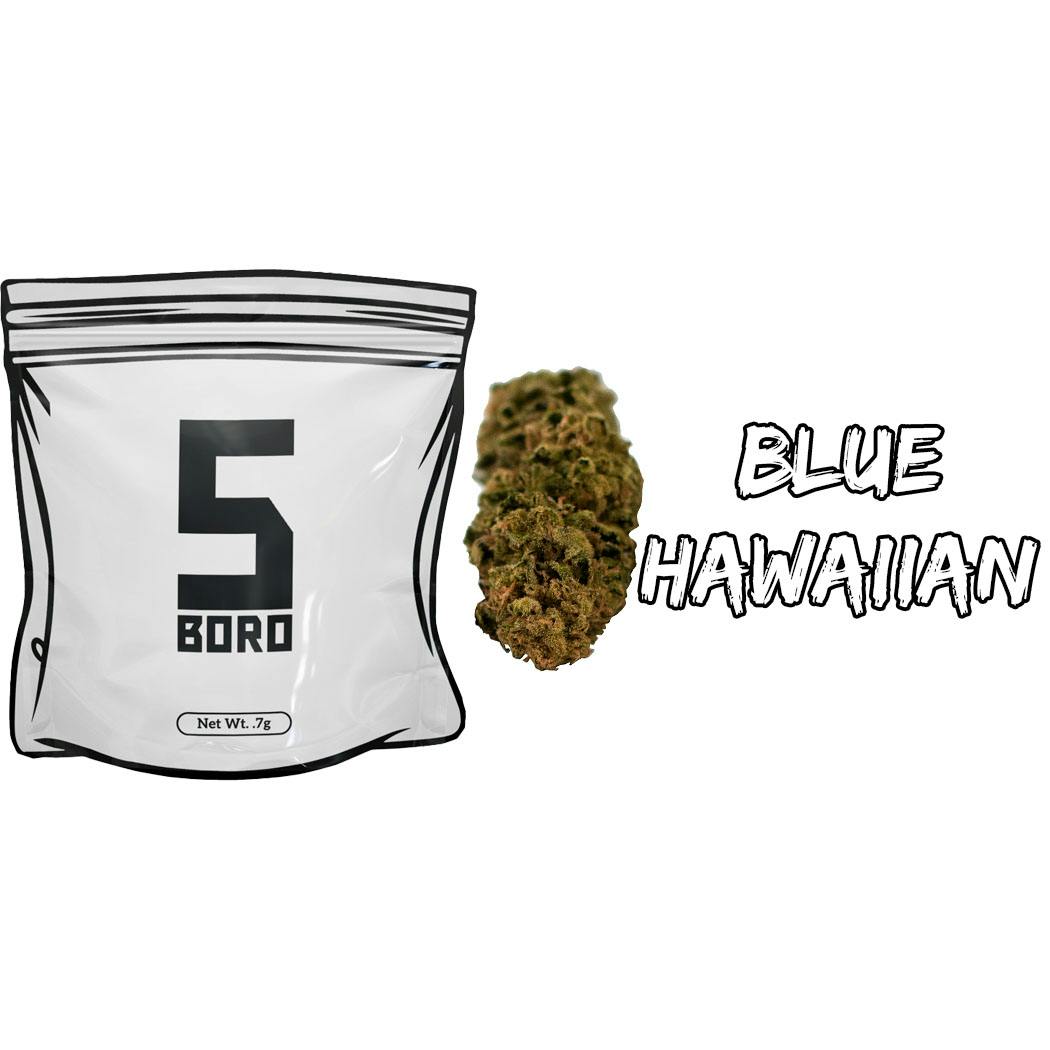
Blue Hawaiian typically presents as a medium-to-large bud with a structure that reflects its hybrid nature — neither as tightly compressed as a pure indica nor as loosely assembled as a classic sativa. The calyxes stack in a way that gives the flower a full, rounded silhouette, and well-cultivated specimens carry a notable trichome density that gives the surface a frosted, almost luminous quality under direct light. The color palette leans into the strain's name: deep forest greens and occasional blue-green hues are common, a chromatic trait inherited from the Blueberry side of the family, particularly in plants grown in cooler late-flowering conditions that encourage anthocyanin expression. Pistils run from amber to rust-orange and are distributed generously across the bud surface, adding warmth to an otherwise cool-toned appearance. The overall impression is of a carefully finished flower — dense enough to suggest potency, visually expressive enough to merit attention on a well-curated dispensary shelf.
Growing notes
Blue Hawaiian is considered a moderately approachable cultivar for home growers with some prior experience, though its sativa-leaning structure means it benefits from training techniques — low-stress training or topping — to manage canopy height and encourage lateral branching. Indoors, flowering typically concludes in approximately nine to ten weeks, and yields are generally described as moderate to above-average when the plant receives adequate light intensity and proper nutrient management through the mid-to-late flower phase. Outdoors, Blue Hawaiian performs well in warm, Mediterranean-like climates with consistent sun exposure, though the Hawaiian lineage's tropical origins mean the plant appreciates humidity management, particularly in the final weeks of flower when dense bud structure can create microclimate conditions susceptible to mold. Harvest outdoors typically falls in mid-to-late October in the Northern Hemisphere. The strain is not considered ideal for complete novice cultivators given its moderate stretch and the attention required to bring out the full color and terpene expression that define its character at its best.
When it's best enjoyed
Blue Hawaiian is well-suited to the long, unhurried hours of a weekend afternoon — the kind of time that has no particular agenda and benefits from a gentle nudge toward engagement rather than sedation. It is a sociable strain, comfortable at a small gathering where conversation is the main event, yet equally at home in a solitary creative session: writing, sketching, or working through a playlist that deserves focused attention rather than background-listening. The cerebral lift pairs naturally with tasks that reward associative thinking rather than linear precision. For food pairings, the tropical fruit aromatics suggest an affinity with dishes that carry brightness and acidity — a ceviche, a mango-dressed salad, or a well-made fruit-forward sour cocktail (non-alcoholic or otherwise) consumed before the session. For music, the strain's energy aligns with something unhurried but rhythmically alive: vintage Hawaiian slack-key guitar, early-period Vampire Weekend, or a warm bossa nova record. It is, at its core, a strain for people who want to be present and pleasantly alert — not pushed, not sedated, simply open.
If you like Blue Hawaiian, also explore
Blue Dream
Shares the Blueberry genetic backbone and a similarly balanced, sativa-leaning lift, making it a natural next step for anyone drawn to Blue Hawaiian's berry sweetness and clear-headed energy.
Maui Wowie
Another Hawaiian-lineage sativa with comparable tropical fruit aromatics and an uplifting, bright effect profile that appeals to the same mood-forward, daytime consumer.
Pineapple Express
Offers a similarly tropical, fruit-forward terpene experience with a sativa-dominant effect arc that fans of Blue Hawaiian's aromatic and energetic character will find immediately familiar.
Strawberry Cough
A fruit-accented sativa with a smooth, uplifting effect quality and social ease that mirrors the accessible, mood-brightening experience Blue Hawaiian is known for.
Tangie
For those who respond most strongly to the citrus-limonene dimension of Blue Hawaiian, Tangie offers a similarly bright, uplifting profile with tropical citrus aromatics at the forefront.
Common questions
Is Blue Hawaiian indica or sativa?+
Blue Hawaiian is a sativa-leaning hybrid. It is generally understood to descend from Blueberry, an indica-leaning classic, and Hawaiian, a sativa landrace-derived line. The result tilts toward the sativa side in its effect profile — offering a primarily cerebral, uplifting experience — while the Blueberry parentage provides a mild physical warmth that prevents it from feeling purely stimulating or energizing.
What does Blue Hawaiian taste like?+
Blue Hawaiian carries a distinctive tropical fruit character on the palate — ripe blueberry on the front, with a guava or passion fruit quality in the mid-palate that reflects its Hawaiian lineage. The exhale is smooth and gently sweet, with a faint spiced finish attributable to secondary caryophyllene. Vapor rendition tends to highlight the citrus and floral notes more prominently than combustion.
What are the typical effects of Blue Hawaiian?+
The experience typically begins with a gentle mood lift and a brightening of mental focus that sets in within five to fifteen minutes. At peak, users commonly report clear-headed creative energy, conversational ease, and a relaxed physical warmth — particularly in the shoulders and chest. Duration is generally two to three hours, with a mild, gradual comedown. It is not typically associated with heavy sedation.
What strains are similar to Blue Hawaiian?+
Consumers who enjoy Blue Hawaiian often respond well to Blue Dream, which shares the Blueberry backbone and balanced sativa lift. Maui Wowie and Pineapple Express offer comparable tropical aromatics and uplifting effects. Strawberry Cough provides a similar fruit-accented, socially oriented sativa experience, while Tangie appeals to those most drawn to the citrus-limonene dimension of Blue Hawaiian's terpene profile.
Is Blue Hawaiian good for beginners?+
Blue Hawaiian is generally considered approachable, but its sativa-leaning character means the mental energy can feel amplified for those new to cannabis, particularly at higher quantities. Beginners are encouraged to start with a small amount and allow sufficient time to assess before continuing. The smooth onset and balanced hybrid nature make it more forgiving than many pure sativas, but a measured, patient approach is always advisable.
What are the dominant terpenes in Blue Hawaiian?+
Myrcene is typically the most abundant terpene, contributing an herbal, mildly musky base note and a gentle physical ease. Limonene provides the bright citrus and tropical fruit lift on the nose and in the effect profile. Caryophyllene adds a warm, subtle spice. Terpinolene and ocimene may also appear in various expressions, contributing floral, piney, and softly herbal nuances that round out the overall tropical character.
When is the best time of day to enjoy Blue Hawaiian?+
Blue Hawaiian is best suited to daytime and early-evening use. Its sativa-leaning effects — clear-headed lift, mild physical ease, and sociable energy — align well with afternoon creative sessions, casual social gatherings, or any unhurried window of time that benefits from an open, engaged mindset. It is generally not considered a late-night or wind-down cultivar, as the uplifting cerebral character may interfere with relaxation for some individuals.
Does Blue Hawaiian have a strong smell?+
Blue Hawaiian has a notably expressive aromatic profile. The scent is distinctly fruity — ripe blueberry layered over tropical notes of guava and citrus — with a grounding herbal undertone from myrcene. It is not a subdued or subtle cultivar in terms of fragrance; broken buds release the full aromatic complexity clearly. Those sensitive to cannabis odor in shared or enclosed spaces should take appropriate precautions.
Related strains