
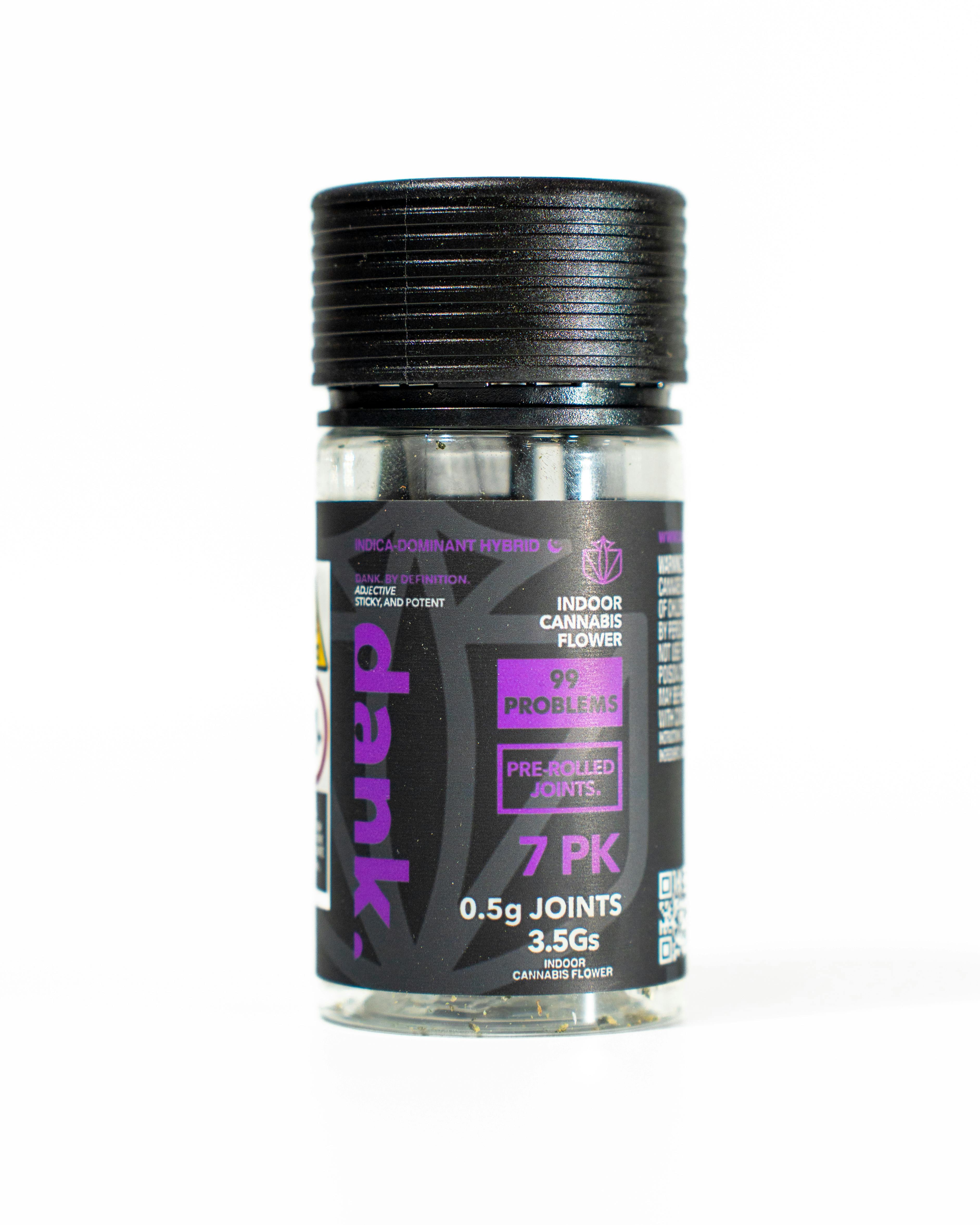
Hybrid
All strains 99 Problems
1 live products in stock
Quick answer · What is the 99 Problems cannabis strain?
99 Problems is a well-balanced hybrid that earns its name through layered complexity rather than difficulty. Born from a pairing of distinguished genetic lineage, it presents a measured, evolving experience — cerebral clarity giving way to a composed physical ease. Its aroma carries a distinctive citrus-and-earth duality, and its trim reflects the care of its breeding. For the discerning New York adult-use consumer, this is a strain worth sitting with.
Shop 99 Problems · 1 of 1 live products
About 99 Problems
Everything to know about 99 Problems.
Lineage & origin
99 Problems is generally attributed to a cross of White Widow and an undisclosed or debated second parent — some sources cite a New York City Diesel influence, while others reference a Stardawg or similar fuel-forward cultivar in the background. The breeder of record is not universally agreed upon in public cannabis databases, and the name itself has been applied to more than one distinct phenotype across different regional markets, which contributes to some inconsistency in reported characteristics. What most accounts do agree on is that the White Widow backbone lends a resinous, trichome-heavy foundation, while the secondary parent — wherever it falls on the fuel-to-floral spectrum — contributes the strain's distinctive brightness and social energy. White Widow itself, developed by Green House Seeds in the Netherlands during the early 1990s, is one of the most documented and award-winning cultivars in modern cannabis history, making it a logical anchor for a hybrid designed for broad appeal. The 99 Problems name has circulated within East Coast cannabis culture for well over a decade, gaining particular traction in New York and New Jersey markets where diesel-adjacent genetics have long commanded respect. Genetic siblings sharing the White Widow parentage include Blue Widow, White Russian, and White Rhino, each diverging in character depending on the secondary influence introduced.
Effects
The onset of 99 Problems tends to arrive within five to fifteen minutes of inhalation, beginning as a mild pressure behind the eyes and a subtle lift in mood and cognitive tempo. This initial phase is predominantly cerebral — conversation flows more freely, peripheral anxieties quiet down, and there is a noticeable sharpening of sensory focus that many users associate with the limonene and terpinolene components common in White Widow-lineage cultivars. The experience at this stage feels clean rather than overwhelming, which makes it particularly suited to social or creative contexts. As the session progresses into the mid-peak — roughly thirty to sixty minutes in for most people — the body begins to register a gentle, grounding warmth. This is not sedation in the traditional indica sense; rather, it is a softening of physical tension that complements the mental engagement rather than overriding it. The myrcene and caryophyllene present in the terpene profile are likely contributors to this physical dimension. Duration for most users falls in the two-to-three-hour range, with a gradual, unhurried comedown that rarely produces the abrupt drop associated with more potent one-note cultivars. Those new to cannabis or hybrid experiences are encouraged to start with a conservative amount and allow adequate time before re-dosing.
Aroma, flavor & terpenes
The aromatic profile of 99 Problems opens with a prominent citrus note — bright lemon zest with a secondary lime or grapefruit quality — that signals the presence of limonene as a likely dominant terpene. Beneath this immediate top layer, an earthy, slightly piney foundation emerges, consistent with the myrcene and alpha-pinene contributions that White Widow genetics reliably express. Some phenotypes carry a faint diesel or chemical sharpness in the background, which, depending on the secondary parent, can range from subtle to noticeably present. On the palate, the smoke or vapor experience tends to mirror the aromatic promise. Inhalation delivers the citrus brightness first, with the earthy and woody tones following on the exhale. Vapor — when consumed through a mid-temperature vaporizer — preserves the terpene detail most faithfully, allowing the secondary notes of black pepper (caryophyllene) and faint floral sweetness (linalool, where present) to register more distinctly. The smoke is generally smooth with a clean finish, though the occasional hint of fuel sharpness on the back of the throat is characteristic of the diesel-adjacent phenotypes and is considered part of the strain's identity by many of its longtime admirers. Terpinolene, when present, adds a pleasant herbal-woody complexity that bridges the citrus and earth elements, rounding the profile into something cohesive and multi-dimensional rather than one-dimensional.
Appearance
Visually, 99 Problems presents as a well-structured, medium-dense hybrid bud — neither the tight, almost calcified density of a pure indica nor the airy, elongated form of a classic sativa expression. Calyxes stack in a slightly elongated formation, giving well-grown specimens a full, almost architectural quality. The color palette leans toward a deep forest green with occasional olive undertones, punctuated by amber to rust-orange pistils that curl generously across the surface of the flower. Trichome coverage is one of the more immediately striking visual attributes, a direct inheritance from the White Widow side of the family. Under even modest magnification, a dense layer of milky to amber-tipped glandular trichomes coats both the calyxes and the surrounding sugar leaves, lending the bud a frosted, silvery luminescence. Phenotypes grown under optimal light and temperature conditions can exhibit faint purple blushes in the deeper crevices of the flower, though this is considered an occasional rather than defining characteristic.
Growing notes
99 Problems is considered a moderately approachable cultivar for home growers with some prior experience, though its White Widow heritage means it rewards attentive canopy management and consistent environmental control more than it tolerates neglect. Indoors, flowering time typically falls between eight and nine weeks, with yields that fall into the moderate-to-generous range under well-dialed conditions — White Widow-derived genetics have a reputation for producing dense, resinous buds that can stress branches without proper support. Outdoors, the strain performs well in temperate climates with warm days and moderate humidity control, particularly in environments that mirror the Mediterranean or Northern California coastal conditions where many White Widow crosses have been refined over the decades. New York's outdoor season, which runs roughly from late spring to early October, can accommodate this strain with proper timing. The plants tend toward medium height, making them manageable in controlled indoor spaces. Cultivators should be attentive to airflow around the dense bud sites, as the resinous structure that makes this strain visually appealing can also make it susceptible to moisture-related issues without adequate circulation.
When it's best enjoyed
99 Problems is a strain that finds its clearest expression in the early-to-mid evening — after the obligations of the day have concluded but before the hour calls for full rest. Its balance of mental engagement and physical ease makes it a natural companion for creative projects that benefit from a loosened internal editor: sketching, writing, or working through a challenging playlist with real attention. The citrus-forward terpene profile pairs particularly well with cuisine that shares its brightness — a well-seasoned ceviche, a glass of dry Riesling, or a light citrus-dressed salad speak the same sensory language. In social settings, 99 Problems functions as a considered hybrid that does not push either participant into excessive sedation or anxious over-stimulation. It is the kind of strain that suits a small dinner gathering or a thoughtful conversation with a trusted friend as easily as it does an hour alone with an instrumental record. For the latter, jazz with structural complexity — think mid-period Miles Davis or a Bill Evans trio session — offers a tonal and textural match to the strain's layered, evolving character.
If you like 99 Problems, also explore
White Widow
As the foundational parent, White Widow shares the resinous structure, trichome density, and balanced cerebral-body arc that defines the 99 Problems experience, making it an obvious bridge for fans seeking the source material.
NYC Diesel
Fans drawn to the fuel-and-citrus duality in 99 Problems will find a familiar aromatic and energetic register in NYC Diesel, which similarly blends uplifting, social effects with a sharp, complex nose.
Blue Dream
Those who appreciate 99 Problems for its even-handed hybrid balance — clear-headed onset without heavy sedation — will find Blue Dream occupies a comparable middle ground with a smoother, berry-forward flavor profile.
Trainwreck
The diesel-adjacent sharpness and cerebral energy that characterize some 99 Problems phenotypes align closely with Trainwreck's known effect profile and fuel-and-earth terpene character.
Sour Diesel
If the fuel sharpness and mood-elevating, socially engaging quality of 99 Problems resonates most strongly, Sour Diesel is the natural next exploration — a New York classic that shares the strain's East Coast sensibility.
Common questions
Is 99 Problems indica or sativa?+
99 Problems is a hybrid, generally considered to lean slightly toward the sativa side of the spectrum in its early-onset effects before settling into a more balanced, body-inclusive experience. The precise indica-to-sativa ratio varies across phenotypes and growers. Its White Widow lineage ensures that neither profile fully dominates, making it a versatile choice for consumers who prefer a measured, even-handed session over a strongly directional one.
What does 99 Problems taste like?+
The flavor profile of 99 Problems is anchored in citrus — primarily lemon and grapefruit — with an underlying earthiness and, in some phenotypes, a faint diesel or chemical sharpness on the exhale. Secondary notes of pine, black pepper, and subtle floral sweetness round out the experience. Vapor tends to express the terpene complexity most faithfully, while smoke delivers a smooth draw with a clean, slightly woody finish.
What are the typical effects of 99 Problems?+
99 Problems typically produces an initial cerebral uplift — heightened mood, sharpened focus, and a sociable ease — that transitions over thirty to sixty minutes into a gentle physical relaxation. The experience is balanced rather than extreme in either direction, lasting roughly two to three hours for most users. It is generally regarded as a strain suited to activity and engagement rather than deep sedation, though the body component becomes more pronounced toward the session's peak.
What strains are similar to 99 Problems?+
Consumers who enjoy 99 Problems often find common ground with White Widow (its parent strain), NYC Diesel, Sour Diesel, Blue Dream, and Trainwreck. Each shares at least one dimension of the 99 Problems experience — whether that is the citrus-and-earth terpene profile, the balanced hybrid arc, or the fuel-forward sharpness present in certain phenotypes. The degree of overlap depends on which qualities of 99 Problems resonate most with the individual consumer.
Is 99 Problems good for beginners?+
99 Problems is approachable for adult-use consumers new to cannabis, provided they follow a start-low, go-slow approach. Its balanced hybrid character means neither the cerebral nor the physical effects tend to arrive with the sudden intensity associated with more potent single-note cultivars. That said, the White Widow heritage does lend notable resin production and potency, so newcomers are advised to begin with a small amount, allow fifteen to twenty minutes for effects to manifest, and resist the urge to re-dose prematurely.
What are the dominant terpenes in 99 Problems?+
The dominant terpenes in 99 Problems are generally understood to include limonene, which contributes the characteristic citrus brightness; myrcene, which grounds the profile with earthy, herbal warmth; and caryophyllene, which adds a peppery, subtly spicy edge. Secondary terpenes may include alpha-pinene, terpinolene, and linalool depending on the specific phenotype and growing conditions. This terpene combination is consistent with the strain's balanced, mood-elevating, and gently relaxing reputation.
Where does the name '99 Problems' come from?+
The name 99 Problems is a cultural reference that has circulated in East Coast cannabis markets for over a decade, likely coined as a knowing nod to the well-known Jay-Z track of the same name. It reflects the strain's New York sensibility and the region's longstanding affinity for diesel-adjacent, complex genetics. As with many regionally named cultivars, the branding carries as much cultural weight as botanical specificity, and the name has been applied to more than one phenotype across different markets.
How long do the effects of 99 Problems last?+
For most adult-use consumers, the effects of 99 Problems last approximately two to three hours from onset, with a gradual and unhurried comedown that does not typically produce an abrupt drop in energy or mood. Individual experience will vary based on factors including personal tolerance, method of consumption, and the specific phenotype. Vapor consumption tends to produce a slightly faster onset and a somewhat shorter overall duration compared to smoked flower.
Related strains