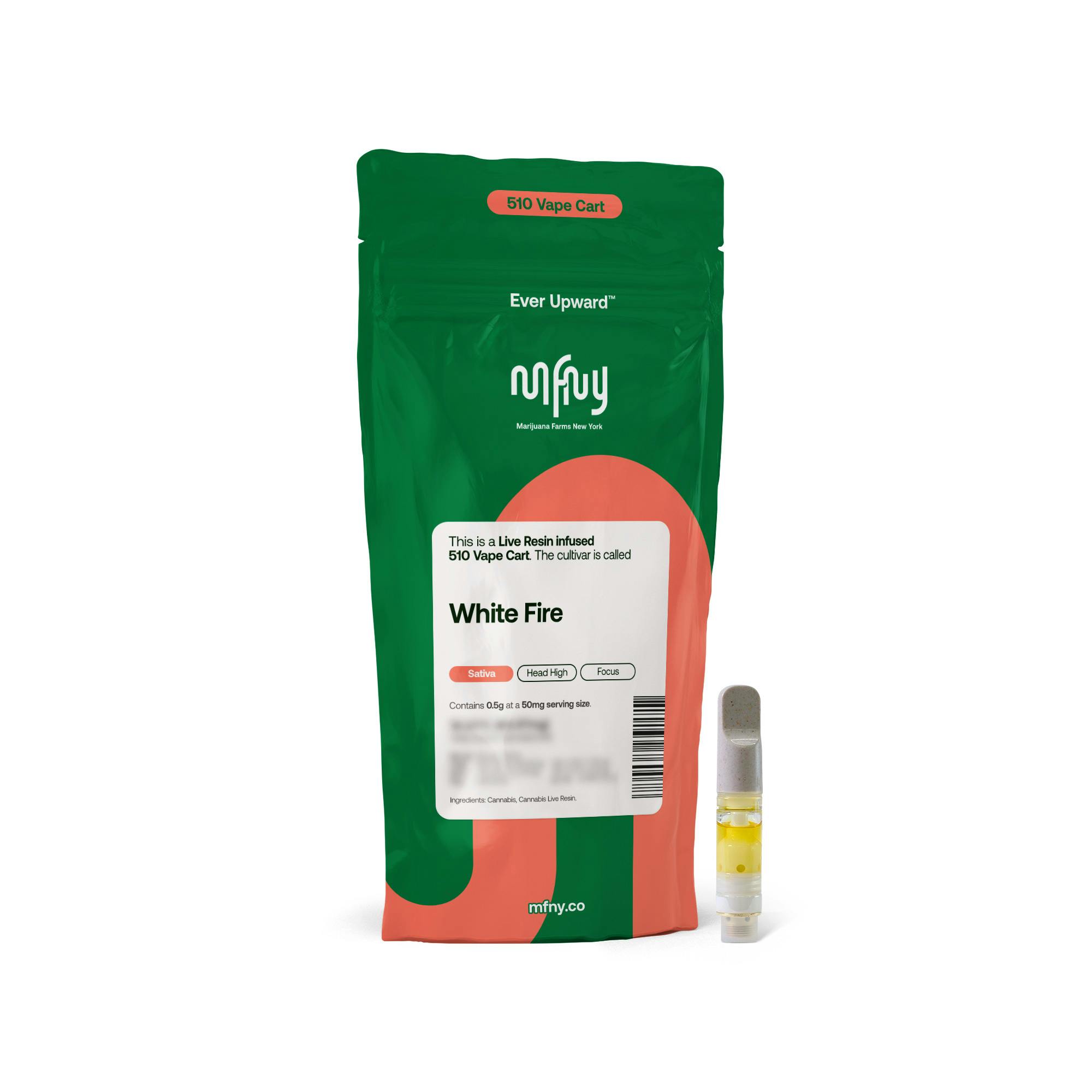
On sale· 15% OFF
THC 84.8%Sativa
MFNYWhite Fire OG Live Resin 510 Cart | .5g · .5g
$32.30$38.00
$37after tax

weeddispensarynearme.com
You must be 21 years or older to enter. By entering, you confirm you’re of legal age in your state to purchase cannabis.
For use only by adults 21+ • Keep out of reach of children
1 live products in stock
Quick answer · What is the White Fire OG cannabis strain?
White Fire OG — more often called WiFi OG — carries itself with the quiet confidence of a strain that needs no introduction in discerning circles. A densely structured, resin-laden hybrid born from two celebrated California genetics, it offers a bright, fuel-edged aroma softened by earthy warmth, and an experience that balances sharp mental clarity with a grounding physical ease. For the thoughtful New York consumer who favors nuance over brute force, White Fire OG remains one of the more reliably elegant choices on the shelf.
$37after tax
About White Fire OG
White Fire OG is the result of crossing The White with Fire OG, a pairing attributed to the Southern California collective and breeder known as OG Raskal, who worked extensively with OG-family genetics throughout the early 2010s. The White, itself a strain of somewhat mysterious origin — often described as an S1 or phenotype selection whose breeder lineage is not publicly confirmed — is prized almost exclusively for its extraordinary resin production and its relatively neutral, nearly flavorless smoke that acts as a blank canvas for whatever it is crossed with. Fire OG, the other parent, is a well-documented and potent member of the OG Kush family, typically understood to be a cross of OG Kush and SFV OG Kush, and is recognized for its sharp, fuel-forward aroma and notably intense cerebral character. The combination produced a strain that inherited The White's legendary trichome density alongside Fire OG's aromatic complexity and uplifting drive, and White Fire OG gained significant traction in the California medical market around 2012 to 2014 before spreading to dispensaries and seed banks across North America. OG Raskal released seeds through his catalog, which helped stabilize the genetics for broader cultivation. Several phenotypes have been documented by cultivators, with some leaning more toward the cerebral, sativa-dominant expression and others presenting a heavier, more balanced effect profile. The strain has since become a fixture in West Coast cannabis culture and is frequently cited as an example of purposeful OG-family breeding.
White Fire OG tends to announce itself with relative speed. Most consumers report onset within five to ten minutes when inhaled, beginning as a focused, bright elevation that settles behind the eyes and across the temples — a quality often associated with its Fire OG parentage and the limonene and caryophyllene terpenes present in its profile. The initial character is distinctly cerebral: thoughts become ordered rather than scattered, conversation flows with ease, and creative tasks feel approachable rather than overwhelming. This is not a strain that typically produces anxiety-inducing stimulation; instead, the mental lift feels measured and purposeful. As the session matures — usually somewhere between thirty and sixty minutes in — the physical dimension of the experience becomes more apparent, a contribution likely tied to the myrcene content and The White's body-forward genetics. Muscle tension softens, posture relaxes, and there is a warmth across the chest and shoulders that rounds out the otherwise alert headspace. The dual-register quality is what has kept White Fire OG in high regard: it is neither purely invigorating nor fully sedating, making it a functional hybrid in the truest sense. Duration generally runs two to three hours, with a gradual, easy comedown rather than an abrupt drop. Those new to high-potency hybrids are encouraged to start with a modest amount and allow ample time before considering a second dose.
The aromatic profile of White Fire OG is one of its most immediately recognizable qualities. On first approach, the nose encounters a sharp, diesel-edged top note — a hallmark of the OG Kush family lineage and attributable in part to elevated caryophyllene, which carries a spicy, peppery warmth alongside its fuel quality. Beneath that dominant register sits a bright, citrus-forward layer, typically described as lemon or orange peel, associated with limonene — a terpene linked in general sensory terms to uplifting, mood-adjacent effects. The combination gives the aroma a complexity that rewards a slow, deliberate inhale rather than a passing glance. Earthy, slightly floral base notes emerge as the bud is broken apart, often with a faint pine quality from alpha-pinene, which contributes a clean, forest-floor freshness that tempers the heavier fuel tones. Myrcene, frequently the most abundant terpene in OG-derived genetics, lends a subtle herbal muskiness that grounds the otherwise electric aromatic profile. Ocimene, when present — as some phenotypes suggest — adds a faintly sweet, herbaceous dimension that is easy to overlook but contributes to the overall impression of complexity. On the palate, whether smoked or vaporized, White Fire OG delivers a notably smooth inhale given its pungency, with the citrus and pepper notes carrying cleanly through to the exhale. The finish is earthy and lingering, with a faint floral aftertaste that distinguishes it from more one-dimensionally fuel-forward OG expressions. Vaporizing at moderate temperatures tends to preserve the citrus top notes with greater fidelity.
White Fire OG produces buds that are immediately arresting in their structural density. The calyxes stack tightly into medium to large formations that feel almost hard to the touch when properly cured — a characteristic inherited from both parent strains, each known for producing compact, weighty flowers. The color palette sits in the mid-green to sage range, occasionally punctuated by subtle olive undertones depending on the phenotype and growing conditions. What most distinguishes this strain visually, however, is its trichome coverage. True to The White's genetic legacy, White Fire OG develops a frost so heavy and uniform that the surface of the bud can appear almost colorless under direct light — a shimmering, silver-white dusting that extends well onto the sugar leaves. Pistils are typically amber to rust-orange and appear in moderate density, weaving through the tight calyx structure. Well-grown examples are a reliable indicator of attentive cultivation, as the trichome density tends to reflect both genetic quality and careful environmental management.
White Fire OG is considered an intermediate to advanced cultivar by most experienced growers, primarily because realizing the full potential of its trichome production and structural density requires close attention to environmental conditions. It performs well both indoors under controlled lighting setups and outdoors in warm, Mediterranean-style climates with low humidity during the late flowering period — a consideration relevant to the broader cannabis community even when home cultivation context varies by jurisdiction. Indoors, the flowering window typically runs eight to nine weeks, with some phenotypes pushing toward ten weeks when a cultivator is patient enough to wait for full trichome maturity. Indoor yields are generally described as moderate to above average, rewarded by density rather than sheer volume. Outdoors, harvest typically falls in mid to late October in the Northern Hemisphere. The plant responds well to low-stress training and defoliation techniques that improve light penetration into the canopy, as its compact structure can sometimes trap moisture if left unmanaged. Maintaining relative humidity below fifty percent during late flowering is frequently recommended to protect the resinous flowers and reduce the risk of mold.
White Fire OG occupies a particularly useful position in the daily rhythm for consumers who value both mental engagement and physical comfort. Its cleaner, more alert early-stage effects make it a natural companion for the hours between late afternoon and early evening — that transitional window when the demands of the workday are winding down but the desire for creative or social engagement has not yet passed. It suits solo pursuits that benefit from a focused yet relaxed mindset: writing, sketching, thoughtful reading, or working through a complex piece of music. For social settings, White Fire OG is well-suited to a small dinner gathering where conversation is the primary entertainment — the cerebral clarity encourages articulate, engaged exchange without the restlessness that more stimulating cultivars can produce. On the pairing side, its citrus and pepper terpene profile finds a natural complement in dishes built around bright acidity and umami depth: think a well-dressed ceviche, a citrus-forward cured fish, or a dish with a clean pepper-forward heat. For a musical accompaniment, the measured, architectural quality of White Fire OG's effect pairs well with jazz that favors structure — late-period Miles Davis or early Weather Report sit comfortably within the mood this strain tends to cultivate.
Fire OG
As one of White Fire OG's parent strains, Fire OG offers the same OG-family fuel and citrus character with a slightly more intense and body-forward experience for those who want to understand the lineage directly.
The White
Fans drawn to White Fire OG's extraordinary trichome density and smooth smoke will find The White offers a similarly resin-rich experience with an even more neutral flavor profile and a calming, full-body character.
OG Kush
The foundational ancestor of the OG family shares White Fire OG's earthy, fuel-and-citrus aromatic identity and balanced hybrid effects, making it a natural reference point for anyone exploring this lineage.
Chemdawg
For consumers who appreciate White Fire OG's sharp, diesel-forward aroma and clear-headed onset, Chemdawg delivers a comparably pungent, cerebral experience with its own well-documented hybrid character.
SFV OG
Another OG-family cultivar with a similar lemon-pine-fuel profile, SFV OG appeals to White Fire OG admirers who prefer a slightly more relaxed, body-oriented expression of the same aromatic tradition.
White Fire OG is classified as a hybrid, typically described as sativa-dominant, though phenotype expression can shift this balance. Its early effects lean cerebral and uplifting — characteristic of sativa-leaning genetics — while a grounding physical warmth emerges through the mid-session, reflecting its indica heritage from The White and the body notes present in Fire OG. Most consumers experience it as a well-integrated hybrid rather than a strain defined by either extreme.
White Fire OG delivers a layered palate built on citrus, pepper, and diesel notes, with a softer earthy and faintly floral finish. The citrus quality — often described as lemon or orange peel — comes through cleanly on the exhale, balanced by a spicy, fuel-forward warmth from caryophyllene. The smoke or vapor is notably smooth relative to its aromatic intensity, and a subtle pine freshness from alpha-pinene rounds out the overall flavor profile.
The experience typically begins with a focused, clear-headed elevation that sharpens attention and eases social engagement without inducing restlessness. As the session develops, a relaxing physical warmth settles in, softening tension without producing sedation. The combined effect is often described as functional and grounded — useful for creative tasks, conversation, or simply unwinding with intention. Duration generally runs two to three hours, with a smooth, gradual comedown. New consumers should start with a small amount and allow time before reassessing.
Consumers who enjoy White Fire OG often find common ground with Fire OG and OG Kush, which share its fuel-citrus aromatic identity and OG-family lineage. The White appeals to those drawn to White Fire OG's exceptional resin production and smooth smoke. Chemdawg offers a comparably pungent, cerebral experience, while SFV OG provides a slightly more relaxed OG-family alternative with a similar lemon-pine profile.
White Fire OG is generally considered a strain better suited to consumers with some prior experience, as its potency — particularly in the cerebral onset — can feel pronounced for those unaccustomed to high-resin hybrids. That said, the effect profile is balanced enough that a thoughtful, low-and-slow approach makes it accessible. Beginning with a very modest amount, waiting a full fifteen to twenty minutes before considering more, and choosing a calm, comfortable setting are all reasonable practices.
White Fire OG is most commonly characterized by caryophyllene, limonene, and myrcene as its dominant terpenes. Caryophyllene contributes the spicy, peppery, fuel-adjacent quality that defines the strain's aroma. Limonene provides a bright citrus brightness on both the nose and palate. Myrcene, prevalent across OG-family genetics, lends an earthy, herbal muskiness and is associated with the physical warmth that emerges through the session. Alpha-pinene and occasional ocimene round out the secondary aromatic layer.
White Fire OG is credited to the Southern California breeder OG Raskal, who is widely recognized within the OG-family breeding community. The strain emerged and gained meaningful traction in the California cannabis market in the early 2010s, approximately 2012 to 2014, following the release of seeds through OG Raskal's catalog. It was developed by crossing The White — a strain of debated but resin-celebrated origin — with Fire OG, a documented OG Kush descendant known for its intensity and fuel-forward character.
White Fire OG shares OG Kush's foundational aromatic DNA — fuel, citrus, earth — but presents a notably more resin-dense physical appearance thanks to The White's genetic contribution. The effect profile is generally considered cleaner and more cerebral at onset than traditional OG Kush, which tends to lean more heavily into physical relaxation. White Fire OG functions with greater daytime versatility, while OG Kush's character is often described as more evening-appropriate and sedating.
Related strains
Pick your store
We'll show pricing, deals, and delivery zones for the store you pick. You can switch any time from the header.