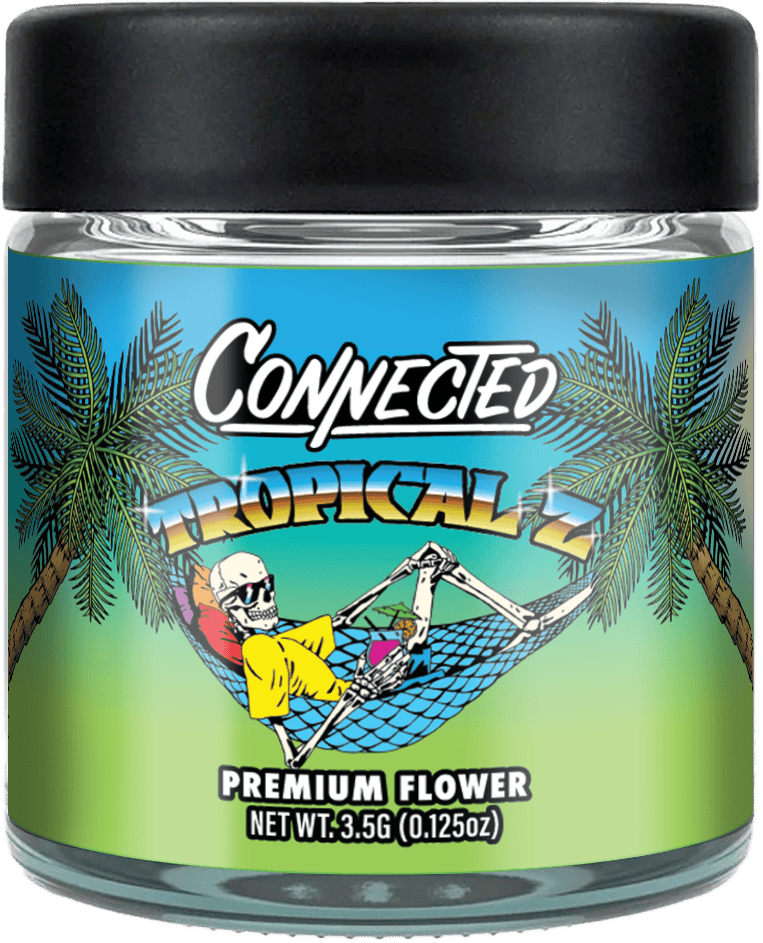
THC 25.81%Sativa
Connected CannabisConnected | Tropical Z | Indoor Large Bud · 3.5g
$60.18
$68after tax

weeddispensarynearme.com
You must be 21 years or older to enter. By entering, you confirm you’re of legal age in your state to purchase cannabis.
For use only by adults 21+ • Keep out of reach of children
1 live products in stock
Quick answer · What is the Tropical Z cannabis strain?
Tropical Z arrives like a postcard from somewhere warm and unhurried — a sativa-leaning cultivar whose fruit-forward aromatics and clear-headed lift make it a natural companion for long afternoons and creative pursuits. With a terpene profile that leans into ripe citrus and tropical stone fruit, it occupies a rare place in the New York market: genuinely uplifting without the edge that can accompany more potent sativas.
$68after tax
About Tropical Z
Tropical Z's precise lineage has not been fully disclosed by its breeder, and public cannabis databases including Leafly and Wikileaf list its parentage as either proprietary or debated. What is consistently reported is that the strain belongs to a broader family of tropically oriented sativas developed in the mid-to-late 2010s, a period when cultivators were actively crossing classic Caribbean and Hawaiian landrace genetics with more stable, resin-heavy modern hybrids to capture expressive terpene profiles without sacrificing yield or consistency. The 'Z' designation in the name is most commonly associated with Zkittlez-influenced genetics — a strain developed by the Dying Breed Seeds collective and Terp Hogz around 2012, itself a cross of Grape Ape and Grapefruit. Zkittlez brought an unusually candy-like, fruit-salad aromatic quality to contemporary breeding programs, and its influence is detectable in Tropical Z's sweet, layered nose. If Zkittlez genetics are indeed present, they would account for the strain's structural sweetness and moderate body weight. A tropical sativa counterpart — possibly drawing from strains in the Tangie, Maui Wowie, or Pineapple Express lineage family — is thought to supply the brightness and the upward-oriented effect profile. Until the originating breeder publicly confirms the cross, however, any specific second-parent attribution remains speculative. What is not in dispute is that Tropical Z consistently expresses a sativa-dominant phenotype with a vivid, fruit-forward character.
Tropical Z tends to announce itself quickly. Most consumers report onset within five to ten minutes of inhalation — a relatively fast opening for a sativa — beginning with a subtle brightening behind the eyes and a gentle increase in mental clarity. The early phase is characterized by a lifting quality rather than an energizing jolt; thoughts become more associative, ambient sensory detail seems to sharpen, and conversation flows more readily. This is not the wired, heart-racing onset associated with some high-myrcene-low-CBD sativas; it lands more softly. At peak, roughly twenty to forty minutes in, the cerebral quality deepens into something more sustained and focused. Creative tasks — writing, sketching, listening to music with genuine attention — feel naturally supported by this window. The body remains largely present and functional, with only a mild physical ease settling into the shoulders and upper back. There is little sedation here; Tropical Z is not a strain that gravitates toward the couch. The duration of the experience, for most consumers, falls in the two-to-three-hour range before a gradual, unhurried comedown. The descent is generally smooth — a slow return to baseline rather than an abrupt drop. The terpene caryophyllene, if present in meaningful concentration, may contribute a subtle grounding quality that tempers any anxiety at the peak, while limonene is widely associated in the literature with mood elevation, which would align with the strain's characteristic uplift.
The first encounter with Tropical Z in the jar is immediate and generous. The dominant impression is ripe citrus — something between mandarin orange and Meyer lemon — layered over a base of stone fruit sweetness that recalls white peach or lychee. This top-note brightness is most commonly attributed to elevated limonene, a monoterpene found throughout the citrus family and frequently identified in sativa-leaning cultivars for its sharp, clean aromatic lift. Secondary to this, a softer tropical sweetness emerges, suggestive of ripe mango or guava, which points toward myrcene — the most prevalent terpene in cannabis broadly, known for its earthy-musky-sweet character and its role in smoothing the overall aromatic profile. On closer inspection, there is a subtle floral thread winding through the fruit — a quality sometimes associated with ocimene, a terpene found in several tropical-adjacent cultivars that contributes a light, herbaceous-sweet dimension without overwhelming the fruit-forward lead. Terpinolene, when present, can add a slightly piney, almost floral-woody counterpoint that keeps the nose from reading as purely candy. The smoke or vapor translates the aromatic promise faithfully. On the inhale, citrus and tropical fruit dominate, with a smooth, clean mouthfeel. The exhale introduces a mild sweetness that lingers on the palate — not cloying, but present. There is very little harshness or earth on the back end, which makes Tropical Z particularly approachable in a glass spoon or clean vaporizer at moderate temperatures.
Tropical Z typically presents in medium-to-large, somewhat elongated buds — the loose, airy structure common to sativa-dominant cultivars, where internodal spacing during flower development produces a less compressed calyx arrangement than indica-leaning counterparts. The density, while not as tight as a classic OG or Kush structure, is not insubstantial; well-grown cuts hold together with integrity. The color palette leans toward vivid spring green with occasional lime-yellow undertones, particularly in the interior of the bud where light penetration during growth was limited. Pistils — the fine, hair-like structures that emerge from the calyxes — tend toward a warm burnt orange or amber, providing a pleasing contrast against the green base. Trichome coverage is generous for a sativa expression; under magnification, the resin glands appear full and milky, with occasional amber heads on mature harvests. This trichome density is part of what makes Tropical Z's aroma so immediately expressive upon opening the package.
Tropical Z is considered a moderately demanding cultivar — accessible enough for an intermediate home grower, but rewarding for those who invest attention in canopy management. Its sativa-dominant structure means it will stretch significantly during the transition to flower, sometimes doubling in height in the first two weeks of the flowering cycle. Indoor growers will benefit from low-stress training or screen-of-green (SCROG) techniques to manage this vertical energy and improve light distribution across the canopy. Indoors, Tropical Z typically finishes in nine to eleven weeks of flowering — on the longer end for contemporary cultivars, which is characteristic of strains with meaningful sativa or tropical landrace heritage. Yields indoors are moderate to above average when the stretch is well-managed. Outdoors, the strain thrives in warm, Mediterranean-style climates with long summers, and can produce generous harvests when given full sun and space. Humidity management during late flower is advisable given the looser bud structure, which can be more susceptible to moisture retention than dense indica forms. For the cultivator-curious shopper, Tropical Z represents a strain whose full expressive potential is genuinely unlocked by the care put into its environment.
Tropical Z is a strain for the unhurried afternoon — the kind of session that precedes a long walk through a neighborhood you know well but want to see differently, or the hour before sitting down to work on something that requires lateral thinking rather than linear focus. Its sativa orientation and fruit-forward brightness make it less suited to the wind-down ritual and better aligned with the moments when engagement, not disengagement, is the goal. Solo creative work is a natural pairing: the associative quality at peak effect complements writing, illustration, or any practice that benefits from a loosening of habitual mental patterns. For music, the strain's citrus and tropical terpene profile pairs intuitively with recordings that share a similar brightness — classic Brazilian bossa nova, modern Afrobeat, or the more melodic edges of jazz. In terms of food, the limonene-forward nose makes Tropical Z a natural companion before a meal that leans into citrus or acidity: a well-dressed ceviche, a Thai green papaya salad, or a simple plate of stone fruit and aged cheese. The sweetness of the terpene profile echoes without competing.
Tangie
Fans of Tropical Z's dominant citrus aromatics and clear-headed sativa lift will find Tangie — a California Indica and Skunk hybrid known for its intensely orange-forward nose — a natural and closely aligned companion.
Pineapple Express
The shared tropical fruit character and approachable, functional sativa energy make Pineapple Express an intuitive next step for anyone drawn to Tropical Z's balanced, uplifting profile.
Zkittlez
Given the probable genetic connection, Zkittlez shares much of Tropical Z's candy-sweet, fruit-salad aromatic quality, though it leans more indica in its physical effect — a useful comparison for understanding which direction Tropical Z's sativa heritage pulls the experience.
Maui Wowie
A foundational Hawaiian landrace cultivar, Maui Wowie offers a similar tropical brightness and gentle, creative sativa arc that resonates strongly with what Tropical Z delivers in a more modern expression.
Mimosa
A cross of Purple Punch and Clementine, Mimosa shares Tropical Z's citrus-forward nose and mood-elevating, socially oriented effect profile, making it a reliable alternative for consumers who respond well to Tropical Z's character.
Tropical Z is classified as a sativa-dominant cultivar. Its growth structure, effect arc, and terpene expression all align with sativa characteristics: an upward-oriented, cerebral onset, a loose bud structure with notable stretch in flower, and a fruit-forward, bright aromatic profile. Consumers seeking a more body-heavy or sedating experience would generally be better served by an indica or balanced hybrid.
Tropical Z leads with ripe citrus — mandarin and Meyer lemon are common reference points — layered over stone fruit sweetness reminiscent of white peach or lychee. The smoke or vapor is smooth and clean, with a lingering sweetness on the exhale. A subtle floral or herbal thread, likely from ocimene or terpinolene, adds depth without pulling the profile away from its fruit-forward character.
Tropical Z typically produces a clear-headed, uplifting onset that brightens mood and sharpens sensory awareness without inducing anxiety or restlessness. The peak is cerebral and creatively oriented, with mild physical ease in the body. The experience generally lasts two to three hours and concludes with a gradual, smooth comedown. It is considered a daytime-appropriate cultivar by most who consume it regularly.
Consumers who enjoy Tropical Z often respond well to Tangie, Pineapple Express, Maui Wowie, Mimosa, and Zkittlez. Tangie and Pineapple Express most closely replicate the citrus-sativa profile; Zkittlez shares probable genetic roots and aromatic sweetness; Maui Wowie represents the landrace tradition from which many tropical sativas descend; and Mimosa parallels the mood-elevating, fruit-forward character.
Tropical Z is relatively approachable for adults new to cannabis, though its sativa orientation means the onset can feel pronounced for those unaccustomed to cerebral effects. The standard guidance applies: start with a small amount, allow adequate time to assess the experience before consuming more, and choose a comfortable, familiar environment. Its smooth smoke and gentle physical character make it less intimidating than more potent or heavily sedating cultivars.
Tropical Z is understood to be rich in limonene, which contributes its characteristic citrus brightness and is associated with mood elevation, and myrcene, which provides a soft tropical-fruit sweetness and a smooth aromatic base. Ocimene and terpinolene are likely secondary contributors, adding floral and faintly herbal dimensions. Caryophyllene may also be present, lending a subtle grounding quality to the overall terpene composition.
Tropical Z is best suited to daytime or early-evening consumption. Its sativa-dominant effect profile — uplifting, mentally engaging, and low in sedative quality — makes it well-matched to active, creative, or social contexts. Most consumers find it counterproductive as a late-night cultivar, as its clarity-forward character is unlikely to facilitate rest. Mid-morning through late afternoon represents the window in which it tends to perform most coherently.
Tropical Z has a notably expressive aroma. The limonene-forward terpene profile produces a bright, immediate citrus scent that is detectable even through standard packaging. Stone fruit and light floral undertones add complexity. Consumers who prefer more subtle or earthy cultivars may find the aromatic intensity of Tropical Z notable; those drawn to fruit-forward, vivid cannabis profiles will likely consider it one of the strain's most appealing qualities.
Related strains
Pick your store
We'll show pricing, deals, and delivery zones for the store you pick. You can switch any time from the header.